
FR, FRLS & FRLSH Cables: What the Fire Ratings Really Mean
The confusing alphabet on a cable's label decoded — FR, FRLS, FRLSH and LSZH — what each grade actually does in a fire, the difference between resisting flame and limiting smoke and toxic gas, which to use where in a home, and the honest truth about the marketing.
Buy house wiring in India and you will meet an alphabet soup on the label: FR, FRLS, FRLSH, LSZH. Shops present the pricier grades as simply "more fire-safe", but the letters mean specific, different things — and understanding them helps you spend on the safety that actually matters for your home. Crucially, most house fires that involve cables are made deadlier not by the flame itself but by the smoke and toxic gas the burning insulation gives off. That is the problem these grades address. This guide decodes them honestly.
It is a companion to the home electrical wiring guide and the copper vs aluminium guide.
The safety line. Cable grade is one factor in fire safety, chosen as part of a wiring specification; the cables are made to IS 694 : 2010 and tested to international flammability methods. Real fire safety in a home comes from the whole system — correct sizing, protection (RCCB/MCB), earthing and workmanship — installed by a licensed electrician. Choosing a better cable does not make a bad installation safe.
The two different jobs a "fire" cable does
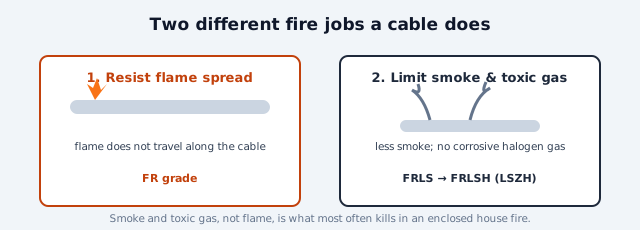
The confusion clears the moment you separate two distinct things a cable can do in a fire:
1. Resist catching fire and spreading flame — the insulation is formulated so that a flame does not travel along the cable and turn one fault into a whole-house fire.
2. Limit what the burning cable releases — when insulation does burn, ordinary PVC gives off dense black smoke and corrosive, toxic gases (including hydrogen chloride). In an enclosed home, that smoke and gas is what blinds and overcomes people trying to escape — often before the flames reach them.
The grades are steps along these two axes. Read the label with those two jobs in mind and it stops being marketing and starts being meaningful.
Decoding the grades
| Grade | Stands for | What it adds | In plain terms |
|---|---|---|---|
| FR | Flame Retardant | Insulation resists igniting and spreading flame | Won't easily carry fire along the cable |
| FRLS | Flame Retardant Low Smoke | FR, plus reduced smoke and reduced acid-gas emission | Burns less readily and gives off less smoke/corrosive gas |
| FRLSH / LSZH | (Flame Retardant) Low Smoke Zero/Halogen-free | Low smoke and virtually no toxic halogen gas | The cleanest-burning — minimal smoke, no corrosive halogen fumes |
The progression is cumulative: FR handles flame spread; FRLS adds the low-smoke, reduced-acid-gas behaviour; FRLSH (also sold as LSZH — low smoke zero halogen) goes furthest by removing the halogens that produce toxic, corrosive gas altogether. These behaviours are verified by standard tests — flame propagation (IEC 60332 series), smoke density (IEC 61034), and halogen acid-gas emission (IEC 60754) — that a reputable maker's grade is certified against.
The single most important step up for a home is from plain cable to low-smoke (FRLS): it attacks the thing that most often kills in a house fire — the smoke and toxic gas in an enclosed space — not just the flame.
Which should a home use?
An honest, practical position for an Indian home:
- FRLS is a sensible default for home wiring. The modest extra cost buys meaningfully less smoke and toxic gas in a fire — exactly the hazard that matters most in an enclosed living space. Many good installations now use FRLS throughout.
- FRLSH / LSZH is worth the further step in high-risk or high-occupancy places — near escape routes, in buildings where many people must evacuate, and where regulations or a fire consultant require it. In these settings, eliminating toxic halogen gas is a real life-safety gain.
- Plain, ungraded cable is best avoided for a home you care about; the saving is small and the trade-off is exactly the wrong one.
For a single home, the common and defensible choice is FRLS as standard, stepping up to FRLSH near critical escape paths if budget allows. For larger and public buildings, the building electrical services guide and the fire code (NBC Part 4) drive the requirement.
The honest caveats
- Terminology varies by manufacturer. "FRLS", "FRLSH", "ZHFR", "HFFR", "LSZH" are used loosely and sometimes interchangeably in the market. Do not buy on the acronym alone — buy on the certified test performance (which flame, smoke and gas standards the cable is verified against) from a reputable, ISI-marked maker.
- A better cable is not a fire strategy. It reduces one hazard. It does not replace correct sizing, an RCCB, good earthing, sound joints and proper workmanship — the things that stop the fault that starts a fire in the first place.
- Don't over-buy on fear. For most home circuits, FRLS is a proportionate, effective choice; you do not need the highest grade everywhere to be sensibly safe.
The one-line answer
FR, FRLS and FRLSH are steps in cable fire performance: FR resists spreading flame, FRLS adds low smoke and reduced toxic gas, and FRLSH (LSZH) additionally removes corrosive halogen gas. Because smoke and toxic gas — not flame — is what most often kills in an enclosed house fire, FRLS is a sensible default for home wiring, stepping up to FRLSH near escape routes in higher-risk buildings. Buy on certified test performance from a reputable maker, remember it is one factor among many, and let a licensed electrician specify it within a properly designed, protected installation.
Where to go next
- The wiring overview: Home Electrical Wiring Guide.
- The conductor choice: Copper vs Aluminium Wiring.
- Bigger-building fire power: Building Electrical Services.
- The whole system: Residential Electrical Systems.
References
- IS 694 : 2010, PVC Insulated Cables/Cords up to and including 1100 V, Bureau of Indian Standards.
- IEC 60332 (flame propagation), IEC 61034 (smoke density), IEC 60754 (halogen acid gas emission) — the international test methods behind FR / low-smoke / halogen-free claims.
- National Building Code of India, Part 4 (Fire & Life Safety) — note the widely-quoted NBC 2016 (SP 7 : 2016) is withdrawn, superseded by SP 7 : 2026; verify via the BIS catalogue.
- National Electrical Code of India, SP 30 : 2023, BIS: https://www.bis.gov.in/
Grade terminology varies in the market; buy on certified test performance. Cable selection must be made by a licensed electrician within a properly designed installation. Verify any standard's status via the BIS catalogue before relying on it.
Export this guide
Related Guides — Deep-dive reading
Cable Fire-Performance Requirements in India (2026): The Wiring That Behaves in a Fire
Ordinary PVC cable is fuel: it spreads flame and fills a building with dense, choking, blinding smoke. This is a plain-language guide to flame-retardant, low-smoke and fire-survival cable, where each belongs, and how to make sure the cable specified is the cable installed.
SecurityElectrical Fire Safety in India (2026): Overloads, Wiring and the Right Protection
Why electrical faults cause so many Indian building fires, and the fix: correct cable sizing and a properly designed board by a licensed electrician, MCB plus RCCB protection, no overloading, and never water on a live fire.
SecurityHow to Choose a Security System (2026): The Master Buying Guide for Indian Homes and Buildings
The mental model that ties the whole buying decision together: start from your own risk, not a product; build the layers your situation actually needs; make the big architecture choices (wired vs wireless, local vs cloud, DIY vs professional); tell real product quality from marketing; and choose a vendor you can trust.
SecurityRelated Tools — Try Free
Electrical Safety & Load Audit
Home electrical audit — 10 categories, 65+ checkpoints across earthing, RCCB, MCB, wiring, switchboards, appliance circuits, DG/inverter backup.
Safety AuditEarth Conductor Size Calculator
Find the minimum protective (earth) conductor size for a circuit from its phase conductor size, using the standard IS 732 / IEC 60364 rule.
ElectricalWire Size Calculator
Find the minimum copper or aluminium cable size for a circuit that satisfies both current-carrying capacity and voltage drop over the run length.
Electrical