
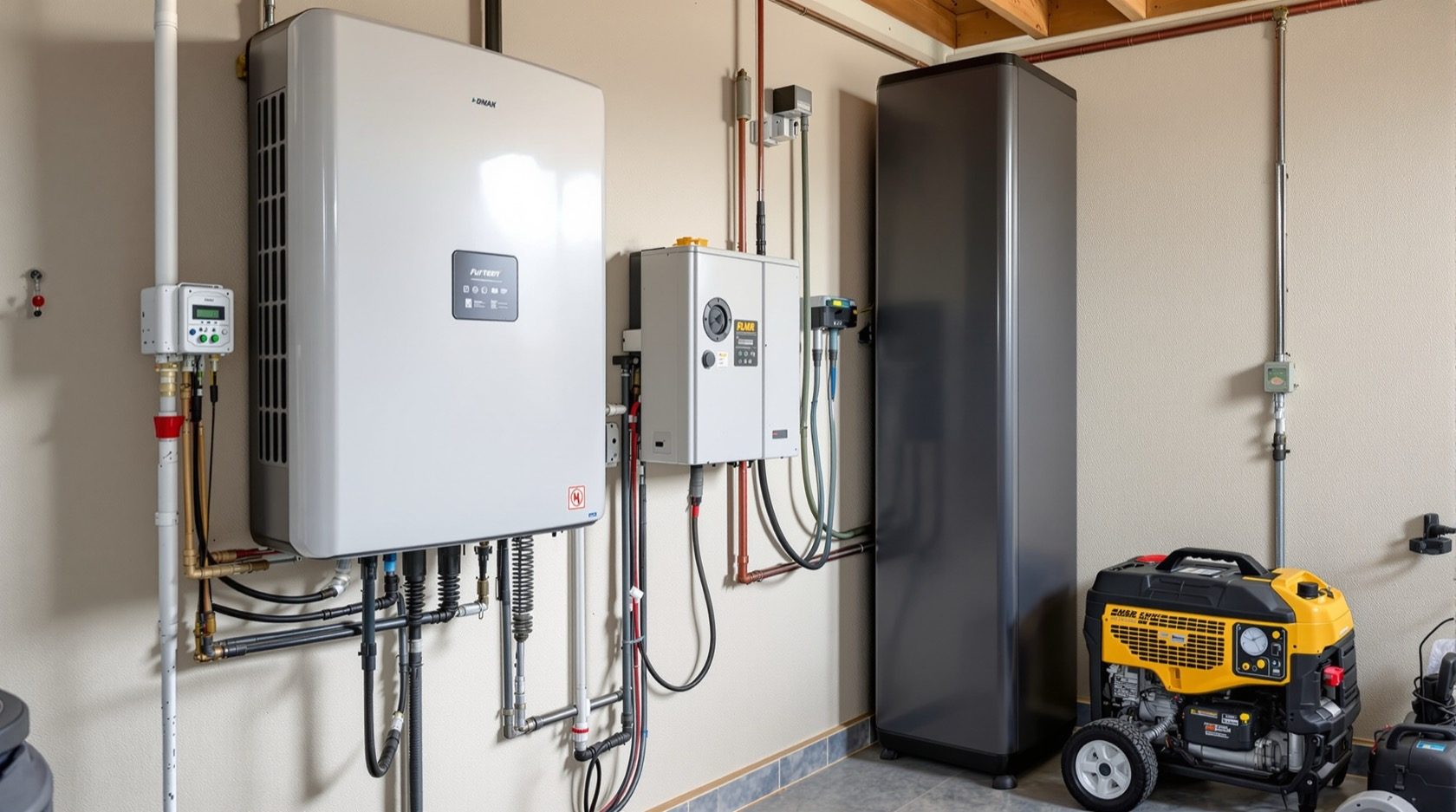
Home Backup Power: Inverter, Generator or UPS?
How to keep the lights on when the grid goes down — the three backup options compared (inverter-battery, generator, UPS), how to decide which your home needs, the idea of 'essential loads' that makes backup affordable, and why a proper changeover switch is non-negotiable.
Across much of India, the grid is reliable most of the time and absent exactly when you least want it — through a summer evening, a monsoon night, a work call. Backup power is how a home carries on through those gaps, and choosing it well is a matter of matching the right solution to what you actually need to keep running, not buying the biggest system a salesperson offers. This guide is the map: the three backup options, how to choose between them, and the two ideas — essential loads and a proper changeover — that make backup both affordable and safe.
It sits under the residential electrical systems pillar and leads into the focused guides on inverters & batteries, generators, UPS systems and the automatic transfer switch.
The safety line. Choosing and sizing backup is the homeowner's decision; installing it — the wiring, the changeover switch, the earthing — is a licensed electrician's job. A backup system wrongly connected can back-feed the grid and electrocute a lineman, or bypass your safety devices. Never wire backup yourself.
The one idea that makes backup affordable: essential loads
Before comparing options, grasp this: you almost never back up the whole home. You back up the essential loads — the things you genuinely need during an outage:
- Always: lights, fans, Wi-Fi/router, TV, phone charging, a few sockets.
- Often: the fridge, a computer, a water pump.
- Rarely on battery backup: air-conditioners, geysers, motors and other heavy loads — these are huge and drain a battery in minutes (they belong on a generator, if at all).
Wiring the essential loads to a separate backup circuit (or a backup distribution board) means your inverter only feeds those, so it can be small, cheap and last for hours — instead of a giant system trying and failing to run the whole house. Deciding your essential loads is the single most important backup decision, and it belongs in the planning stage.
The three options
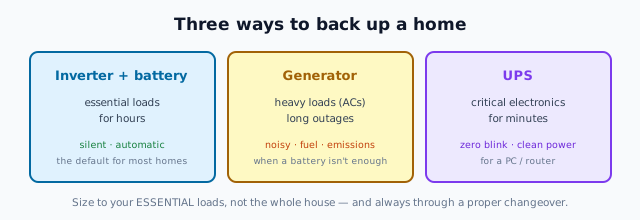
1. Inverter + battery — the default for Indian homes
An inverter converts battery DC into mains AC, and a battery stores the energy. On a power cut it switches over in a fraction of a second, silently. It is the standard home backup: quiet, automatic, maintenance-light, and ideal for essential loads (lights, fans, electronics, fridge) for a few hours. It cannot practically run heavy loads like ACs for long. This is the right answer for most homes — covered in the inverter & battery guide and battery types guide.
2. Generator — for heavy loads and long outages
A generator (DG set) burns fuel (diesel, petrol or gas) to produce electricity, and can run heavy loads — ACs, the whole home — for as long as it has fuel. It suits long outages, large homes, and places with unreliable supply, but it is noisy, needs fuel and ventilation, produces emissions, and needs maintenance. For a flat, it is usually the building's shared DG; for a villa or where outages are long, a home generator makes sense. See the generator guide.
3. UPS — for electronics that must never blink
A UPS (uninterruptible power supply) provides instant, clean power to sensitive electronics — a computer, a router, medical equipment — bridging the gap with zero interruption and protecting against surges and dips. It typically backs a small, critical load for a short time, not the home. Many homes use a small UPS for the desktop and an inverter for the house. See the UPS guide.
| Inverter + battery | Generator | UPS | |
|---|---|---|---|
| Best for | Essential home loads, hours | Heavy loads, long outages | Critical electronics, minutes |
| Switchover | Near-instant, silent | Delay (unless auto-start) | Truly instant, no blink |
| Runs ACs? | No (impractical) | Yes | No |
| Noise / fuel | None | Noisy, needs fuel | None |
| Runtime | Hours (battery) | Long (while fuel lasts) | Short (minutes) |
How to choose
- Frequent short cuts, ordinary home, essential loads: an inverter + battery — the default, and enough for most Indian homes.
- Long or frequent long outages, or heavy loads (ACs, whole home): a generator, or a hybrid of inverter for light loads plus generator for heavy.
- A computer or equipment that must never blink: add a small UPS for that device, alongside whatever whole-home backup you have.
- A modern, forward-looking home: increasingly, solar + battery (see the solar guides) blurs into backup, storing solar energy for use during cuts.
The honest rule: size to your essential loads and realistic outage length, not to the whole house. Most homes are best served by a right-sized inverter, occasionally paired with a generator or UPS for specific needs.
The non-negotiable: a proper changeover
However you back up, the connection between the grid and your backup must go through a proper changeover / transfer switch so the two can never be connected at once. This is not optional — it is a life-safety requirement:
- It stops the backup from back-feeding electricity into the grid, which can electrocute a lineman working on a "dead" line during the outage.
- It keeps your safety devices and earthing correctly in circuit.
A manual changeover switch is the minimum; an automatic transfer switch (ATS) does it automatically. Either way, it is installed by a licensed electrician — never a DIY jumper or a reversed plug. This is covered in the automatic transfer switch guide.
The one-line answer
Back up your home by matching the option to the need: an inverter + battery for essential loads (lights, fans, electronics, fridge) for a few hours — the right default for most Indian homes; a generator for heavy loads and long outages; and a small UPS for electronics that must never blink, often alongside the others. The key to affordable backup is wiring only your essential loads to it, sized to a realistic outage — and the non-negotiable safety requirement is a proper changeover switch so backup can never back-feed the grid, all installed by a licensed electrician.
Where to go next
- The default solution: Inverters & Batteries Guide.
- Which battery: Inverter Battery Types.
- Heavy loads: Generator Guide.
- Critical electronics: UPS Systems Guide.
- The safety switch: Automatic Transfer Switch.
- Size it: Inverter & Battery Calculator.
References
- IS 16242 (Parts 1–5), Uninterruptible Power Systems (UPS), Bureau of Indian Standards.
- IS/ISO 8528 (Parts 1–12), Reciprocating Internal Combustion Engine Driven AC Generating Sets, BIS.
- IS 15549 : 2005, Stationary Regulated Lead Acid Batteries, BIS.
- Central Electricity Authority (Measures relating to Safety and Electric Supply) Regulations, CEA: https://cea.nic.in/
- IS 732 : 2019, Code of Practice for Electrical Wiring Installations; National Electrical Code SP 30 : 2023, BIS: https://www.bis.gov.in/
Backup options and sizing are indicative for typical Indian homes; the system, changeover switch, wiring and earthing must be designed and installed by a licensed electrician. Verify any standard's status via the BIS catalogue before relying on it.
Export this guide
Related Guides — Deep-dive reading
Residential Electrical Systems: The Complete Guide for Indian Homes
How the electricity in an Indian home actually works — from the utility supply and meter through the distribution board, circuits, wiring, earthing and protection, to lighting, safety, energy efficiency, smart controls, solar and backup — written so a homeowner can understand, plan and judge it, and know exactly where a licensed electrician must take over.
Electrical & WiringVideo Door Phone Power Backup in India (2026): Keeping the Door Alive Through Power Cuts
How to keep the indoor monitor, door station and — for app kits — the router and ONT running through India's power cuts, using a small UPS, the home inverter circuit, or a built-in battery, so you can still see and answer the door.
SecurityHybrid Solar System Guide for Indian Homes: Solar Plus Battery Backup (2026)
A design and specification guide to the hybrid solar system -- grid-connected solar with a battery that keeps critical loads running through a cut. How it works, how it differs from pure on-grid and off-grid, the components, sizing the battery, the trade-offs, and when hybrid beats an on-grid system with a separate inverter.
Solar & EnergyRelated Tools — Try Free
Electrical Safety & Load Audit
Home electrical audit — 10 categories, 65+ checkpoints across earthing, RCCB, MCB, wiring, switchboards, appliance circuits, DG/inverter backup.
Safety AuditInverter & Battery Calculator
Size a home inverter (VA) and battery (Ah) for the load you want to back up and the hours of backup you need.
Backup PowerSecurity Backup Power Calculator
Size a UPS/inverter and battery to keep CCTV, NVR, router and alarm running through a power cut — load, Ah, VA and cost.
Backup Power