
Home Generators: Portable, Standby, Sizing & When You Need One
When a battery isn't enough — how a generator produces power for heavy loads and long outages, the difference between a portable set and a fixed standby DG, how they are sized, the fuel, noise and emission realities, and whether a home actually needs one.
An inverter-battery is silent and effortless, but it has a hard limit: it cannot run heavy loads like air-conditioners for long, and its runtime ends when the battery drains. When you need to power heavy loads or survive long outages, the answer is a generator — an engine burning fuel to produce electricity for as long as the fuel lasts. This guide explains how generators fit a home, the portable-versus-standby choice, how they are sized, and the honest realities of fuel, noise and emissions that decide whether you actually want one.
It sits under the home backup power guide. For most homes, the inverter-battery is the first line; the generator is for when that isn't enough.
The safety line. Generators involve fuel, exhaust (deadly carbon monoxide), high current and a mandatory changeover switch. Installation, exhaust routing, fuel storage and the transfer switch are strictly for qualified people. Never run a generator indoors or in an enclosed space (CO poisoning kills), and never connect one without a proper transfer switch. Generating sets follow IS/ISO 8528.
Portable vs standby
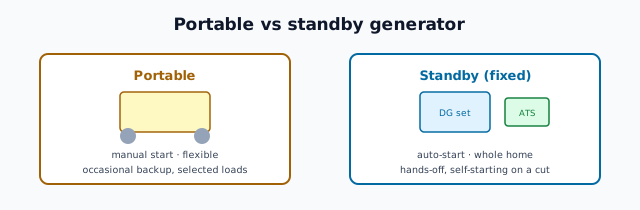
Home generators fall into two broad types:
- Portable generator — a wheeled or carried set (petrol, diesel or increasingly inverter-type) you start manually and connect to selected loads. Cheaper, flexible, good for occasional backup, worksites, or a rented home — but manual, noisier, and you must fuel and start it. Inverter generators are a quieter, cleaner-power variant good for electronics.
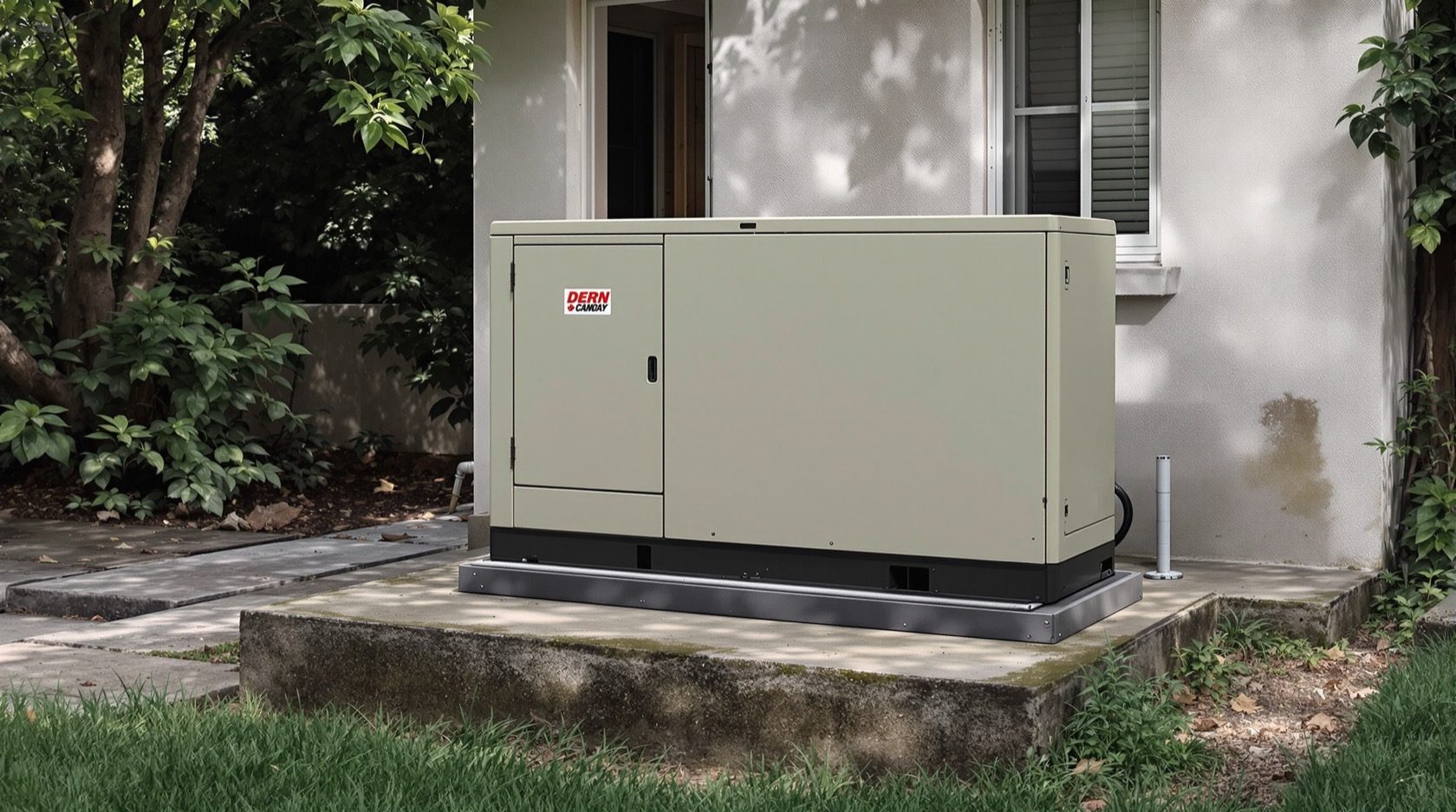
- Standby (fixed) generator — a permanently installed DG set, often with an automatic transfer switch (ATS/AMF) so it starts itself on a power cut and shuts down when the grid returns. More expensive and needing proper installation, fuel supply and ventilation, but automatic and able to carry the whole home or heavy loads. Suited to villas, essential-service homes, and areas of long, frequent outages.
For a flat, backup is usually the building's shared DG; a home generator makes sense mainly for independent houses.
Sizing a generator
A generator is rated in kVA (or kW) — its power capacity — and sizing is a balance: too small and it can't start your loads or is overworked; too large and you waste money and run it inefficiently.
- Total the loads you want to run at once, in watts, including the heavy ones (ACs, pump, whole home) that justify a generator in the first place.
- Allow for starting surge — motors (ACs, pumps, fridges) draw several times their running current for a moment at start-up, so the generator must have headroom for that inrush.
- Convert to kVA with the power factor, and choose a set with margin.
Because of the starting surge and the mix of loads, generator sizing is genuinely a professional calculation — under-sizing is a common, frustrating mistake. Decide what you truly need to run (often not the entire home — essential heavy loads plus lights), and let a supplier or electrician size it.
The honest realities
A generator solves the heavy-load problem but brings trade-offs an inverter doesn't:
- Noise — generators are loud; "silent" canopy sets are quieter but not silent. Placement and neighbours matter.
- Fuel — you must store and supply fuel (diesel/petrol/gas), and running cost is real and ongoing.
- Emissions & CO — exhaust is polluting and carbon monoxide is lethal; the set must be outdoors/well-ventilated with exhaust routed safely, never in an enclosed or indoor space.
- Maintenance — engines need servicing, oil changes and periodic test runs.
- Regulations — emission and noise norms apply, and larger installations have siting and safety requirements.
These are why a generator is a considered purchase, not a default — most homes are better served by a right-sized inverter, adding a generator only when heavy loads or long outages genuinely demand it.
Does your home need one?
- Ordinary home, essential loads, short-to-medium cuts: no — a good inverter-battery is enough.
- Long or very frequent outages, or you must run ACs / heavy loads: yes, a generator (or an inverter-for-light-loads-plus-generator hybrid).
- Independent house vs flat: a home generator suits houses; flats rely on the building DG.
- Critical needs (medical, work): a standby generator with auto-start provides continuity a battery can't sustain for long.
The one-line answer
A generator burns fuel to produce electricity for heavy loads and long outages that an inverter-battery can't sustain — a portable set for occasional, manual backup, or a fixed standby set on an automatic transfer switch for whole-home, self-starting continuity. Size it professionally to your real loads plus motor-starting surge (under-sizing is the common mistake), and weigh the honest costs — noise, fuel, lethal exhaust that must vent outdoors, and maintenance. Most homes need only a good inverter; add a generator when heavy loads or long cuts genuinely require it, always through a proper transfer switch installed by qualified people.
Where to go next
- The strategy: Home Backup Power Guide.
- The everyday backup: Inverters & Batteries Guide.
- The mandatory switch: Automatic Transfer Switch.
- Bigger buildings: Building Electrical Services.
References
- IS/ISO 8528 (Parts 1–12), Reciprocating Internal Combustion Engine Driven AC Generating Sets, Bureau of Indian Standards.
- IS/ISO 8528 : Part 12, Emergency Power Supply to Safety Services, BIS.
- Central Pollution Control Board emission norms for DG sets (verify current requirements), CPCB: https://cpcb.nic.in/
- IS 732 : 2019, Code of Practice for Electrical Wiring Installations; National Electrical Code SP 30 : 2023, BIS: https://www.bis.gov.in/
Generator sizing, siting, fuel, exhaust and the transfer switch must be designed and installed by qualified professionals to the current codes and emission/noise norms. Never run a generator in an enclosed space. Verify any standard's status via the BIS catalogue before relying on it.
Export this guide
Related Guides — Deep-dive reading
Smart Air Purifiers for Indian Homes: Beating PM2.5
Across Delhi-NCR winters and year-round urban haze, indoor air is often worse than the street. This guide explains what actually makes a purifier smart, how CADR and room sizing work, what HEPA and activated carbon really remove, honest running costs on filters and power, and which brands earn their price in Indian conditions.
Smart HomeEmergency Lighting Testing in India (2026): The Function Test, the Duration Test and the Battery That Quietly Dies
Emergency lighting is what gets people out of a building in a power cut or a fire — and it is useless if its batteries have silently gone flat. This professional guide covers what emergency lighting is, the two tests that keep it honest (the short frequent function test and the longer periodic duration test that catches dying batteries), what to test across escape routes, stairs and exit signs, the statutory test log, and the safe split of who does what.
SecurityBathroom Plumbing Code India: NBC 2016 Part 9, UPC-I & the IS Standards That Govern Pipework
A professional reference to the codes and standards that govern bathroom plumbing in India — the National Building Code (NBC 2016) Part 9 on Plumbing Services, the Uniform Plumbing Code India (UPC-I), the CPHEEO Manual, and the IS standards for water supply, drainage, trap seals, pipe sizing, slopes and venting — with a caveat to always verify the current code and your local authority.
BathroomsRelated Tools — Try Free
Electrical Safety & Load Audit
Home electrical audit — 10 categories, 65+ checkpoints across earthing, RCCB, MCB, wiring, switchboards, appliance circuits, DG/inverter backup.
Safety AuditInverter & Battery Calculator
Size a home inverter (VA) and battery (Ah) for the load you want to back up and the hours of backup you need.
Backup PowerAccess-Control Battery-Backup Calculator
Size the standby battery so an access system keeps running through a power cut, with an egress life-safety note.
Battery Backup