
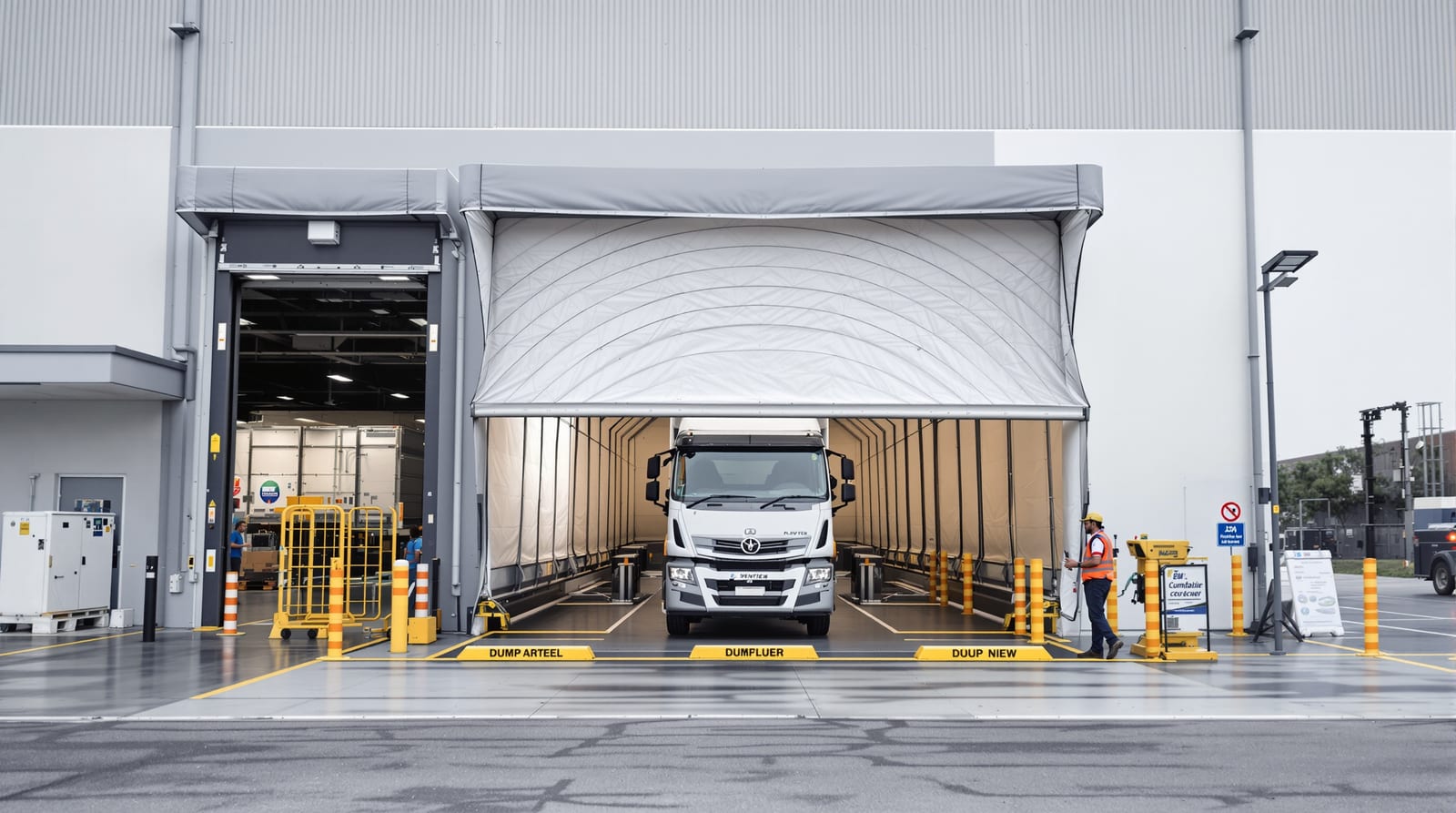
Dock Shelter Doors & Seals: Loading Bay Guide India 2026
Cushion, inflatable and retractable dock shelters plus dock seals — how to seal a reversed truck against weather, energy loss and pests at the bay.
A dock door, on its own, only closes the opening — it does nothing about the 100-300 mm gap that opens up all around a reversed truck. Dock shelter doors and dock seals are the products that bridge that gap, pressing fabric or foam against the trailer body so the bay stays weather-tight, energy-efficient, pest-free and secure while goods move across the threshold. For any temperature-controlled warehouse, pharma dispatch dock or high-throughput DC in India, the shelter and seal are not an accessory; they are the part of the loading-bay envelope that actually saves money. This guide explains how dock shelters and seals work, the cushion-versus-inflatable-versus-retractable choice, how to size them to your truck mix, and how they sit inside the full dock-door + leveller + shelter system. It complements our product guide to the loading dock door, which covers the door leaf itself.
Why the seal, not just the door
When a truck reverses onto a bay, the dock leveller bridges the height difference and the trailer doors swing open inside the building line. The internal dock door then rolls up. At that moment the building is open to the outside along the full perimeter of the trailer rear — unless a shelter or seal closes it. In a chilled or frozen DC that gap bleeds conditioned air continuously; in monsoon it lets driving rain wash across the threshold and onto pallets; year-round it is the main entry point for birds, rodents and insects, which is a direct FSSAI and WHO-GMP hygiene risk for food and pharma operations.
The rule of thumb is simple: the door keeps the bay closed when no truck is present; the shelter or seal keeps it closed when a truck is present. A complete bay therefore needs both. Skipping the shelter to save capital is the single most common — and most expensive — false economy in Indian warehouse design, because the recurring energy and spoilage cost dwarfs the one-time shelter price within a year or two on a busy cold-chain bay.
Dock seals versus dock shelters
The two families differ in how they make contact with the trailer and in how much trailer-size variation they tolerate.
Dock seals are compression products: foam pads (covered in tough hypalon or vinyl) mounted on the head and both sides of the opening. The truck reverses into them and physically compresses the foam, which springs back to grip the trailer. Seals give the tightest seal and best insulation but only suit a narrow band of trailer sizes — a smaller vehicle simply won't touch the side pads. They are the classic choice for dedicated cold-store bays with a uniform fleet.
Dock shelters are curtain products: a steel or aluminium frame carries side and head curtains of reinforced fabric that drape over and around the trailer rear. They tolerate a much wider mix of vehicle heights and widths because the fabric flexes rather than compresses, which is why they dominate Indian DCs serving everything from a 32-foot container to a small 14-foot pickup. The trade-off is a slightly looser seal than a foam pad.
The three shelter types
- Cushion (foam-frame) shelter — a hybrid: foam side and head members faced with fabric, halfway between a seal and a shelter. Good general-purpose insulation, moderate vehicle range, robust.
- Inflatable shelter — the frame stays clear of the truck while reversing, then a fan inflates fabric bladders on the head and/or sides that press snugly against the trailer once parked. Best-in-class seal across a wide truck mix and very forgiving of off-centre reversing, but it needs power, a blower and more maintenance.
- Retractable (mechanical/spring) shelter — side and head frames swing or slide aside, absorbing trailer impact and returning into place; the curtains then follow the trailer contour. Durable, no power needed, and tolerant of careless drivers; the standard workhorse for general logistics.
Comparison: seal and shelter types
| Type | Vehicle-size range | Seal quality | Power needed | Indicative cost (supply-only) |
|---|---|---|---|---|
| Foam dock seal | Narrow (uniform fleet) | Excellent | No | ₹35,000–80,000 |
| Cushion shelter | Moderate | Very good | No | ₹55,000–1,20,000 |
| Retractable shelter | Wide | Good | No | ₹70,000–1,60,000 |
| Inflatable shelter | Very wide | Excellent | Yes (blower) | ₹1,50,000–3,50,000 |
Bands are supply-only; add installation, structural sub-frame and (for inflatable) electrical work. Prices exclude 18% GST. Treat these as project-engineered figures — final cost depends on opening size, fabric grade, projection and impact protection, so always take a vendor spec.
Sizing to your truck mix
A shelter is only as good as its fit to the actual fleet. Specify against the real range of vehicles that will dock, not a nominal trailer.
- Trailer height range — measure the rear-door top edge of your tallest and shortest vehicles at the dock. The head curtain or seal must reach the lowest one yet not foul the tallest.
- Trailer width — side curtains should overlap the trailer body by 100-150 mm each side under compression.
- Projection — how far the shelter stands proud of the wall, set by how far trailers stop short of the building face (and any bumper/leveller geometry). Typical projection 400-600 mm.
- Opening size — common Indian bay openings are 2.4-2.7 m wide × 2.7-3.0 m high; the shelter frame is sized around this.
Where the fleet spans containers down to small trucks, an inflatable or wide-range retractable shelter is the honest answer; a foam seal will simply leave a gap on the smaller vehicles. For a mixed cold-chain operation, pair the shelter with a high-speed internal door and PVC strips — see high-speed doors and PVC strip curtain doors.
The dock-door + leveller + shelter system
The four bay components work as one envelope and should be specified together:
1. Bumpers — laminated rubber or steel-faced, take the trailer impact and set the stand-off distance that the shelter projection is calculated from.
2. Dock leveller — hydraulic or mechanical, bridges floor-to-bed height; choose capacity for the heaviest loaded forklift + pallet.
3. Shelter / seal — the weather and hygiene closure around the trailer.
4. Dock door — the sectional, high-speed or rolling closure that secures the opening when idle.
Get the sequence and clearances coordinated at design stage; retrofitting a shelter onto a bay whose bumper stand-off is wrong is a recurring, avoidable headache. For the broader picture of industrial closures see industrial door types and the cluster complete door guide; this specialty product sits alongside the others catalogued in specialty doors.
Materials, durability and codes
Shelter curtains are typically 900-1300 gsm PVC-coated polyester or hypalon, UV-stabilised for Indian sun, with reinforced wear strips along the trailer-contact edges (these are wear items and should be a replaceable part). Frames are galvanised steel or aluminium. There is no single Indian standard dedicated to dock shelters; specify to manufacturer data and align the system with the warehouse's governing requirements — NBC 2016 for the building, FSSAI/WHO-GMP hygiene if food or pharma, and fire-egress separation so the dock door does not double as a designated fire exit unless rated. GST on dock equipment is 18%. Indian and global suppliers active in this space include Gandhi Automations, Shakti Hörmann, ASSA ABLOY and others; frame any brand mention generically and take a written spec.
Quick selection by operation
| Operation | Recommended closure |
|---|---|
| Ambient general DC, mixed fleet | Retractable shelter |
| Cold store / freezer, uniform fleet | Foam seal + insulated door |
| Pharma / food dispatch | Inflatable shelter (tight, hygienic) |
| High-throughput cross-dock | Retractable shelter + high-speed door |
| Cyclone-prone coastal bay | Heavy retractable + impact bumpers |
For the chilled/frozen case, read this together with our cold storage door guide.
Costing and lifecycle
Budget the bay as a system. A typical Indian ambient bay (door + leveller + bumpers + retractable shelter) lands roughly ₹2.5-5 lakh installed per position; a cold-chain bay with insulated door, foam seal and heavier leveller can run ₹4-8 lakh+. Inflatable shelters add the blower, controls and electrical work. Against that, a leaking bay on a cold-chain DC can waste energy and spoil stock at a rate that pays back a good shelter inside one or two seasons — run the numbers for your site with the high-speed door savings calculator and the cold-store door heatload calculator. All figures are indicative bands; dock shelters are project-engineered, so the final specification and price come from a vendor surveying your actual openings, fleet and bumper geometry.
Frequently asked questions
What is the difference between a dock seal and a dock shelter?
A dock seal uses compressible foam pads that the truck presses into, giving the tightest seal but suiting only a narrow range of trailer sizes. A dock shelter uses a framed fabric curtain that drapes over the trailer, tolerating a much wider vehicle mix at a slightly looser seal. Uniform fleets favour seals; mixed fleets favour shelters.
Which shelter type is best for a mixed truck fleet?
A retractable (mechanical) shelter for general logistics, or an inflatable shelter where the tightest seal matters — both flex to fit everything from a container down to a small truck. A foam seal would leave a gap on the smaller vehicles and is the wrong choice for a mixed fleet.
Do I still need a dock door if I have a shelter?
Yes. The shelter seals the gap around a reversed truck while loading; the dock door secures and closes the opening when no truck is present. They are complementary parts of the same bay envelope — see the loading dock door guide for the door itself.
How much does a dock shelter cost in India?
Supply-only bands run roughly ₹35,000-80,000 for a foam seal, ₹70,000-1,60,000 for a retractable shelter and ₹1,50,000-3,50,000 for an inflatable, plus installation, sub-frame and (for inflatable) electrical work, all excluding 18% GST. A complete bay is best costed as a system; get a vendor survey.
Are dock shelters worth it for an ambient (non-refrigerated) warehouse?
Often yes — even without refrigeration they keep out monsoon rain, dust, birds and pests, protect goods at the threshold and improve worker comfort. For temperature-controlled bays they are essential and pay back fastest through energy and spoilage savings.
Export this guide
Related Guides — Deep-dive reading
Loading Dock Door in India: The Truck-to-Building Interface - Sectional Door, Dock Leveller, Seal and Restraint (2026)
How an Indian loading dock actually works as one system - the insulated sectional overhead door at each bay, the dock leveller that bridges the gap to the truck bed, the dock shelter or seal that weatherproofs around the vehicle, bumpers, vehicle restraints and the high-speed door behind - sized to your trucks and containers, with indicative per-dock costs.
Home Doors & EntrancesIndustrial Doors in India: The Heavy-Duty Door Menu and How to Choose (2026)
High-speed roll-up, sectional overhead, rolling shutters, strip curtains, fire shutters and dock doors - the complete industrial door menu, ranked by the driver that decides it (cycle speed, load and size, thermal and dust separation, fire compartmentation, security and durability), with indicative per-door costs.
Home Doors & EntrancesHigh-Speed Doors in India: Rapid Roll-Up Guide (India 2026)
How rapid roll-up and spiral doors opening at 1-3 m/s cut energy loss, dust and downtime in Indian cold-chain, pharma and factory plants.
Home Doors & EntrancesRelated Tools — Try Free
Curtain Cost Calculator
Get the fabric metres you need plus the total curtain cost by window size, fabric, pleat, lining and hardware.
Curtain CalculatorMotorized Curtain Cost Calculator
Estimate the all-in cost to motorise curtains — motors, tracks, hub and installation.
Cost CalculatorMonsoon-Readiness Checklist
Pre-rain home audit across 9 categories — terrace, drains, waterproofing, electrical, HVAC, pest, vehicles, documents.
Seasonal Audit