
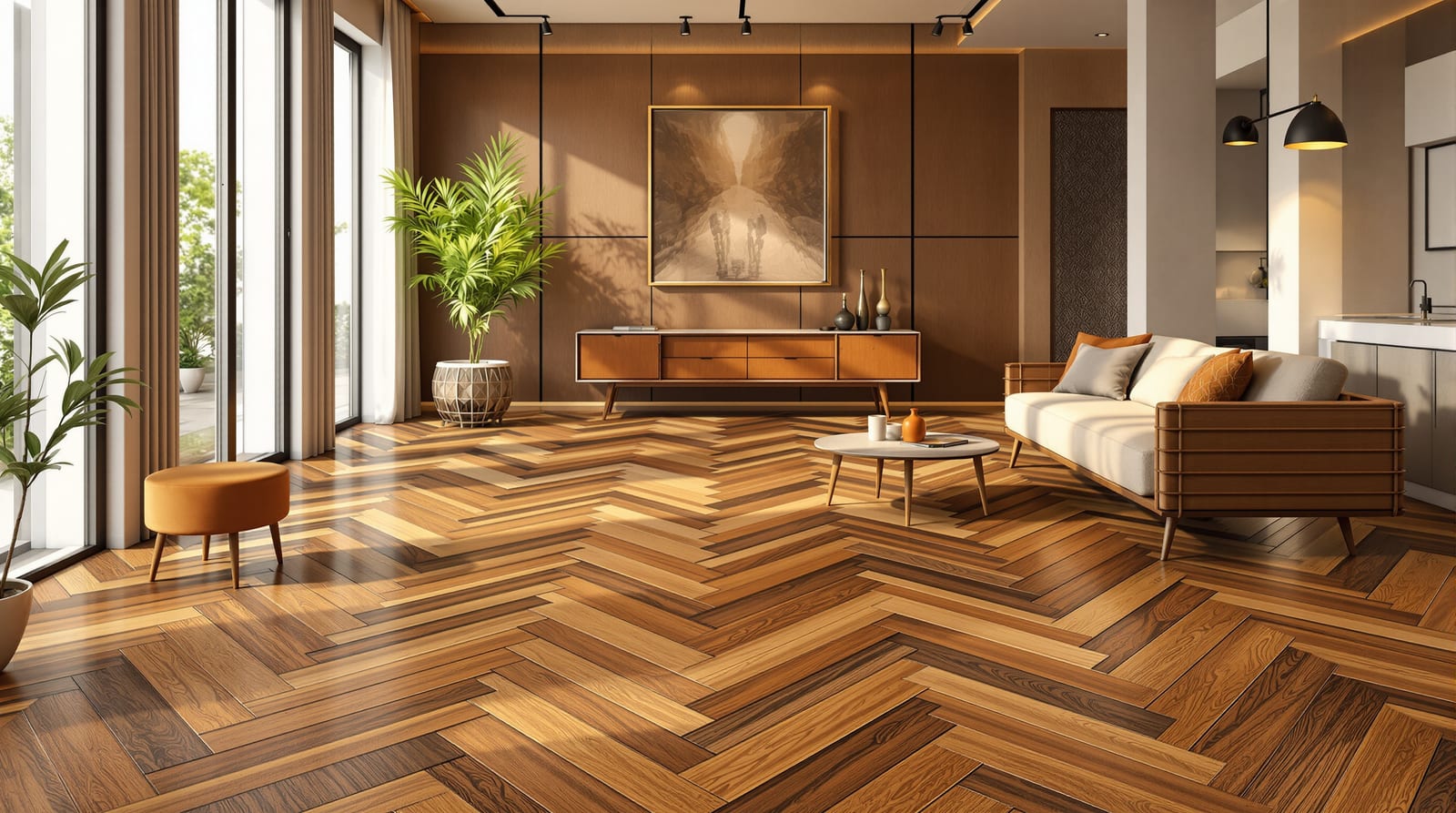
Herringbone Flooring in India: The Zig-Zag Pattern in Wood, Laminate, SPC, Tile and Brick, with Wastage, Labour and Cost
Herringbone is the timeless zig-zag pattern that sets rectangular planks at 90 degrees to make a room feel bigger and grander — here is how the pattern works in wood, laminate, SPC, LVT, tile and brick, the +15 to 20 percent wastage and higher labour it adds, and the rupee premium over straight-lay.
Herringbone is the pattern that turns an ordinary plank floor into an event. The same rectangular pieces of wood, laminate, SPC or tile that would otherwise run in plain parallel rows are instead set at ninety degrees to one another, so each plank steps off the next in a tight, interlocking zig-zag that looks a little like the bones of a fish — which is exactly where the name comes from. It is one of the oldest decorative floor patterns in the world, and after years of plain straight-lay floors it is firmly back in fashion in Indian homes, cafes and boutiques.
This guide explains how the herringbone pattern actually works, why it makes a room feel bigger and grander, which materials you can get it in (and which planks now come herringbone-ready), the wastage and labour premium it adds, the rupee cost over a straight-lay floor, and how it differs from its close cousin, chevron.
What herringbone flooring actually is
Herringbone is a laying pattern, not a material. You can lay almost any rectangular plank or tile in herringbone — engineered wood, solid hardwood, laminate, SPC, LVT (luxury vinyl tile), porcelain or ceramic tile, and even clay brick. What defines the pattern is the geometry: rectangular pieces, typically with a length-to-width ratio of 2:1, 3:1 or 4:1, are arranged so that the end of one plank meets the side of the next at a right angle, and the whole field marches forward in a staggered, repeating L-shape.
The crucial visual difference from a plain floor is that the planks are NOT all pointing the same way. In a straight-lay floor every plank runs in one direction; in herringbone they alternate between two directions ninety degrees apart, and it is that constant change of direction — and the play of light off planks facing different ways — that gives the floor its richness and movement.
Because the pattern is built from ordinary rectangular units cut square at the ends, herringbone is more forgiving and more economical than chevron, where every plank end has to be cut at an angle. We will come back to that distinction at the end.
Studio Matrx treats herringbone as one of the headline patterns in the specialty flooring family, alongside the classic block patterns covered in the parquet flooring guide.
Single herringbone vs double herringbone
There are two main versions of the pattern, and the difference changes both the look and the cutting.
Single herringbone is the classic: one plank, then a second plank turned ninety degrees, repeating across the floor. Each "step" is a single board. This is the version most people picture and the one most engineered-wood and SPC herringbone kits are made for.
Double herringbone (sometimes called double-weave) pairs two planks side by side as a unit, then turns the next pair ninety degrees. The result reads as a chunkier, more textile-like weave and suits larger rooms and wider boards. It uses slightly more set-out planning but the same cutting logic.
A related decision is the laying angle. Herringbone can run straight (the points of the zig-zag aim along the length of the room) or be set on a 45-degree diagonal (the points aim into a corner). A diagonal set looks more dynamic and hides out-of-square walls well, but it adds perimeter cutting and a little more wastage.
Why herringbone makes a room look bigger and grander
There are genuine, repeatable reasons designers reach for herringbone when a space needs to feel special.
- It draws the eye across the whole floor. The constant change of direction stops the eye running straight out of the room the way parallel planks do, so the floor reads as a considered surface rather than a corridor. In a small or narrow Indian apartment living room, a diagonal herringbone can make the floor feel wider than it is.
- It catches light from two directions at once. Because adjacent planks face ninety degrees apart, daylight reflects off them differently, giving the floor a subtle shimmer and depth a flat straight-lay floor never has — most striking in wood and high-gloss finishes.
- It signals craft and permanence. Herringbone parquet was historically a feature of grand homes and heritage buildings; the pattern still carries that association of quality, which is why it lifts the perceived value of a room, lobby or boutique. It also hides minor colour and grain variation between boards, which blends into the busy pattern rather than lining up in distracting stripes.
The trade-off for all that drama is more material and more skilled labour, which is the next thing to be honest about.
The wastage and labour premium
This is the part homeowners are most often surprised by, so plan for it from the start.
Extra material — budget +15 to 20 percent wastage. A straight-lay floor is usually estimated at around 5 to 10 percent wastage for offcuts and breakages. Herringbone needs more, because the pattern leaves a saw-tooth edge all around the room that has to be filled with planks cut to a triangle, and those offcuts often cannot be reused. Order roughly 15 to 20 percent extra material over the bare room area (more for small rooms, diagonal sets, or boards with strong directional grain). Underordering is risky: a later batch of wood, laminate or tile may not match colour exactly.
More labour, more time. Setting out and laying herringbone is fiddly: the installer has to strike accurate centre lines, dry-lay the first rows to lock the angle, and check the ninety-degree relationship constantly so the pattern does not "drift" across the room. Expect the laying charge to be meaningfully higher than a straight floor — commonly 1.5x to 2x the per-square-foot fitting rate, depending on city and material — and the job to take longer. Insist on an installer who has actually laid herringbone before; a drifted or out-of-square herringbone floor is painfully visible and effectively cannot be fixed without relaying.
For an accurate plank count and offcut allowance for your specific room size and plank dimensions, run the figures through the Studio Matrx tile pattern calculator before you place the order.
Material options, look, wastage and the rupee premium
You can have herringbone in almost any plank material. The pattern adds roughly the same wastage and labour premium across all of them; what changes is the base cost and the feel underfoot. The table below gives indicative all-India ranges (material before laying, GST extra; indicative, varies by city and vendor).
| Material in herringbone | The look | Typical wastage to budget | Indicative material cost (₹/sq ft) | Premium vs straight-lay |
|---|---|---|---|---|
| Engineered wood | Warmest, most classic; real wood veneer, refinishable once | +15 to 20% | 250 to 700 | High labour + ~15-20% material |
| Solid hardwood (teak/oak parquet blocks) | The heritage original; fully refinishable, very long-lived | +15 to 20% | 400 to 900 | Highest labour; skilled fitter |
| Laminate | Budget wood-look, scratch-resistant, click-lock herringbone kits | +12 to 18% | 90 to 250 | Moderate; DIY-friendlier |
| SPC (stone-polymer core) | Waterproof, dent-resistant, ideal for Indian humidity; herringbone click planks now common | +12 to 18% | 120 to 300 | Moderate |
| LVT (luxury vinyl tile) | Soft, quiet, waterproof; glue-down herringbone is very stable | +12 to 18% | 110 to 280 | Moderate |
| Porcelain / ceramic tile (wood-look or plain) | Hard, waterproof, great for kitchens/cafes; needs tiler skill | +15 to 20% | 70 to 250 | High; tile-saw cutting |
| Clay / terracotta brick | Rustic, warm, very durable; classic for verandahs, courtyards, cafes | +15 to 20% | 50 to 150 | High; mortar-bed labour |
A few practical notes from Indian sites:
- For wet or humid conditions — coastal cities, ground floors, kitchens — SPC, LVT and porcelain herringbone are the safer choices over laminate or unsealed wood. See the SPC flooring guide and the laminate flooring guide for how the cores behave in monsoon humidity.
- For the real-wood look, engineered wood in herringbone is the popular middle path between cost and authenticity; the wooden flooring guide covers species, finishes and refinishing.
Which planks come herringbone-ready
This matters more than most buyers realise. With a straight-lay click floor, every plank is identical and faces the same way. Herringbone is different: a true click-lock herringbone product is supplied as matched A and B planks — mirror-image pairs whose click profiles are cut so that an A plank locks into a B plank at ninety degrees. You buy them in roughly equal numbers (often boxed 50:50), and you cannot make a proper click herringbone floor from ordinary straight-lay planks.
So when you shop laminate, SPC or engineered-wood herringbone, confirm the product is sold as a dedicated A/B herringbone SKU. By contrast, glue-down LVT, tile and brick have no click profile, so any rectangular unit can be set in herringbone — the pattern lives entirely in how the fitter lays them, and the A/B distinction does not apply.
How herringbone is set out and laid
A good herringbone floor is won or lost at the set-out stage, before a single plank is glued or clicked down.
1. Find the room centre and strike reference lines. The fitter marks the centre of the room and strikes a 90-degree pair of chalk lines (or a 45-degree line for a diagonal set). The pattern is built outward from these lines so it stays symmetrical and the cut triangles at opposite walls match.
2. Dry-lay and lock the angle. The first few planks are laid loose to confirm the ninety-degree relationship and the direction of the points. For click A/B planks this is where you confirm you have the A-into-B orientation right; getting it backwards means the whole field runs the wrong way.
3. Work outward, checking square constantly. Each plank is checked against the reference lines so the pattern does not creep. Small errors compound: a one-degree drift becomes a visible kink three metres away.
4. Cut the perimeter triangles last. Once the field is laid, the saw-tooth edge at every wall is filled with planks cut to triangles — this is where most of the offcut wastage goes.
For tile and brick herringbone there is the extra step of a level mortar bed or adhesive screed; an uneven base shows up far more in a busy pattern than in plain tiling. See how to lay floor tiles and the floor screed and mortar bed guide for the base preparation that herringbone tiling depends on.
Where herringbone suits — and where to think twice
Herringbone earns its premium in spaces where the floor is meant to be noticed and where the area is open enough for the pattern to breathe.
- Living and dining rooms are the classic home choice; an engineered-wood or SPC herringbone anchors the main social space. The living room flooring guide covers how it sits with the rest of the room.
- Master bedrooms in warm wood or laminate herringbone feel restful and considered; see bedroom flooring.
- Feature zones — an entrance foyer, a hallway, a single accent wall-to-floor run, a pooja or study corner — are ideal, because a small herringbone area reads as a deliberate design move without the cost of doing the whole house.
- Cafes, boutiques and showrooms lean on herringbone (often in tile or brick) for its instant sense of craft and warmth, and for the way it photographs well.
Think twice when the room is very small and cluttered with furniture (the pattern gets lost), when the budget is tight (the wastage and labour premium is real), or when you need a fast, low-skill install — straight-lay click planks are far quicker and more forgiving. For busy, narrow utility spaces, a plain floor is usually the smarter spend.
Herringbone vs chevron
These two patterns are constantly confused, but the difference is simple and it drives both the look and the cost.
In herringbone, the planks are cut square at the ends (a plain rectangle) and meet at a ninety-degree angle, so each plank steps off the side of its neighbour. The seam between rows is a stepped, broken zig-zag.
In chevron, each plank end is cut at an angle (usually 45 or 60 degrees) so that the planks meet point-to-point along a continuous straight line, forming clean, unbroken V-shapes that run up the room like arrows.
Practically: chevron needs angle-cut planks, which means more cutting, more wastage and a higher price, but gives a crisper, more formal continuous-V look; herringbone uses square-cut rectangles, is a little more economical and reads as the busier, more traditional interlocking weave. If you are choosing between the two, the chevron flooring guide covers the angled-cut pattern in full.
Frequently asked questions
Is herringbone flooring more expensive than a straight-lay floor?
Yes, but the premium is in the laying and the wastage, not usually the plank itself. Budget roughly 15 to 20 percent extra material for offcuts and 1.5x to 2x the fitting labour rate compared with a plain straight-lay floor of the same material. On a real living room that often adds up to a noticeable but manageable uplift — and it is concentrated in labour, so it is most cost-effective on a small feature area.
Can I get herringbone in waterproof flooring for Indian humidity?
Yes. SPC, LVT and porcelain tile all come in herringbone and are well suited to Indian monsoon humidity, kitchens and ground floors because their cores or bodies do not swell with moisture the way laminate or unsealed wood can. For coastal or wet conditions these are the safer herringbone choices over laminate.
Do I need special planks to lay a click herringbone floor?
For click-lock products, yes — true herringbone is sold as matched A and B planks (mirror-image pairs) that lock together at ninety degrees, usually boxed in roughly equal numbers. You cannot make a proper click herringbone floor from ordinary straight-lay planks. Glue-down LVT, tile and brick have no click profile, so any rectangular unit can be set in herringbone purely by how it is laid.
Is herringbone harder to install than a normal floor?
Yes. It needs careful set-out from the room centre, accurate ninety-degree reference lines, constant checking so the pattern does not drift, and skilled cutting of the perimeter triangles. A drifted or out-of-square herringbone floor is very visible and hard to fix, so it is worth insisting on an installer who has laid the pattern before.
Export this guide
Related Guides — Deep-dive reading
Chevron Flooring in India: The Angle-Cut V Pattern, Cost & Install Guide
Why chevron's continuous V costs more than herringbone, the materials and angles that work, and where the sleek directional look pays off in Indian homes.
Flooring & SurfacesWooden Flooring in India: Solid, Engineered, Laminate & Wood-Look SPC Compared (2026)
The decision-oriented hub for wood floors in Indian homes — the three families plus wood-look SPC, the warm look, honest monsoon-and-termite caveats, where wood works, finishes, installation types, ₹/sq ft ranges and maintenance.
Flooring & SurfacesEngineered Wood Flooring in India: Layers, Wear Layer, Install & Cost (2026)
Engineered wood is a real-wood top veneer bonded over a cross-laminated plywood or HDF core, which makes it far more dimensionally stable than solid wood in Indian humidity — the practical way to get a genuine timber floor here. This guide covers the layer build-up, wear-layer thickness, click vs glue-down install, where it suits, ₹/sq ft, brands and maintenance.
Flooring & SurfacesRelated Tools — Try Free
Apartment Furniture Size Chart
Standard furniture dimensions for Indian apartments — sofas, beds, tables, dining, storage.
Reference ChartWooden Flooring Cost Calculator
Estimate installed wood or wood-look floor cost — solid, engineered, laminate or SPC — with underlay and skirting.
Flooring CalculatorFalse Ceiling Cost Estimator
Live ₹/sqft across 8 ceiling types — POP, gypsum, designer, metal, PVC, wooden — with cove and spot lighting for 20 Indian cities.
Cost Calculator