
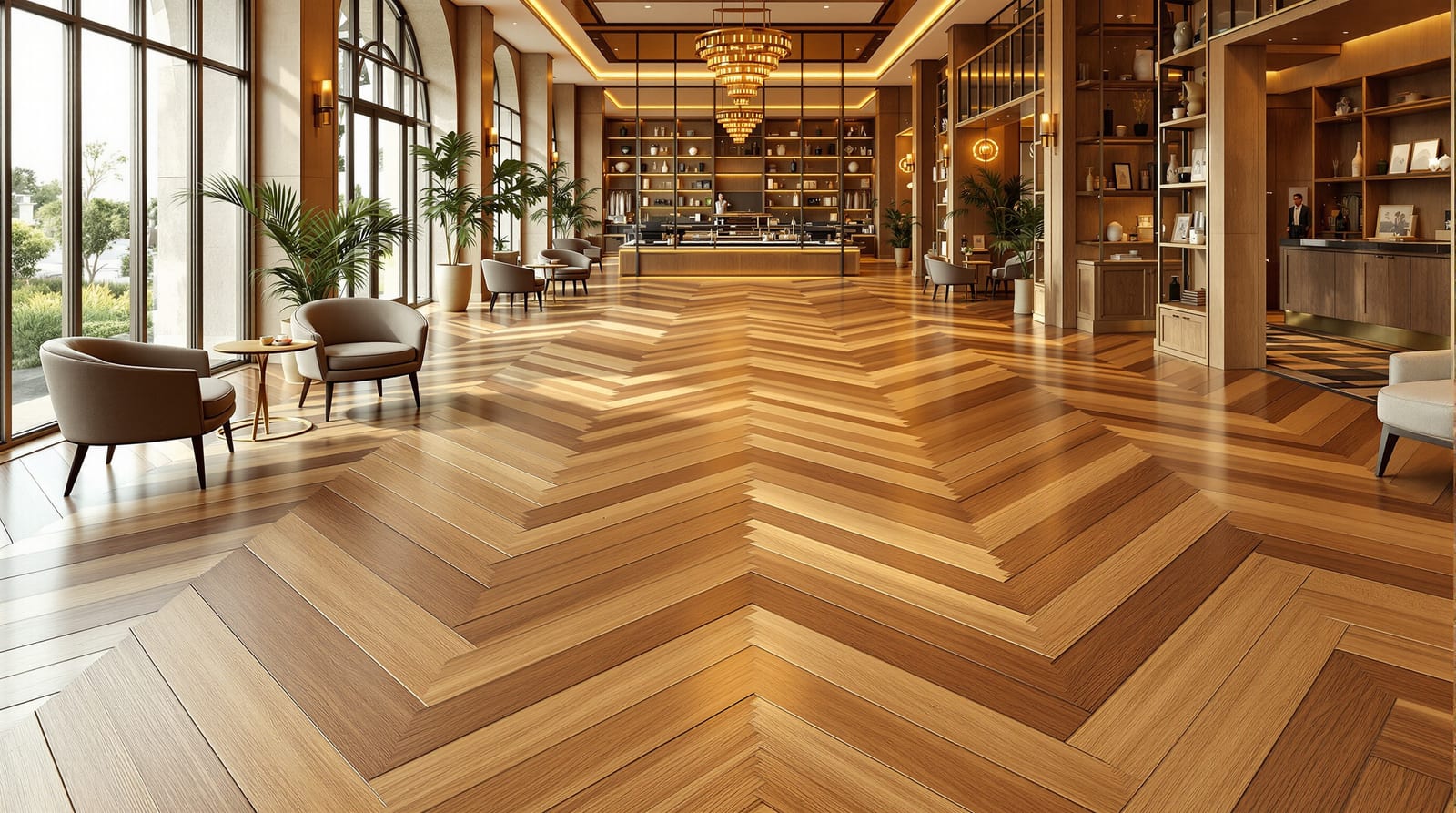
Chevron Flooring in India: The Angle-Cut V Pattern, Cost & Install Guide
Why chevron's continuous V costs more than herringbone, the materials and angles that work, and where the sleek directional look pays off in Indian homes.
Chevron is the sleekest, most directional way to lay a wood or plank floor: every board is cut at an angle so the two halves meet in a crisp, unbroken V that runs the length of the room like an arrow. It is the floor you see in European palaces and high-end boutiques, and it is now arriving in Indian luxury homes — but it asks for more material, more skill and more money than the herringbone it is constantly confused with. This guide explains exactly what makes chevron different, what it costs to lay in India, and where the look earns its premium.
Chevron vs herringbone: the difference that matters
People use the two names interchangeably, but they are genuinely different patterns and the distinction decides cost, look and labour.
In herringbone, the planks are ordinary rectangles with square-cut (90-degree) ends. They are laid in an interlocking L, where the end of one plank butts against the side of the next. The result is a broken, woven zig-zag with a slight step at every join. It is forgiving, classic and the off-cuts are reusable, so wastage is modest.
In chevron, the planks are cut at an angle on each end — usually 45 or 60 degrees — so that two planks join end-to-end and meet in a continuous, mitred point. Run those points down the room and you get an unbroken V, a series of perfect arrows, with a clean spine line where the two sides meet. There is no step and no offset: it reads as one sharp, geometric ribbon.
So the one-line rule: herringbone is square-cut rectangles in a broken zig-zag; chevron is angle-cut planks meeting in a continuous point. Chevron looks more formal, more modern and more "designed"; herringbone looks more classic and traditional. Because chevron needs angled cuts and a dead-straight spine, it costs and wastes more. If you are weighing the two, read our dedicated herringbone flooring guide alongside this one — the section below tells you when to pick which.
What chevron is made from
Chevron is a laying pattern, not a material, so you can have it in several finishes. The look and budget change dramatically with what you choose.
- Engineered wood / parquet is the classic and best choice. Factory-bevelled engineered planks (a real-wood wear layer on a plywood/HDF core) hold their angle cut, resist Indian humidity far better than solid wood, and many ranges sell pre-mitred chevron planks ("left" and "right" boards) ready to lay. This is what you see in premium European-style interiors. See our engineered wood flooring guide and the broader parquet flooring guide.
- Laminate, SPC and LVT now come in chevron-format planks too, often as a clickable factory chevron at a fraction of wood's cost. SPC (stone-polymer core) and LVT are dimensionally stable and waterproof, which suits Indian apartments and monsoon humidity. Compare in our luxury vinyl tile (LVT) guide.
- Tile, stone and brick can be cut to a chevron too — rectangular vitrified tiles or stone strips mitred at 45 degrees give a hard-wearing, water-tolerant chevron for living rooms, lobbies and cafes. This needs a skilled mason and increases tile wastage.
Materials and wastage at a glance
The table below sets chevron material choices against the property that matters most for this pattern — wastage and skill — and a realistic 2026 India supply-plus-laying figure. Costs are indicative and vary by city, brand and vendor; add 18% GST.
| Chevron material | Supply ₹/sq ft | Laying ₹/sq ft | Wastage allowance | Skill / notes |
|---|---|---|---|---|
| Engineered wood (pre-mitred chevron) | 250-700 | 90-180 | 10-15% | Specialist; spine line critical |
| Engineered wood (site-mitred) | 200-550 | 120-220 | 15-25% | High skill; on-site angle cutting |
| Laminate chevron (clickable) | 90-220 | 50-110 | 8-12% | Factory chevron, easier |
| SPC / LVT chevron | 110-300 | 60-130 | 8-12% | Waterproof, dimensionally stable |
| Vitrified tile, mitre-cut | 60-180 | 90-180 | 18-30% | Mason cuts each angle; high waste |
| Natural stone strip, mitre-cut | 120-400 | 120-250 | 20-35% | Highest waste; very skilled |
Two themes run through that table. First, chevron almost always carries a higher wastage allowance than herringbone (which typically runs 10-15%), because every angled off-cut is harder to reuse — the more you site-cut, the more you waste. Second, labour is a bigger share of the bill than for a straight or even herringbone floor, because the installer is mitring, aligning a spine and tolerating zero drift. Budget 20-35% more overall than the same material laid straight.
The angles: 45 vs 60 degrees
Chevron is defined by its cut angle, and you have two common choices:
- 45-degree chevron gives the steepest, sharpest, most dramatic V — a tight arrow. It is the most popular and most "graphic" look, and it suits modern, minimalist and luxe interiors.
- 60-degree chevron produces a gentler, longer, more elongated V that stretches the room visually and feels a little softer and more traditional. It uses slightly longer angle cuts.
Either way, the two boards meeting at the spine must add to a straight line — so a 45-degree cut meets another 45-degree cut to form the point. Factory chevron planks come pre-cut to a fixed angle, so you choose the angle when you choose the product. Site-mitred wood or tile lets you pick the angle but multiplies the skilled cutting.
How chevron is set out and installed
A chevron floor lives or dies on its set-out, because the eye instantly catches any wobble in that long central spine. A good installer plans before laying a single plank.
Left and right planks
Unlike herringbone, where every plank is identical, chevron needs two mirror-image planks — "left-cut" and "right-cut". One side of the V is built from left planks, the other from right planks. Pre-mitred chevron product is sold in equal left/right counts; if you site-cut, the installer mitres both directions. Mixing them up breaks the point.
The spine line
The installer snaps a chalk centreline (the spine) down the room — usually along the longest sightline or the line you walk in through the main door. The first row of left and right planks is dry-laid against this line to form the first run of points, and every subsequent course follows it. If the spine drifts even a few millimetres, the V skews and the error compounds across the floor, so the spine is checked constantly with a long straightedge and laser.
Build-up and subfloor
Chevron is unforgiving of an uneven base. The screed or subfloor must be flat (typically within 3 mm over 2 m) and dry before laying — see our floor screed and mortar bed guide. Engineered chevron is glued down or clicked over an underlay; tile and stone chevron is laid on a mortar/adhesive bed by a mason. Below is the geometry that makes chevron different from herringbone.
Where chevron suits Indian homes
Chevron rewards spaces where the directional pull and the sense of length actually do something:
- Luxury living and dining rooms — chevron in engineered oak or walnut is a signature luxe move; lay the V along the room's main axis to lengthen it. See our living room flooring guide.
- Feature floors and entrance halls — a chevron run leading from the door draws the eye in and reads as bespoke craftsmanship.
- Boutiques, cafes, salons and hospitality — the pattern photographs beautifully and signals premium; here SPC/LVT or tile chevron handles footfall and spills.
- Long corridors and open-plan apartments — the elongating V makes narrow or long rooms feel intentional rather than awkward.
Where to think twice: very small or busy rooms (the pattern gets lost), wet zones in solid wood (use SPC, LVT or tile chevron instead), and tight budgets — straight-laid or herringbone gives more floor for the money. For the full menu of pattern and specialty floors, see our specialty flooring pillar guide, and to estimate planks and wastage for a chevron layout, use our tile pattern calculator.
Chevron vs herringbone: which to pick
| If you want... | Choose |
|---|---|
| A sharp, modern, directional luxe look | Chevron |
| A classic, traditional, woven look | Herringbone |
| Lower wastage and easier laying | Herringbone |
| A continuous unbroken V / strong sightline | Chevron |
| To stretch a long or narrow room | Chevron (lay along axis) |
| Best value for the same material | Herringbone |
| To DIY with clickable planks | Either (factory format) |
Both are premium patterns over a straight lay; chevron sits at the top for drama and cost. If budget or skilled-labour availability is tight, herringbone delivers most of the impact for less — read the herringbone flooring guide and the parquet flooring guide before deciding.
Frequently asked questions
Is chevron flooring more expensive than herringbone in India?
Yes. Chevron needs angle-cut (mitred) planks and a perfectly aligned spine, which raises both wastage (often 15-35% versus 10-15% for herringbone) and skilled labour. Expect to pay roughly 20-35% more overall than the same material laid in herringbone, and far more than a straight lay.
What is the difference between chevron and herringbone?
Herringbone uses square-cut rectangular planks laid in an interlocking, broken zig-zag with a slight step at each join. Chevron uses angle-cut planks that meet end-to-end in a continuous, unbroken V point. Chevron looks sleeker and more modern; herringbone looks more classic and is cheaper to lay.
Which material is best for chevron flooring in Indian homes?
Engineered wood or pre-mitred parquet for the authentic luxe look in dry living and dining areas; SPC or LVT chevron for waterproof, humidity-stable, lower-cost floors and high-traffic or boutique spaces; mitre-cut vitrified tile or stone where you need maximum durability and water tolerance.
Does chevron flooring make a room look bigger?
It can. Running the continuous V along the room's longest axis draws the eye down its length and makes a long or narrow space feel intentional and elongated. In very small or cluttered rooms, though, the bold pattern can feel busy, so it works best in generous, open spaces.
Can chevron flooring be installed as a DIY project?
Factory chevron in clickable laminate, SPC or LVT is the most DIY-friendly, since the planks come pre-mitred as matched left and right pieces. Even then, snapping and holding a dead-straight spine line is the hard part. Site-mitred wood, tile or stone chevron should always be left to a skilled installer.
Export this guide
Related Guides — Deep-dive reading
Herringbone Flooring in India: The Zig-Zag Pattern in Wood, Laminate, SPC, Tile and Brick, with Wastage, Labour and Cost
Herringbone is the timeless zig-zag pattern that sets rectangular planks at 90 degrees to make a room feel bigger and grander — here is how the pattern works in wood, laminate, SPC, LVT, tile and brick, the +15 to 20 percent wastage and higher labour it adds, and the rupee premium over straight-lay.
Flooring & SurfacesFlooring Cost in Pune 2026: Installed Price per Sq Ft by Material
What flooring really costs in Pune in 2026 — installed per-square-foot rates for vitrified, granite, marble, wood-look laminate, SPC and vinyl, why Pune usually runs cheaper than next-door Mumbai, popular choices in Pune's flat and villa market, the Shahabad-stone regional note, and a worked 2BHK estimate.
Flooring & SurfacesFlooring Materials Explained: Every Type for Indian Homes (2026)
One scannable reference to every flooring material family — tiles, natural stone, wood, resilient and seamless — with look, durability, water resistance, ₹/sq ft cost band and where each suits Indian homes.
Flooring & SurfacesRelated Tools — Try Free
Tile Pattern Calculator
Choose a tile-laying pattern and estimate tiles, boxes and the pattern's wastage — straight, brick, diagonal, herringbone.
Flooring ToolParquet Flooring Calculator
Estimate parquet or patterned wood flooring and cost, with herringbone and chevron pattern wastage.
Flooring CalculatorHealing View Impact Calculator
Evidence-Based Design dashboard quantifying the recovery impact of nature view + daylight factor on analgesic use, length of stay, and HCAHPS patient-experience uplift. Calibrated against Ulrich 1984 (Science), Park & Mattson 2008, and the CHD EBD evidence base.
EBD Calculator