
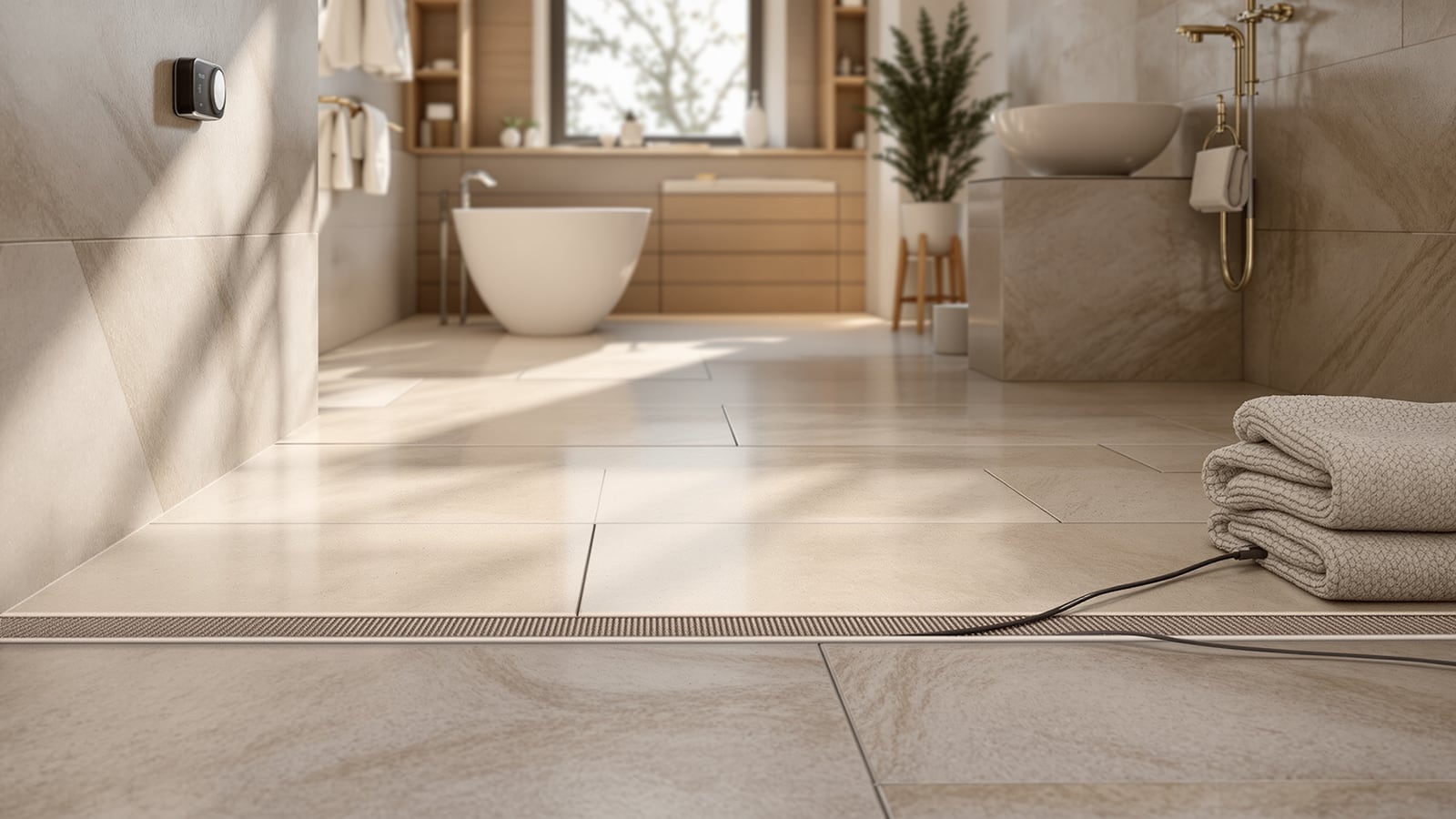
Heated Bathroom Floor India: Underfloor Heating Under Tiles, Cost & When It's Worth It
An honest guide to electric underfloor heating for Indian bathrooms — how the heating mat under tiles works, where it actually makes sense (hill stations and cold north winters), thermostats, running cost and load, how it interacts with waterproofing, and real rupee budgets.
Stepping onto an icy stone floor at 6 a.m. in a Shimla or Manali winter is the kind of small misery that a heated bathroom floor quietly abolishes. Underfloor heating — an electric mat buried under your tiles, controlled by a thermostat — keeps the floor gently warm underfoot and takes the chill off the whole room. It is common in cold countries and, in India, it is a genuine comfort upgrade in the right place.
Let us be honest from the start: for most of India, a heated bathroom floor is a niche luxury item, not a necessity. In Chennai, Mumbai or Bengaluru you will switch it on for perhaps a fortnight a year, if ever. Where it earns its keep is the hill stations, the cold north-Indian winter belt, and premium homes where warmth-underfoot is part of the experience. This guide explains exactly how it works, where it makes sense, what it costs to install and to run, and — crucially for India — how it interacts with your bathroom waterproofing so you do not trade warm feet for a leaking slab.
This is a component guide in the Studio Matrx bathroom hub. For choosing the tile or stone that sits on top, read the bathroom flooring guide for India. If you are specifying a warm floor as part of a high-end scheme, see the luxury bathroom design guide and the spa bathroom design guide, where warmth underfoot is one of the senses that make a room feel restorative.
A heated floor is a comfort luxury, not a heating necessity — worth it in a cold hill-station or a premium spa bathroom, hard to justify in coastal or peninsular India. Decide by climate first, budget second.
How electric underfloor heating actually works
The system most Indian bathrooms use is electric radiant heating — not water pipes. A thin, self-adhesive mat carrying a heating cable (like a very fine electric element woven onto a mesh) is rolled out across the floor, embedded in tile adhesive or a thin screed, and tiled over. When you switch it on, the cable warms the tile bed, the tiles radiate gentle heat upward, and the floor surface sits at a pleasant 24-29°C instead of a bone-cold 12-15°C.
There are two families of system:
- Electric (dry) systems — a heating mat or loose cable under the tiles, run off a normal wall thermostat. Low install cost, easy to retrofit in a single room, ideal for one or two bathrooms. This is what almost everyone in India uses.
- Hydronic (wet) systems — warm water circulated through pipes in the floor from a boiler or heat pump. Cheaper to run over very large areas and whole floors, but expensive and disruptive to install, and overkill for a single bathroom. Rare in Indian homes outside large hill-station villas.
For a bathroom, electric wins on almost every count: lower capital cost, thinner build-up (important when you cannot raise the floor much), zone-by-zone control, and simple wiring. The trade-off is running cost per unit of heat — but a bathroom is small and used briefly, so the electric bill stays modest.
The layers, bottom to top
An electric heated bathroom floor is a sandwich. Getting the order right — especially where the waterproofing sits — is what separates a warm, dry floor from an expensive repair.
The single most important rule for India: the waterproofing membrane goes below the heating layer, never above it. The heat cable lives in the tile adhesive above a fully waterproofed, sloped bed. That way the membrane still does its job of keeping water out of the slab, and the cable stays in the drier zone just under the tile. We come back to this because it is where Indian installs most often go wrong.
Where a heated floor actually makes sense in India
India is not one climate, and this decision is almost entirely about climate plus how much cold-weather use the room really gets. Here is an honest map.
| Location / climate | Winter floor temp | Verdict | Notes |
|---|---|---|---|
| Hill stations — Shimla, Manali, Mussoorie, Nainital, Gangtok, Ooty | Very cold, 4-12°C | Worth it | The clearest case; used daily for months |
| Cold north plains — Delhi NCR, Punjab, Chandigarh, Lucknow | Cold Dec-Feb | Situational | 6-10 weeks of use; nice-to-have in a premium home |
| Jammu, Himachal & Uttarakhand valley towns | Cold winters | Worth it | Long, damp-cold winters reward it |
| Coastal & peninsular — Mumbai, Chennai, Goa, Kerala | Never cold | Skip it | You will almost never switch it on |
| Bengaluru, Pune, Hyderabad | Mild, brief cool spells | Luxury only | Only as a spa/premium indulgence |
| North-east hills — Shillong, Tawang, Darjeeling | Cold, very damp | Worth it | Warmth also helps dry the room |
Two honest caveats. First, a heated floor warms the floor, not the whole room like a heater does — it takes the chill off and feels wonderful underfoot, but in a genuinely freezing bathroom you may still want a wall-mounted heater or heat lamp too. Second, if you only need warmth for a few weeks a year, a good bathmat and a portable heater cost a few hundred rupees and no rewiring — be sure the comfort is worth the capital before you commit.
Thermostat and controls
The thermostat is the brain, and in a bathroom it is also a safety-critical electrical device. Do not economise here.
- Floor sensor is essential. A good thermostat reads a probe embedded in the floor (not just air temperature), so it targets a comfortable surface temperature and never overheats stone or the cable.
- Programmable / timer. Set it to warm the floor for 30-45 minutes before your morning and evening use, then idle. This is the single biggest lever on running cost — heating an empty bathroom all day is pure waste.
- Smart / app control lets you switch on from bed or on the drive home. Useful, not essential. If you are building a connected home, coordinate it with your other systems as covered in the smart bathroom guide.
- Mounting and IP. The thermostat unit goes outside the wet zone or in a splash-safe location; the mat and sensor are inside the floor. Wire everything through a dedicated circuit with an RCCB / earth-leakage protection (30 mA) per IS 732 — a heating cable in a wet room without earth-leakage protection is not negotiable.
A gentle floor is a warm floor, not a hot one. Aim for a surface setpoint around 25-27°C; stone and porcelain feel warm at that, and you avoid cracking adhesive or wasting power chasing a higher number.
Running cost, electrical load and the honest bill
This is where people either relax or reconsider. Electric underfloor heating draws a defined wattage per square metre, and a bathroom is small, so the numbers are manageable.
- Typical mat rating: 120-150 watts per square metre of heated floor.
- A heated area of, say, 2.5 sq m (you heat the walking area, not under the WC or vanity) at 150 W/sq m = ~375 W connected load — less than a hair dryer.
- Because a good thermostat cycles the cable on and off to hold temperature, actual consumption is roughly 40-60% of the connected load over a heating session, not 100%.
| Item | Figure | What it means |
|---|---|---|
| Heated area (typical bathroom) | 2-3 sq m | Only the walking zone is matted |
| Connected load | ~300-450 W | Small; fits an existing bathroom circuit with headroom |
| Real use per day (winter) | ~1.5-2 hours effective | With a timer, not all-day running |
| Units per day | ~0.5-0.8 kWh | Roughly the same as a ceiling fan running all day |
| Cost per winter month | ₹150-350 | At ₹7-9 per unit; only in cold months |
| Annual running cost (hill station) | ₹600-1,500 | Used across the winter season |
So the running cost is small and seasonal. The real spend is the installation, and the real risk is doing the waterproofing wrong. Also confirm your bathroom circuit and the flat's sanctioned load have room for the extra draw — in an older apartment on a tight connection, add it to a properly rated circuit rather than piggy-backing on the geyser line.
Waterproofing: the make-or-break interaction
In India, no bathroom decision can ignore water. A heated floor adds an electrical element into the wettest room in the house, so the waterproofing detail is not optional polish — it is the whole ballgame. Read the bathroom waterproofing guide alongside this; here is how the two systems must cooperate.
Practical rules that keep both systems honest:
- Waterproof first, then heat. Complete and cure the membrane over a properly sloped bed, flood-test it, and only then lay the heating mat in the tile adhesive above it. Never let a cable puncture or sit below the membrane.
- Keep the fall to the drain. Underfloor heating does not excuse a flat floor. You still need the slope so the health-faucet and shower water reaches the trap; the mat follows the same fall.
- No cable under fixed items. Do not run the mat under the WC, vanity or shower tray footprint — only under open, walked-on floor. This saves power and avoids trapping heat.
- Test the mat's resistance three times — before laying, after laying, and after tiling — and record it. A break introduced during tiling is far cheaper to catch before the grout goes in.
- Use a flexible, heat-rated tile adhesive, not sand-cement mortar, so thermal movement does not debond tiles over the cured membrane.
Because a heated floor buries an element you cannot easily reach, it belongs in a new build or a full renovation, planned from the slab up — not as a bolt-on to a finished bathroom.
Install during renovation, not after
The only sane time to add a heated floor is when the floor is already open — a new home or a down-to-the-slab bathroom renovation. Retrofitting into a finished bathroom means demolishing the tiles and screed anyway, so fold it into work you were doing regardless. See the bathroom renovation guide for India for sequencing.
A sensible order of work:
1. Strip to slab; form the correct slope to the drain in the screed.
2. Apply and cure the waterproofing membrane; flood-test 24-48 hours.
3. Run the dedicated RCCB-protected electrical circuit and thermostat back-box.
4. Lay the heating mat over the cured membrane in the walking zone; set the floor sensor in a conduit between loops so it can be replaced.
5. Test cable resistance; embed in flexible adhesive.
6. Tile, grout, and only then power up — never run a cable to cure adhesive faster.
Cost: the honest rupee picture
Prices vary by brand, area and city, but this is a realistic 2026 range for a single Indian bathroom. Treat the mat and the labour as the fixed costs and the thermostat as where you can spend up.
| Item | Budget | Typical | Premium |
|---|---|---|---|
| Heating mat / cable (per sq m) | ₹1,800 | ₹3,000 | ₹5,000+ |
| Thermostat with floor sensor | ₹3,500 | ₹7,000 | ₹15,000 (smart) |
| Electrical circuit + RCCB + labour | ₹3,000 | ₹5,000 | ₹8,000 |
| Install / tiling premium (over normal) | ₹2,000 | ₹4,000 | ₹7,000 |
| Total for ~2.5 sq m heated bathroom | ~₹15,000 | ~₹28,000 | ~₹50,000+ |
So a warm bathroom floor is roughly a ₹15,000-50,000 addition, done once, plus a few hundred rupees a month to run in winter. In a hill-station home used daily for months, that is money well spent. In a coastal flat you might switch on twice a year, it is money better kept — put it toward the tile, the ventilation, or the waterproofing that every Indian bathroom actually needs.
The maths is simple: cheap to run, meaningful to install, only worth it where winters are genuinely cold. Let the climate, not the brochure, make the call.
References
- National Building Code of India (NBC) 2016, Part 8 (Building Services) — electrical installations and general safety in wet areas.
- IS 732 — Code of practice for electrical wiring installations; earth-leakage (RCCB) protection for bathroom circuits.
- IS 15622 — Pressed ceramic tiles; and IS 13630 — methods of test for ceramic tiles (thermal and adhesion properties) for the finished floor.
- IS 3043 — Code of practice for earthing, relevant to electrical safety of the heating circuit.
- Bureau of Indian Standards (BIS) — for current IP-rating and appliance-safety marking on imported heating mats and thermostats.
Export this guide
Related Guides — Deep-dive reading
Underfloor Heating in India: Electric vs Hydronic Warm Floors for Hill Stations and North Indian Winters
The two systems explained, which floor finishes actually conduct the heat, the build-up layers under your tile, real install and running costs in rupees, and the handful of cold Indian regions where underfloor heating genuinely earns its place.
Flooring & SurfacesHeated Towel Rail India: Electric Towel Warmers, Running Cost, Wiring & When It's Worth It
An honest guide to heated towel rails for Indian bathrooms — electric versus hot-water types, warm dry towels plus the genuine humid-climate bonus of helping dry a damp room and fight mould, where it makes sense, wattage and running cost, IP and RCD wiring, sizes, mounting and real rupee budgets.
BathroomsBathroom Planning for New Homes in India: Get It Right Before You Build
The bathroom decisions you cannot undo once the slab is cast — location and stacking, sunken vs non-sunken slabs, waterproofing, and the plumbing, electrical and ventilation you must coordinate with the civil work, stage by stage.
BathroomsRelated Tools — Try Free
Electrical Safety & Load Audit
Home electrical audit — 10 categories, 65+ checkpoints across earthing, RCCB, MCB, wiring, switchboards, appliance circuits, DG/inverter backup.
Safety AuditBathroom Renovation Cost Calculator
Cost to renovate an existing bathroom with a replace-vs-keep model — demolition, re-waterproofing, tiles, fittings and the money saved by keeping items.
Bathroom CalculatorCross-Ventilation Analyzer
Estimate airflow and air changes per hour (ACH) from room size, window areas, layout, and local wind — with NBC 2016 Part 8 compliance check.
Ventilation Calculator