
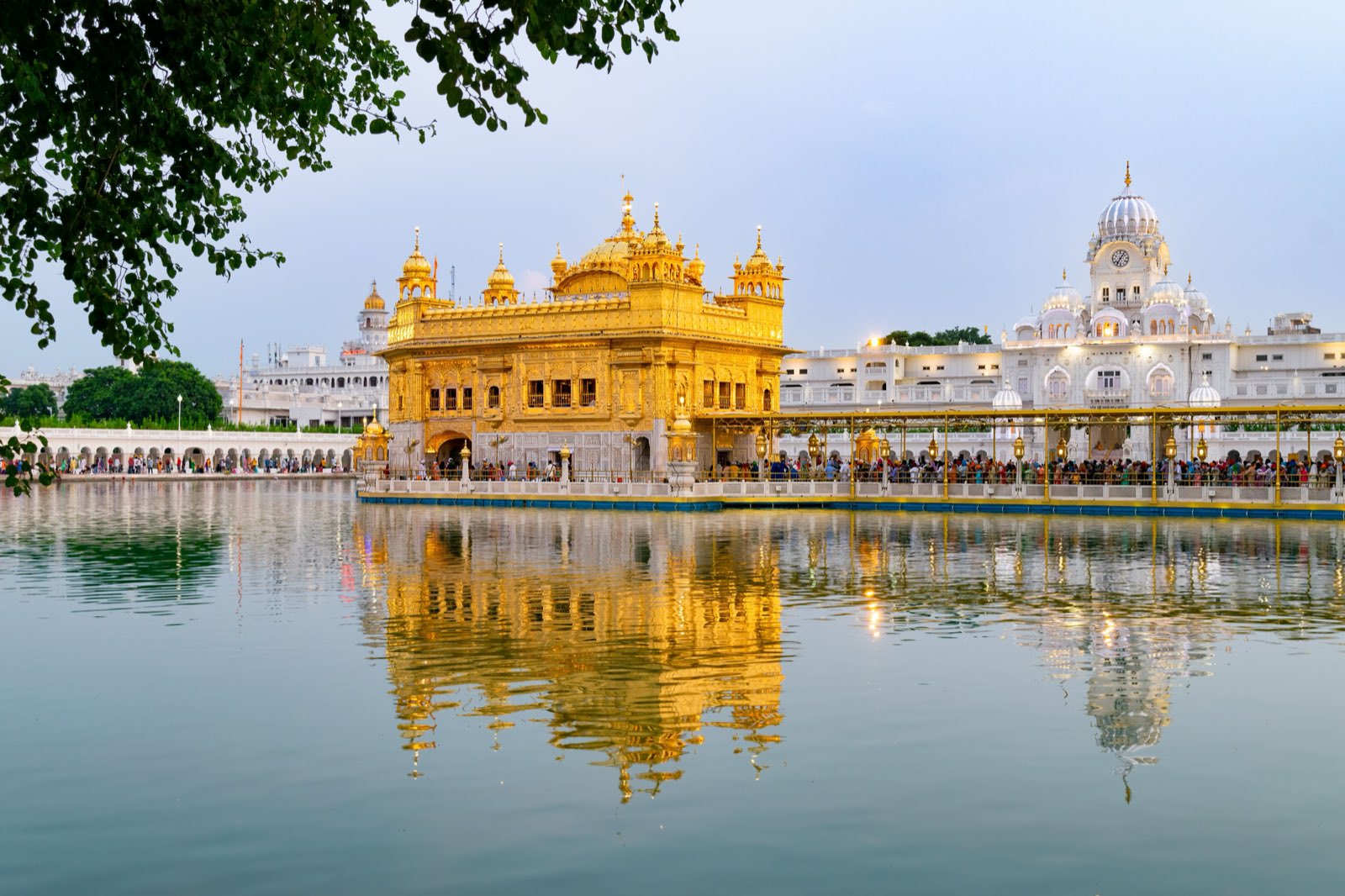
The Golden Temple: The Shrine That Opens on All Four Sides
How the Harmandir Sahib at Amritsar turns Mughal and Rajput forms to a wholly different spirit — a gilded sanctum set low on a pool, open in every direction as a built statement that all are welcome.
There are grander buildings in India and there are older ones, but there are few more moving to stand before than the Harmandir Sahib at Amritsar — the Golden Temple. A small, gilded sanctum sits alone on an island in the middle of a vast, still tank, reached by a single marble causeway, and doubled perfectly in the water below it. It does not tower. It does not overwhelm. It glows, low over the pool, and it is — by deliberate design — open on every side.
That openness is the whole point, and it makes the Golden Temple a fascinating close to the first batch of Indian monuments in our Architectural Wonders series. The Mughals, at Fatehpur Sikri and the Taj Mahal, used the dome, the arch, the marble and the inlaid stone to express imperial magnificence. Here the very same architectural vocabulary is turned to the opposite spirit — to humility, welcome and equality. Same forms; different soul. Understanding how a building says that is worth an essay.
1. A sanctum on the water
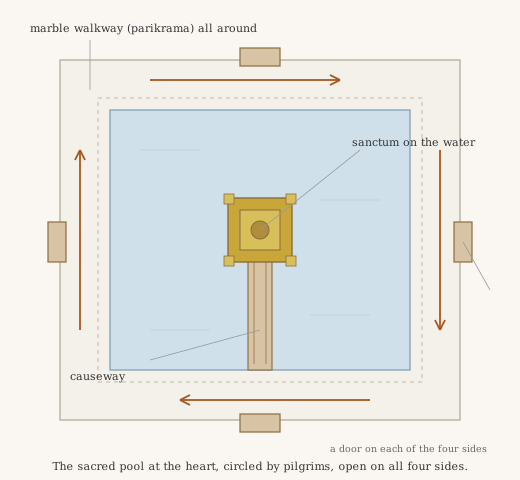
The Golden Temple is not really a building in a courtyard; it is a building in a lake. The whole complex is organised around a great rectangular sacred pool — the sarovar, the "Pool of Nectar" that gives the city Amritsar its name.
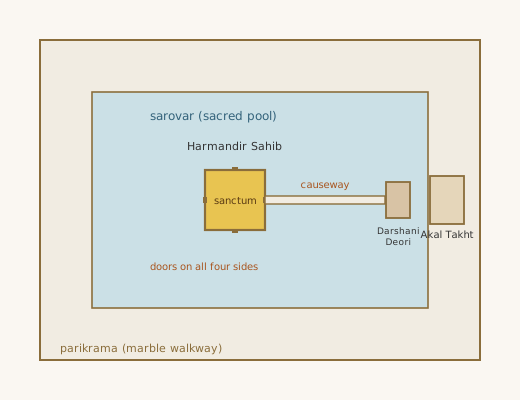
Around the pool runs a broad white-marble walkway, the parikrama, from which pilgrims descend to bathe. The sanctum itself, the Harmandir Sahib, stands on a small island at the centre, connected to the walkway by one narrow causeway — the Guru's Bridge — passing through an ornamental gateway, the Darshani Deori. Facing the sanctum across the water stands the Akal Takht, the seat of the community's temporal authority — so that the plan sets the spiritual centre and the worldly centre in a deliberate dialogue across the pool. Everything — the approach, the bathing, the circumambulation, the single glowing focus at the centre — is composed around water.
2. Four doors, and what they mean
Now the detail that matters most, and that no photograph quite explains. A Hindu temple has one door, facing the deity in the dark sanctum. A mosque is oriented decisively toward Mecca. The Harmandir Sahib has four doors, one on each side, open to the four directions — and it is meant to be understood exactly as it looks.
The four openings are a built declaration that the shrine — and the faith — is open to everyone, from every direction, of every caste and creed. You may approach and enter from any side; no direction is privileged, no one is turned away. It is one of the clearest examples in all of architecture of a plan that is also an ethic — where a decision about openings is a statement about who belongs. Where the Qutb Minar used height to declare power, the Golden Temple uses openings to declare welcome.
3. The form — Mughal dome, Rajput kiosk, Sikh spirit
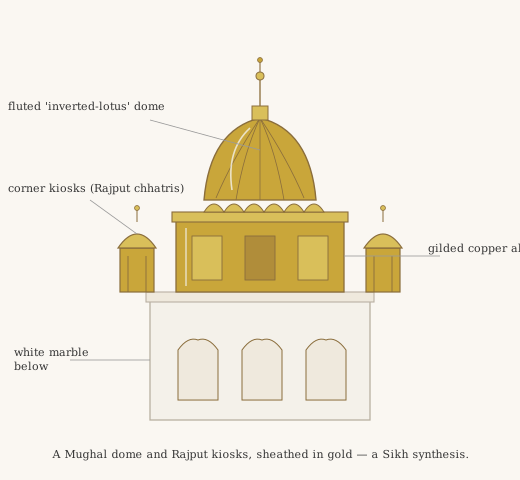
Look closely at the sanctum and you can read the two great courtly traditions of the age fused into a new one.
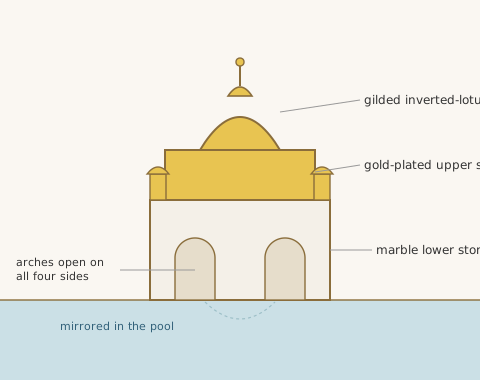
The lower storey is white marble, opening in cusped arches and inlaid with pietra dura floral work — the delicate stone-inlay craft of the Mughals, the same art that flowers on the Taj. Above it, the upper storey and the crowning dome are sheathed in gilded copper — the gold that gives the temple its name, added in the early nineteenth century by the Sikh ruler Maharaja Ranjit Singh. The dome is not a plain hemisphere but a fluted, inverted-lotus form, and the roofline is punctuated by small domed chhatri kiosks at the corners — the pavilion vocabulary of Rajput architecture. Mughal inlay, Rajput kiosk, a lotus dome, and gold: the elements are borrowed, but their combination — serene, low, water-bound, gilded — is unmistakably and newly Sikh.
4. The architecture of humility and reflection
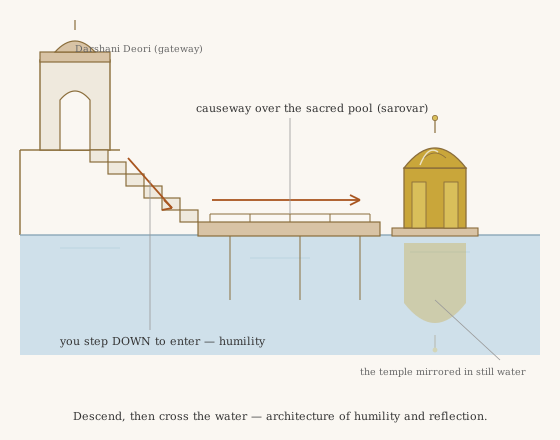
Here is the design move that inverts everything you have learned from the temples earlier in this series. At Khajuraho or Konark you climb a high platform to reach the god; ascent is the sacred gesture. At the Golden Temple you do the opposite: you descend the steps from the surrounding streets and walkway down toward the water to reach the shrine. The sanctum sits below the level of the city around it. To approach the holiest point, you go down — an architecture of humility built into the very section.
And then there is the water itself, doing quiet, constant work. The still surface of the sarovar doubles the gilded sanctum in a perfect reflection, so the building appears to float between a real gold above and a shimmering gold below; the light bouncing off the pool animates the marble and the metal all day. The serenity everyone feels there is not an accident of mood — it is engineered, out of reflection, low horizontals and gold. Around it, the enormous langar, the free community kitchen that feeds tens of thousands of all faiths every day, extends the same idea into daily life: architecture as an instrument of equality.
5. A shrine rebuilt again and again
The complex grew under the Sikh Gurus: Guru Ram Das had the sacred pool excavated in the later sixteenth century, and Guru Arjan completed the central temple and installed the Sikh scripture, the Adi Granth, within it around 1604 — the shrine built to house a book, the living word, rather than an image. Over the turbulent eighteenth century the temple was destroyed and desecrated more than once in Afghan invasions, and each time the community rebuilt it; the form we admire, and the gold, largely date from Ranjit Singh's restoration in the early 1800s. It is, in the deepest sense, a living monument — continuously worshipped, repeatedly rebuilt, never a ruin. It is not (yet) a UNESCO World Heritage Site, though it stands on India's tentative list and is among the most visited sacred places on earth.
6. What a modern architect can learn from the Golden Temple
- A plan can be an ethic. Four doors instead of one is not a structural decision; it is a moral one made in stone. The way you place an opening, a threshold, an entrance says who is welcome — design it as if it means something, because it does.
- Borrow forms, and change their spirit. The Golden Temple uses the Mughals' own dome, arch and inlay — and makes something humble and open out of a vocabulary built for empire. What matters is not where a form comes from but what you make it say.
- Design downward, not always upward. By setting the sanctum below the city and making you descend to it, the building turns the usual sacred gesture on its head and expresses humility in pure section. The direction of movement is a design tool.
- Build with water and reflection. Half of the Golden Temple's power is in the pool — the doubling, the light, the calm. Water is not landscape decoration around a building; it can be the building's other half.
- Engineer serenity. The peace people feel there is produced by specific, repeatable moves — low horizontals, a single glowing focus, still water, warm metal. Atmosphere is not luck; it is a designable outcome.
The Golden Temple closes this first group of Indian wonders by making the series' recurring point from an unexpected direction: one clear idea, carried without compromise. Here the idea is not a mountain or a chariot or an empire — it is openness itself, built as a gilded room on the water with a door on every side.
References & further reading
1. Encyclopaedia Britannica — Golden Temple (Harmandir Sahib), Amritsar. https://www.britannica.com/topic/Golden-Temple
2. UNESCO World Heritage Centre — Tentative Lists: India (Golden Temple / Sri Harimandir Sahib). https://whc.unesco.org/en/tentativelists/
3. Shiromani Gurdwara Parbandhak Committee (SGPC) — Sri Harmandir Sahib. https://sgpc.net/sri-harmandir-sahib/
4. Punjab Tourism — Golden Temple, Amritsar. https://punjabtourism.punjab.gov.in/
Last verified 2026-07-04. Dates, attributions and the phasing of construction follow standard historical and reference sources and are given as widely accepted approximations; the excavation of the pool under Guru Ram Das, the completion and installation of the Adi Granth under Guru Arjan around 1604, the repeated eighteenth-century destruction and rebuilding, and the gilding under Maharaja Ranjit Singh follow the established historical record; the Golden Temple is on India's UNESCO tentative list and is not (as of writing) an inscribed World Heritage Site.
Export this guide
Related Guides — Deep-dive reading
The Golden Temple Precinct Upgrades: Designing the Approach to a Sacred Centre
Across the 2010s a cluster of projects — the white-marble entrance plaza, the 1.1 km pedestrianised Heritage Street, and the older Galliara corridor — rebuilt the ground around Amritsar's Harmandir Sahib. Together they pose one of the hardest questions in contemporary architecture: how do you redesign the setting of a living shrine for millions of pilgrims without erasing the city that made it sacred?
The Future of ArchitectureĠgantija: The Oldest Temple Standing, Built by 'Giants'
How a Neolithic island people on Malta — with no metal and no wheel — raised the oldest free-standing stone temples on Earth a thousand years before Stonehenge or the pyramids, moving fifty-tonne blocks on stone balls into clover-leaf sanctuaries for a faith we can trace but cannot read, then vanished, leaving stones so vast that later islanders swore only giants could have built them.
Architectural WondersThe Mud Mosques of Timbuktu: The University Made of Earth
On the edge of the Sahara, a city that Europe turned into a byword for the middle of nowhere was in truth one of the great centres of learning in the medieval world — with a university of 25,000 students and libraries of hundreds of thousands of manuscripts. Its three great mosques are built entirely of mud, bristling with wooden beams, and must be re-plastered by the whole community every single year — which is exactly why, after seven centuries, they still stand.
Architectural WondersRelated Tools — Try Free
Full-Room BOQ — Living, Bedroom, Kitchen, Bath
Room-wise BOQ across living, bedrooms, kitchen, utility, and bathrooms with line-item pricing.
Full-Room BOQRainwater Tank Sizer
How big should your rainwater tank be? Computes annual harvest, recommended tank capacity in litres, water-bill savings, and payback — for 10 Indian cities.
RWH CalculatorHome Building & Interior Cost Calculator — 20 Cities
Construction + interior costs for 20 Indian cities across kitchen, wardrobes, flooring, painting, ceiling.
Cost Calculator