
Konark Sun Temple: The Chariot of the Sun, Carved in Stone
How 13th-century Odisha built a god a vehicle — a colossal stone chariot with wheels that still tell the time — and what its triumph, and its collapse, can teach a modern architect.
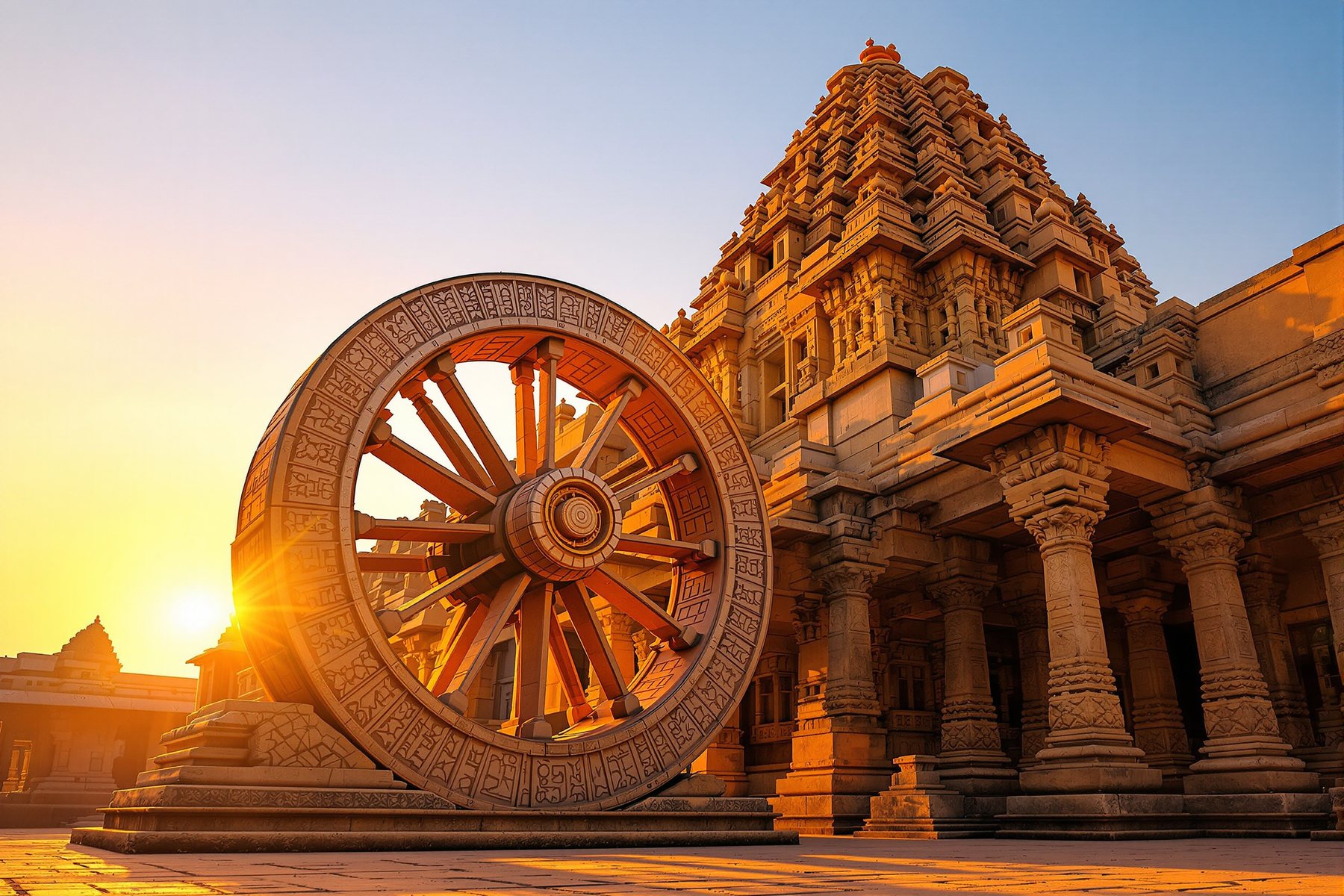
Stand on the Odisha coast a little before dawn and watch the first light come off the Bay of Bengal and strike the eastern face of Konark. The stone warms from grey to honey to rose. And the building you are looking at is not, in the imagination of the people who made it, a building at all. It is a chariot — a vast, galloping vehicle of stone, mounted on twenty-four carved wheels and drawn by seven straining horses, built to carry Surya, the sun god, across the sky. The sun did not visit a temple at Konark. The sun's own chariot was made permanent, in rock, on the shore it rises over.
This is the second article in our Architectural Wonders series, and it makes a deliberate pair with the first. Petra is architecture _subtracted_ — a city released from a single cliff. Konark is the opposite art: architecture _assembled_, stone deliberately stacked on stone until it became a mountain. One of these can never fall down. The other did. Both have a great deal to teach.
1. A temple shaped like a chariot
The temple was built around 1250 CE by King Narasimhadeva I of the Eastern Ganga dynasty, at the height of the Kalinga school of temple-building that flowered across Odisha. Its very name encodes its purpose: _Konark_ joins kona (corner or angle) and arka (sun). It was dedicated to Surya, and it was conceived not as a house _for_ the god but as the god's vehicle itself.
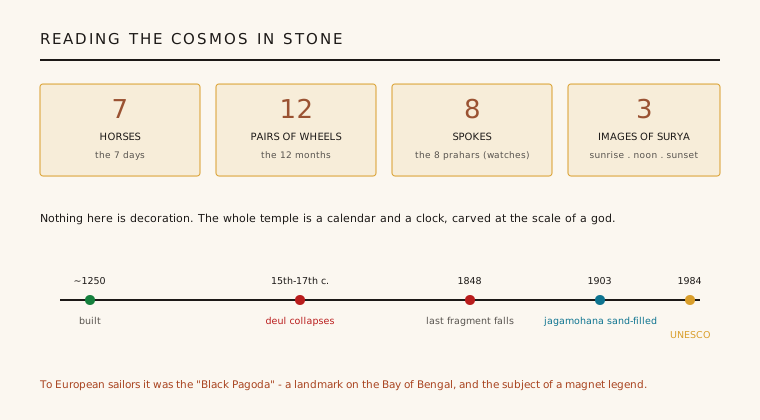
That single idea governs everything. The base of the temple is carved as a great chariot platform riding on twelve pairs of monumental wheels — twenty-four in all, each roughly three metres across — and out in front, hauling the impossible weight, stand seven powerful horses. Three images of Surya were set on the temple's sides so that, in the old understanding, each would catch the sun in turn — at its rising, at its noon, and at its setting.
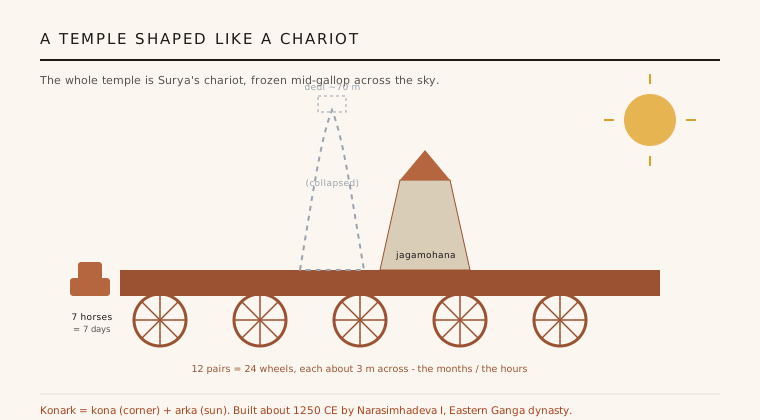
One idea, total commitment. The architecture, the sculpture, the orientation and the symbolism are not separate decisions — they are all the same decision, carved at the scale of a god.
2. The wheels that tell time
The wheels are the most famous thing at Konark, and the most quietly astonishing. They look, at first, like sublime decoration — and then you learn that they are working sundials, and the building changes in front of you.
Each wheel has eight major spokes and, set between them, eight minor spokes. The eight major spokes divide the day into eight prahars — the traditional three-hour watches of the Indian day. The minor spokes mark the ninety-minute midpoints. Around the rim, rows of carved beads subdivide each interval again, down to units of roughly three minutes. At the centre, the hub projects a short axle pin; as the sun moves, the pin throws a shadow across the spokes and beads, and a person who knows how to read it can tell the time of day to within a few minutes. Modern observers have checked the surviving wheels against a watch and found them startlingly accurate, nearly eight centuries on.
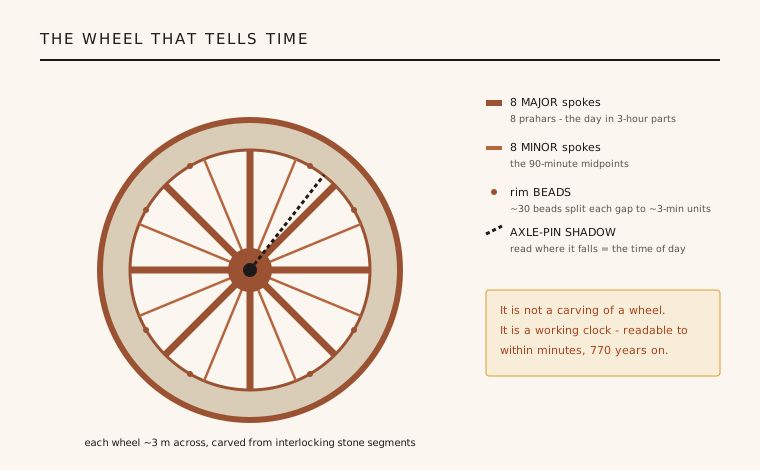
It is worth pausing on what this means. The Nabataeans at Petra engineered _water_; the Kalinga masons at Konark engineered _time_, and hid the instrument inside an object so beautiful that most visitors never realise they are looking at a clock. Each wheel, by the way, was not cut from one block — it was assembled from several interlocking stone segments, pinned with iron, and finished as a single seamless ring.
3. Built up, stone on stone
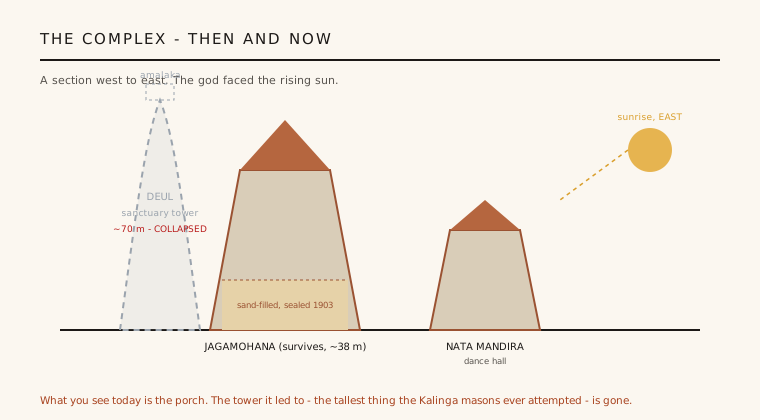
Konark is the masterwork of Kalinga architecture, the temple tradition of Odisha, and to understand the building you have to read its parts. A classic Kalinga temple is a procession of linked halls along an east-west axis: a nata mandira (dance hall), a jagamohana (assembly or audience hall) with a stepped pyramidal roof, and behind it the deul or rekha deula — the towering curvilinear sanctuary that holds the deity and soars highest of all.
The builders used three different stones, each for what it did best: khondalite, a coarse cream-to-grey rock, for the carved exterior; laterite, a porous iron-rich stone, for the heavy structural core; and fine dark chlorite for the most delicate sculpture and the doorframes. Remarkably, the khondalite was not local — it was quarried in the Odisha highlands and hauled some 170 to 200 kilometres to the coast. None of it grew there. Every block was a decision and a journey.
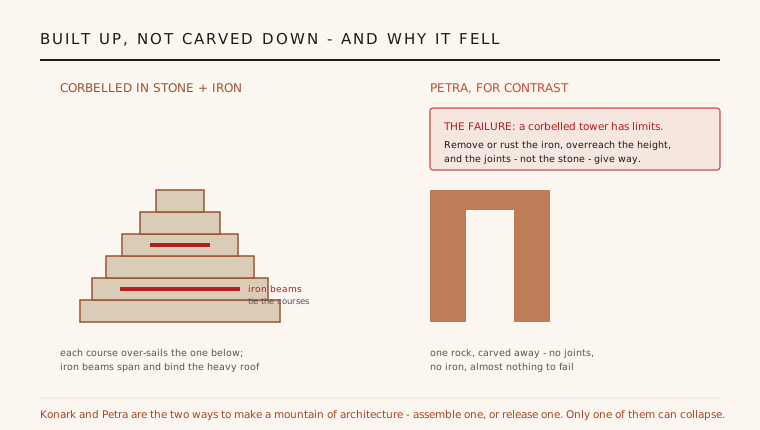
And here is the crucial structural fact, the one that ties Konark to the whole of this series. A Kalinga tower is corbelled: it has no true arch and no vault. Each course of stone is laid to over-sail the course below, stepping inward and inward until the courses meet at the top, and the whole heavy mass is tied and spanned with iron beams. It is a magnificent technique — and it has a ceiling. Push a corbelled tower too high, and the stresses at the joints, not the strength of the stone, become the limit.
4. The fall of the great tower
The deul at Konark was meant to be the tallest thing the Kalinga masons had ever raised — about seventy metres, the height of a modern twenty-storey building. Today it is gone. What survives is the porch in front of it, the jagamohana, and a detached dance hall; the sanctuary tower it led to has collapsed entirely.
Exactly when and why is debated, and the honest answer is _several reasons at once_. The deul came down somewhere between the 15th and 17th centuries; a last broken fragment of the main temple is recorded falling as late as 1848. Historians point to a combination of causes: the sheer structural ambition of a corbelled tower pushed near its limit, the removal or failure of the iron beams that bound the upper mass, weak foundations on sandy coastal ground, and very probably deliberate damage during periods of invasion.
Around that loss grew one of India's great architectural legends. To European sailors on the Bay of Bengal the temple was the "Black Pagoda" — a dark, unmistakable landmark, the counterpart to the "White Pagoda" of Jagannath at nearby Puri. And the story went that a colossal lodestone, a natural magnet, had been set at the temple's apex; that it held the iron beams of the whole structure in invisible tension, and even made ships' compasses swing as they passed. When the lodestone was finally prized out — by raiders, or by sailors tired of being wrecked, depending on who tells it — the iron let go and the tower came down. It is almost certainly a legend. But like all good legends it points at a truth: this was a building that lived and died by its iron and its joints.
The surviving jagamohana was itself so close to collapse that, in the early 20th century (around 1903), the British administration did something drastic to save it: they filled the entire hall with sand and stone and sealed it shut. It cannot be entered to this day. The most beautiful surviving room at Konark is preserved precisely because it was buried from the inside.
5. Reading the cosmos
Step back from the engineering and Konark reveals itself as a vast diagram of time and the heavens. Seven horses for the seven days of the week. Twelve pairs of wheels for the twelve months. Eight spokes on each wheel for the eight watches of the day. Three images of Surya for sunrise, noon and sunset. Nothing on the temple is idle ornament; the whole structure is a calendar and a clock written in stone at colossal scale, an entire cosmology you could walk around.
Konark is also famous, like Khajuraho, for its frankly erotic sculpture — couples and dancers and scenes of love carved across its walls. Read in its own context this is not scandal but theology: a celebration of life, fertility and the full sweep of human experience as part of the sacred, of which the life-giving sun is the source. The carving at Konark is encyclopaedic — gods, musicians, dancers, animals, soldiers, lovers, daily life — an entire society pressed into stone around its chariot.
6. What a modern architect can learn from Konark
- Let one idea govern everything. The single greatest lesson of Konark is conceptual wholeness. "The temple is the sun's chariot" is not a theme applied to a building — it _is_ the building, and it decides the plan, the structure, the sculpture, the orientation and the symbolism together. The most powerful architecture almost always comes from one clear idea carried, without flinching, all the way through.
- Hide the instrument in the art. The wheels are gorgeous and they are functional; the sundial and the sculpture are the same object. Good design rarely separates the beautiful from the working. (It is the lesson our Facade Engineering course makes for the modern envelope — performance and expression should be one move, not two.)
- Respect the limit of your structure. Konark's tower fell because a corbelled mass was pushed past what its joints and iron could hold. Ambition is wonderful; it still has to answer to the load path. Knowing _exactly_ how high your chosen system can go is not timidity — it is the difference between a wonder that stands and a wonder we draw as a dashed ghost.
- Orient with intention. Konark is locked to the sunrise. The best buildings still treat the sun, the wind and the site as design partners, not afterthoughts.
- Loss is part of the story. Half of Konark is gone, and it is still one of the greatest buildings ever made. A building's meaning is not only what survives, but what it attempted — and what its ruin teaches those who come after.
References & further reading
1. UNESCO World Heritage Centre — Sun Temple, Konârak (inscribed 1984). https://whc.unesco.org/en/list/246/
2. Ministry of Culture, Government of India / Archaeological Survey of India — Sun Temple, Konarak. https://culture.gov.in/sun-temple-konarak
3. World History Encyclopedia — Konârak Sun Temple. https://www.worldhistory.org/Konarak_Sun_Temple/
4. Encyclopaedia Britannica — Konark Sun Temple. https://www.britannica.com/place/Konark-Sun-Temple
Last verified 2026-06-30. Heights, dates and the dimensions of the chariot follow standard archaeological and ASI reference sources and are given as widely accepted approximations; the collapse chronology and the lodestone legend are presented as the historical record and the tradition, respectively.
Export this guide
Related Guides — Deep-dive reading
Petra: The Architecture of the Rose-Red City
How a desert people carved a city from living rock — the Treasury, the royal tombs, and the hidden water engineering that made it all possible — and what a modern architect can still learn from it.
Architectural WondersThe Palace of Sennacherib at Nineveh: The Palace Without Rival
Twenty-seven centuries ago, on the Tigris opposite modern Mosul, an Assyrian king built a palace so vast he named it, in his own words, 'the Palace that has no rival' — and lined its walls, room after room, with miles of carved stone panels telling the story of his wars. It is the birthplace of narrative art, the home of the winged guardian, and a wonder destroyed not once but twice. The second article in our chapter on the palaces of worldly power.
Architectural WondersAbu Simbel: The Temple a Pharaoh Cut Into a Mountain — and the World Moved to Save It
How Ramesses the Great hollowed two temples out of a Nubian cliff, guarded them with four twenty-metre giants of himself, and aimed the whole mountain so precisely that twice a year the rising sun still races sixty metres into the dark to touch the gods at the very back — and how, three thousand years later, more than fifty nations sawed the temples into a thousand pieces and lifted them bodily up the cliff to escape a rising lake.
Architectural WondersRelated Tools — Try Free
Cross-Ventilation Analyzer
Estimate airflow and air changes per hour (ACH) from room size, window areas, layout, and local wind — with NBC 2016 Part 8 compliance check.
Ventilation CalculatorBrise-Soleil Visualizer
Interactive horizontal-louvre cut-off angle calculator — sun altitude, louvre depth, and spacing inputs with a live shadow preview. Computes θ = arctan(spacing/depth) for façade shading, ECBC envelope compliance, hospital daylight design, and tropical sun-control detailing.
Sun Shading ToolMain Door Design Selector
Answer a few questions and get a main-door style — traditional, contemporary, luxury or budget-smart — plus material.
Design Selector