
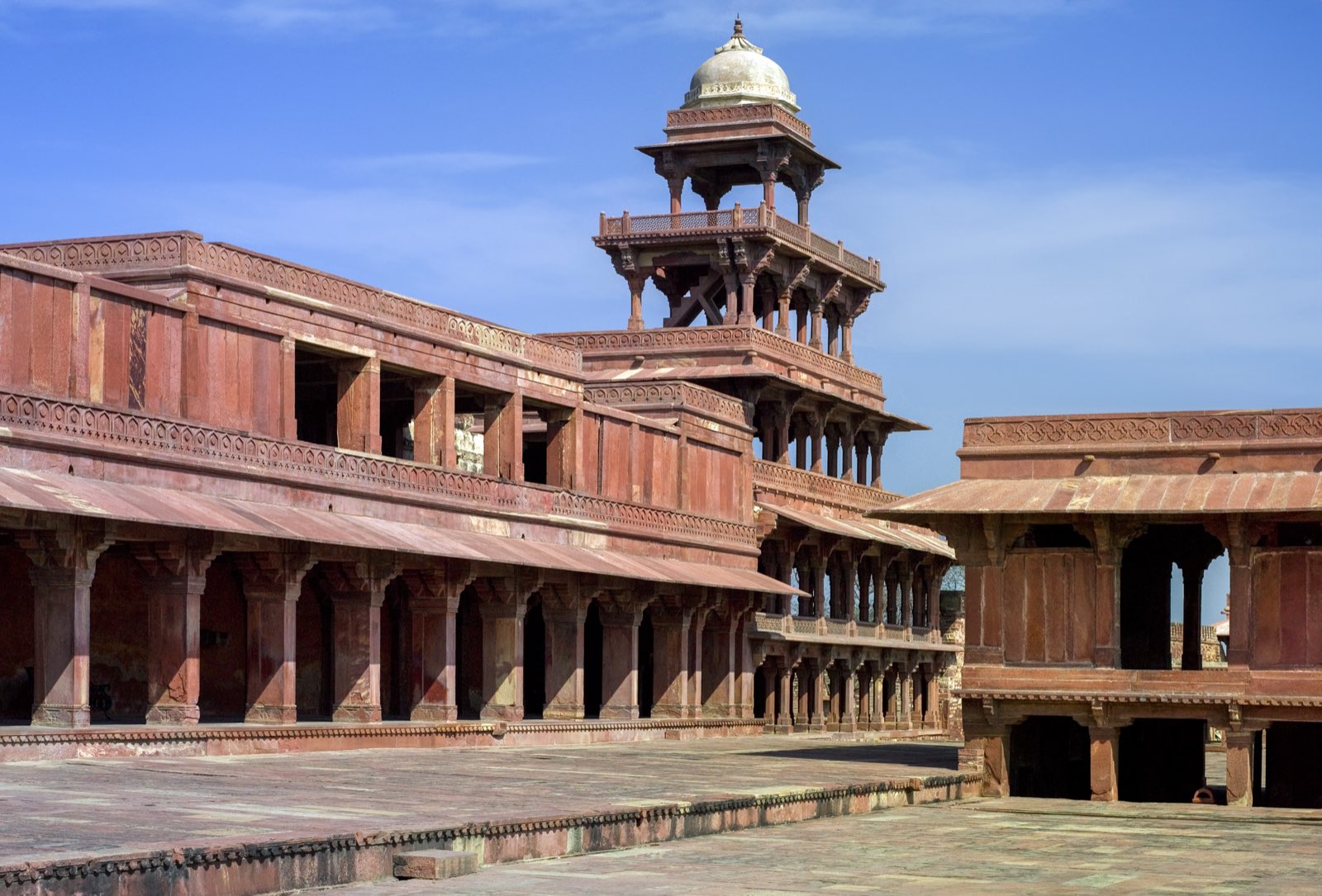
Fatehpur Sikri: The Perfect City That Was Abandoned
How Akbar raised a complete imperial capital of red sandstone in a single vision — a confident fusion of Hindu craft and Islamic idea — and how, within a generation, it was left empty for want of water.
Some buildings are ruins because they fell. Fatehpur Sikri is that far rarer thing — a great work of architecture that is almost perfectly intact, and yet empty. Walk its red-sandstone courts on the ridge outside Agra and you are walking through a complete imperial capital, designed and built in one sustained act by the emperor Akbar between about 1571 and 1585, and then, within barely fifteen years, abandoned. Nothing was destroyed. Everyone simply left. The result is the most vivid picture we have of Mughal court architecture at its most confident — frozen, unaltered, waiting.
If the Qutb complex showed the Islamic arch arriving in India awkwardly, four centuries later Fatehpur Sikri shows the resulting architecture entirely at home — and it makes a fascinating companion, in this Architectural Wonders series, to the Taj Mahal that Akbar's grandson would build a short ride away. Where the Taj is marble, symmetrical and singular, Fatehpur is sandstone, sprawling and urban — a city, not a jewel.
1. A city designed all at once
Most cities grow. Fatehpur Sikri was composed — laid out deliberately along its rocky ridge as a set of walled courtyards and terraces, in two great zones joined by the spine of the site.
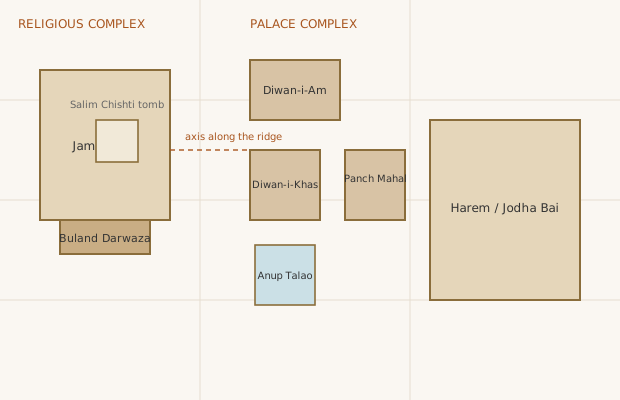
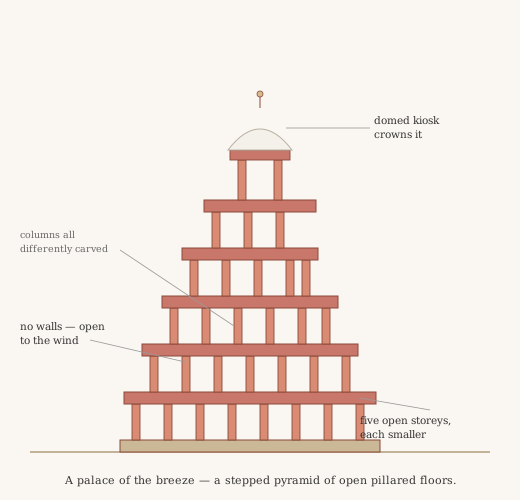
At one end sits the religious complex — the great Jami Masjid, the marble tomb of the saint Salim Chishti, and the towering Buland Darwaza gateway. At the other lies the palace complex — the Diwan-i-Am (hall of public audience), the Diwan-i-Khas (hall of private audience), the whimsical five-storey Panch Mahal, the Anup Talao pool with its central island platform, and the courts of the royal household. There is no single grand axis forcing everything into line; instead the buildings are set to the terrain in a series of linked, human-scaled courtyards, all in the same warm red sandstone, so that the whole city reads as one material and one moment. It is one of the finest surviving examples anywhere of a pre-modern planned capital.
2. Post and beam — an Islamic city built the Indian way
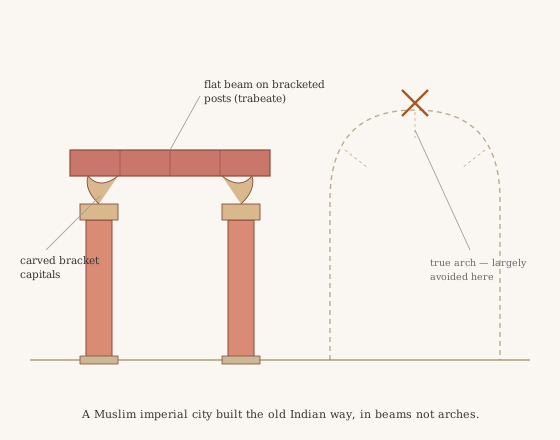
Here is the architectural heart of the matter. Fatehpur Sikri was built for a Muslim emperor, yet it is built almost entirely in the Indian structural language — not the arch and dome of the wider Islamic world, but the trabeate system of post and beam: pillars carrying flat lintels, deep bracketed capitals, projecting chhajja eaves of overhanging stone, and rooftop chhatri kiosks. This is the vocabulary of Hindu, Rajput and Gujarati temple and palace craft — and Akbar's masons deployed it, with dazzling skill, in the service of a Mughal court.
That was not an accident. Akbar's reign was defined by a deliberate policy of synthesis — of drawing Hindu and Muslim, Persian and Indian, into one imperial culture — and Fatehpur Sikri is that policy rendered in stone. Carved brackets that could have come from a Gujarati temple hold up the pavilions of an Islamic emperor. The building is the argument: that a new, genuinely Indian imperial architecture could be made by fusing the traditions of everyone the empire contained.
3. The Diwan-i-Khas and its impossible pillar
Of all the invented rooms in Indian architecture, none is stranger or more brilliant than the interior of the Diwan-i-Khas, the hall of private audience. From the outside it looks like a modest two-storey pavilion. Inside, it is a single tall space with one astonishing object at its centre.
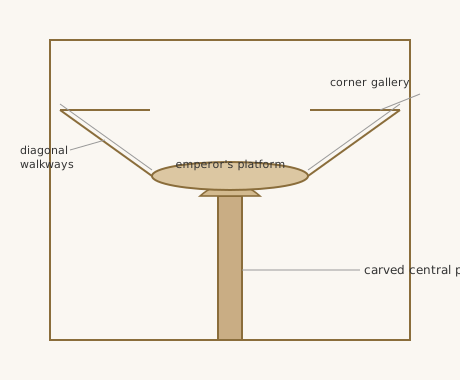
A single, richly carved central pillar rises from the floor and blossoms at the top into a huge circular bracketed capital — a round stone platform. From that platform, four narrow railed walkways run diagonally to a gallery at the four upper corners of the hall. The emperor, by tradition, sat on the central platform — at the literal axis of the room, elevated and equidistant from his counsellors, who stood or moved along the galleries at the corners. It is architecture as diagram of sovereignty: the ruler as the still centre from which every direction radiates. Whatever debates it actually hosted, the space makes an idea physical in a way few rooms ever have.
4. The Buland Darwaza: scale as a statement
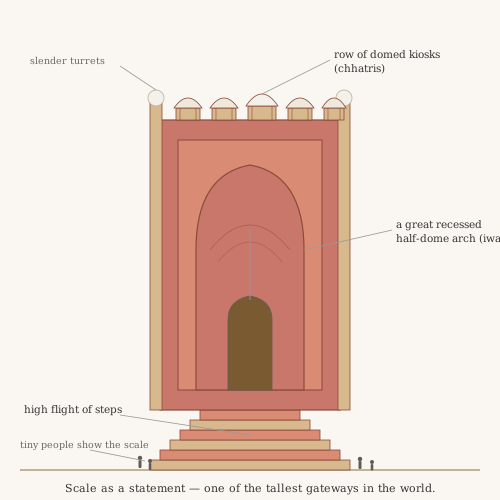
The religious complex is dominated by the Buland Darwaza, the "Gateway of Magnificence" — a colossal entrance to the Jami Masjid, roughly fifty-four metres high including the steps, and one of the tallest gateways in the world. It is built around a great recessed half-dome (iwan) framed by a rectangular screen and crowned with rows of chhatris. Added to mark a military victory, it does exactly what the Qutb Minar did with height and this does with sheer scale — it overwhelms the approaching visitor and announces an authority beyond argument. Nearby, in deliberate contrast, sits the delicate white-marble tomb of Salim Chishti, the Sufi saint whose blessing Akbar credited for the birth of his heir — its filigree marble screens a quiet jewel against the gateway's thunder.
5. Built for a saint, emptied by water
The whole city owes its existence to that saint. Childless and anxious for an heir, Akbar sought out Sheikh Salim Chishti at the village of Sikri; when a son was born, the grateful emperor moved his capital there and named it Fatehpur — the "City of Victory." For a decade and a half it was the glittering centre of the Mughal world. And then it was left. The reasons are debated, but the decisive one appears to be brutally practical: the site could not supply enough water for a great city. The most magnificent capital of its age was undone not by an enemy but by an inadequate reservoir. Akbar returned to Agra, and Fatehpur Sikri was gradually deserted, to survive — precisely because no one wanted it enough to alter it — as an almost perfect fossil of Mughal design. UNESCO inscribed it in 1986.
6. What a modern architect can learn from Fatehpur Sikri
- Design at the scale of the city, not just the building. Fatehpur's genius is the relationship between its courts and pavilions — the sequence, the linked outdoor rooms, the shared material. The most ambitious architecture composes the spaces between buildings as carefully as the buildings themselves.
- Build in the language you have truly mastered. Akbar's masons did not fake the arch and dome; they built superbly in the trabeate craft they knew, and made something new with it. Authenticity of technique reads in every joint.
- Architecture can be an act of synthesis. A Hindu bracket holding up a Muslim emperor's hall is not a compromise; it is a statement of inclusion. Buildings can argue for a way of living together — and be more powerful for it.
- Invent the room the occasion needs. The Diwan-i-Khas is not a standard type; it is a bespoke spatial idea for a specific ritual of power. Sometimes the right answer is not a known plan but a wholly new one.
- The unglamorous constraint decides everything. A perfect city fell to a water shortage. Drainage, servicing, supply — the "boring" infrastructure — is not a footnote to great architecture; it is the ground it stands or falls on.
Fatehpur Sikri is the rare masterpiece that teaches as much by its emptiness as by its design: a total vision, carried without compromise — and a reminder that even the most complete idea must still answer to the well.
References & further reading
1. UNESCO World Heritage Centre — Fatehpur Sikri (inscribed 1986). https://whc.unesco.org/en/list/255/
2. Encyclopaedia Britannica — Fatehpur Sikri. https://www.britannica.com/place/Fatehpur-Sikri
3. Archaeological Survey of India — Fatehpur Sikri. https://asi.nic.in/
4. Incredible India (Ministry of Tourism) — Fatehpur Sikri. https://www.incredibleindia.gov.in/en/uttar-pradesh/agra/fatehpur-sikri
Last verified 2026-07-04. Dates, dimensions and attributions follow standard historical and art-historical reference sources and are given as widely accepted approximations; the founding of the city after the birth of Akbar's heir, the trabeate construction, and the abandonment owing to water supply follow the established historical record; the tradition of the emperor's use of the Diwan-i-Khas central platform is presented as the widely held account.
Export this guide
Related Guides — Deep-dive reading
The Red Fort, Delhi: Shah Jahan's Palace of Paradise on the River
How the emperor who built the Taj Mahal raised a whole walled palace-city in red sandstone and white marble — a fortress on the outside, a garden threaded with running water within, and the stage on which modern India was born
Architectural WondersHampi: The Stone City of Vijayanagara
How a medieval South Indian empire built an entire capital out of the boulder field it stood on — granite that sings, a chariot carved in rock, two architectural worlds fused into one — and how the whole of it fell in a single year.
Architectural WondersFrom Space to Place: Turning Empty Rooms into a Home
How to transform a bare builder flat into a warm, lived-in home — through scale, zones, layering, retreat corners and flow
Design EducationRelated Tools — Try Free
Rainwater Tank Sizer
How big should your rainwater tank be? Computes annual harvest, recommended tank capacity in litres, water-bill savings, and payback — for 10 Indian cities.
RWH CalculatorHome Building & Interior Cost Calculator — 20 Cities
Construction + interior costs for 20 Indian cities across kitchen, wardrobes, flooring, painting, ceiling.
Cost CalculatorConcept Generator
Get 3 AI-generated design concepts for any room with style, materials, and cost estimate.
DesignAI