
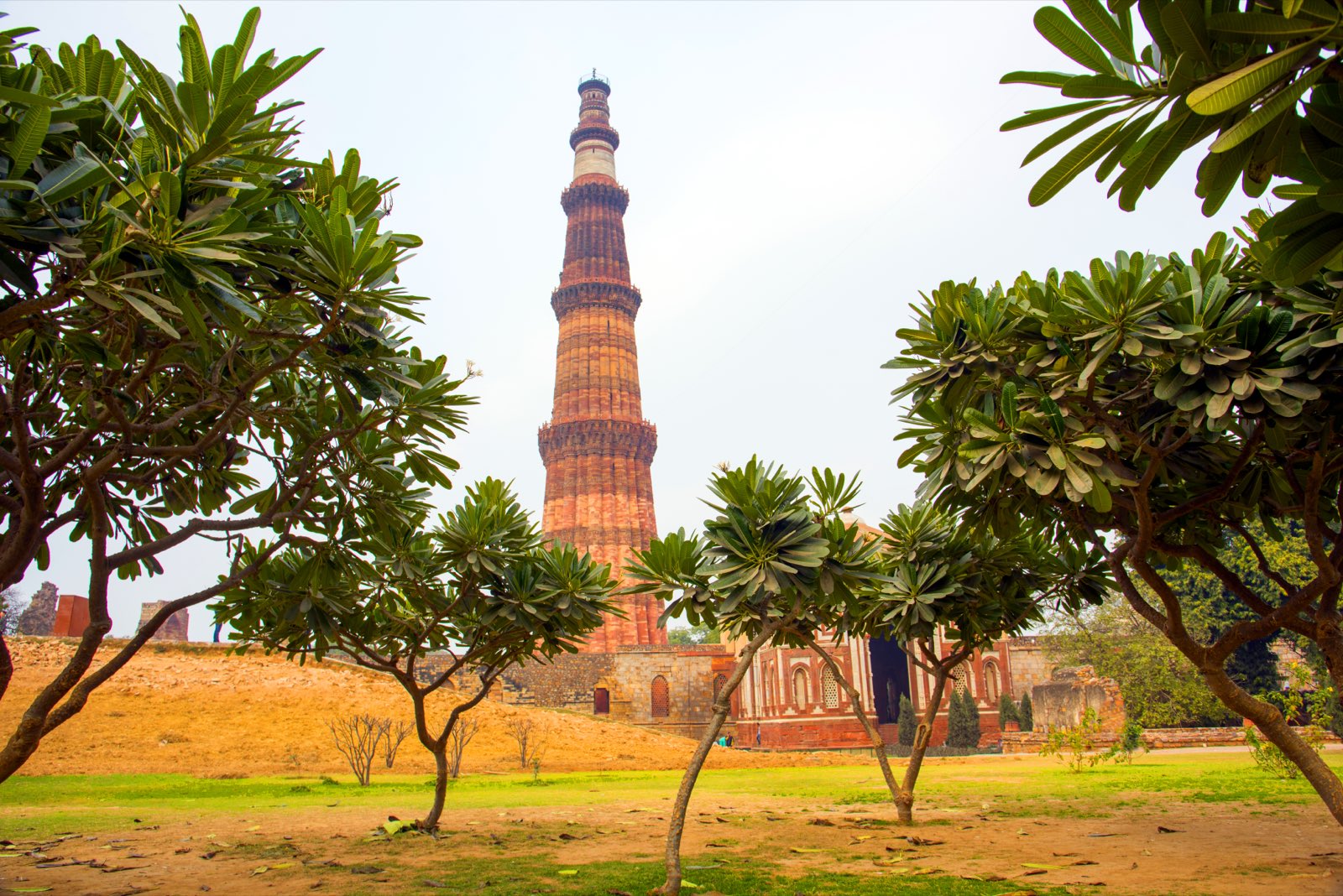
The Qutb Minar: The Tower That Announced a New Architecture
How a 73-metre victory tower and India's first great mosque, raised in Delhi around 1200, marked the arrival of the arch, the dome and the minaret — and the first, halting meeting of Islamic form with Indian craft.
Stand at the foot of the Qutb Minar in Delhi and tip your head back, and you are looking at the moment Indian architecture changed. For fifteen centuries — since the dome at Sanchi — India had built in its own long, unbroken traditions of solid mass and carved stone, reaching the soaring temple spire at Khajuraho and the chariot at Konark. Then, around the year 1200, a new language arrived from the west — the arch, the dome, the minaret — carried by the armies and builders of the Delhi Sultanate. This tower, and the mosque at its foot, are where that language first spoke on Indian soil. Everything Indo-Islamic that follows, up to and including the Taj Mahal, begins here.
This is the founding monument of a whole new chapter in our Architectural Wonders series, and it is worth reading closely — because it captures, in stone, the awkward and fertile first meeting of two great building cultures.
1. The tower
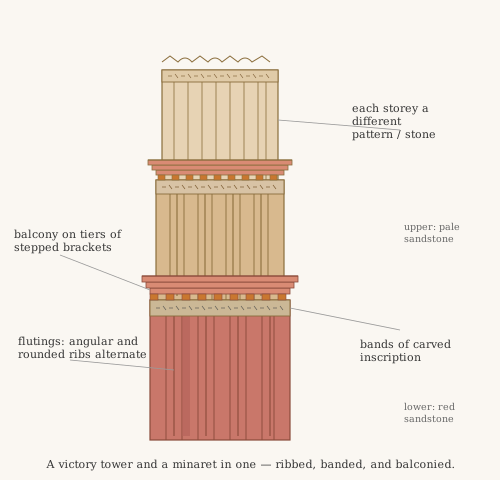
The Minar itself is a victory tower and a minaret in one — a thing of triumph and of the call to prayer — and at roughly 73 metres it is the tallest masonry tower in India and one of the tallest in the world of its kind.
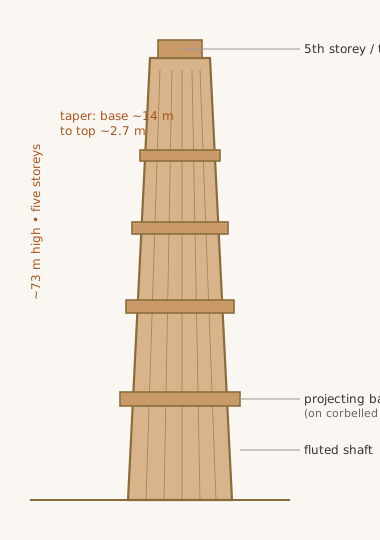
Look at how it is composed. The tower rises in five storeys, each marked off by a projecting balcony that rings the shaft, and it tapers dramatically as it climbs — from about fourteen metres across at the base to under three at the top — so that the eye is drawn irresistibly upward and the whole thing reads as taller and more slender than it is. The lower storeys are of red sandstone, fluted with a marvellous alternating rhythm of angular and rounded ridges that catch the light; the upper storeys, rebuilt later, switch to marble and sandstone banding. And there is already a tell-tale sign of the meeting of cultures: those projecting balconies are carried on tiers of small stepped brackets — Indian corbelling pressed into the service of an Islamic form. The tower was begun by Qutb-ud-din Aibak around 1199, carried up by his successor Iltutmish, and its top storeys were remade by Firoz Shah Tughlaq after a lightning strike — three sultans, more than a century, one soaring idea.
2. A mosque built from temples
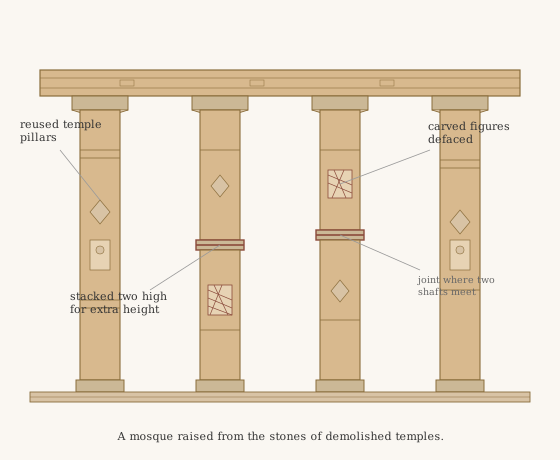
At the foot of the tower stands the Quwwat-ul-Islam — the "Might of Islam" — the earliest surviving mosque in India. And it was raised, quite literally, out of the buildings it replaced. The courtyard is surrounded by pillared cloisters whose columns were taken from around two dozen demolished Hindu and Jain temples and re-erected here — so that if you look closely at the mosque's own colonnades you can still read the bells, chains, foliage and figures of the temples they once belonged to, sometimes stacked two deep to gain height.
This practice — building the new order out of the physical stones of the old — is called spolia, and nowhere in India is it more raw or more legible than here. The result is a genuinely strange and moving building: an Islamic prayer hall speaking, in its every column, the visual language of the temples it displaced.
3. An arch that is only the shape of an arch
Here is the single most instructive thing at the Qutb complex, and every student of architecture should understand it. To give the reused-temple courtyard a properly Islamic face, a great arched screen — the maqsura — was raised across the front of the prayer hall, its tall pointed arches the very emblem of the new architecture. But the Indian masons who built it did not yet know how to build a true arch.
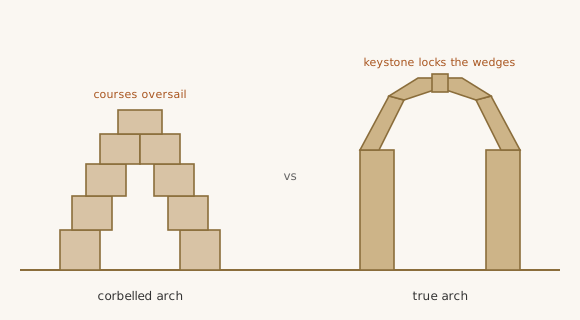
A true arch is a piece of structural cunning: wedge-shaped stones — voussoirs — lean against one another around a curve and are locked at the crown by a keystone, so that the whole span carries load in pure compression and can leap across a wide opening. The Indian tradition had never needed it; it spanned openings by corbelling — stepping each course of stone a little further out than the one below until the two sides met, or by laying a flat beam (a lintel) across posts. So the masons of the Quwwat-ul-Islam built their magnificent pointed arches the only way they knew: by corbelling them into the shape of an arch. They are arches in silhouette and Indian in structure — form without the engineering that would later go under it.
It is a perfect illustration of a truth that runs through architectural history: a new form is very often adopted long before the technique that makes it work is understood. The true arch and the true dome would come — the Alai Darwaza gateway added to this very complex in 1311 is India's first real one — and from there the road runs straight to the perfect domes of the Mughals.
4. The pillar that will not rust
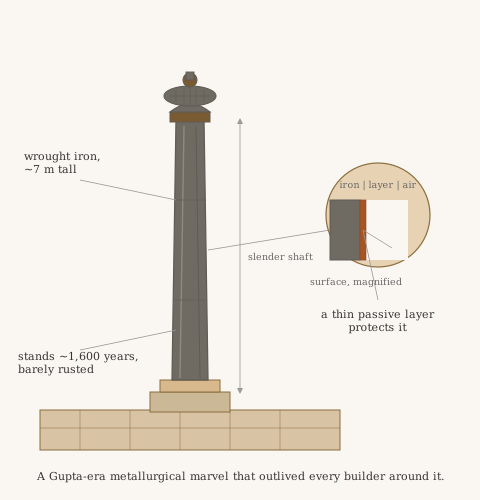
In the middle of the mosque courtyard stands an object older than everything around it and stranger than all of it: the Iron Pillar, some seven metres of nearly pure wrought iron, cast in the 4th century during the Gupta age and moved here later. In sixteen centuries of Delhi's monsoons it has barely rusted — a feat of ancient Indian metallurgy that still draws metallurgists to study it. It is a quiet reminder, planted at the heart of the new order, of just how sophisticated the civilisation being built over already was.
5. Three centuries in one courtyard
The complex is really a layered record of the early Sultanate. Aibak began the mosque and the tower's first storey around 1199; Iltutmish enlarged the mosque and raised the tower; Alauddin Khalji added the exquisite Alai Darwaza in 1311 — the first building in India with a true dome and true arches — and began a second tower, the Alai Minar, meant to dwarf the Qutb, which was abandoned as a colossal stub when he died. Read together, the buildings show a foreign architecture learning to build in India, decade by decade, until it had fully mastered the arch and dome. UNESCO inscribed the Qutb Minar and its Monuments in 1993.
6. What a modern architect can learn from the Qutb complex
- Form is adopted before technique is mastered. The corbelled "arches" of the Quwwat-ul-Islam are a vivid lesson: builders reach for a new shape because of what it means long before they can engineer it honestly. Know the difference between a form you are drawing and a structure you can stand behind.
- You can build the new out of the old. The mosque is made from the columns of the temples it replaced — spolia at its most literal. Reuse is not only a sustainability strategy; it is a way of building memory, tension and history directly into a wall.
- Make the tower do the talking. The Minar announces a new authority the way no low building could. Height is the oldest rhetoric in architecture; a single vertical gesture can claim a city's skyline and its allegiance.
- Taper and rhythm read as height. The dramatic narrowing and the balcony-banded storeys make the tower feel far taller and more graceful than its raw dimensions. Proportion and articulation, not size alone, are what create the sense of the sublime.
- Watch a language being learned. Across a single courtyard you can see corbelled pseudo-arch give way, a century later, to the true dome of the Alai Darwaza. The most interesting architecture is often transitional — caught in the act of absorbing something new.
The Qutb complex is where this series' Indian story turns a page. It is not a perfect building; it is something more interesting — the first sentence of a new architectural language, spoken with an Indian accent, that would take three more centuries to reach its masterpiece at Agra.
References & further reading
1. UNESCO World Heritage Centre — Qutb Minar and its Monuments, Delhi (inscribed 1993). https://whc.unesco.org/en/list/233/
2. Encyclopaedia Britannica — Qutb Minar and Quwwat-ul-Islam mosque. https://www.britannica.com/topic/Qutb-Minar
3. Archaeological Survey of India — Qutb Minar Complex. https://asi.nic.in/
4. Incredible India (Ministry of Tourism) — Qutub Minar. https://www.incredibleindia.gov.in/en/delhi/new-delhi/qutub-minar
Last verified 2026-07-04. Dates, dimensions and attributions follow standard archaeological and art-historical reference sources and are given as widely accepted approximations; the reuse of temple columns, the corbelled construction of the screen arches, and the phasing under Aibak, Iltutmish, Khalji and Firoz Shah follow the established art-historical and historical record.
Export this guide
Related Guides — Deep-dive reading
Brihadeeswara: The Chola Tower That Never Fell
How an 11th-century Tamil emperor raised a 216-foot tower of solid granite — with no mortar, no iron and no machine — and why this colossal corbelled mountain has stood for over a thousand years where Konark's fell. The engineering, the 80-tonne capstone, and the lesson.
Architectural WondersKhajuraho: The Temple Built to Be a Mountain
How the Chandela masons of 10th-century central India made the northern temple rise like a Himalayan peak — and why its sculpture, its engineering and its improbable survival still instruct the modern architect.
Architectural WondersKonark Sun Temple: The Chariot of the Sun, Carved in Stone
How 13th-century Odisha built a god a vehicle — a colossal stone chariot with wheels that still tell the time — and what its triumph, and its collapse, can teach a modern architect.
Architectural WondersRelated Tools — Try Free
Before & After Studio
Generate AI before-and-after renders to preview how your redesign could look.
DesignAIArchitectural Style Identifier
Upload a building photo and an on-device AI names its likely architectural style and era, with the visual cues — private and free.
On-device AIProportion Studio
Explore the golden ratio, root rectangles and other proportioning systems — a dimension ladder, rectangle subdivision and a ratio checker.
Fundamentals