
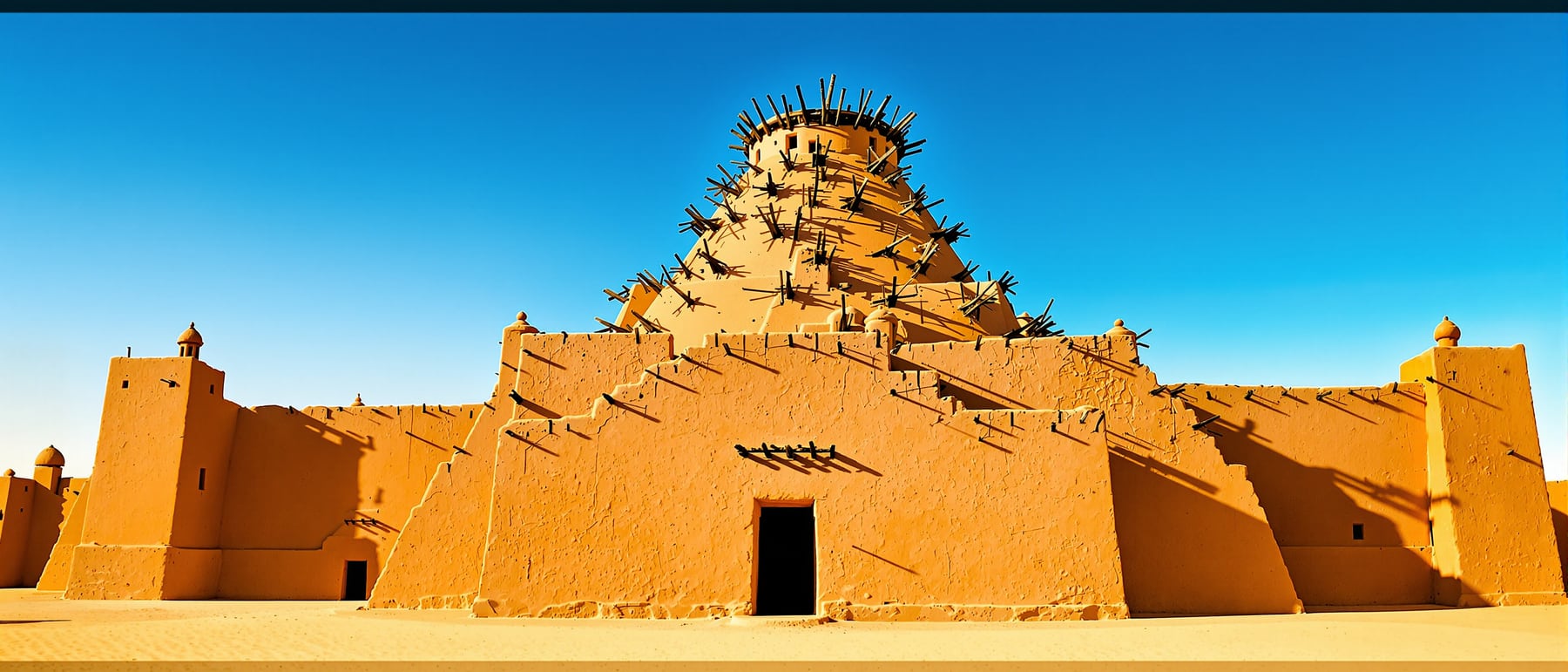
The Mud Mosques of Timbuktu: The University Made of Earth
On the edge of the Sahara, a city that Europe turned into a byword for the middle of nowhere was in truth one of the great centres of learning in the medieval world — with a university of 25,000 students and libraries of hundreds of thousands of manuscripts. Its three great mosques are built entirely of mud, bristling with wooden beams, and must be re-plastered by the whole community every single year — which is exactly why, after seven centuries, they still stand.
The great earthen city of Cahokia was built by a people who left no writing, and it vanished so completely that its very name was forgotten. Now we travel to another monumental architecture of earth — but one that could hardly be more opposite in its fate. In the West, the name "Timbuktu" became a byword for the most remote, empty place imaginable, the very ends of the earth. The truth is almost the reverse: this city on the southern edge of the Sahara, in what is now Mali, was one of the great centres of learning of the medieval world — a place of scholars and libraries, whose three great mosques, built entirely of mud, still stand today.
This is the sixty-second article in our Architectural Wonders series, and the fifteenth in our chapter on the great temples and sacred places of the world.
And it stands for a reason that is itself one of the most beautiful ideas in all of architecture. These buildings are made of mud, which the rains should long ago have washed away. They survive because, every single year, the whole community climbs up and rebuilds them by hand. Timbuktu is a place where architecture is not a finished object but a living act — and where, as we will see, that same habit of coming together to remake what is broken saved the city's soul in our own century.
1. A city of gold and scholars at the edge of the desert
To understand the mosques, you first have to demolish a myth — the one hiding in the English language itself.
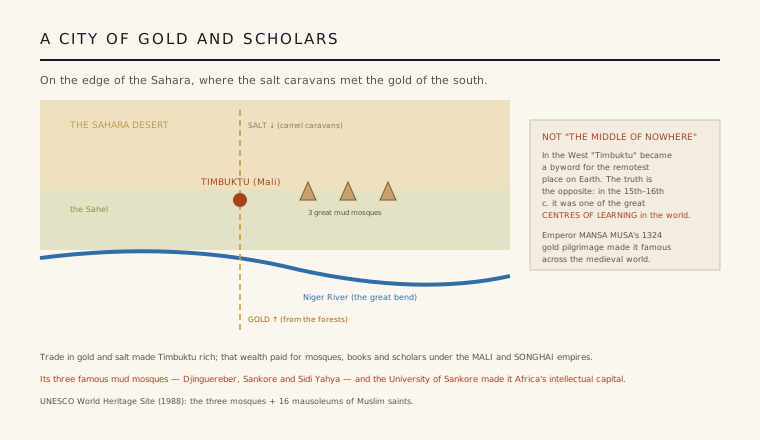
Timbuktu sits at a crossroads — where the camel caravans crossing the Sahara from the north, laden with slabs of salt, met the gold, ivory and goods coming up from the forests of the south, just above the great bend of the Niger River. That trade made it fabulously rich. Under the Mali and then Songhai empires, and made world-famous by the 1324 pilgrimage of the Mali emperor Mansa Musa — who carried so much gold to Mecca that he reportedly crashed its price in Egypt for years — Timbuktu grew, in the fifteenth and sixteenth centuries, into one of the great intellectual capitals of the world. Here is the myth-buster worth stating plainly: the Western idea of "Timbuktu" as a synonym for the back of beyond is exactly wrong. This was a city of scholars and books, where an old saying held that "salt comes from the north, gold from the south, but the word of God and the treasures of wisdom come from Timbuktu." And its greatest monuments were its three mud mosques — Djinguereber, Sankoré and Sidi Yahya — which were also its centres of learning.
2. An architecture of earth
The mosques belong to one of the world's most distinctive building traditions — and it is a triumph of making the most of the least.
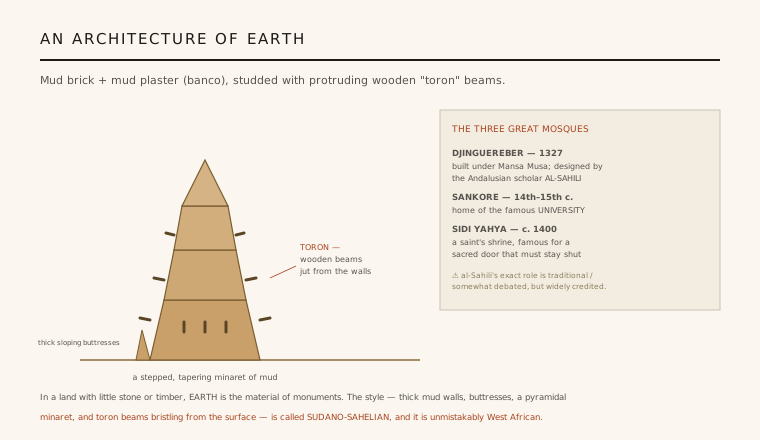
In a land with almost no stone and little timber, the material of monuments is earth. The walls are built of sun-dried mud brick — the same humble material that raised the Ziggurat of Ur in Mesopotamia three thousand years earlier — and then coated in a smooth skin of mud plaster called banco; because mud is weak, the walls are thick, sloping and buttressed, and the towers rise as squat, stepped, pyramidal minarets rather than the slender spires of Arabia or Persia. This is the Sudano-Sahelian style, and it is unmistakably West African. Its most striking feature, and the key to everything, is the rows of wooden beams — toron — that stick straight out of the walls all over the surface, like the quills of a porcupine. The oldest and grandest of the three mosques, Djinguereber, was built in 1327 under Mansa Musa, and is traditionally credited to Abu Ishaq al-Sahili, an Andalusian (Granada) poet and scholar said to have been brought back from the pilgrimage to design in this new manner. (The exact extent of al-Sahili's role is debated by scholars, but the credit is old and widespread.) Sankoré followed in the fourteenth and fifteenth centuries, and Sidi Yahya around 1400 — a saint's shrine famous for a sacred door that tradition says must never be opened, lest it bring the end of the world. Beautiful as the toron are, they are not decoration. They are the reason the mosques survive.
3. A mosque you must rebuild every year
Here is the idea at the heart of Timbuktu's architecture — and it may change how you think about what a building is.
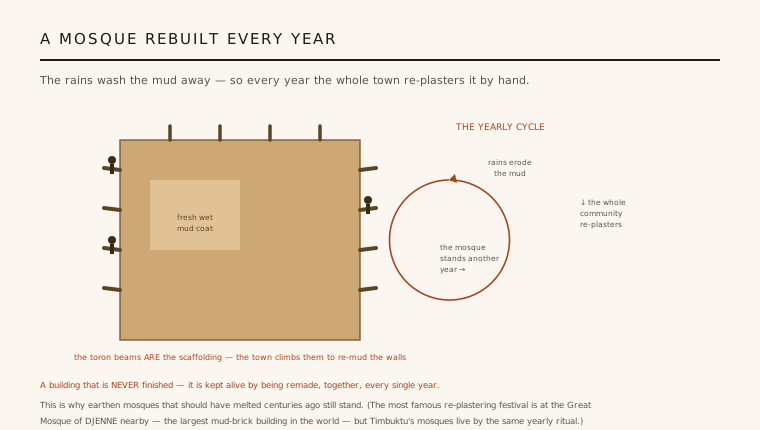
A building of mud, left alone, is doomed: each year's rains slowly dissolve it back into the ground. So the builders turned that weakness into a ritual of renewal. The toron beams are permanent, built-in scaffolding. Every year, after the rainy season, the whole community — masons, families, children — gathers and, standing on the beams, re-coats the entire mosque with a fresh layer of mud. This communal re-plastering is at once a practical repair, a festival, and an act of devotion; the most famous version, at the nearby Great Mosque of Djenné (the largest mud-brick building on Earth), draws the whole town in a single joyous, muddy morning, and Timbuktu's mosques live by the same yearly rhythm. Think about what this means. These buildings are never finished. They are not objects that were completed once and have survived since; they are processes, kept alive only by being remade, together, again and again. A mosque in Timbuktu is less like a statue than like a garden, or a language, or a tradition — something that exists only so long as a community keeps choosing to renew it. It is one of the most profound answers ever given to the question of how anything lasts: not by being indestructible, but by being endlessly, lovingly repaired.
4. The university of the desert
The mosques were not only places of prayer. They were the campus of one of the medieval world's great universities.
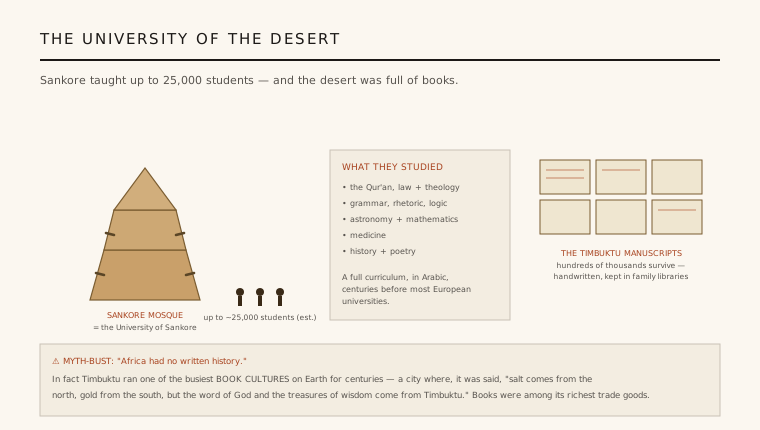
The Sankoré Mosque was the heart of the University of Sankoré, which at its height is said to have drawn as many as 25,000 students — in a city of perhaps 100,000 — studying not only the Qur'an, law and theology but astronomy, mathematics, medicine, grammar, history and poetry. Like the Buddhist Somapura Mahavihara in Bengal, it was a mosque that was also a university, a place where faith and scholarship were one. And Timbuktu was, above all, a city of books. Scholars and families amassed enormous private libraries of handwritten manuscripts — the famous Timbuktu Manuscripts — of which hundreds of thousands survive to this day, on every subject from mathematics to music. This matters far beyond architecture, because it demolishes another stubborn myth: the idea that pre-colonial Africa "had no written history." Here, for centuries, was one of the busiest book-cultures on Earth, where a fine manuscript could be worth more than a slave or a horse, and where the treasures of wisdom were, as the saying went, Timbuktu's proudest export.
5. Broken, and remade
Timbuktu's deepest lesson — that survival means constant, communal rebuilding — was put to a terrible test in our own century, and the city proved it true.
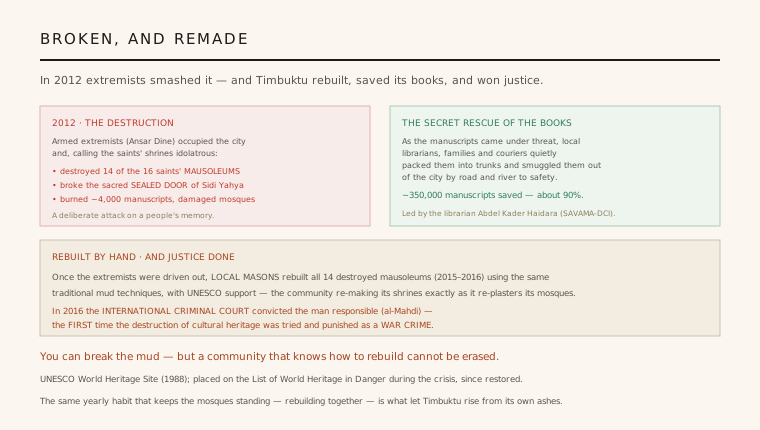
In 2012, during a conflict in northern Mali, armed extremists (Ansar Dine) occupied Timbuktu and, condemning the veneration of Sufi saints as idolatry, set about destroying its heritage: they demolished 14 of the 16 ancient mausoleums of the saints, damaged mosques, smashed the sacred sealed door of the Sidi Yahya Mosque, and burned some 4,000 manuscripts. It was a deliberate attack on a people's memory. But two things saved Timbuktu's soul. First, a quiet, heroic rescue of the books: as the danger grew, local librarians and families — led by the archivist Abdel Kader Haidara — secretly packed the manuscripts into trunks and smuggled some 350,000 of them out of the city by road and river, saving roughly 90 percent. Second, once the extremists were driven out, the people simply did what they had always done: they rebuilt. Between 2015 and 2016, local masons reconstructed all fourteen destroyed mausoleums using the same traditional mud techniques, with UNESCO's support — the community re-making its shrines exactly as it re-plasters its mosques. And there was justice: in 2016, the International Criminal Court convicted the man responsible — the first time in history the destruction of cultural heritage was tried and punished as a war crime. You can break the mud. But a community that knows how to rebuild cannot be erased — a truth the razed and buried Templo Mayor of the Aztecs, unearthed five centuries after its destruction, proves in its own way. (Timbuktu became a UNESCO World Heritage Site in 1988.)
6. What a modern architect can learn from Timbuktu
- A building can be a verb. Timbuktu's mosques are not finished objects but ongoing acts of maintenance. They teach the most counter-intuitive truth in architecture: that some of the most enduring things last precisely because they are never treated as permanent — only endlessly renewed.
- Design maintenance into the form itself. The toron beams are the repair strategy built into the building. Great design anticipates its own upkeep — it makes caring for a thing possible, even communal, rather than a burden bolted on later.
- The humblest material can carry the highest civilisation. Mud built a university. There is no such thing as a lowly material — only a failure of imagination about what it can be made to do and mean.
- Buildings can bind a community — by needing it. Because the mosque requires the whole town to rebuild it each year, it continually re-knits the community that gathers to save it. A structure that needs people keeps its people together.
- Fight the myths your buildings can correct. Timbuktu's mosques and manuscripts are the standing refutation of the lie that Africa had no cities, no learning, no written history — as are the mighty stone walls of Great Zimbabwe far to the south. Architecture is evidence — and preserving it is a way of defending the truth.
- What is destroyed can be remade — and that is itself a kind of victory. The rebuilt mausoleums and the rescued manuscripts are proof that heritage lives not only in original stones but in the living knowledge of how to make them again. The surest way to keep a thing is to keep the skill and the will to rebuild it.
References & further reading
1. UNESCO World Heritage Centre — Timbuktu (inscribed 1988) and Reconstruction of the mausoleums. https://whc.unesco.org/en/list/119/
2. Encyclopaedia Britannica — Timbuktu. https://www.britannica.com/place/Timbuktu-Mali
3. World History Encyclopedia — Timbuktu and Mansa Musa I. https://www.worldhistory.org/Timbuktu/
4. UNESCO — The Timbuktu Manuscripts / Reconstruction of the destroyed mausoleums of Timbuktu. https://whc.unesco.org/en/canopy/timbuktu/
5. International Criminal Court — Prosecutor v. Ahmad Al Faqi Al Mahdi (2016; cultural destruction as a war crime). https://www.icc-cpi.int/mali/al-mahdi
6. Hammer, Joshua — The Bad-Ass Librarians of Timbuktu (the 2012–13 manuscript rescue). https://www.worldcat.org/title/bad-ass-librarians-of-timbuktu/oclc/933284951
*Last verified 2026-07-04. Figures follow UNESCO, Britannica, the World History Encyclopedia, and reporting on the 2012–16 events, and are given as widely cited approximations that vary by source. Timbuktu (Tombouctou) is in Mali, on the southern edge of the Sahara near the Niger River (the Sahel). A trans-Saharan trade hub (salt/gold) under the Mali and Songhai empires, famed via Mansa Musa's 1324 pilgrimage; a leading centre of Islamic learning in the 15th–16th centuries. Its three great mosques are Sudano-Sahelian earthen architecture (sun-dried mud brick + "banco" mud plaster; thick buttressed walls; stepped pyramidal minarets; protruding wooden "toron" beams that serve as permanent scaffolding for annual re-plastering): DJINGUEREBER (built 1327 under Mansa Musa; traditionally attributed to the Andalusian scholar Abu Ishaq al-Sahili — the extent of his role is debated); SANKORÉ (14th–15th c.; heart of the University of Sankoré); SIDI YAHYA (c. 1400; a saint's shrine with a famous sacred door). Annual communal re-plastering keeps the mud mosques standing (the most famous festival is at the nearby Great Mosque of Djenné, the world's largest mud-brick building). The University of Sankoré reputedly taught up to ~25,000 students (estimates vary) across religious and secular subjects; the "Timbuktu Manuscripts" (hundreds of thousands survive) refute the myth that pre-colonial Africa lacked written history. In 2012 (Northern Mali conflict) Ansar Dine destroyed 14 of the 16 World-Heritage-listed saints' mausoleums, damaged mosques, broke the Sidi Yahya door, and burned ~4,000 manuscripts; ~350,000 manuscripts were secretly evacuated to safety (Abdel Kader Haidara / SAVAMA-DCI; ~90% saved); the mausoleums were rebuilt by local masons (2015–16, UNESCO-supported); and in 2016 the ICC convicted Ahmad al-Faqi al-Mahdi — the first prosecution of cultural destruction as a war crime. UNESCO World Heritage Site "Timbuktu," inscribed 1988 (placed on the List of World Heritage in Danger during the crisis, since restored).
Export this guide
Related Guides — Deep-dive reading
Cahokia and Monks Mound: The Great City America Forgot
A thousand years ago, across the river from where St Louis now stands, Native Americans built a city of perhaps twenty thousand people — larger than London at the time — with a hundred and twenty earthen mounds, a plaza the size of dozens of football fields, and a solar calendar of cedar posts. At its heart rose Monks Mound, the largest earthwork in the Americas, with a footprint to rival the Great Pyramid. Then, before Europeans ever arrived, it vanished — and almost no one remembers it.
Architectural WondersGreat Zimbabwe: The Stone City Europe Refused to Believe Africans Built
In the hills of southern Africa stand the largest ancient stone ruins south of the Sahara — a whole city of massive granite walls built without a drop of mortar, the wealthy capital of a gold-trading kingdom. For a century, colonists refused to accept that Africans had raised it, and invented every other builder they could. This is the story of that architecture, and of the lie it outlived. The article that closes our chapter on the palaces and pleasures of worldly power.
Architectural WondersSomapura Mahavihara: The Buddhist University Hidden Inside a Hill
Twelve hundred years ago in Bengal, a Pala emperor built one of the largest monasteries the Buddhist world had ever seen — a walled quadrangle a fifth of a mile across, ringed by 177 monks' cells, with a great cross-shaped, terraced temple rising from its courtyard. For four centuries scholars came from as far as Tibet to study here; then it was abandoned, and slowly buried, until villagers knew it only as Paharpur — 'the hill-town.'
Architectural WondersRelated Tools — Try Free
Child & Elder Home-Safety Audit
Room-by-room safety audit for households with children or seniors — 10 categories, 70+ checkpoints tagged by audience.
Safety AuditConcept Generator
Get 3 AI-generated design concepts for any room with style, materials, and cost estimate.
DesignAIDesign Style Finder Quiz
Answer 10 visual questions to discover your Indian interior style profile with materials and colours.
Interactive Quiz