
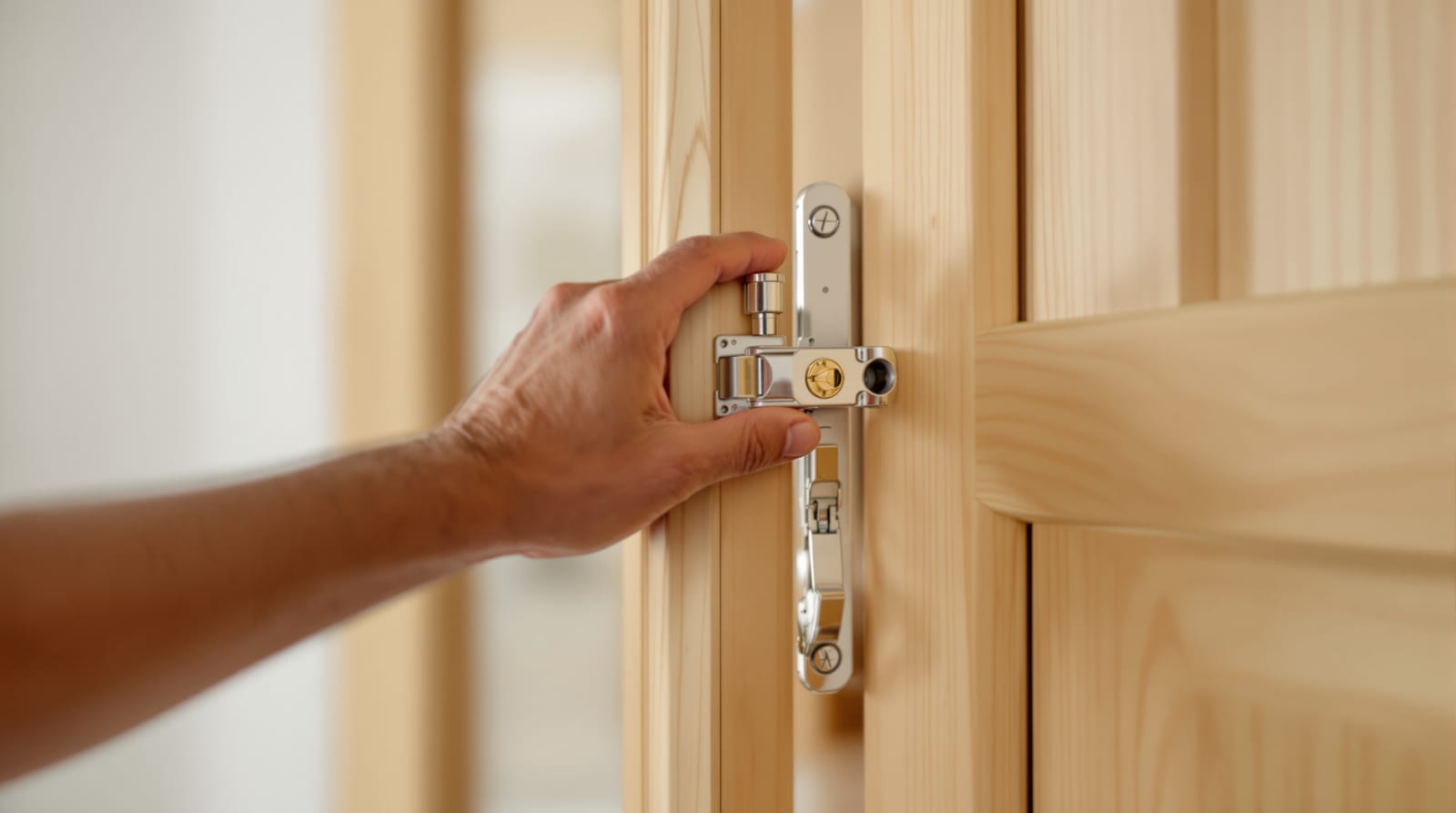
Door Operation Testing at QA: Functional Checks India 2026
The functional tests on a fitted door at handover — smooth swing, first-time latching, lock and key throw, self-closing, one-hand operation and a slam-cycle check, with clear pass criteria.
Door operation testing is the moment a fitted door earns its sign-off. Every measurement can be within tolerance — plumb frame, even reveals, the right hinges — and the door can still fail in use because it binds at full swing, will not latch first time, or refuses to throw its lock. Operation testing is the functional layer of QA: you stop measuring the door and start using it, the way an occupant will every day for years. On an Indian site this matters doubly, because mixed-skill labour, dust, monsoon swelling and last-minute paint can all turn a door that hung perfectly last week into one that drags today. This guide is the fitter's and inspector's routine for proving a door works — swing, latch, lock, self-close, accessible one-hand use and a slam-cycle check — with honest pass criteria you can record against each door reference. For the wider QA picture, start with the complete door guide and the door snagging discipline.
Why functional testing comes after the measured checks
A door passes acceptance in two layers. First the measured checks — gaps, plumb, reveal, leaf flatness — covered in our door acceptance criteria and door gap inspection guides. Then the functional checks in this guide, where you operate the door and watch how it behaves. The two are linked: a door that drags at the head is usually hinge-bound or has the leaf sitting hard in the frame, and a door that will not latch first time almost always has a strike-plate or keep set-out problem. So operation testing is also a diagnostic — when a door fails a functional test, it points you back to the measured fault. Run it last, after wet trades and final paint, because a freshly painted edge can swell or stick and a closer can be knocked off adjustment during finishing.
Do every test with the door in its finished state: hardware fitted and tightened, keys cut, closer (if any) adjusted, and the floor finish down so the bottom clearance is final. Testing before the floor tiles go in gives a false pass.
The seven operation tests
Work through these in order on each leaf. Record a pass or fail against the door reference in the schedule — the door snagging checklist generator produces a per-door sheet so nothing is skipped.
| # | Test | What you do | Pass criteria |
|---|---|---|---|
| 1 | Smooth swing | Open the leaf slowly through its full arc, then briskly | Moves freely end to end; no binding, dragging, squeak or catch |
| 2 | Latch first time | Let the door close at normal speed from ~30° open | Latch bolt engages the keep first time, no push or lift needed |
| 3 | Lock throw & keys | Throw the deadbolt/latch by key and by thumb-turn, both leaves of any pair | Bolt throws fully and smoothly; every key turns and withdraws cleanly |
| 4 | Self-close & latch (closer doors) | Open to 90° (and to 5–10°), release | Closes fully under its own power and latches from any angle |
| 5 | One-hand operation | Operate lever and lock with one hand only | Works one-handed without tight grip, twisting or excess force |
| 6 | No binding / dragging | Open part-way and let go; feel for resistance through arc | Leaf neither self-swings open/shut nor drags on floor or frame |
| 7 | Slam / cycle check | Close firmly several times, then cycle the closer/latch repeatedly | Latches reliably every time; nothing loosens, rattles or mis-aligns |
1. Smooth swing through the full arc
Stand the door open and move it slowly from fully shut to fully open and back. The leaf should travel the whole arc without binding, rubbing the frame, catching the floor or making the leaf squeak. A door that is stiff near the closed position is often hinge-bound (hinges set too deep); one that drags at the head or threshold has a clearance fault. Listen as much as you watch — a squeak is a dry hinge or a binding knuckle.
2. Latch first time
From roughly 30° open, let the door close at the speed an occupant would use and watch the latch. It must engage the keep first time, with no need to lift, push or slam. A door that bounces back or needs a shove has a misaligned strike plate or keep — re-set it rather than telling the client to "give it a push". For the alignment craft, see door strike-plate alignment.
3. Lock throw and keys
Throw every bolt the door has — latch, deadbolt, thumb-turn, key both sides — and confirm each moves its full travel smoothly and the bolt enters the keep without scraping. Then test every key: it should turn freely and withdraw cleanly in all positions. On a pair, test both the active and the bolted secondary leaf. A stiff key or a bolt that only half-throws is a set-out or alignment fault, not something to "work in".
4. Self-close and latch (closer doors)
Where a closer is fitted — and on every fire door it is a life-safety must — the door must close fully and latch under its own power from any opening angle, including a small 5–10° crack. Open it to 90° and release; it should sweep shut and latch without slamming, with the latching action (final snap) firm enough to engage the keep. If it stalls short of closed or fails to latch, adjust the closing and latch speed valves; never wedge a fire door to mask a weak closer. See fitting door closers for the adjustment method and fire-door installation compliance for the rated-set context.
5. One-hand operation (accessibility)
Under the RPwD Act and the Harmonised Guidelines, doors on accessible routes must be operable with one hand, without tight grasping, pinching or twisting of the wrist — which is why lever handles, not knobs, are mandated. Test it: operate the lever and any lock one-handed, with a loose grip. The lever centre should sit in the accessible band (commonly around 900–1050mm, within the 800–1100mm range). If the door is too heavy to open one-handed, or the lock needs two hands to throw, it fails accessibility even if it "works" — see accessible doors for the full requirement.
6. No binding or dragging
Open the leaf to several positions and release it. It should stay put — a door that self-swings open or shut is out of plumb (the frame is leaning) and the leaf is running downhill. Then feel for drag: the bottom edge catching the floor finish or threshold, or the latch edge rubbing the frame. Both are clearance faults that trace back to the door clearances and tolerances.
7. Slam and cycle check
Finally, prove durability, not just a single lucky latch. Close the door firmly several times as a real occupant would, and cycle the latch and closer repeatedly (a dozen or more times). After cycling, re-check that nothing has loosened: hardware screws still tight, the latch still engages first time, the closer still latches fully, no new rattle or mis-alignment. A door that passes once but loosens after ten cycles has under-driven screws or a marginal set-out.
Pass, fail and what each fault means
| Symptom in testing | Likely cause | Action |
|---|---|---|
| Stiff near closed | Hinge-bound (hinges too deep) | Pack out / re-set hinge gains |
| Drags on floor | Bottom clearance too tight | Ease leaf bottom or check threshold |
| Won't latch first time | Strike/keep mis-aligned | Re-position strike plate |
| Self-swings open/shut | Frame out of plumb | Re-plumb frame / re-hang |
| Key stiff or bolt half-throws | Lock body or keep mis-set | Re-mortise keep / align lock |
| Closer stalls short | Closer under-set / wrong size | Adjust valves / upsize closer |
| Loosens after cycling | Screws under-driven | Re-fix into solid timber |
| Needs two hands / tight grip | Knob fitted or door too heavy | Replace with lever / ease door |
A door passes operation testing only when all seven checks pass: it swings freely, latches first time, locks and unlocks smoothly with every key, self-closes and latches (where a closer is fitted), operates with one hand, neither binds nor self-swings, and stays reliable through a slam-cycle. Record the result against the door reference and feed it into the punch-list. The door acceptance tolerance checker lets you log the measured tolerances and functional pass/fail per door, and the door snagging checklist generator rolls failures into the handover snag list.
Be honest about life safety: on fire doors, the self-close-and-latch test is not optional polish — a fire door that does not close fully and latch from any angle does not protect the escape route, whatever NBC 2016 rating is on the label. And on accessible routes, one-hand operability is a legal requirement under the RPwD framework, not a nicety. For the order all this fits into, cross-link door inspection checklist and door handover.
Frequently asked questions
What does "latch first time" actually mean?
It means that when the door is released from a normal open position and allowed to close at everyday speed, the latch bolt engages the keep on the first attempt — no lift, no push, no slam. If you have to nudge it, the strike plate or keep is mis-aligned and must be re-set. Telling the occupant to "give it a push" is not a pass.
How many times should I cycle a door in the slam test?
As a rule of thumb, close it firmly several times and cycle the latch and closer a dozen or more times. The point is to expose hardware that latches once but loosens or mis-aligns under repeated use — usually from under-driven screws or a marginal set-out. After cycling, re-confirm every test still passes.
Does every door need a self-close test?
Only doors fitted with a closer — but for those, especially fire doors, it is a life-safety must. The door must close fully and latch under its own power from any opening angle, including a small 5–10° crack. Never wedge a fire door to hide a weak closer; adjust the closer or upsize it instead.
What is the one-hand operation test for?
It proves the door meets accessibility requirements under the RPwD Act and Harmonised Guidelines: the lever and lock must work with one hand, without tight grasping, pinching or wrist-twisting. That is why lever handles, not knobs, are required, with the lever centre roughly 900–1050mm above the floor.
A door tests fine in the morning but drags by afternoon — why?
Usually moisture. In humid or monsoon conditions a timber leaf swells and a tight edge starts to bind; dust in the hinges or a closer knocked during finishing can also do it. Test after wet trades and final paint, with the floor finish down, and re-check on a damp day before final sign-off if the margins are tight.
Export this guide
Related Guides — Deep-dive reading
Door Acceptance Criteria: Tolerances & Tests India 2026
What 'acceptable' means for a fitted door: even gaps, frame plumb, flat leaf, one-hand operation, latches first time, clean finish — and the accept/snag/reject thresholds.
Home Doors & EntrancesDoor Inspection Checklist for Fitted Doors: India 2026
A post-fit inspection checklist a supervisor or homeowner can run on a hung door: frame plumb, gaps and reveal, swing, latch, hardware heights, seals, finish and fire-door items.
Home Doors & EntrancesDoor Not Closing Properly? Fix It Step-by-Step (India 2026)
A clear decision tree for a door that won't shut — latch, hinge-bind, swelling, sag, warp or a moved frame — with DIY fixes and ₹ costs.
Home Doors & EntrancesRelated Tools — Try Free
Accessible Door Checker
Check a door against wheelchair-accessibility guidance — clear width, threshold, handle and closer force per RPwD 2021.
Compliance ToolAccess-Control Schedule Generator
Build the time schedules that decide when each access group can enter — an editable list for your integrator.
Time SchedulesDoor Acceptance Tolerance Checker
Check a fitted door's gaps, plumb and operation against acceptance tolerances and get an accept, snag or reject verdict.
Acceptance Checker