
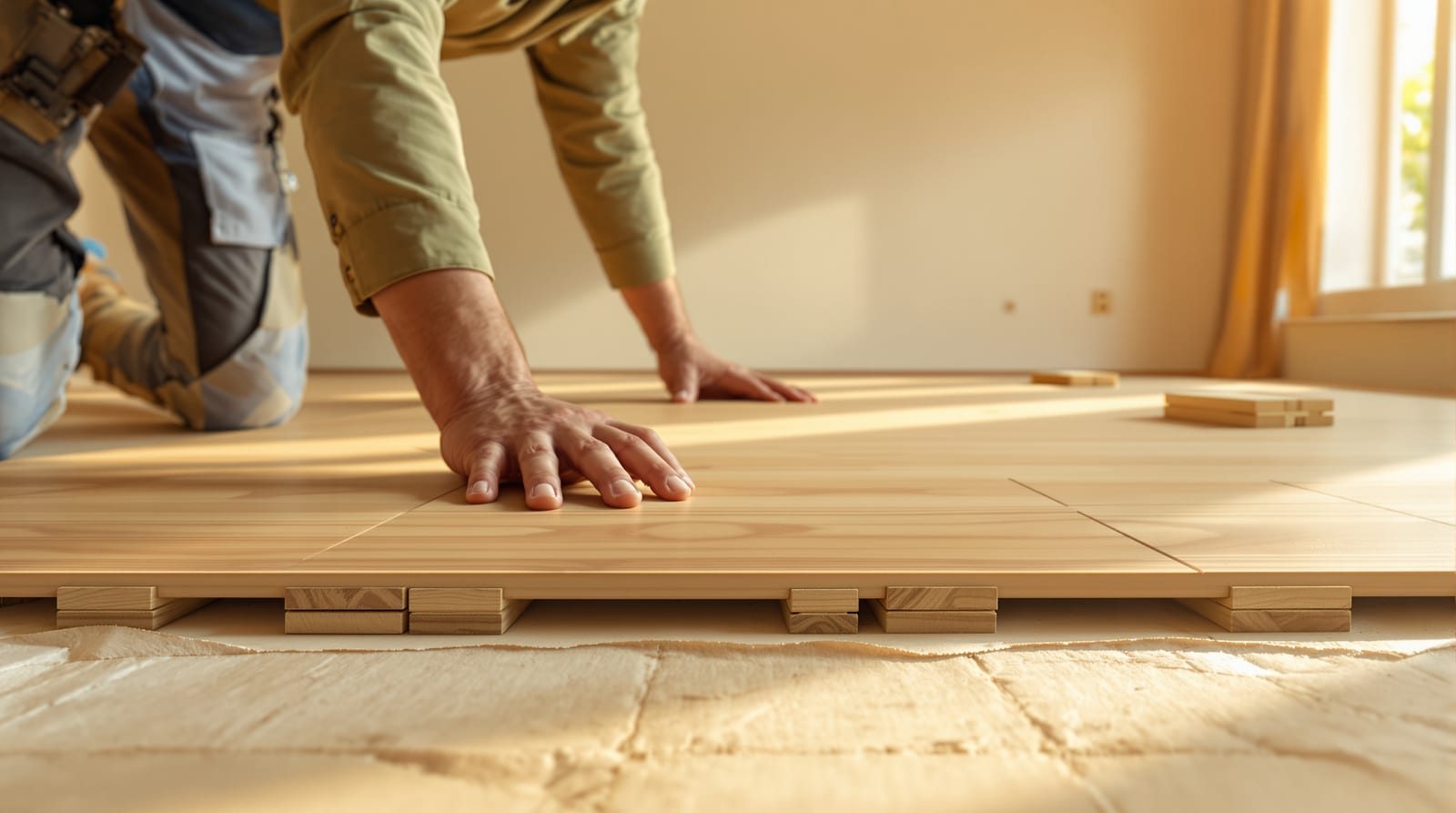
Wooden Floor Installation in India: Nail-Down, Glue-Down & Floating Methods
How solid and engineered wood floors are actually laid in Indian homes — acclimatising planks, moisture barriers, the three fixing methods, expansion gaps and labour rates that decide whether your floor stays flat or cups.
A wooden floor lives or dies in the two days before the first plank goes down. Get the moisture, the flatness and the expansion gap right and a good floor stays flat for decades. Skip them and even premium Burma teak will cup, lift and creak inside one Indian monsoon. This guide walks through how solid and engineered wood floors are genuinely installed here — the three fixing methods, what carpenters charge, and the small details that separate a floor that survives from one that fails.
The three ways wood gets fixed to the floor
Almost every wooden floor in India is laid by one of three methods. Which one you use depends mostly on what you bought — solid hardwood, engineered wood, or a click-locking plank — and on the surface underneath.
Nail-down (secret-nailing over a plywood subfloor). This is the classic method for solid hardwood and for thicker engineered boards. The carpenter first screws a marine or BWP plywood subfloor (12-18 mm) over battens or directly onto the levelled slab, then blind-nails or staples each plank through its tongue at an angle so the fixing is hidden by the next board. It gives the firmest, most traditional feel underfoot and the least movement, but it is the slowest and the most labour-heavy method, and it only works where you can fix into plywood or battens.
Glue-down (full adhesive to the screed). Here the planks are bonded directly to a flat, dry, primed cement screed with a flexible polyurethane or MS-polymer wood-flooring adhesive, trowelled on with a notched trowel. It is the standard professional method for engineered wood over concrete in India because it kills hollow sound, resists humidity movement and needs no plywood layer. It demands a genuinely flat, dry slab and the right adhesive — ordinary tile adhesive or Fevicol-type white glue is not appropriate for a full-bed wood install.
Floating click (no fixing at all). Engineered and laminate planks with a click-lock edge simply snap together into one large floating sheet that rests on a foam or IXPE underlay; nothing is glued or nailed to the subfloor. It is the fastest, cleanest and most DIY-friendly method, easy to lift and replace, and the easiest to get wrong on expansion gaps. A 200-micron polyethylene damp-proof membrane (DPM) goes under the underlay on any concrete base.
Method comparison
| Method | Best for | Subfloor needed | Speed | Labour (₹/sq ft)* | Feel & repairability |
|---|---|---|---|---|---|
| Nail-down (secret-nail) | Solid hardwood, thick engineered | Plywood over battens/slab | Slowest | 70-150 | Firmest, solid; boards replaceable with skill |
| Glue-down | Engineered wood over concrete | Flat, dry, primed screed | Medium | 60-120 | Solid, quiet; individual board repair hard |
| Floating click | Engineered & laminate click planks | Underlay + DPM over any flat base | Fastest | 35-70 | Slight give; whole rows lift out easily |
*Labour only, indicative, varies by city, plank type and site; add material, plywood, underlay and adhesive separately. GST 18% applies on materials. For your own numbers, the Studio Matrx wooden flooring cost calculator lets you combine material and labour by area.
Acclimatise the planks for 48 hours — non-negotiable
Wood breathes. A plank shipped from a cool warehouse and laid the same afternoon in a humid Chennai flat will swell after fitting and have nowhere to go but up — that is cupping and tenting. Leave the boxes flat in the actual room where they will be installed, opened or loosely stacked so air reaches them, for at least 48 hours (longer for solid wood in extreme humidity). The room should be at its normal lived-in condition — windows and AC behaving as they will day to day. This single step lets the wood reach equilibrium moisture content with your home before it is locked in place, and it is the cheapest insurance against the most common failure.
While planks acclimatise, this is also the window to confirm the subfloor is ready: clean, sound, flat and dry.
Subfloor flatness and moisture — the make-or-break checks
Flatness. Wood is unforgiving of dips and humps. Lay a 2-metre straightedge across the floor in several directions; deviation should be within roughly 3 mm under 2 m for glue-down and floating installs. Fill low spots and grind high spots, or pour a self-leveling compound for thin corrections under 10 mm. A dished or wavy slab causes hollow spots, clicking joints and eventually broken click-locks. Our subfloor preparation guide covers assessing and correcting the base in detail, and the self-leveling compound guide covers thin levelling.
Moisture and the DPM. Concrete in India holds moisture far longer than people expect, and a green or damp slab will wick water straight into the underside of the wood. New screeds need adequate drying time before any wood goes down, and in humid and coastal zones a moisture test is wise. On every concrete base, lay a 200-micron polyethylene DPM (sheets lapped and taped at joints, turned up at walls) under floating installs, or use a moisture-barrier primer under glue-down installs. No DPM under wood is a leading cause of cupping. The underlayment and moisture barrier guide explains the full stack — DPM, foam, IXPE and acoustic cork — and which goes where.
The expansion gap: 8-12 mm at every wall
The most-skipped detail and the most damaging. Wood expands and contracts with seasonal humidity, and a wooden floor must be able to grow toward the walls. Leave an 8-12 mm gap around the entire perimeter — at every wall, doorframe, pillar and fixed object — held with spacers during installation and then hidden under skirting or beading. Do not fill this gap with adhesive, grout or silicone, and do not let planks touch the wall anywhere. For floating floors longer than about 8-10 metres in any direction, or through doorways into other rooms, add an intermediate movement break with a T-profile rather than running one unbroken sheet. Pin the skirting or beading to the wall, never to the floor, so the floor can still slide beneath it.
Here is the section through a glued or nailed plank over its subfloor, with the perimeter gap and beading shown.
Layout, direction and the laying sequence
Direction. As a rule of thumb, run planks parallel to the longest wall or toward the main light source from a window — it makes a room read longer and hides joints. In narrow corridors, run planks along the length.
Plan the first and last rows. Measure the room and work out the width of the final row before you start; you do not want a 2 cm sliver against the far wall. Adjust by trimming the first row so the first and last rows are balanced. Stagger end joints between rows by at least 250-300 mm (a third to half a plank) so the floor looks random and stays strong — never line up joints in adjacent rows.
Sequence in brief: acclimatise 48 h, prep and clean the subfloor, lay DPM, lay underlay (floating) or prime (glue-down), dry-lay the first rows to set the layout, then fix method-by-method working away from your reference wall with spacers at the perimeter throughout. Remove spacers, fit beading to the wall, fit door thresholds, then keep heavy traffic and furniture off for the adhesive cure period.
What it costs, in practice
| Item | Indicative rate (2026) | Notes |
|---|---|---|
| Engineered wood material | ₹250-800/sq ft | Varies by species, thickness, brand |
| Solid hardwood material | ₹400-1500+/sq ft | Teak / oak high; +18% GST |
| Laminate (click) material | ₹80-300/sq ft | Cheapest plank option |
| Plywood subfloor (BWP/marine) | ₹70-160/sq ft installed | For nail-down |
| Underlay (foam/IXPE) | ₹15-45/sq ft | Floating installs |
| DPM (200-micron PE) | ₹8-20/sq ft | Over concrete |
| Wood-flooring adhesive | ₹150-400/kg | PU / MS-polymer, glue-down |
| Labour (method-dependent) | ₹35-150/sq ft | See method table above |
All figures indicative and vary by city and vendor; treat them as a starting point, not a quote. Compare plank families and budgets in the wooden flooring guide, and weigh build types in engineered wood vs solid wood.
Curing, first use and aftercare
After a glue-down floor, keep foot traffic off for 24-48 hours and heavy furniture off for several days while the adhesive cures fully; PU adhesives reach strength over roughly a week. Floating and nail-down floors can be walked on sooner but still benefit from a settling day. From day one, use felt pads under all furniture legs, never let standing water sit on the floor, and clean only with a damp — never wet — microfibre mop and a wood-specific cleaner. Ongoing care, recoating and scratch repair are covered in the wooden floor maintenance guide.
Other wood-family installs
If you are laying a click-locking laminate, the floating method above applies with its own underlay specifics — see the laminate flooring installation guide. The principles also overlap heavily with engineered click planks covered in engineered wood flooring. Whatever the plank, the same three rules carry: acclimatise, control moisture, leave the gap.
Frequently asked questions
Can I lay a wooden floor directly over my old tiles?
Often yes, for floating and glue-down installs, provided the tiles are well bonded (tap for hollow ones), the surface is flat within tolerance, and it is clean and dry. Lay a DPM and underlay for a floating floor, or use a suitable primer and flexible adhesive for glue-down. Check for hollow tiles first and fix or remove them, since they will telegraph movement up into the wood.
Why do wooden floors cup or lift in India?
The three usual culprits are skipping acclimatisation, no damp-proof membrane over concrete, and no perimeter expansion gap. All three trap or feed moisture the wood cannot release, so it swells and has nowhere to go but up at the edges or in the middle. Coastal and monsoon humidity make these mistakes far less forgiving than in dry climates.
Do I really need 48 hours of acclimatisation?
Yes — it is the single cheapest way to prevent failure. Leave the planks flat in the actual installation room, in normal living conditions, for at least 48 hours so they reach equilibrium with your home's humidity before being fixed. In very humid or coastal homes, allow longer, especially for solid wood.
How big should the expansion gap be?
Leave 8-12 mm around the entire perimeter — every wall, doorframe and fixed object — held with spacers and then hidden under skirting or beading. Never fill it with adhesive or silicone, and never pin the skirting to the floor. Larger floating floors also need intermediate movement breaks at thresholds.
Which method is best for an Indian apartment?
For engineered wood over a concrete slab, glue-down or floating click are the practical choices; floating is fastest and easiest to replace, glue-down feels more solid and quieter. Solid hardwood usually means nail-down over a plywood subfloor. In humid and coastal homes, prioritise engineered wood with a proper DPM over solid wood, which moves more.
Export this guide
Related Guides — Deep-dive reading
Subfloor Preparation in India: Get the Base Right Before Any Floor
Why the slab below decides whether your tiles go hollow or your wood cups — assessing, cleaning, repairing, leveling, moisture-testing, priming, screeding and laying over old tiles.
Flooring & SurfacesLaminate Flooring Installation in India: DIY Floating Floor Step-by-Step
A practical, weekend-friendly guide to laying click-lock laminate over concrete — subfloor prep, DPM and underlay, acclimatisation, staggering, expansion gaps and clean transitions.
Flooring & SurfacesEngineered Wood Flooring in India: Layers, Wear Layer, Install & Cost (2026)
Engineered wood is a real-wood top veneer bonded over a cross-laminated plywood or HDF core, which makes it far more dimensionally stable than solid wood in Indian humidity — the practical way to get a genuine timber floor here. This guide covers the layer build-up, wear-layer thickness, click vs glue-down install, where it suits, ₹/sq ft, brands and maintenance.
Flooring & SurfacesRelated Tools — Try Free
Cross-Ventilation Analyzer
Estimate airflow and air changes per hour (ACH) from room size, window areas, layout, and local wind — with NBC 2016 Part 8 compliance check.
Ventilation CalculatorWindow Maintenance Cost Calculator
Estimate annual window upkeep by frame material — yearly, per-window and 5-year cost.
Window CalculatorWooden Flooring Cost Calculator
Estimate installed wood or wood-look floor cost — solid, engineered, laminate or SPC — with underlay and skirting.
Flooring Calculator