
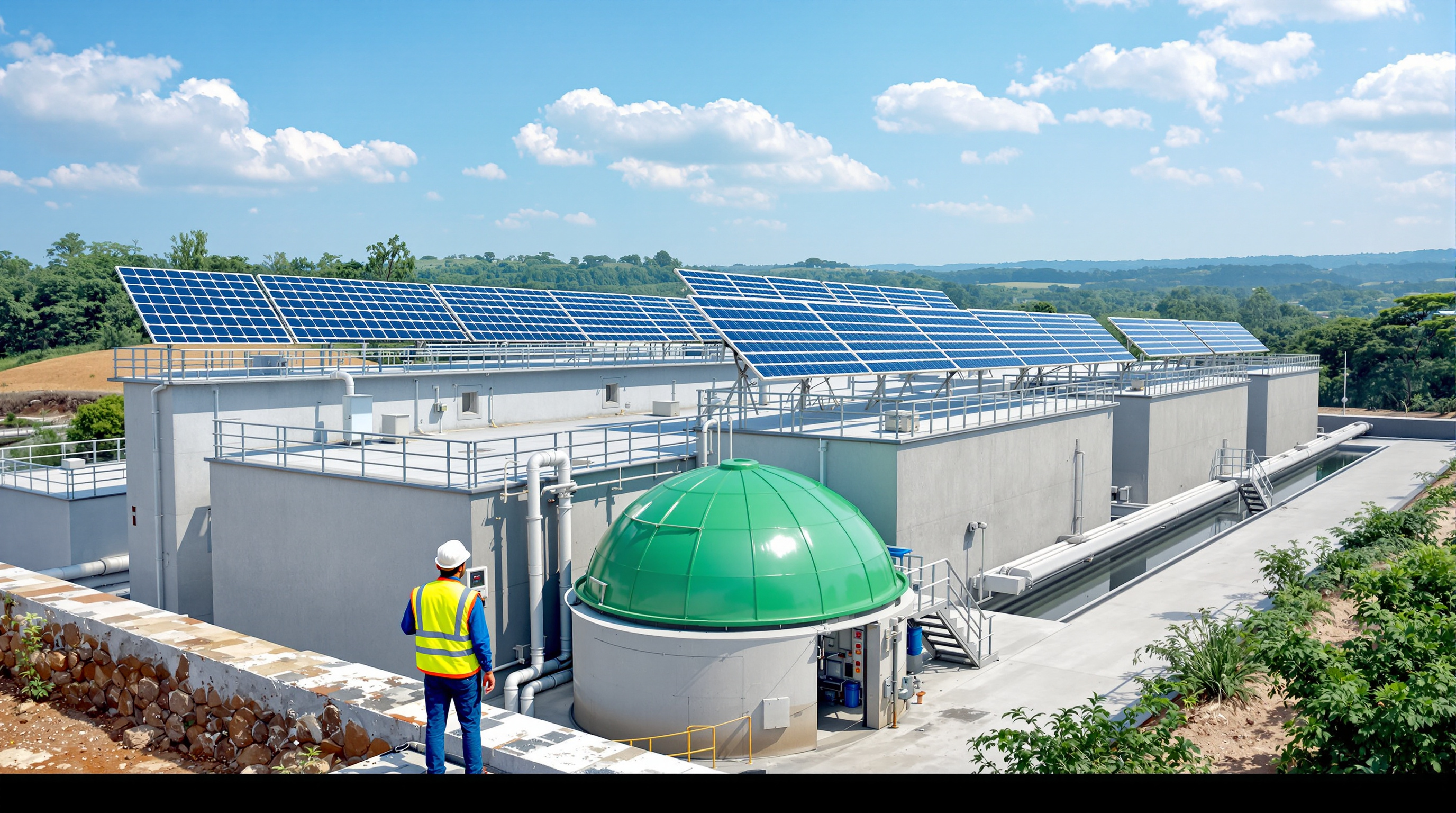
Energy-Neutral & Energy-Positive STPs: The Path from Power-Hungry to Power-Neutral
How a sewage treatment plant can approach net-zero energy — through anaerobic biogas recovery, solar power, ultra-efficient aeration and heat recovery — and how close Indian STPs can realistically get today.
An STP is one of the hungriest machines in any building. Day and night, blowers push air through the aeration tanks, pumps lift sewage between stages, and the electricity meter never stops turning. For a mid-sized plant, power is comfortably the single largest line in the operating budget — often 30 to 50 percent of the total cost of running it. So the idea of an STP that produces as much energy as it consumes sounds, at first, like wishful thinking.
It is not. The concept is called an energy-neutral STP — a plant whose on-site energy generation over a year equals the energy it draws. Push a little further and you reach an energy-positive STP, one that exports surplus power. This is not laboratory science; large municipal plants in Europe already run net-positive, and the same physics applies at Indian scale. The gap between a conventional power-hungry STP and a power-neutral one is closed not by a single miracle, but by stacking four levers on top of each other.
Sewage is not just a waste to be cleaned — it is a fuel. Every litre of raw sewage carries roughly two to four times more chemical energy than the plant needs to treat it. The whole game of an energy-neutral STP is to stop throwing that energy away.
Why a conventional STP burns so much power
To see where the energy goes, you have to know where it is spent. In a typical aerobic STP the breakdown looks like this:
| Load | Share of energy use | What it does |
|---|---|---|
| Aeration (blowers) | 45–65% | Pumps oxygen into the aeration tank to feed the microbes |
| Pumping | 10–20% | Lifts sewage, recirculates sludge, sends treated water to reuse |
| Sludge handling | 10–15% | Thickening, dewatering, mixing |
| Filtration & disinfection | 5–15% | Sand/carbon filters, UV or dosing systems |
| Lighting, controls, misc. | 5–10% | Panels, instrumentation, building services |
The lesson is blunt: aeration is the battleground. More than half the meter reading of most STPs is spent blowing air. Any serious attempt at energy neutrality has to attack that number first, then find ways to generate energy to cover what remains. We cover the demand-side tactics in depth in the guide on reducing STP electricity consumption; this guide focuses on the path all the way to net-zero.
Lever 1 — Recover the energy in the sewage as biogas
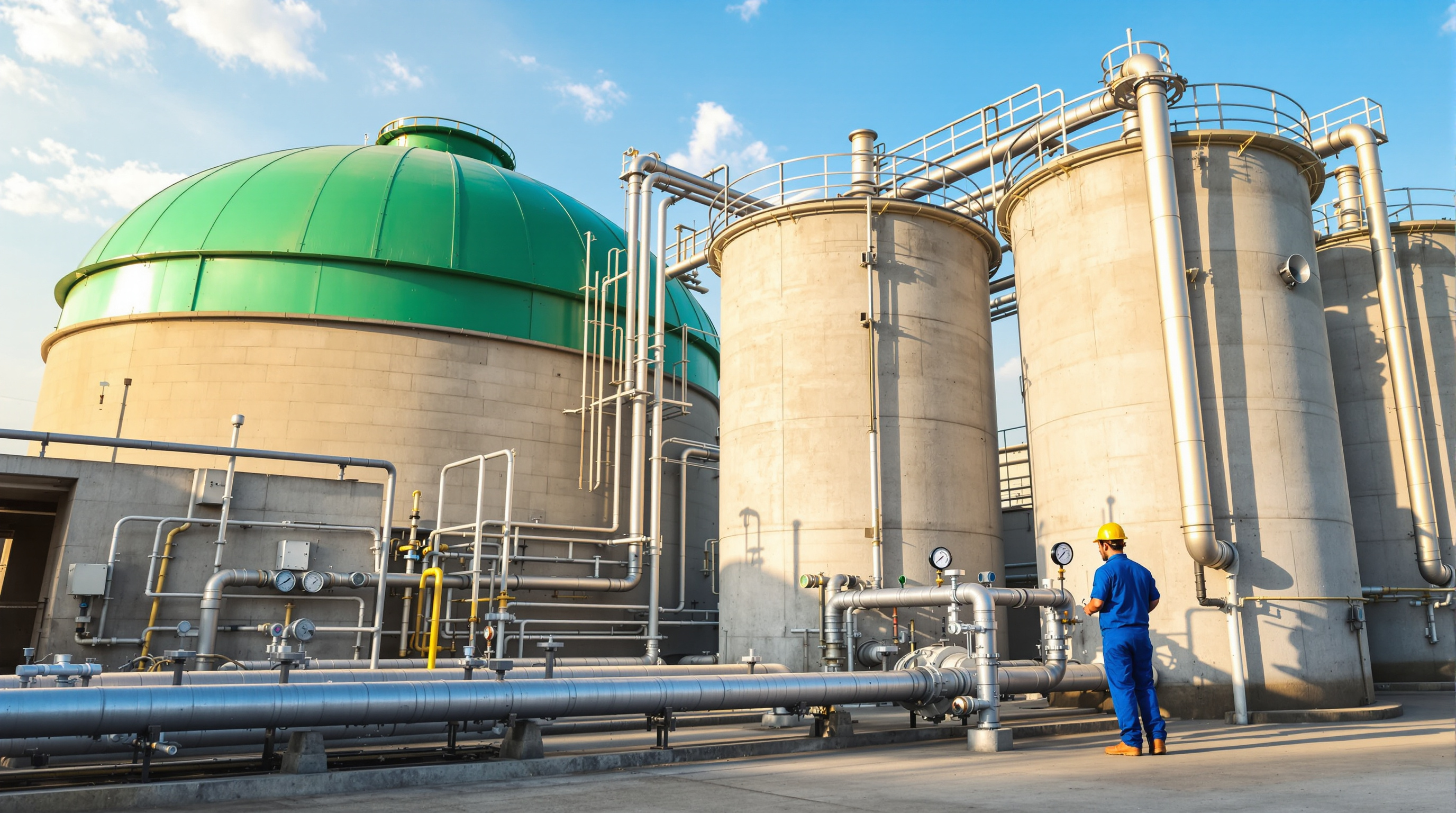
The biggest source of on-site energy is hiding in the sludge. When organic matter is broken down without oxygen — anaerobic digestion — the bacteria release biogas, a mixture that is roughly 60–65% methane. Methane burns. Feed it into a small gas engine or a combined-heat-and-power (CHP) unit and you get electricity plus useful heat, from a stream you were previously paying to treat and cart away.
This is the single largest lever toward energy positivity, and it reframes the whole plant. Instead of aerobically burning organic load away with expensive blown air, you divert as much of it as possible into an anaerobic digester where it becomes fuel. Technologies built around this principle — the UASB (upflow anaerobic sludge blanket) reactor and dedicated anaerobic digesters fed from the sludge holding tank — are the backbone of every energy-positive municipal plant. The mechanics of capturing, scrubbing and using that gas are covered in detail in the guide on biogas from sewage.
The honest caveat: biogas economics need scale and strength. A small apartment STP of a few hundred KLD, running dilute domestic sewage, rarely produces enough gas to justify an engine. Anaerobic energy recovery is where large municipal and industrial-scale plants — hundreds to thousands of KLD — do most of their winning. The bigger and more concentrated the sewage, the more decisively biogas tips the balance.
Lever 2 — Slash the aeration demand
You cannot generate your way to neutrality if the demand side is bleeding power. Before adding a single solar panel, the cheapest kilowatt-hour is the one you never use. On aeration, the modern toolkit is mature:
- Fine-bubble diffusers instead of coarse-bubble or surface aerators — far more oxygen transferred per unit of air, often cutting blower energy 25–40%.
- Turbo / high-speed blowers with magnetic or air bearings, dramatically more efficient than old positive-displacement machines.
- Dissolved-oxygen (DO) control — sensors that throttle the blowers to match the actual oxygen demand, instead of running flat-out around the clock. This alone commonly saves 20–30%.
- Variable-frequency drives (VFDs) on blowers and pumps so motors ramp to load rather than running full-tilt and wasting the excess.
These are the levers a smart, sensor-driven plant pulls automatically. Approaches like AI in STP operations and IoT-based STP monitoring exist largely to keep aeration matched to the incoming load in real time — squeezing out the over-aeration that quietly inflates most plants' bills. You can pressure-test your own plant's numbers against typical benchmarks with the Energy Benchmark Calculator.
Lever 3 — Cover the roof and land with solar
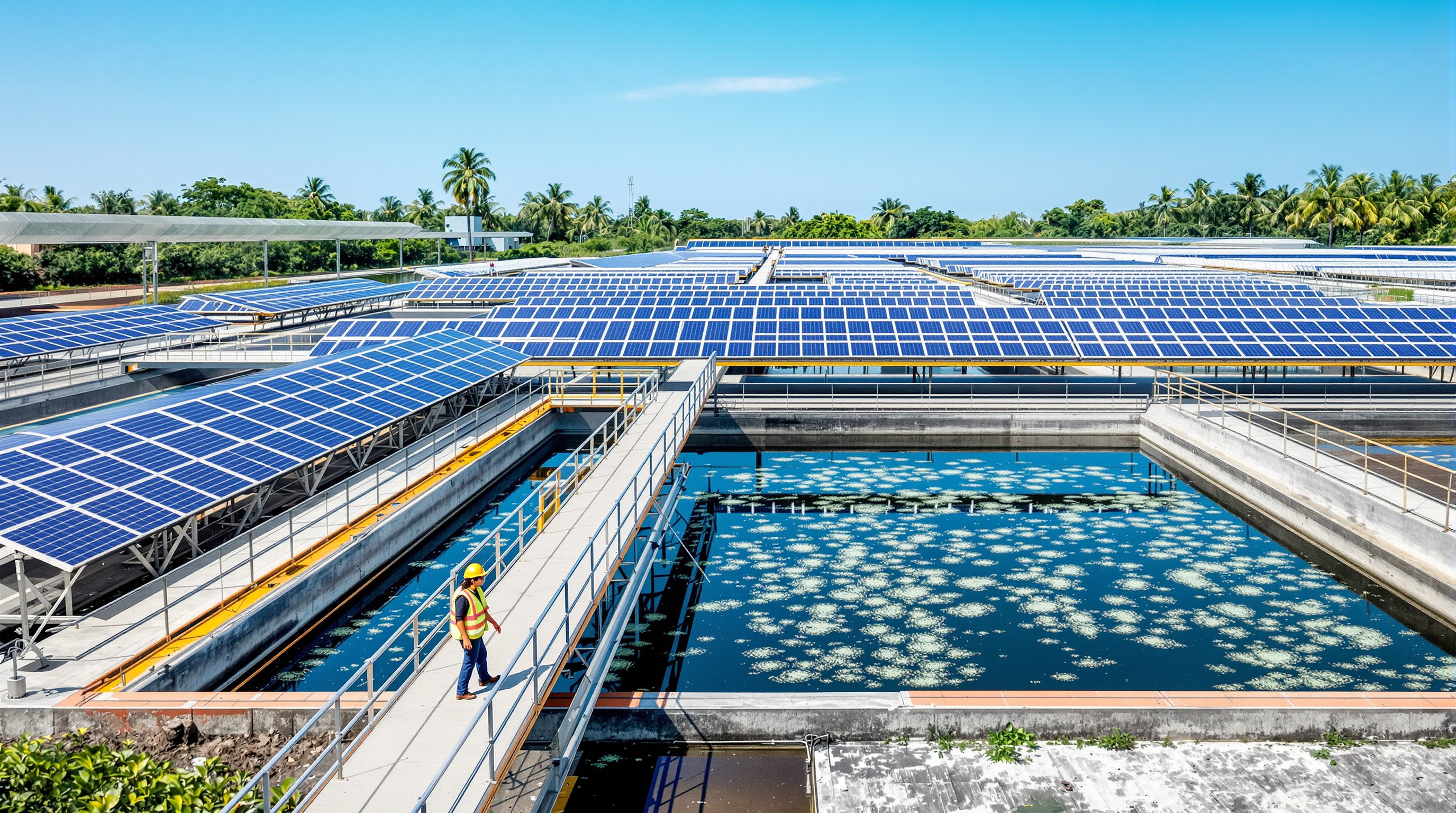
An STP has two things a solar array loves: a steady daytime electrical load, and open flat surfaces — tank tops, buildings, and often spare land around the plant. Rooftop and ground-mount solar PV can directly offset the daytime draw of blowers and pumps, and in India the economics are among the best in the world thanks to strong irradiation and falling panel prices.
Solar rarely gets a plant to neutrality on its own — it produces nothing at night, when the plant keeps running — but it is the most accessible lever for the many STPs where biogas is not viable. For a small or mid-sized building STP, the realistic ambition is not full energy neutrality but a meaningful cut: solar shaving the daytime load, efficient aeration shrinking the base demand, and the grid quietly covering the rest.
Lever 4 — Recover the heat
This is the emerging, still-maturing lever, and honesty matters here. Sewage leaves a building warm — from bathing, washing and kitchens — and that low-grade heat carries real energy. Heat exchangers on the incoming or outgoing stream can capture it to warm digesters (anaerobic bacteria work best around 35°C, so keeping the digester warm is itself an energy cost worth offsetting), or to serve building hot-water loads through heat pumps.
In cold European cities, wastewater heat recovery is a genuine district-heating resource. In most of India, where heating demand is low, the case is narrower — its main role here is keeping digesters at temperature so that Lever 1 works well, rather than exporting heat. Treat it as a supporting act, not a headline. As a category it is real and worth designing for, but do not let a vendor sell it to you as a large standalone saving in a warm climate.
How close can an Indian STP realistically get?
Stacking the levers gives a rough hierarchy of ambition:
- Small building STP (under ~500 KLD): biogas usually not viable. Realistic target is a 30–50% energy cut via efficient aeration, DO control and solar — meaningful savings, but not true neutrality.
- Large campus / township STP (500–5,000 KLD): anaerobic recovery starts to pay. Energy neutrality becomes a genuine design target, especially by pairing a UASB or digester front-end with fine-bubble aeration and a solar array.
- Municipal / industrial scale (5,000+ KLD): energy-positive operation is proven globally and increasingly feasible in India, exporting surplus power from biogas CHP.
The route to any of these runs through the same first steps: know your load, benchmark your energy, and fix the aeration before you chase generation. Start by sizing the plant correctly with the STP Capacity Calculator, then measure where you stand against peers, and only then layer on biogas and solar.
The bottom line
An energy-neutral STP is not a gadget you buy — it is the result of stacking four moves in the right order: cut the aeration demand, recover biogas from the sludge, harvest solar on the roof and land, and reclaim heat where it pays. For a small building the honest prize is a large efficiency gain rather than true neutrality; for a township or municipal plant, neutrality — and even a power-exporting, energy-positive plant — is an achievable engineering goal today. The energy was always in the sewage. The engineering just decides whether you throw it away or put it to work.
To go deeper, continue through the Sewage Treatment Plants guide library, or start on the demand side with reducing STP electricity consumption.
Export this guide
Related Guides — Deep-dive reading
Reducing an STP's Carbon Footprint: The Net-Emissions Guide
An STP burns power around the clock — but the treated water it produces displaces tankered and pumped freshwater. This guide shows how to weigh the two, then shrink the net carbon footprint with efficient aeration, solar and biogas.
Sewage Treatment PlantsDecentralised Wastewater Treatment Systems (DEWATS): Treatment at Source
What it means to treat sewage where it is produced instead of piping it miles away — the modular, low-energy, gravity-and-anaerobic DEWATS approach, its building blocks, its honest limits, and how STPs fit this philosophy.
Sewage Treatment PlantsEnergy-Efficient STP Design: How to Build a Plant That Sips Power
Aeration eats 50-70% of an STP's electricity bill. This guide shows how right-sized blowers, fine-bubble diffusers, DO control with VFDs, gravity flow and the right technology cut running cost for the life of the plant.
Sewage Treatment PlantsRelated Tools — Try Free
Apartment STP Planner
Plan an apartment complex sewage treatment plant from flats and occupancy — get population load, sewage flow, recommended STP capacity in KLD, treatment technology and approximate space.
PlannerRainwater Tank Sizer
How big should your rainwater tank be? Computes annual harvest, recommended tank capacity in litres, water-bill savings, and payback — for 10 Indian cities.
RWH CalculatorHealing View Impact Calculator
Evidence-Based Design dashboard quantifying the recovery impact of nature view + daylight factor on analgesic use, length of stay, and HCAHPS patient-experience uplift. Calibrated against Ulrich 1984 (Science), Park & Mattson 2008, and the CHD EBD evidence base.
EBD Calculator