

Security Maintenance Logbook in India (2026): The Record That Proves It Was Done
How to keep a simple security maintenance logbook at home or in an apartment building in India: the one record that proves the system is maintained, supports warranty, AMC and insurance claims, satisfies statutory fire-testing rules, catches the device that keeps failing, and survives a change of vendor or resident.
The night a security system is finally tested is the night you needed it, and by then it is too late to discover the battery was flat, the lens was dusted over, or the extinguisher was last checked three monsoons ago. Most security failures are not dramatic. They are quiet: a device that had been drifting toward failure for months, with nobody noticing because nobody wrote anything down.
A maintenance logbook is the humble fix for that. It is not clever technology. It is a plain, honest record of what was checked, when, by whom, and whether it passed. Its whole value sits behind a single rule that this guide keeps returning to: if it is not written down, it did not happen. A verbal "yes, the guard tests the alarm" is worth nothing to a warranty desk, an insurance surveyor, a fire inspector, or the next resident who inherits the building. A dated entry is worth a great deal.
This guide shows a homeowner or an apartment committee how to keep that record: why it matters, exactly what to write for each entry, the different kinds of log you actually need, whether to keep it on paper or in an app, who owns it, and how it links to the maintenance calendar. The logbook is the proof half of upkeep; the security maintenance calendar is the reminder half.
Scope and safety. This is an upkeep and record-keeping guide for homeowners and apartment (RWA) committees, not an installation manual. Keeping a logbook, pressing a test button, reading an indicator light and noting the result are all things you can safely do yourself. Anything behind them — mains electrical work, working at height, opening sealed or pressurised equipment, servicing a fire pump or sprinkler, or statutory fire-system certification — is strictly for a qualified technician or your AMC provider and a competent, licensed person. Life-safety testing (fire alarm, detectors, extinguishers, emergency lighting) is scheduled and often statutory under the National Building Code (NBC = SP 7:2026) and local fire rules, and its records must be kept and produced on demand. This is not a price guide or a buying guide; for those, follow the cross-links. Logs that hold CCTV footage, faces or vehicle numbers carry personal data under the DPDP Act 2023 and must be stored and shared with care.
Why a logbook matters more than the hardware
A neglected expensive system loses to a maintained cheap one, every time. The logbook is how "maintained" stops being a hope and becomes a fact you can show. It earns its place in six concrete ways.
- Accountability. A named entry answers the only question that matters after a failure: was this actually done, by whom, and when? Without it, everyone remembers doing it and nobody did.
- Warranty, AMC and insurance claims. When a device fails inside warranty, when you want your AMC provider to honour their contract, or when you file an insurance claim after a burglary or fire, the first thing asked for is proof of maintenance. A gap in the record can void a claim. A clean log supports it.
- Statutory fire records. Fire-equipment testing and servicing is not optional and not casual. Extinguisher refill dates, fire-alarm and detector tests, pump and hydrant checks and emergency-light tests are the kind of records a fire inspector, an insurer, or an occupancy authority can ask to see. Keeping them is part of the law, not a nicety.
- Spotting the device that keeps failing. One flat battery is a battery. The same camera going offline every third week, written down each time, is a pattern that tells you the device (or its power, or its cabling) is the real problem. The log is what turns three separate annoyances into one diagnosis.
- Handover. Vendors change. Guards change. RWA committees change every year. A resident sells and moves. The logbook is the institutional memory that walks the next person in without losing a decade of knowledge about which gate motor is temperamental and when the panel battery is next due.
- Discipline. What gets recorded gets done. The act of having to sign a line quietly enforces that the check actually happened.
What to record in every entry
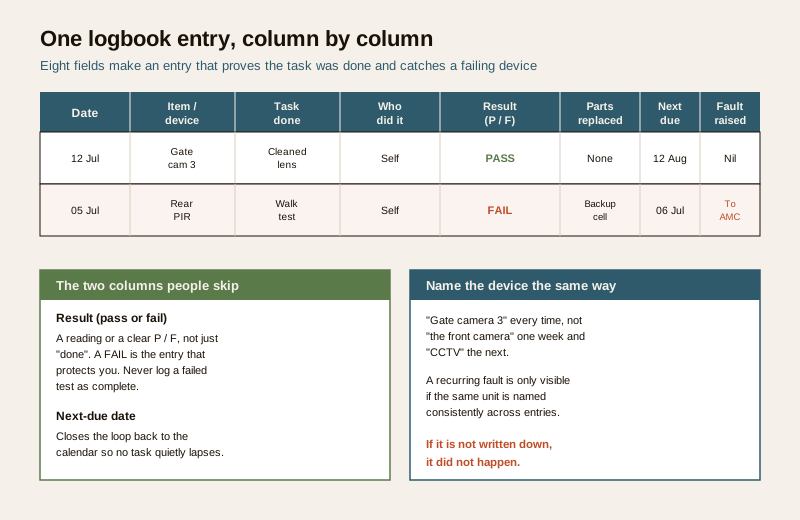
An entry is only useful if it is complete. A line that says "checked CCTV — OK" tells a future reader almost nothing. A good entry captures eight things, and they map neatly to columns you can rule on a page or set up in a sheet.
| Column | What goes in it | Why it matters |
|---|---|---|
| Date | The actual date the task was done | Anchors every claim; proves frequency was met |
| Item / device | Which unit — "Gate camera 3", "Panel battery", "Extinguisher, stilt level" | A pattern is only visible if the same device is named the same way each time |
| Task done | The specific check or service — "tested alarm", "cleaned lens", "refilled extinguisher" | Distinguishes a glance from a real service |
| Who did it | Name of the person or the AMC firm and technician | Accountability; who to ask when a question arises later |
| Reading / result (pass or fail) | The measured value or a clear pass or fail — "battery 12.4V", "siren sounded, PASS", "no response, FAIL" | A result, not just "done"; a reading trends over time |
| Parts replaced | Any consumable or component changed — "backup battery", "detector", "none" | Feeds warranty and cost tracking; explains a later change in behaviour |
| Next-due date | When this same task is next required | Closes the loop back to the calendar so nothing lapses |
| Fault raised | Any defect found and the action or ticket raised | Turns a found fault into a tracked one, not a forgotten one |
The single most-skipped column is result, expressed as pass or fail. "Done" hides a failure. "Tested, siren did not sound, FAIL, technician called" is the entry that actually protects you. Never record a task as complete when it failed; record the failure and the follow-up.
The kinds of logs you actually need
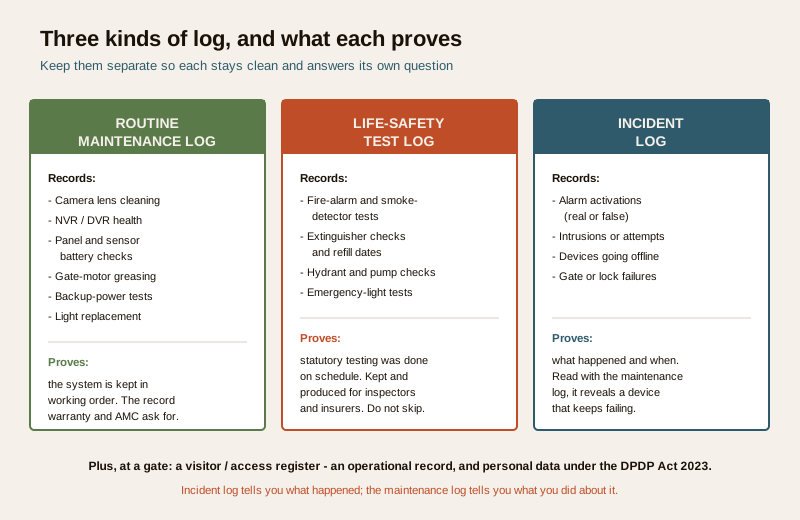
"Logbook" is not one book. In practice a home or a building keeps a few distinct logs, because they answer different questions and are read by different people. Keeping them separate keeps each one clean.
Routine maintenance log
The workhorse. Every scheduled check and service goes here — camera lens cleaning, NVR health, panel and sensor battery checks, gate-motor greasing by the AMC, light replacement, backup-power tests. It proves the system is kept in working order and is the record a warranty or AMC desk asks for. Structure it exactly on the eight columns above.
Test log for life-safety devices
Keep the life-safety tests in their own register, because they are the ones an inspector or insurer will ask for by name and because a lapse here is a life risk, not just an inconvenience. This is where fire-alarm and smoke-detector tests, extinguisher inspections and refill dates, hydrant and pump checks, and emergency-lighting tests live.
Life-safety — do not skip, and do not do yourself. Testing and certifying fire systems on schedule is often a statutory duty, and these records must be retained and produced on demand. Pressing a test button and noting the result is safe. Servicing a fire pump, recharging or hydro-testing an extinguisher, or certifying a fire-alarm panel is strictly for a competent, licensed person under NBC (SP 7:2026) and your local fire rules. Log the test; hire the service. See the fire-safety maintenance calendar for what is due when.
Incident log
Not a maintenance record but its close cousin, and it belongs in the same discipline. Every alarm activation (real or false), every intrusion or attempt, every device that went offline unexpectedly, every gate or lock failure gets a dated line. Read alongside the maintenance log, the incident log is what reveals a recurring fault: a sensor that false-alarms every windy night, a camera that keeps dropping off the network. The incident log tells you what happened; the maintenance log tells you what you did about it.
Visitor and access log (context)
Guarded and gated buildings keep a visitor or access register at the gate. It is an operational security record, not a maintenance one, but it lives in the same family of "write it down" discipline and is frequently the first record read after an incident. Keep it, and remember that a visitor register — like CCTV footage — holds other people's personal data under the DPDP Act 2023, so store it securely and do not leave it open on a desk for anyone to read.
How the logbook links to the calendar and the audit
The logbook does not work alone. It is one part of a simple loop that keeps a system honestly maintained, and understanding the loop is what stops the book from becoming a dead formality.
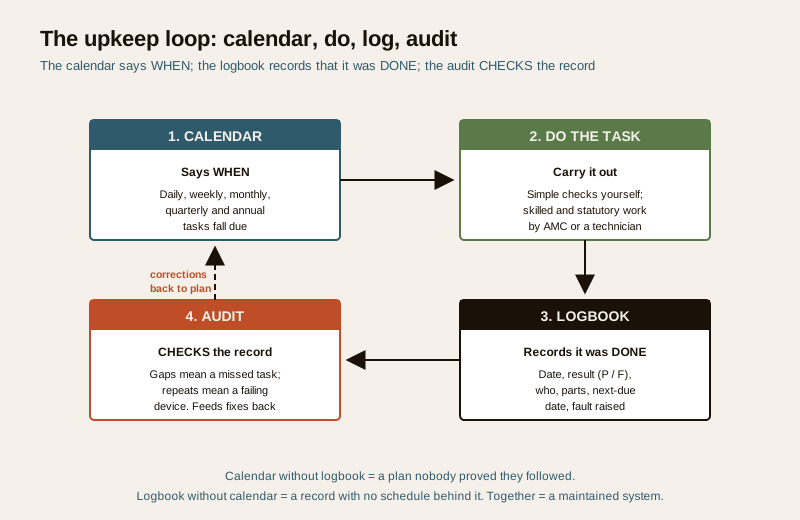
- The calendar says when. The security maintenance calendar is the schedule — daily, weekly, monthly, quarterly and annual tasks and when each falls due.
- You do the task. Simple checks yourself; skilled and statutory work by your AMC provider or a qualified technician.
- The logbook records that it was done. With the date, the result, and the next-due date — which quietly feeds back into the calendar.
- The audit checks the record. Periodically, someone reads the log itself, looking for gaps (a task with no entry means it was missed) and for patterns (a device that keeps failing). That is the job of the security maintenance audit.
The calendar without the logbook is a plan nobody proved they followed. The logbook without the calendar is a record with no schedule behind it. Together they are a maintained system. All of this sits under the broader upkeep discipline in the security system maintenance guide and the security maintenance hub.
Paper, spreadsheet or app — which to keep
There is no single right answer; there is a right answer for your building. Each format trades away something.
| Format | Strengths | Weaknesses | Best for |
|---|---|---|---|
| Paper register | Simple, cheap, no login, a physical signature carries weight, works in a power cut | Can be lost, damaged by damp, hard to search, no reminders, one copy only | A single home; a small building; the gate visitor register |
| Spreadsheet | Searchable, sortable, easy to copy and back up, filter by device to spot patterns | Needs a computer and some discipline; easy to fudge dates; no built-in reminders | An RWA committee comfortable with a shared sheet |
| Maintenance or AMC app | Reminders, photos, timestamps, multi-user, cannot lose it, the AMC firm may provide one | Subscription or vendor lock-in, needs phones and a network, data sits with a third party | A larger complex, or where the AMC already runs one |
Two honest cautions. First, an app that only the vendor can read is a handover risk — if you change vendors, make sure the records leave with you. Second, whatever the format, a signature or a named user against each entry is what gives the record its weight; an anonymous tick is easy to backfill and hard to trust. Many buildings run a hybrid: a paper register at the gate for daily guard checks, and a spreadsheet or app for the scheduled and AMC work.
Who owns it and where it lives
A record with no owner rots. Someone must be named as responsible for the logbook: in a home, usually the owner; in an apartment building, the RWA secretary or the appointed facility manager, with the AMC provider filling in their own service entries. Keep it somewhere fixed and known — not in one person's private drawer — so it survives that person leaving. Back it up: a paper register should be photographed periodically; a spreadsheet or app should have a copy that the committee, not only the vendor, can reach. On handover to a new committee, a new resident or a new vendor, the logbook is one of the first things that changes hands.
A logbook structure you can copy
Rule up a page, or open a sheet, with these columns. This single structure serves the routine and the test log; the incident log swaps a couple of columns for "what happened" and "action taken".
| Date | Item / device | Task done | Who did it | Reading / result (P/F) | Parts replaced | Next due | Fault raised |
|---|---|---|---|---|---|---|---|
| 12 Jul 2026 | Gate camera 3 | Cleaned lens, checked view | Self | Clear image, PASS | None | 12 Aug 2026 | Nil |
| 12 Jul 2026 | Alarm panel | Pressed test, checked battery | AMC (S. Kumar) | Siren OK, battery 12.4V, PASS | None | 12 Oct 2026 | Nil |
| 12 Jul 2026 | Extinguisher, stilt | Checked pressure and refill date | Self | Gauge in green, PASS | None | Refill Mar 2027 | Nil |
| 05 Jul 2026 | Rear PIR sensor | Tested walk-through | Self | No trigger, FAIL | Backup cell | Retest 06 Jul | Raised to AMC |
A quick checklist
- One named owner for the logbook; a fixed, known place to keep it; and a backup the committee can reach.
- Every entry carries all eight fields — never skip the pass-or-fail result or the next-due date.
- Separate registers for routine maintenance, life-safety tests, and incidents.
- Life-safety test records kept and retained for inspection; the servicing itself done by a competent, licensed person.
- Read the log periodically, not just to fill it: gaps mean a missed task, repeats mean a failing device.
- A signature or named user against each line; never mark a failed test as done.
- On any change of vendor, resident or committee, hand the logbook over.
The logbook is the least glamorous part of a security system and quietly the most important. Hardware fails silently; the record is what breaks the silence. Keep it faithfully, read it honestly, and the night you finally need the system, you will already know it works — because it is written down.
Export this guide
Related Guides — Deep-dive reading
Security Maintenance and Audit Guide for Indian Homes
The neglected half of home security — keeping the system actually working. Why defences silently decay, a weekly-to-annual maintenance schedule (task, frequency, who), how to periodically re-audit and re-score your home, and how to hold your AMC vendor and guards accountable. India-grounded, plain language.
SecuritySecurity System Maintenance Guide (2026): Keeping a Home Security System Working the Night It Matters
The master framework for maintaining a home or building security system in India — the layers to keep working, a daily-to-annual master schedule, the DIY-safe versus professional-only split, when an AMC earns its keep, statutory life-safety servicing, and the discipline of records that ties the whole maintenance library together.
SecurityFire Safety Maintenance Calendar for India (2026): The Year-Round Routine That Keeps It All Working
India's core fire-safety disease is installed for the NOC, then neglected. The cure is a written, owned maintenance calendar - who checks what, when - so no fire-safety element ever silently fails.
SecurityRelated Tools — Try Free
CCTV Camera Coverage & Count Calculator
Estimate how many CCTV cameras you need, the NVR channels, storage in TB for your retention period, and an indicative all-in cost with GST.
CCTV CalculatorPre-Possession Inspection Checklist
Inspect your flat before registration — 10 categories, 70+ checkpoints across legal, carpet area, structure, finishes, and deviations.
Homebuyer ChecklistCCTV Cloud vs Local Cost Calculator
Compare cloud CCTV subscription against a local NVR + HDD — upfront, 5-year total, monthly fee and break-even.
Cloud vs Local