
Electrical Wire Colour Codes in India: Live, Neutral & Earth Explained
What the colours of the wires actually mean — the Indian wiring colour convention for live, neutral and earth (and the three phases), why it matters for safety, and the honest caution about never trusting colour alone in old or DIY wiring.
Open any switchboard and you meet a bundle of coloured wires — and those colours aren't decorative. They tell an electrician (and you) which wire is live, which is neutral and which is earth, so the installation is wired consistently and safely. Knowing the Indian wiring colour convention helps you understand your home's electrics and spot obvious wrongness — with one crucial caveat: never rely on colour alone to assume a wire is dead. This guide explains the colour codes and how to think about them.
It is a wiring deep-dive in the Electrical Knowledge Hub, a companion to the home wiring guide.
The safety line. Colours are for understanding, not for working live. A wire's colour is not proof it's safe to touch — only a licensed electrician testing with proper instruments confirms that. Never open live wiring or trust colour to tell you a conductor is dead.
The Indian colour convention
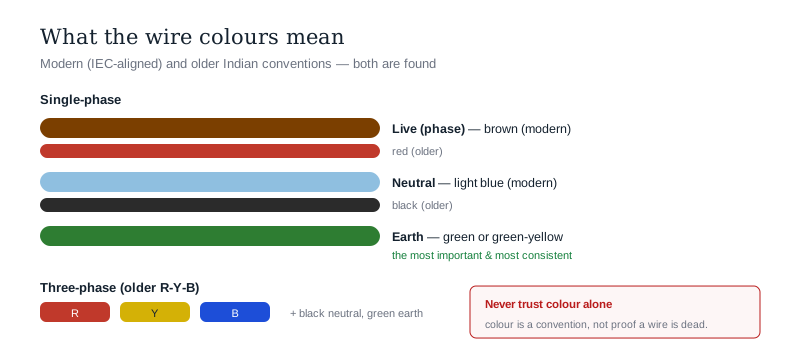
For single-phase home wiring, the modern Indian convention (aligned with IS practice) is:
| Conductor | Modern colour | Older colour (still seen) |
|---|---|---|
| Live (phase) | Brown | Red |
| Neutral | Light blue | Black |
| Earth | Green or green-and-yellow | Green |
- Live (phase) — the "hot" conductor carrying the supply. Brown in the modern convention; red in older Indian wiring (still very common).
- Neutral — the return conductor. Light blue modern; black older.
- Earth — the safety conductor to earth. Green, or green-and-yellow striped — the most consistently recognised, and the most important.
The shift from the older red/black/green to brown/blue/green-yellow follows international (IEC) harmonisation, so both are found in Indian homes depending on age.
Three-phase colours
For three-phase supplies, the three live phases are traditionally:
- Red, Yellow, Blue (the classic Indian three-phase colours, R-Y-B), with black neutral and green earth in the older scheme.
- Modern/IEC schemes use brown, black, grey for the three phases, blue neutral, green-yellow earth.
- In a home you'll mostly meet single-phase; three-phase colours matter more for larger installations and are your electrician's domain.
Why the colour code matters
- Consistency and safety — standard colours mean any electrician can work on the installation correctly, connecting live-to-live, neutral-to-neutral, earth-to-earth.
- Correct connections — appliances and switches/sockets rely on live, neutral and earth going to the right terminals; the earth especially must be connected for shock protection to work.
- Spotting obvious problems — a missing earth (no green wire) at a socket, or clearly mismatched wiring, is a visible red flag to raise with an electrician.
The honest caution: don't trust colour alone
This is the part that matters most:
- Colour is a convention, not a guarantee. Old wiring, non-standard work, DIY jobs and faded insulation can all mean a wire's colour is wrong or ambiguous.
- Never assume a wire is dead because of its colour. A "neutral"-coloured wire can be live if miswired; only testing proves a conductor is safe.
- This is exactly why live work belongs to a licensed electrician with test instruments — they verify, they don't assume.
- Use colours to understand and to spot obvious gaps (like a missing earth), then leave the work to a professional.
The one-line answer
India's wiring colour code identifies the conductors: live (phase) is brown in the modern convention (or red in older wiring), neutral is light blue (or black), and earth is green or green-and-yellow — the most important and most consistent. Three-phase supplies use red-yellow-blue (older) or brown-black-grey (modern) for the three phases. The colours give consistency, ensure correct connections (the earth especially, for shock protection), and let you spot obvious problems like a missing earth. But the essential caution is this: colour is a convention, not proof — never assume a wire is dead from its colour, because old or non-standard wiring can be miswired. Understand the colours; leave the live work to a licensed electrician who tests rather than trusts.
Where to go next
- The wiring it labels: Home Electrical Wiring Guide.
- The all-important earth: Home Earthing Guide.
- The dangers behind it: Home Electrical Safety Guide.
- Three-phase supplies: Single-Phase vs Three-Phase Guide.
References
- IS 732 : 2019, Code of Practice for Electrical Wiring Installations (conductor identification), Bureau of Indian Standards.
- IS 694 : 2010, PVC Insulated Cables for Working Voltages up to 1100 V (core colours), BIS.
- National Electrical Code of India, SP 30 : 2023, BIS: https://www.bis.gov.in/
Colour conventions vary between older and modern wiring and can be non-standard in practice; never rely on colour to assume a wire is dead. All work must be done by a licensed electrician. Verify any standard's status via the BIS catalogue before relying on it.
Export this guide
Related Guides — Deep-dive reading
Residential Electrical Systems: The Complete Guide for Indian Homes
How the electricity in an Indian home actually works — from the utility supply and meter through the distribution board, circuits, wiring, earthing and protection, to lighting, safety, energy efficiency, smart controls, solar and backup — written so a homeowner can understand, plan and judge it, and know exactly where a licensed electrician must take over.
Electrical & WiringInstalling Smart Lighting in India: A Step-by-Step Guide (Bulbs & Switches)
The two ways to make your lights smart — screw-in smart bulbs you can fit in five minutes, and in-wall smart switches that need the MCB off, a neutral wire and a licensed electrician. Tools, wiring, pairing, dimmer compatibility, testing and the problems that trip up Indian homes.
Smart HomeBathroom Electrical Safety India: 30 mA RCD/RCBO, IP Ratings & Waterproof Switches
Wet skin plus mains voltage is the deadliest combination in an Indian home. This is a practical safety guide — why the 30 mA RCD/RCBO that trips in milliseconds is non-negotiable, the IP44/IP54/IP65 rating your fittings need by zone, waterproof switches and sockets (or better, switches outside the door), proper earthing and bonding, avoiding the classic geyser-shock scenario, how to test the RCD, and what to fix in an old bathroom — all per IS 732 and IS 3043.
BathroomsRelated Tools — Try Free
Electrical Safety & Load Audit
Home electrical audit — 10 categories, 65+ checkpoints across earthing, RCCB, MCB, wiring, switchboards, appliance circuits, DG/inverter backup.
Safety AuditEarth Conductor Size Calculator
Find the minimum protective (earth) conductor size for a circuit from its phase conductor size, using the standard IS 732 / IEC 60364 rule.
ElectricalElectrical Load Calculator
Estimate a home's connected load and realistic maximum demand from its appliances, whether it needs single or three-phase supply, and a suggested main switch rating.
Electrical