
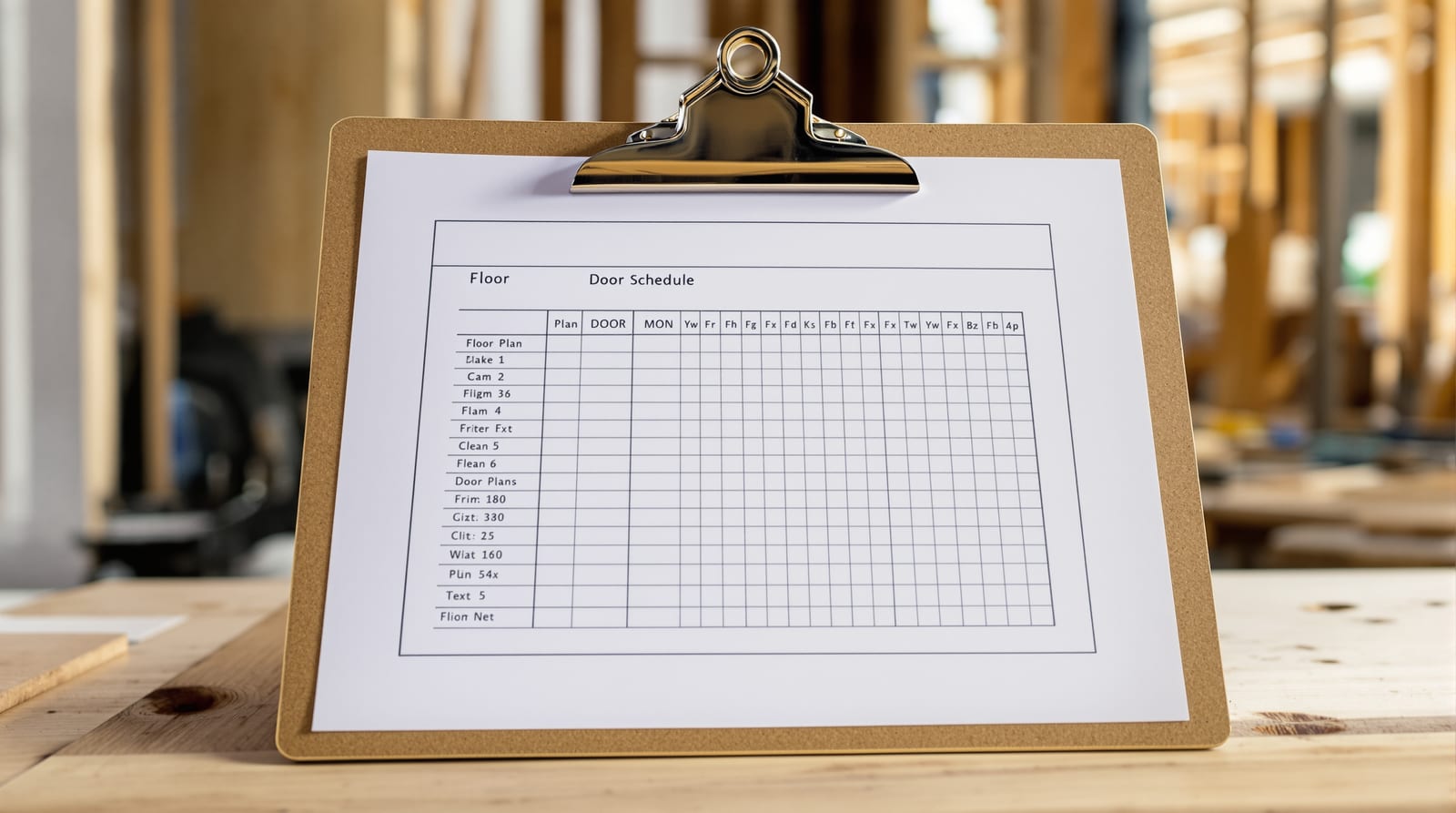
Door Schedule Guide: Reading & Preparing One (India 2026)
What a door schedule is, every column explained, and how this single table controls door procurement, fitting and snagging across an Indian project.
Every door on a project hangs off one document. The door schedule is the master table that names each door by a reference number and records, in disciplined columns, exactly what it must be: its size, leaf type, material, fire rating, handing, glazing, frame and the ironmongery set it carries. Get the schedule right and procurement, fitting and snagging fall into line; get it wrong and you order the wrong leaves, cut locks into hinge stiles and discover at handover that a fire compartment door was supplied as a plain flush leaf. This is the conceptual guide to reading and preparing a door schedule on an Indian project — what each column means, why it exists, and how the table controls the whole door package. If you want the table built for you, the door ironmongery schedule builder generates the hardware half automatically; this guide explains the thinking behind it.
What a door schedule is and why it controls the job
A door schedule is a single coordinated table — usually a sheet or spreadsheet — with one row per door (or per door-set) and a fixed set of columns describing it. It is the bridge between the architect's drawings and the site: the floor plan shows where each door sits and gives it a number; the schedule says what that numbered door is. On a contract governed by CPWD specifications and IS 1200 (methods of measurement), the schedule is also the basis of measurement and valuation — it is how the door package is priced, ordered, supplied, fitted and finally signed off.
The reason it earns its own document is control. On an Indian site with mixed-skill labour, multiple suppliers and a long programme, "the bathroom door" is hopelessly ambiguous — there may be thirty of them at three sizes and two ratings. A reference number plus a row of columns removes the ambiguity completely. The carpenter, the hardware supplier, the painter and the fire consultant all read the same row and arrive at the same door. That is why the schedule controls procurement (you order against it), controls fitting (you set out against it) and controls acceptance (you snag against it).
The schedule never works alone. It is keyed to the drawings by door numbering and tagging, it spawns the per-door hardware list in the ironmongery schedule, and on bigger jobs it is split into focused views such as the door handing schedule and the door fire-rating schedule. Together these form the door package referenced by the complete door guide.
Every column, explained
Schedules vary by office, but a competent Indian door schedule carries the columns below. Read them left to right as the door's full specification.
| Column | What it records | Why it matters |
|---|---|---|
| Reference / door number | Unique tag, e.g. D-01, GF-12 | Keys the row to the plan; one door, one number |
| Location / room | Where the door is (room, level, grid) | Lets site find the door; groups like-for-like |
| Size (W x H x thickness) | Structural opening or leaf size, mm | Drives procurement and frame order |
| Leaf type | Flush, panel, glazed, louvred, double | Sets construction and supplier |
| Material / core | Solid timber, flush ply, HDF, WPC, metal, FD core | Cost, durability, fire and moisture fit |
| Fire rating | None / FD30 / FD60 (minutes) | Life-safety; demands a tested door-set |
| Handing | LH / RH, in-swing / out-swing | Hinge and lock edge; egress direction |
| Glazing | Vision panel size, glass type, rating | Fire glass where rated; privacy elsewhere |
| Frame | Material, profile, rebate, fixing | Must match leaf and wall type |
| Ironmongery set | Set code (IM-1, IM-2...) | Points to the per-door hardware list |
| Finish | Paint, polish, laminate, factory finish | Coordinates with painter / polisher |
| Remarks | Acoustic, accessible, undercut, threshold | Catches the exceptions |
Reference / door number
The anchor of the whole schedule. Each door gets one unique reference that also appears on the plan — commonly level-and-sequence (GF-01, FF-14) or by zone. Never reuse a number; never leave a door unnumbered. The numbering convention itself is set out in door numbering and tagging.
Size, leaf type and material
Size is given as width x height x leaf thickness in millimetres, and you must be explicit whether it is the structural opening or the finished leaf — confusing the two is a classic ordering error. Common Indian leaf thicknesses are 30-35mm for internal flush and 38-45mm for main and fire doors. Leaf type (flush, panelled, glazed, louvred, single or double) and material/core (solid timber, flush ply, HDF, WPC for wet areas, metal-clad, or a tested fire core) together tell the supplier exactly what to make. For the product trade-offs behind these choices, see the door hardware guide and how to fit a door.
Fire rating, handing and glazing
These three columns carry the life-safety load. Fire rating (FD30, FD60 in minutes, to IS 3614 and NBC 2016) is not a property of a leaf alone — it demands a tested door-set: leaf, frame and ironmongery as a certified assembly, installed with continuous intumescent and smoke seals and gaps of 3mm or less around the leaf. If the schedule says FD60, the procurement, the hinges and the seals all change. Handing (left/right hand, in/out swing) fixes which edge takes the hinges and which the lock, and on escape routes the swing must follow the direction of egress — never specify a fire-escape door to swing against the flow. Glazing records vision-panel size and glass type; in a rated door it must be fire-rated glass in a tested bead. Pull handing and fire data into their dedicated views with the door handing schedule and door fire-rating schedule.
Frame, ironmongery set and finish
The frame column records material, profile, rebate depth and fixing method, which must suit both the leaf and the wall (masonry, block, drywall). The ironmongery set column is a code — IM-1, IM-2 — that points to a separate per-door list of hinges, lock, lever, closer, bolts, seals and viewer with their finishes; that detail lives in the ironmongery schedule, not in the door schedule itself, which only names the set. The finish column (paint, polish, laminate or factory finish) coordinates the painter and polisher and feeds the snag inspection later.
A worked door schedule
Here is a small worked schedule for a typical Indian floor — read each row as a complete specification a supplier could quote and a carpenter could fit.
| Ref | Location | Size W x H x T (mm) | Leaf / material | Fire | Handing | Glazing | Frame | IM set | Finish |
|---|---|---|---|---|---|---|---|---|---|
| GF-01 | Main entrance | 1050x2100x45 | Panel / solid teak | None | RH in | None | Teak, 100mm rebate | IM-1 | Melamine polish |
| GF-04 | Living to lobby | 900x2100x35 | Flush / flush ply | None | LH in | None | Sal hardwood | IM-2 | Enamel paint |
| GF-09 | Master bath | 750x2050x32 | Flush / WPC | None | RH in | None | WPC frame | IM-4 | Factory laminate |
| FF-07 | Stair lobby | 1000x2100x45 | Flush / FD core | FD60 | RH out | 300x600 fire glass | Hardwood, fire-tested | IM-3 | Fire-rated paint |
| FF-12 | Bedroom | 900x2100x35 | Flush / flush ply | None | LH in | None | Sal hardwood | IM-2 | Enamel paint |
| FF-15 | Balcony (accessible) | 1000x2100x38 | Glazed / aluminium | None | RH out | DGU, full | Aluminium | IM-5 | Powder-coated |
Notice how one column changing cascades through the whole supply chain. FF-07 is FD60, so it is procured as a tested door-set, fitted with fire hinges and intumescent seals, and accepted only when its gaps are 3mm or less and it self-closes — exactly the install-time discipline in fire-door installation compliance. FF-15 is flagged accessible, so its lever must sit in the RPwD 800-1100mm band and its threshold stay low. The IM set code on every row points to a hardware list; turn those codes into real quantities with the ironmongery schedule.
How to prepare and read a door schedule
Preparing a schedule is a coordination exercise, not data entry. Work in this order.
| Step | Action | Output |
|---|---|---|
| 1 | Number every door on the plan | Reference column populated |
| 2 | Take sizes off the openings | Size column, opening vs leaf clarified |
| 3 | Assign leaf type and material | Construction fixed per door |
| 4 | Mark fire ratings from the fire strategy | FD30 / FD60 doors identified |
| 5 | Set handing from swing on plan | Hinge and lock edge fixed |
| 6 | Allocate ironmongery sets | IM codes against each row |
| 7 | Specify frame and finish | Procurement-ready row |
| 8 | Issue, then update as as-built | Living document to handover |
To read a schedule on site, start from the door reference on the plan, find its row, and treat the row as a checklist before you cut anything: confirm the size against the opening, confirm the handing against the swing you can see, confirm the fire rating against the door-set delivered, and confirm the IM set against the hardware box. A mismatch on any one of these is a stop-work flag, not a thing to "adjust" on site. This reading discipline ties straight into the set-out work in setting out doors and the final checks in door snagging. A door schedule is a living document: as you fit, you mark up the actual sizes, ratings and hardware so the issued schedule becomes the as-built record used at handover and through the defect-liability period. Where leaf sizes are uncertain, confirm against measuring for a door before you commit the size column. To draft the hardware half of the table quickly, use the door ironmongery schedule builder.
Frequently asked questions
What is a door schedule?
A door schedule is the master table that lists every door on a project by a unique reference number, with columns for location, size, leaf type, material, fire rating, handing, glazing, frame, ironmongery set and finish. It is the single document that controls how doors are procured, fitted and accepted, keyed to the floor plan by the door numbers.
What is the difference between a door schedule and an ironmongery schedule?
The door schedule describes the doors — size, type, material, rating, handing, frame, finish — and names an ironmongery set code per door. The ironmongery schedule expands each set code into the hardware list: the specific hinges, lock, lever, closer, bolts, seals and viewer with finishes. The door schedule says which set; the ironmongery schedule says what is in it.
What columns should a door schedule have?
At minimum: reference number, location, size (width x height x thickness), leaf type, material/core, fire rating, handing, glazing, frame, ironmongery set code, and finish, plus a remarks column for exceptions such as acoustic, accessible or undercut requirements. Each row is one door, fully specified.
How do I read handing on a door schedule?
Handing records which edge takes the hinges and the swing direction, usually as left-hand or right-hand and in-swing or out-swing. Read it together with the plan: the swing arc on the drawing must match the handing in the schedule. On escape routes the swing must follow the direction of egress. See door handing and swing.
Why does the fire-rating column matter so much?
Because a rating like FD30 or FD60 is a property of the whole tested door-set — leaf, frame and ironmongery installed with intumescent and smoke seals — not of the leaf alone. If the schedule says FD60, the procurement, hinges, seals, gaps and signage all change. Treat the fire column as a life-safety instruction, governed by IS 3614 and NBC 2016, and verify install compliance via fire-door installation compliance.
Is the door schedule used for measurement and payment?
Yes. On contracts following CPWD specifications and IS 1200, the door schedule is the basis for measuring and valuing the door package — doors are counted and priced against their schedule rows, and the as-built schedule supports the final account and the defect-liability snagging.
Export this guide
Related Guides — Deep-dive reading
Door Fire Rating Schedule in India: FD30/FD60 Compliance 2026
How to schedule fire-rated doors across a project, record FD30/FD60 ratings, match certified sets and prove compliance at procurement and fitting.
Home Doors & EntrancesDoor Trades Coordination: Fitting Sequence on Site (India 2026)
How carpenter, mason, electrician and painter hand off work in the right order so doors fit without rework on an Indian site.
Home Doors & EntrancesFire-Door Installation Compliance: India 2026 Fitting Guide
Getting a fire door right at fitting — certified set, gaps under 3mm, continuous seals, fire-rated hinges, self-closing and signage to NBC 2016 and IS 3614.
Home Doors & EntrancesRelated Tools — Try Free
Fire Door Rating Checker
See the likely fire-door rating (30/60/90/120 min) and components a location needs per IS 3614 / NBC — guidance, confirm with your architect.
Compliance ToolMaterial Schedule Generator
Generate a room-wise finish schedule — walls, floors, ceilings, trim, and joinery by location.
Material ScheduleDoor Ironmongery Schedule Builder
Build a per-door ironmongery schedule — hinges, lock, lever, closer, seals, bolts — with an indicative hardware cost and GST.
Schedule Builder