
Door Inspection Checklist for Fitted Doors: India 2026
A post-fit inspection checklist a supervisor or homeowner can run on a hung door: frame plumb, gaps and reveal, swing, latch, hardware heights, seals, finish and fire-door items.
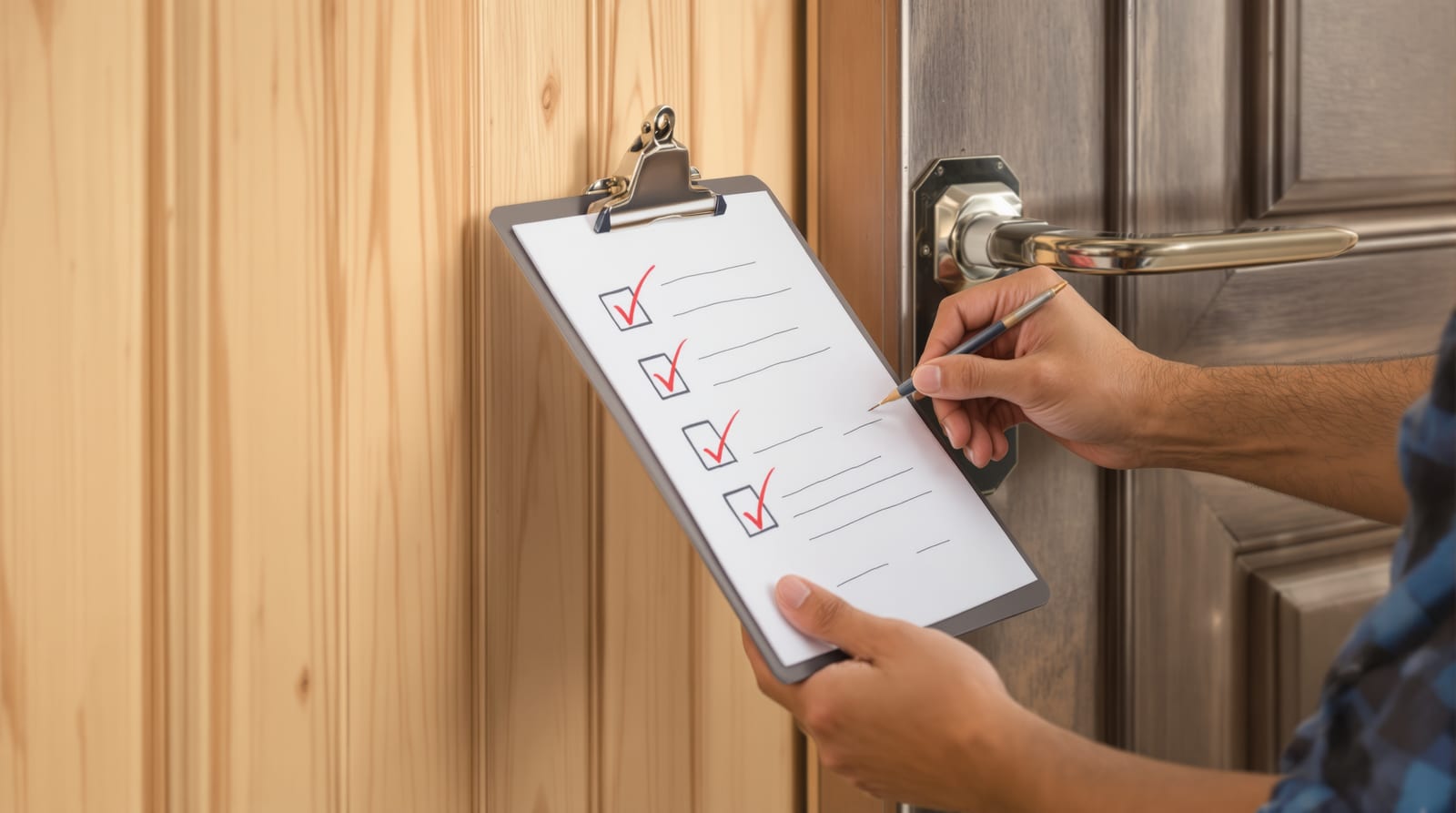
Once a leaf is hung and the hardware is on, somebody has to walk up to the door and decide whether it is right. This door inspection checklist is the post-fit test you run on a finished, fitted door before you accept it: a head-to-toe, frame-to-finish punch that a site supervisor, contractor's QA engineer, or a homeowner managing a fit-out can run in a few minutes per leaf. It is deliberately different from the door installation checklist, which guides you during the install — the order of fixing the frame, hanging the leaf and mounting hardware. This piece assumes the door is already up: you are now inspecting the result against clear acceptance criteria, marking defects, and deciding pass or snag.
Run it the same way every time and in the same order, because the faults compound. A frame that is out of plumb throws the reveal off, which makes the door bind or self-swing, which makes the latch miss. Start at the frame and work outwards, and most defects explain themselves.
How to use this checklist
Inspect with the leaf at the door, a 600 mm and a 1200 mm spirit level, a tape, a feeler gauge or a 2-4 mm spacer, and a torch for the finish. Open and close the door several times, both quietly and at speed. Mark every fail against the door reference from the door schedule so the defect ties back to a numbered opening — see door numbering & tagging for keeping site references straight. A failed item becomes a line on the door snagging punch list, not a verbal grumble.
The rule of thumb across the whole inspection: even 2-4 mm margins, frame plumb to within ±1.5-2 mm, a leaf that is flat with no visible bow, that operates with one hand, latches first time, and self-closes fully where a closer is fitted, with a finish free of runs and scratches. Those tolerances follow good-practice workmanship under IS 1200 (measurement and workmanship) and NBC 2016; for the formal pass/fail bands see door acceptance criteria.
The eight inspection stations
| # | Station | What you check | Pass criterion (rule of thumb) |
|---|---|---|---|
| 1 | Frame | Plumb on both jambs, level head, square corners, fixings hidden | Plumb ±1.5-2 mm over height; head level; no rock |
| 2 | Gaps / reveal | Margin all round the leaf | Even 2-4 mm; threshold per spec |
| 3 | Leaf | Flat, no bow, lippings intact, handing correct | No visible bow; correct swing & hand |
| 4 | Swing | Opens and closes freely, no bind, no self-swing | One-hand operation; stays where left |
| 5 | Latch & lock | Latches first time, bolt throws, key works | Latches once, cleanly; bolt fully home |
| 6 | Hardware heights | Lever, lock, viewer, bolts at set-out heights | Lever ~900-1050 mm; viewer ~1400-1500 mm |
| 7 | Seals | Weather / intumescent / smoke seals continuous | Unbroken, correct type, not painted over |
| 8 | Finish | Paint / polish, edges, glazing, cleanliness | No runs, scratches, chips; glazing secure |
Work them in this order. The detail for each follows.
1. Frame
Stand the long level on each jamb in turn: both should read plumb to within ±1.5-2 mm. Lay it across the head for level, and check the frame is square (equal diagonals) and not racked. Push the frame at mid-height — a frame that rocks or springs is under-fixed. Confirm fixings are concealed or plugged. A frame that fails here is the root cause of most downstream binds; see door frame plumb & level.
2. Gaps and reveal
Run your eye, then your feeler gauge, around the whole perimeter. The margin between leaf and frame should be even at 2-4 mm on the hinge side, lock side and head. A tapering gap means the frame or hinges are off; a tight spot means binding to come. The bottom gap follows the spec — undercut for carpet or ventilation, or a tighter sealed gap. For the dedicated drill-down, run the door gap inspection routine, which covers reveal measurement and what each gap fault means.
3. Leaf
Sight along the leaf face and edge for bow — a visibly bowed leaf will never seal evenly. Check the lippings and edges for chips, the handing matches the schedule (door swings the way the drawing says — see door handing & swing), and any vision panel or louvre is the specified type and is secure.
4. Swing
Open and close the door slowly and then briskly. It should swing freely with one hand, with no binding at any point in the arc, no scraping the floor or threshold, and no rubbing the frame. Released part-open, it should stay put — a leaf that self-swings open or closed signals a frame out of plumb or hinges not seated true. Listen for squeak. Formal operation testing is covered in door operation testing.
5. Latch and lock
The latch must spring home and hold on the first close, not on the second attempt or after a shoulder. Throw the deadbolt — it should travel fully into the keep with no fouling. Turn the key from both sides; operate the lever to retract the latch smoothly. A door that needs two goes to latch is a snag, not an acceptable door.
6. Hardware heights and operation
Measure the set-out heights against the schedule and accessibility guidance. The lever centre should sit around 900-1050 mm (≈1000 mm common); under the RPwD Act and the Harmonised Guidelines, accessible doors must have lever handles, not knobs, operable one-handed at a reachable height. The mortise-lock keep mirrors at ~900 mm; a door viewer sits ~1400-1500 mm; tower and flush bolts top and bottom. Cross-check with the door hardware height calculator and confirm hardware is tight, square and not loose on its fixings.
7. Seals
Weatherstripping should be continuous and contact the leaf without forcing it. On a fire door, the intumescent and smoke seals must be continuous in the frame or leaf rebate, the correct tested type, and not painted over, trimmed short, or missing at corners — a broken seal voids the rating. (Fire-door items get their own station below.)
8. Finish
Under a raking torch, inspect for paint runs, brush marks, scratches, chipped lippings, filler showing through, and dust nibs. Check polish is even, glazing beads are mitred and secure, and the door and frame are clean. Finish defects are catalogued in door finish defects, and the wider catalogue in common door defects.
Fire-door inspection items (life-safety — never waive)
A fire door-set is inspected to a higher bar because the items are life-safety, not cosmetic. These are install-time integrity checks; for the ongoing regime read fire door maintenance & inspection, and for install-time compliance fire door installation compliance.
| Fire-door item | What to verify | Acceptance |
|---|---|---|
| Certified set | Leaf, frame and ironmongery match the tested set | As-tested; no substituted parts |
| Leaf-to-frame gap | Feeler-gauge the perimeter | ≤3 mm (4 mm max), even |
| Threshold gap | Gap at the bottom | Typically ≤8-10 mm or sealed per spec |
| Intumescent + smoke seals | Continuous in rebate, correct type | Unbroken, not painted/trimmed |
| Hinges | Count and rating | 3+ CE / fire-rated hinges, none missing |
| Self-closing | Door closes and latches unaided | Closes fully from any open angle |
| Cut-outs | Lock/viewer/vision cut-outs | No oversize breach of the core |
| Signage | "Fire door — keep shut" or as required | Present and legible |
| Rating | Minimum FD30 / FD60 as specified | Matches schedule; IS 3614 / NBC 2016 |
A fire door that does not self-close fully and latch, or whose seals are broken, fails outright — it is not a snag to negotiate. Free egress must be maintained: the door must open in the direction of escape where required and never be obstructed.
Inspection map — one leaf, station by station
Pass, snag or reject
Three outcomes close an inspection. Pass — every station meets the criterion; sign off against the door reference. Snag — cosmetic or minor functional defects (paint run, slightly stiff latch, a margin a hair out) that go on the punch list with a rectification date and feed the door installation QA record. Reject — life-safety failures (a fire door that won't self-close or latch, broken fire seals, blocked egress) or a leaf so out of true it cannot be fettled; the door comes off and is re-hung. Tie defects back through the common door defects catalogue so each fault has a known cause and fix, and generate a clean printable punch with the door snagging checklist generator. Pull the whole new-fit and handover picture together at the complete door guide.
Frequently asked questions
How is this different from the door installation checklist?
The door installation checklist guides the work during fitting — the sequence of fixing the frame, hanging the leaf and mounting hardware. This inspection checklist is run after the door is fitted: you test the finished result against acceptance tolerances and mark pass, snag or reject. Install checklist is for the fitter; inspection checklist is for the supervisor or homeowner signing off.
What tolerances make a fitted door acceptable?
As a rule of thumb: even 2-4 mm margins all round, frame plumb within ±1.5-2 mm, a flat leaf with no visible bow, one-hand operation, latches first time, and self-closes fully where a closer is fitted, with a finish free of runs and scratches. These follow good-practice workmanship under IS 1200 and NBC 2016. See door acceptance criteria.
Can a homeowner run this inspection?
Yes — the eight stations are designed to be run by a homeowner managing a fit-out with a tape, a spirit level and a torch. The two areas to defer to a professional are fire-door integrity (certified set, gap, seals, self-closing) and any structural frame fault. Mark anything you are unsure of as a snag and ask the contractor to demonstrate it passes.
Which checks can I never waive on a fire door?
The certified set must be intact, the leaf-to-frame gap ≤3 mm (4 mm max), intumescent and smoke seals continuous and the correct type, 3+ fire-rated hinges, and the door must self-close and latch fully unaided with "keep shut" signage. These are life-safety under IS 3614 and NBC 2016 — a fire door that fails them is rejected, not negotiated.
A door latches only on the second push — pass or snag?
Snag. A door must latch cleanly on the first close. Second-attempt latching usually means the strike or keep is mis-positioned or the frame is slightly out of plumb. It goes on the punch list for rectification before sign-off; run the door gap inspection and operation tests to find the cause.
How do I record the defects I find?
Mark each fail against the numbered door reference from the schedule, note the station and the fault, and feed it onto the snagging punch list with a rectification date. Use the door snagging checklist generator to produce a clean printable list, and tie it into the project door installation QA record so nothing is closed off verbally.
Export this guide
Related Guides — Deep-dive reading
Door Acceptance Criteria: Tolerances & Tests India 2026
What 'acceptable' means for a fitted door: even gaps, frame plumb, flat leaf, one-hand operation, latches first time, clean finish — and the accept/snag/reject thresholds.
Home Doors & EntrancesDoor Operation Testing at QA: Functional Checks India 2026
The functional tests on a fitted door at handover — smooth swing, first-time latching, lock and key throw, self-closing, one-hand operation and a slam-cycle check, with clear pass criteria.
Home Doors & EntrancesDoor Snagging Guide: Inspect & Fix Defects India 2026
How to build a door snag list, inspect a fitted door systematically and clear binding, gap, latch, finish and hardware defects before handover.
Home Doors & EntrancesRelated Tools — Try Free
Fire Door Rating Checker
See the likely fire-door rating (30/60/90/120 min) and components a location needs per IS 3614 / NBC — guidance, confirm with your architect.
Compliance ToolCCTV Commissioning & Handover Checklist
An interactive go/no-go checklist to run at handover — cameras day and night, recording, alerts, passwords and documents — before you clear the final bill.
Handover ChecklistDoor Security Rating Calculator
Score your main door out of 100 across leaf, frame, lock and hardware — and see the top upgrades.
Security Tool