

Delhi STP Rules & DPCC Norms: The Complete Compliance Guide (2026)
When a sewage treatment plant is mandatory in Delhi, how the DPCC consent process works, the discharge standards you must meet, and the practical steps builders and RWAs need to stay on the right side of the National Green Tribunal.
Delhi is a city that runs on borrowed water. It draws far more than the Yamuna and its aquifers can naturally provide, tankers fill the gap in dozens of colonies every summer, and the same river that supplies the capital is also its largest sewer. That tension — acute scarcity upstream, chronic pollution downstream — is exactly why the rules governing on-site sewage treatment plants (STPs) in Delhi are among the most closely watched, and most aggressively enforced, in the country.
If you build, own or manage property in the National Capital Territory, the regulator you answer to is the Delhi Pollution Control Committee (DPCC) — Delhi's equivalent of a State Pollution Control Board, working under the Central Pollution Control Board (CPCB) framework and under near-constant supervision from the National Green Tribunal (NGT) on the Yamuna clean-up. This guide sets out what the Delhi STP rules actually require, how DPCC consent works, and how to stay compliant.
Delhi does not treat its STP norms as paperwork. With the Yamuna's Delhi stretch among the most polluted river reaches in India, the DPCC monitors plants monthly and levies environmental compensation running into crores — enforcement here is a live, expensive reality, not a theoretical risk.
Is an STP mandatory in Delhi?
There is no single Delhi law that says "every building must have an STP." Instead the obligation is assembled from several overlapping instruments, and the practical answer for most medium and large developments is yes.
- The Water Act, 1974. Anyone who sets up an outlet that discharges sewage — which a housing society, hotel, hospital or commercial complex inevitably does — must obtain the consent of the DPCC before establishing and before operating. No consent, no legal discharge.
- The national STP mandate. Following CPCB and MoEF norms, on-site sewage treatment is generally required for developments above roughly 20,000 sq m of built-up area or generating more than about 10 KLD (kilolitres per day) of sewage. Delhi broadly follows this national baseline; group-housing and large commercial projects fall squarely inside it.
- Environmental clearance. Larger building and construction projects trigger environmental clearance conditions that hard-wire an STP, treated-water reuse and monitoring into the approval itself. See our note on environmental clearance for STPs.
- Building sanction. Delhi's building-plan approval process requires clearance of water supply, sewerage and storm-water schemes from the Delhi Jal Board (DJB), MCD or DDA, which is where the STP provision is checked at the design stage.
Because these thresholds turn on floor area, dwelling-unit count and sewage volume rather than a single round number, the safe assumption for any new group-housing, institutional or commercial project in Delhi is that an STP will be a condition of both your building sanction and your DPCC consent. If you are unsure where your project falls, use the STP Capacity Calculator to size the load first, then confirm the trigger with the DPCC.
The DPCC consent process: CTE and CTO
Delhi runs the standard two-stage consent mechanism used across India, administered online through the DPCC portal.
Consent to Establish (CTE) is obtained before construction of the plant. It is Delhi's sign-off that your proposed STP — its technology, capacity and layout — is acceptable in principle. Our detailed walkthrough of the Consent to Establish (CTE) explains the stage in general terms.
Consent to Operate (CTO) is obtained after the STP is built, before it is commissioned, and confirms the plant as constructed can actually meet the norms. It is renewable, and renewal depends on your monitoring record. See Consent to Operate (CTO).
Key features of the Delhi process, per the DPCC's own consent policy and document requirements:
| Element | What Delhi/DPCC requires |
|---|---|
| Application mode | Fully online through the DPCC portal — no hard-copy submission needed |
| Key documents | Layout plan showing exact STP location; STP size, specification and capacity; ETP/STP effluent analysis reports |
| CTE validity | Granted for the build period, extendable on request (typically one to seven years) |
| CTO validity | Time-bound and renewable, tied to the unit's category |
| Processing | Complete applications are processed within a few months, subject to inspection |
For the wider picture of how state consent fits national rules, see SPCB approvals for STPs and the master overview of STP regulations in India.
Discharge and reuse standards in Delhi

This is where Delhi diverges sharply — and strictly — from the softer national baseline. Under NGT direction for the Yamuna, the DPCC prescribes tighter discharge limits than the general CPCB numbers, and monitors against them.
| Parameter | Delhi / DPCC target | Notes |
|---|---|---|
| BOD (Biochemical Oxygen Demand) | 10 mg/l | Stricter than the older 30 mg/l general norm |
| TSS (Total Suspended Solids) | 10 mg/l | Tight "10/10" BOD-TSS benchmark |
| Faecal Coliform | 230 MPN/100 ml | Disinfection is essential to hit this |
| COD, ammoniacal & total nitrogen, phosphate, pH | Monitored | Part of DPCC's routine sampling suite |
Delhi's large public STPs are being driven toward the BOD/TSS 10/10 standard on a compliance timeline, and private STPs are held to demanding norms as a condition of their CTO. The definitive figures for your specific plant and category must be confirmed with the DPCC — see our general reference on treated water quality standards. On reuse, the expectation across Indian metros, echoed in Delhi's water-stressed context and its clearance conditions, is that a substantial share of treated water is put back to work for toilet flushing, gardening, cooling and car-washing via a dual-plumbing line, rather than simply discharged.
Building bye-laws and development-authority rules
Beyond the DPCC, three local bodies shape STP obligations in Delhi:
- DDA and the Unified Building Bye-Laws. The Delhi Development Authority's building bye-laws govern sanction of group-housing and large plots, and the associated water, sewerage and drainage schemes where the STP is validated. The draft Master Plan for Delhi 2041 pushes decentralised treatment and reuse hard, though as of 2026 it remains unnotified.
- Delhi Jal Board (DJB). As the water and sewerage utility, the DJB's scheme approvals are part of the building-plan chain and it operates the city's major public STPs.
- DUAC and municipal corporations. The Delhi Urban Arts Commission reviews major projects, and the MCD/NDMC sanction plans; STP provisioning is checked here for larger developments.
For how these hooks work generally, see building bye-laws and STPs.
Monitoring and enforcement: Delhi means it
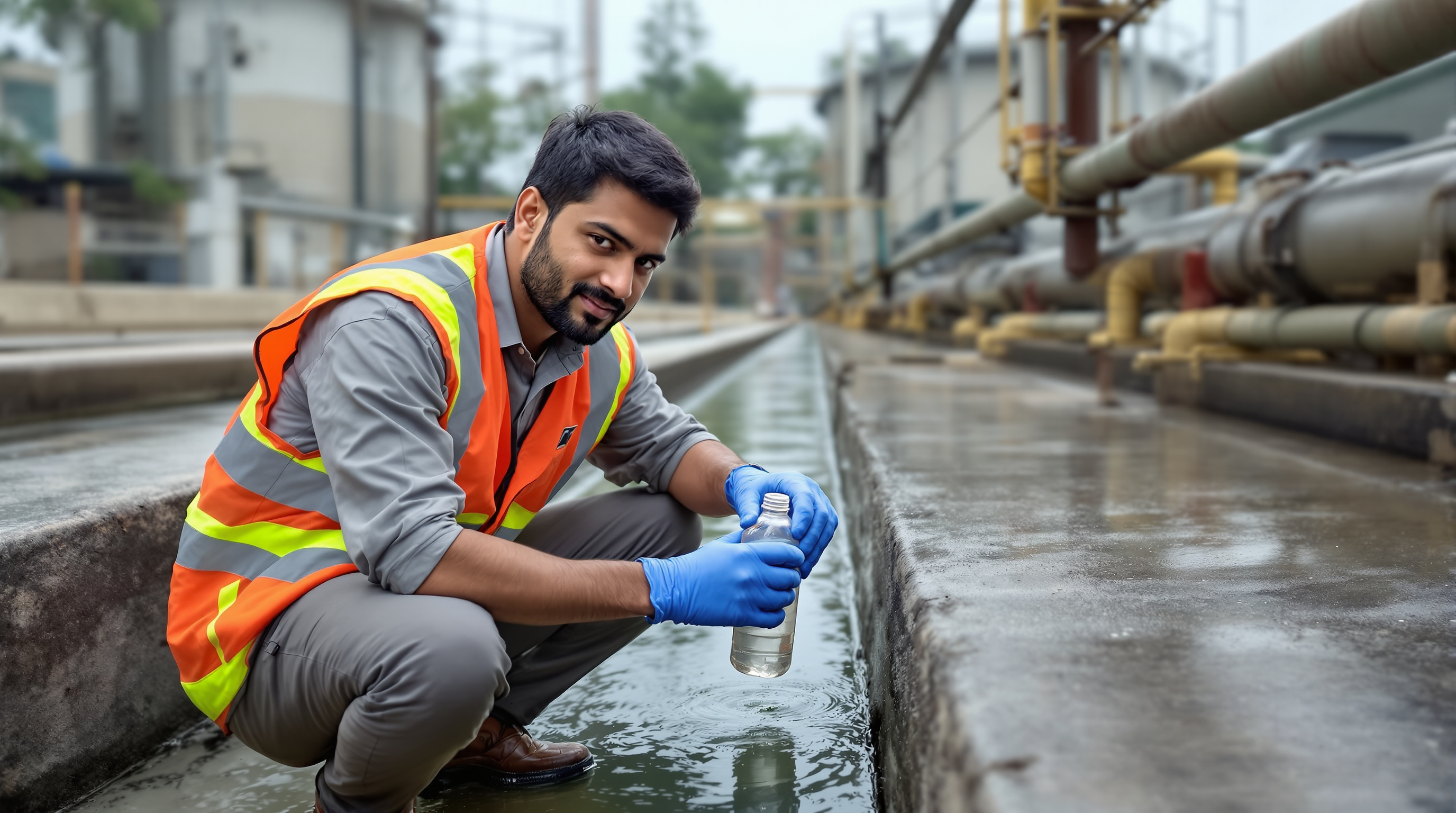
Delhi's enforcement is the sharpest edge of its STP regime. The DPCC monitors operational STPs every month, sampling pH, TSS, BOD, COD, ammoniacal and total nitrogen, phosphate and faecal coliform, and acts on the lab reports.
The consequences are real and recent. In late 2025 the DPCC issued show-cause notices and imposed environmental compensation of about Rs 2.89 crore on operators of more than 15 STPs — several run by the DJB itself — for failing discharge standards feeding the Yamuna, as reported here. Fines of up to Rs 29 lakh per plant were levied on individual STPs at Yamuna Vihar, Molarband, Vasant Kunj, Okhla and elsewhere. The lesson for private operators is unambiguous: a plant that looks compliant on the CTO but drifts out of spec in operation is exactly what the DPCC catches and penalises.
Practical compliance tips for Delhi owners and RWAs
- Size for peak, not average. Delhi's summer occupancy and water use spike; an undersized STP fails the 10/10 norm precisely when scrutiny is highest.
- Budget for real O&M. Skilled operators, power backup, and consumables (chemicals, filter media, UV lamps) are the difference between a plant that meets 10/10 and one that draws a notice.
- Keep your logbook and lab reports current. Monthly self-monitoring records are your first line of defence in a DPCC inspection and at CTO renewal.
- Install and actually use the reuse line. A functioning dual-plumbing system cuts your tanker and freshwater bills and demonstrates good-faith compliance.
- Renew the CTO on time. Lapsed consent is itself a violation, independent of water quality.
- For RWAs and associations, treat STP compliance as a standing governance item — see apartment association STP compliance and the practical STP compliance checklist.
The bottom line
In Delhi, an STP is not a box to tick — it is a live regulatory relationship with the DPCC, sitting under the NGT's Yamuna spotlight. Secure your CTE before you build, your CTO before you operate, hit the 10/10 BOD-TSS and 230 MPN faecal-coliform benchmarks in practice, reuse what you treat, and keep your monitoring records straight.
A note on accuracy: STP rules, thresholds, fees and standards change, and several are set case-by-case by category. Treat this guide as an orientation, not legal advice, and confirm the current position directly with the Delhi Pollution Control Committee before you file. To compare Delhi with its neighbours, see Haryana, Uttar Pradesh and the state-wise STP approval comparison, or return to the full Sewage Treatment Plants guide library.
Export this guide
Related Guides — Deep-dive reading
Punjab STP Rules & PPCB Norms: The Complete Compliance Guide (2026)
When an on-site sewage treatment plant is mandatory in Punjab, how the Punjab Pollution Control Board (PPCB) consent process works, what the building byelaws demand, and how owners and RWAs stay compliant amid the state's intense NGT-driven enforcement.
Sewage Treatment PlantsApartment Association STP Compliance Guide: CTO, Monitoring, Records & Penalties
A practical, honest compliance playbook for RWAs and facility managers running a sewage treatment plant — how to keep your Consent to Operate valid, what to monitor and record, the notices that catch associations out, and how to stay on the right side of the CPCB, your SPCB and the NGT.
Sewage Treatment PlantsKarnataka STP Regulations & KSPCB Norms: The Complete 2026 Compliance Guide
When an STP is mandatory in Karnataka, how the KSPCB consent process works, the discharge and reuse standards your treated water must meet, and what apartment owners and RWAs in Bengaluru must do to stay compliant — explained plainly.
Sewage Treatment PlantsRelated Tools — Try Free
CPCB Compliance Checklist for STPs
Tick off CPCB/SPCB outlet standards, monitoring duties and record-keeping to score your sewage treatment plant's compliance readiness.
ChecklistRainwater Tank Sizer
How big should your rainwater tank be? Computes annual harvest, recommended tank capacity in litres, water-bill savings, and payback — for 10 Indian cities.
RWH CalculatorSTP Compliance Checklist Tool
Interactive self-audit that ticks off STP consents, discharge norms, reuse metering, online monitoring and O&M records to give a live compliance readiness score.
Checklist