
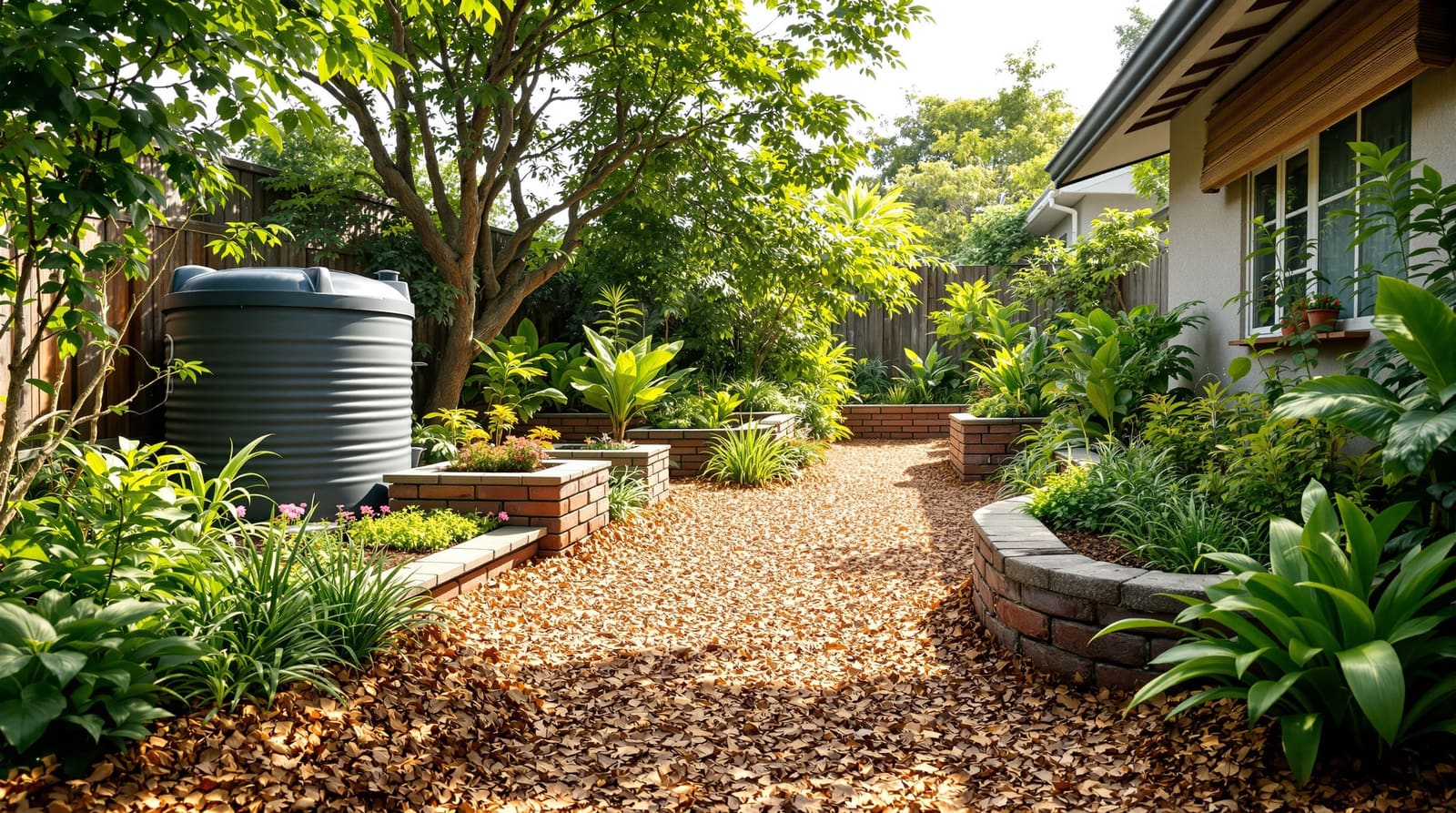
Climate-Resilient Gardens — Designing for Extreme Weather
Designing a garden to survive and recover from heatwaves, cloudbursts and floods, drought and water cuts, and storms — diversity, soil, water redundancy, tough natives and a triage plan
A resilient garden is not the one that looks perfect in a brochure — it is the one still standing after a 46°C heatwave, a 200 mm cloudburst and a six-week tanker summer, because it was designed to absorb shocks rather than resist them. As India's weather grows more violent and less predictable, the question for a home garden is shifting from "what will thrive here in an average year?" to "what will survive — and bounce back from — the worst week of the decade?" This guide is about designing for that worst week.
The narrow lane: resilience, not routine
This is deliberately not a primer on which plants suit a hot-dry versus warm-humid zone, nor a guide to drip irrigation or xeriscaping. Those are covered in depth and you should treat them as prerequisites:
- For the zone-by-zone framework, start with Climate-Responsive Landscape Design.
- For everyday water efficiency — drip, hydrozoning, mulch, recharge — see Sustainable Water Management in the Landscape.
- For slowing and sinking heavy rain, see Rain Gardens Explained.
- For wind-firm planting and shelter, see Designing Wind-Friendly Landscapes.
What follows assumes you have a climate-appropriate planting palette already, and asks a harder question: how do you make that garden robust to extreme events — the record temperatures, the burst clouds, the failed monsoons and the line squalls that are becoming routine? Resilience is the capacity to take a hit and recover, not the capacity to avoid hits. A garden engineered only for the average year is brittle; one designed for the extremes is, by definition, more than comfortable in normal weather too.
The four shocks an Indian garden now faces
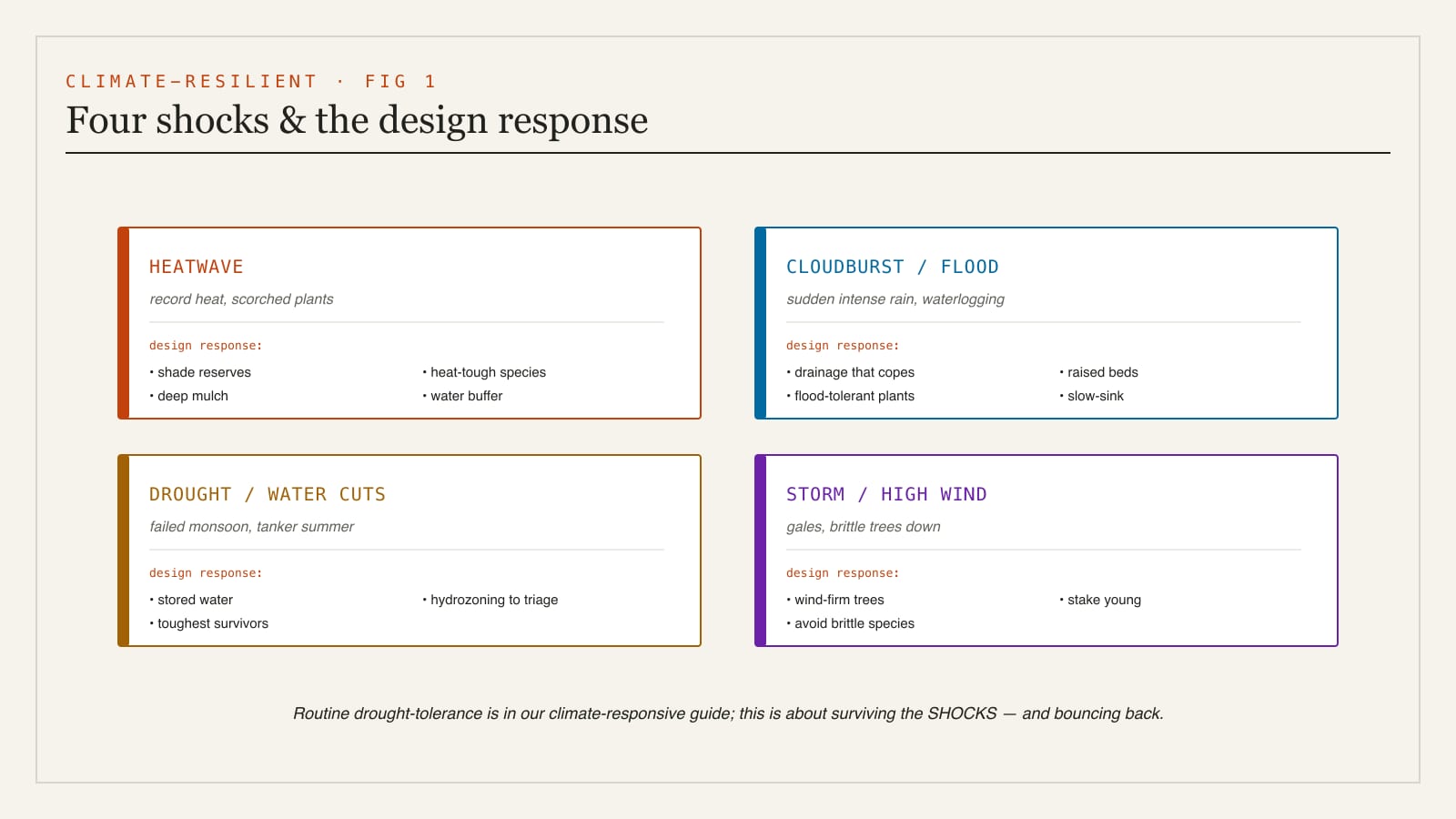
Climate disruption does not arrive as a gentle shift in averages. It arrives as discrete, increasingly frequent shocks. The India Meteorological Department's records show heatwave days, extreme-rainfall events and unseasonal storms all trending up. A resilient garden is designed against four specific shocks, each demanding a different response.
Shock 1 — Heatwaves
When the mercury holds above 45°C for days, transpiration outruns any root system's ability to draw water, soil bakes, and tender growth scorches in hours. The design response is not a single heat-proof plant but a buffered system: a shade reserve of established canopy (see Shade Planning Through Trees) so that understorey and pots sit in dappled light during the worst hours; deep mulch — 75–100 mm of bark, coir or dry leaf — to keep root-zone soil 5–8°C cooler and slow evaporation; water buffering by watering deeply at dawn so the soil profile holds a reserve, never a light midday sprinkle that mostly evaporates; and active protection of young plants with temporary shade-net (50–75% shade cloth) or even an upturned earthen pot over a struggling sapling. New plantings should go in during the monsoon, not before a summer, so roots are established before their first heatwave.
Shock 2 — Cloudbursts, flooding and waterlogging
The same year that brings a heatwave brings the cloudburst: 100–200 mm in a few hours, faster than any compacted urban soil can absorb. Two things kill plants here — physical scouring and, more often, days of anaerobic waterlogged roots. The design response is twofold. First, drainage that copes: graded surfaces that move water away from root crowns, French drains or rubble-filled trenches along low edges, and permeable rather than sealed paving so water sinks instead of sheeting. Second, slow it and sink it rather than rush it to a drain — shallow basins, swales and a rain garden that hold the surge and let it percolate (this is exactly what Rain Gardens Explained details). Raised beds of 200–300 mm lift sensitive roots above the saturated zone. And critically, flood-tolerant species in the low spots — plants that can sit with wet feet for several days and live, rather than ornamentals that drown in 48 hours.
Shock 3 — Drought and water cuts
A failed monsoon or a summer on tanker water is a slow shock, but a brutal one. The resilience strategy is to design so the garden can be triaged: laid out in clear hydrozones so that when supply is cut you can keep the irreplaceable trees alive and let the lawn go dormant without guilt. Practically this means stored water — a tank or sump sized to bridge a multi-week gap, fed by rainwater harvesting — so the garden is not wholly dependent on a single municipal or borewell source. It means a backbone of the toughest survivors: deep-rooted natives that can go weeks on stored soil moisture. And it means accepting that a resilient garden looks tired in a drought and recovers afterwards — survival, not perpetual lushness, is the goal. The water mechanics belong to Sustainable Water Management in the Landscape; here the point is the triage logic and redundancy of supply.
Shock 4 — Storms and high wind
Pre-monsoon line squalls and cyclonic gusts snap brittle trees and turn loose objects into projectiles. The response is structural: choose wind-firm species with strong wood and deep roots, avoid notoriously brittle, shallow-rooted trees near the house, stake young trees correctly (low, loose, removed once established so the trunk strengthens), prune to reduce a dense sail of canopy before storm season, and design hard elements so there is no loose debris to fly. Shelterbelts and graduated wind filtering are the larger craft — see Designing Wind-Friendly Landscapes.
The shocks and their design responses
| Shock | What it does to the garden | Primary design responses | Defer to |
|---|---|---|---|
| Heatwave (>45°C, multi-day) | Scorched foliage, baked soil, dead saplings | Shade reserve, 75–100 mm mulch, deep dawn watering, shade-net for young plants, monsoon planting | Shade Planning Through Trees |
| Cloudburst / flood / waterlogging | Scouring, anaerobic root rot in 2–4 days | Grading + French drains, permeable paving, swales/rain garden, raised beds, flood-tolerant species | Rain Gardens Explained |
| Drought / water cut | Wilting, dieback, total loss if unmanaged | Hydrozones for triage, stored rainwater, deep-rooted native backbone, accept dormancy | Sustainable Water Management |
| Storm / high wind | Snapped trees, uprooting, flying debris | Wind-firm deep-rooted species, correct staking, pre-season pruning, no loose objects | Designing Wind-Friendly Landscapes |
Five cross-cutting resilience principles
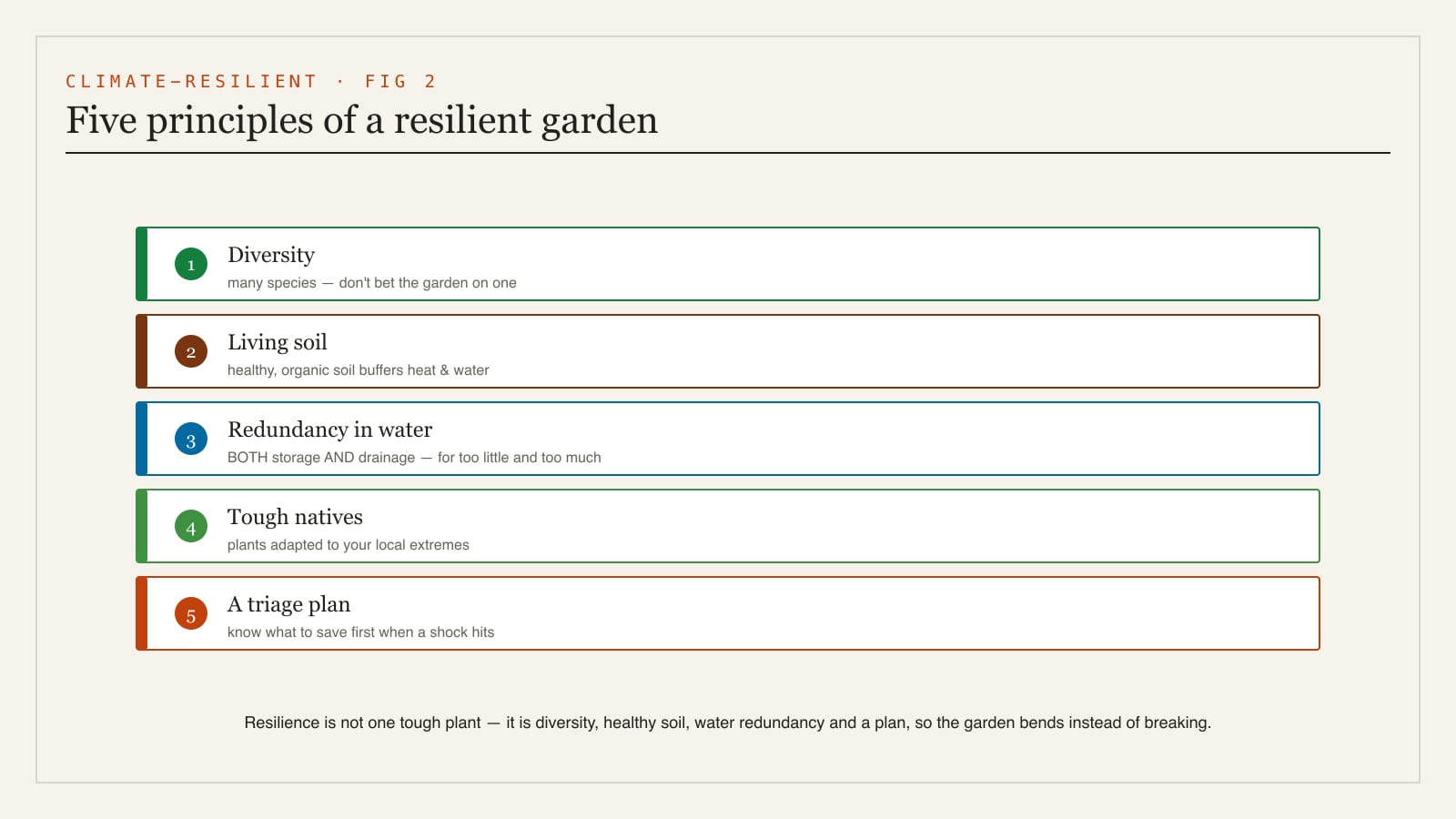
Beyond the response to each individual shock sits a set of principles that make the whole garden robust. These are what separate a resilient garden from a merely well-watered one.
1. Diversity — never bet on one species
A monoculture is a single point of failure: one pest, one pathogen or one freak event can wipe it out at once. Mix species, ages and layers — canopy, shrub, ground cover — so that whatever a given shock favours, something in the garden carries on. Diversity also spreads risk across the four shocks, since no single plant excels against all of them. If a cloudburst takes the flood-sensitive specimens, the flood-tolerant ones hold the structure; if a heatwave scorches the tender layer, the canopy survives.
2. Healthy living soil as a buffer
Soil is the garden's shock absorber. A soil rich in organic matter holds far more water for drought, drains and re-aerates faster after flooding, and stays cooler in heat. Every 1% rise in organic matter lets soil hold meaningfully more plant-available water per cubic metre. Build it with compost, leaf mould and a permanent mulch layer, and avoid compaction (which both worsens flooding runoff and starves roots of air). Living soil with active mycorrhizae also helps plants find water and recover faster after a shock — the single highest-leverage investment in resilience.
3. Redundancy — two of everything that matters
Resilient systems have backups. For water, that means both storage and drainage — a tank and a recharge pit, so you are protected against both too little and too much. It means more than one water source: rainwater harvesting plus municipal, or a sump plus a borewell, so a single failure is not fatal. It means overlapping shade from more than one tree. Redundancy feels wasteful in a good year and saves the garden in a bad one.
4. Tough natives as the backbone
Indigenous and long-naturalised species have already survived centuries of the local climate's extremes; they are the deep-rooted, low-input core around which to build. Use them as the permanent skeleton and treat thirstier ornamentals as the expendable, replaceable trim. Native selection in general is covered in Best Trees for Indian Homes and Biophilic Landscape Design; the resilience filter is simply to ask of each backbone plant: would it survive a heatwave, a flood, a drought and a storm with minimal help?
5. A triage plan before the shock hits
Decide in advance, in writing, what you save first. When water is rationed or a storm warning lands, you will not have time to think. A simple priority list — mature trees and irreplaceable specimens first, productive plants second, lawn and annuals last — lets you act fast and without anguish. Pair it with a small kit: shade cloth, stakes, mulch in reserve, and a charged knowledge of which valve feeds which zone.
A resilient plant shortlist for Indian gardens
Resilience is species-specific to the shock. The list below is organised by which extreme each plant is best at riding out; a well-balanced garden draws from across the columns so no single shock empties it. Always confirm suitability for your specific zone using Climate-Responsive Landscape Design.
| Plant | Type | Best against | Notes |
|---|---|---|---|
| Neem (Azadirachta indica) | Tree | Heat, drought, wind | Deep-rooted, wind-firm, near-bulletproof in hot-dry India |
| Tamarind (Tamarindus indica) | Tree | Heat, drought, storm | Very strong wood, long-lived, excellent shade reserve |
| Jamun (Syzygium cumini) | Tree | Flood, waterlogging | Tolerates wet feet; good for low, flood-prone spots |
| Pongamia / Karanj (Millettia pinnata) | Tree | Flood, wind, heat | Hardy, tolerates waterlogging and tough soils |
| Bougainvillea | Shrub/climber | Heat, drought | Thrives on neglect once established |
| Ixora, Tecoma | Shrub | Heat, drought | Tough flowering structure for hot exposures |
| Vetiver (Khus grass) | Grass | Flood, drought, erosion | Roots bind soil, slow runoff, survive both extremes |
| Canna, Colocasia | Herbaceous | Flood, waterlogging | Happy in saturated rain-garden basins |
| Lantana (sterile cultivars), Portulaca | Ground cover | Heat, drought | Living mulch for the hottest, driest edges |
| Bamboo (clumping, e.g. Bambusa) | Screen | Wind, storm | Flexes in wind; use clumping types, never running |
Avoid as a backbone, especially near the house: notoriously brittle or shallow-rooted trees that fail in storms (such as Peltophorum and some Ficus in exposed sites), and thirsty exotic ornamentals that collapse the moment water is cut. Keep these, if at all, as expendable trim — never as structure you cannot afford to lose.
Putting it together: a resilience checklist
- Establish a shade reserve and plant new stock during the monsoon so roots set before the first heatwave.
- Maintain a permanent 75–100 mm mulch layer and feed the soil organic matter every season.
- Grade and drain so water never pools at root crowns; add a rain garden or swale to absorb cloudbursts.
- Put flood-tolerant species in the low spots and raise sensitive beds 200–300 mm.
- Install rainwater storage sized to bridge several dry weeks, and keep a recharge pit too.
- Lay the garden out in hydrozones so you can triage water to the trees that matter most.
- Choose a backbone of tough, deep-rooted, wind-firm natives; treat ornamentals as expendable trim.
- Write a triage plan and keep a small resilience kit — shade cloth, stakes, reserve mulch — to hand.
A garden built this way will never be the most manicured on the street in a perfect season. But it will be the one still green when the next record summer breaks, the one that drinks a cloudburst instead of drowning in it, and the one that recovers fastest when the extremes — as they increasingly will — arrive.
References & further reading
- Indian Society of Landscape Architects (ISOLA) — resources on climate-adaptive and native planting.
- India Meteorological Department (IMD) — heatwave, extreme-rainfall and cyclone climatology and warnings.
- National Disaster Management Authority (NDMA) — Heat Action Plan guidelines for Indian cities.
- The Energy and Resources Institute (TERI) — publications on urban greening and climate adaptation.
- Centre for Science and Environment (CSE) — rainwater harvesting and urban water resilience resources.
- National Building Code of India 2016 (BIS) — site development, drainage and storm-water provisions.
Export this guide
Related Guides — Deep-dive reading
The Best Trees for Indian Homes
A research-grade guide to choosing and placing trees around an Indian home — the real cooling and clean-air numbers, the right species for shade, flowers, fragrance and fruit, and the placement science that keeps roots out of your walls and drains.
LandscapeHow Buildings Can Give Back: Biodiversity and Environmental Health
How an Indian home and its plot can actively improve the ecology and environment around it, not just reduce harm
SustainabilityWhy Landscape Architecture Matters More Than the Building
How the green around, above and beyond your home out-cools, out-drains and out-appreciates the structure itself — at every scale from balcony to city.
LandscapeRelated Tools — Try Free
Rainwater Tank Sizer
How big should your rainwater tank be? Computes annual harvest, recommended tank capacity in litres, water-bill savings, and payback — for 10 Indian cities.
RWH CalculatorGarden Planning Toolkit
Get a tailored garden plan — planting layers, Indian species, features and a checklist — from your climate, space, sun and goals.
PlannerCross-Ventilation Analyzer
Estimate airflow and air changes per hour (ACH) from room size, window areas, layout, and local wind — with NBC 2016 Part 8 compliance check.
Ventilation Calculator