
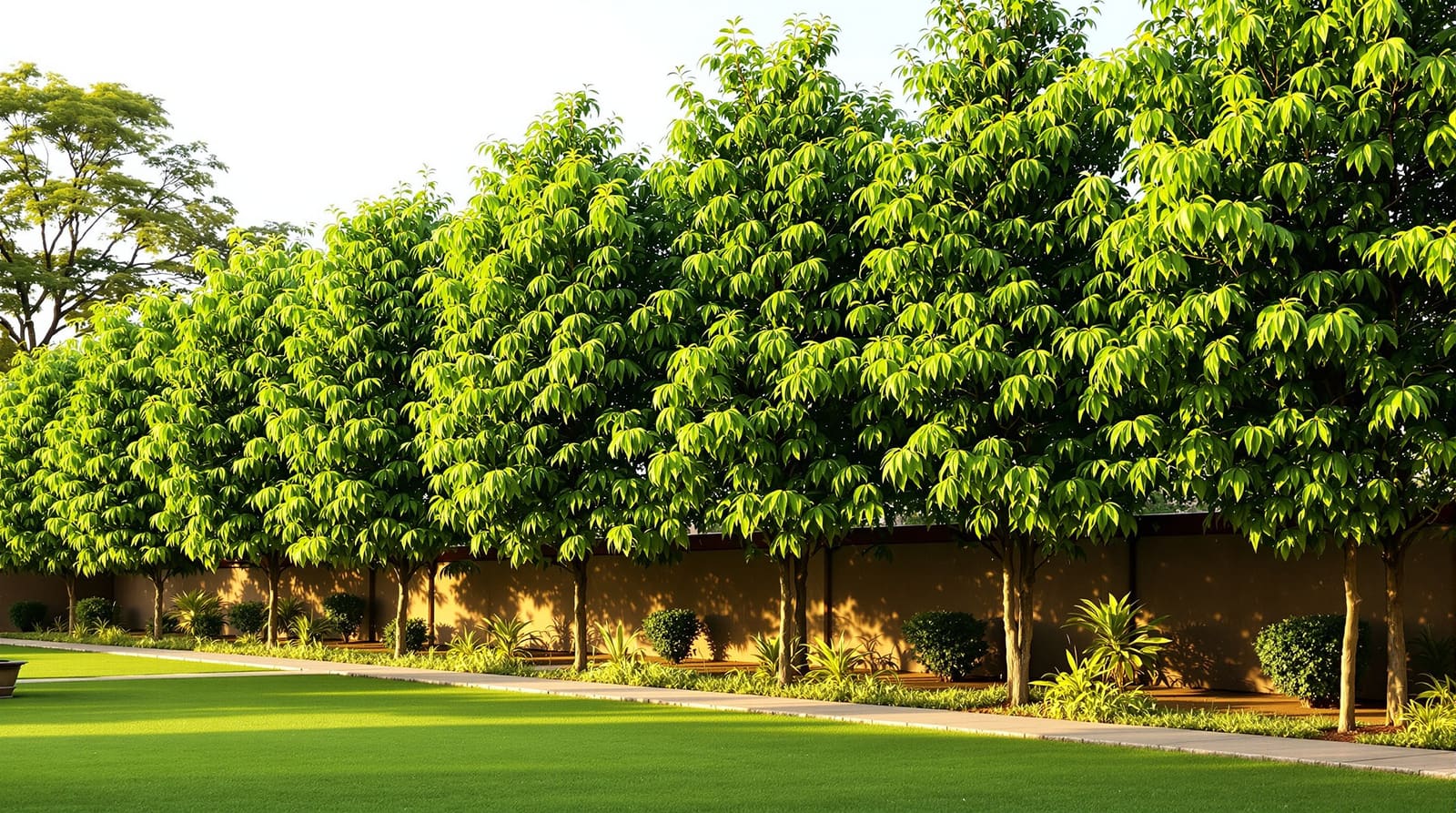
Designing Wind-Friendly Landscapes
Using planting to manage wind — windbreaks and shelter-belts, funnelling the cool breeze, filtering hot dusty wind, and the best windbreak species for India
Wind is the one climate force you can shape with living plants alone — a well-placed belt of trees and shrubs can slow a hot, dusty gale by half, while an opening in the right place pulls the cool evening breeze straight into your sit-out. This guide is about the landscape lens on wind: using planting and a little built form to invite the breeze you want and filter the wind you don't. The architectural side — reading your site's prevailing winds and placing windows and openings — is covered in depth in Understanding Wind Analysis; we link to it rather than repeat it, and stay firmly on the planting side here.
The two jobs of a wind-friendly landscape
Every Indian garden has to do two opposite things with wind, often at the same time.
1. Invite and funnel the cool prevailing breeze toward the house, the windows you open at night, and the places you sit in the evening. In most of India this is the south-west to north-west breeze that arrives after sunset and during the monsoon — the air that makes a courtyard or verandah feel alive.
2. Block and filter the hostile wind — the hot loo of a North Indian May afternoon, the dust storms (andhi) before the monsoon breaks, the salt-laden coastal gusts, and the destructive squalls of a cyclone or thunderstorm.
The skill is doing both without cancelling either out. A solid wall that stops the dust will also kill the evening breeze and create stale, mosquito-friendly dead air on its leeward side. Planting lets you be selective: porous belts that filter and slow, and deliberate gaps that channel and accelerate. Get the geometry right and the same garden that shields you from a 40°C dust-laden westerly in the afternoon opens up to a cool southerly at night.
This is distinct from the broader cooling toolkit. For shade and evapotranspiration cooling see Shade Planning Through Trees; for the zone-by-zone master framework see Climate-Responsive Landscape Design. Here the variable is air movement.
How a windbreak actually works
A windbreak — also called a shelter-belt — is a row or band of trees and shrubs planted across the path of an unwanted wind. The single most important and most misunderstood fact about it is this: a porous belt protects far better than a solid wall.
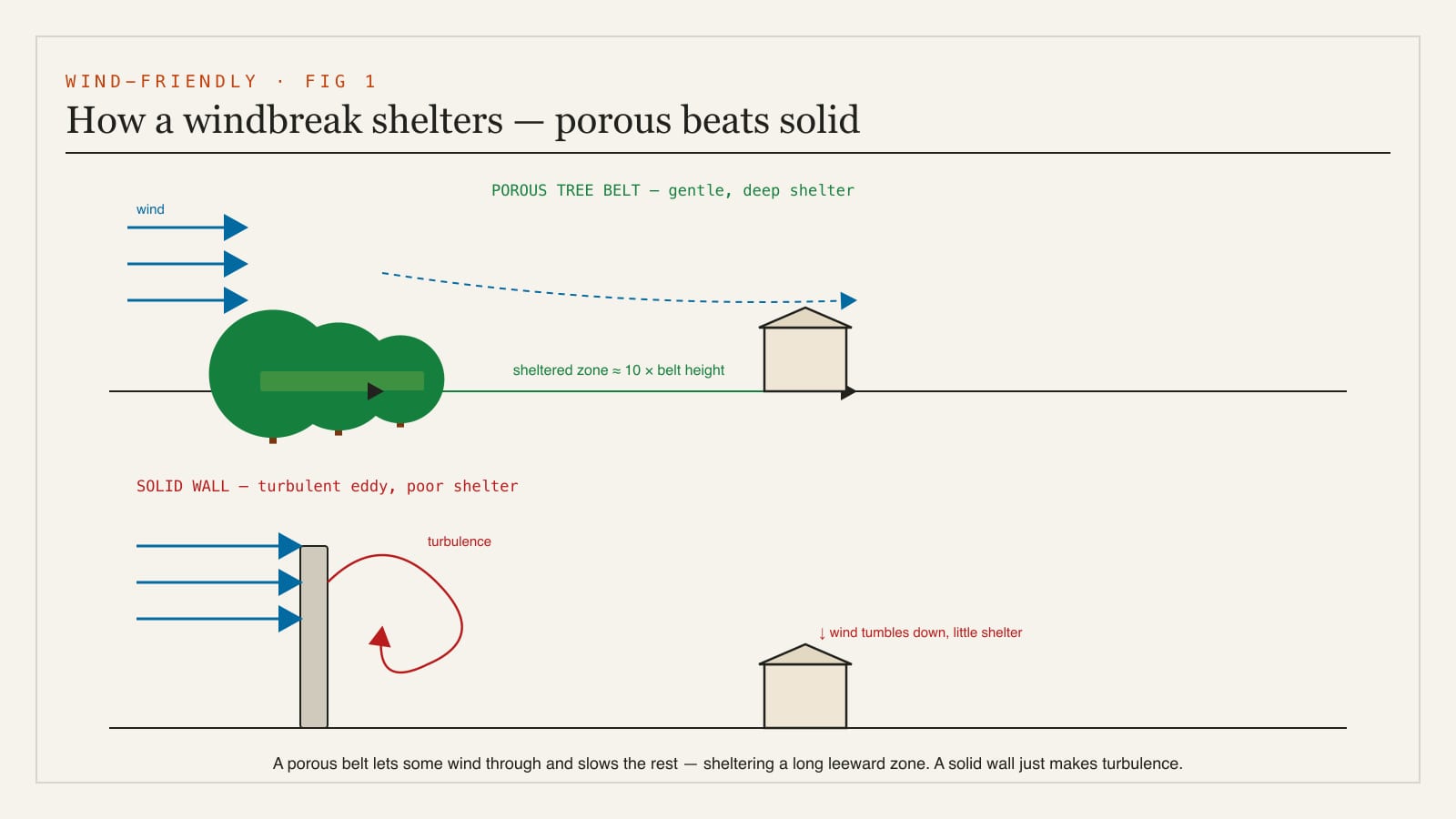
When wind hits a solid barrier — a compound wall, a tight clipped hedge — it is forced up and over, then crashes down on the far side in a churning, turbulent eddy. The sheltered zone is short and gusty, and right at the base of the wall on the leeward side you often get a vicious back-curl. When wind hits a porous barrier of around 40–60% density, a good part of the air filters straight through at reduced speed. This "bleed" prevents the violent over-and-down crash, smooths the flow, and stretches the calm zone far downwind.
The well-established rule of thumb from agroforestry research is:
- A windbreak shelters a leeward zone roughly 10 times its height (10H), with meaningful protection out to about 15–20H in the best cases.
- It also gives a smaller windward benefit of about 2–5H in front of the belt.
- Wind speed in the core sheltered zone (around 5–8H downwind) can drop by 40–60%.
So a belt of trees averaging 8 m tall shelters a zone roughly 80 m deep to leeward — comfortably enough to wrap a typical plot and house. Plant the belt at a distance of about 2–5H from the house, not hard against it, so the house sits in the calm core rather than under any turbulence.
| Barrier type | Porosity | Sheltered zone (leeward) | Behaviour |
|---|---|---|---|
| Solid wall / dense clipped hedge | ~0–20% | Short (2–4H), gusty | Air vaults over, crashes down, turbulent eddy |
| Layered tree + shrub belt | ~40–60% | Long (10–15H), calm | Air filters through, slowed and smoothed |
| Single thin tree row | ~60–80% | Moderate (8–10H) | Effective but less even, more gaps |
The second principle is layering of heights. A single line of tall trees leaves a gap under the canopy where wind accelerates through the trunks. The fix is a stepped profile: low clumping shrubs on the windward face, mid-height shrubs or bamboo behind, then the tall canopy trees — a wedge that presents an even, semi-permeable face from ground to crown. Two to three staggered rows do this far better than one straight line.
Funnelling and channelling the cool breeze
The other half of the job is positive: using planting and built form to steer the breeze you want toward the house. This is where the landscape works hand-in-glove with the openings discussed in Understanding Wind Analysis.
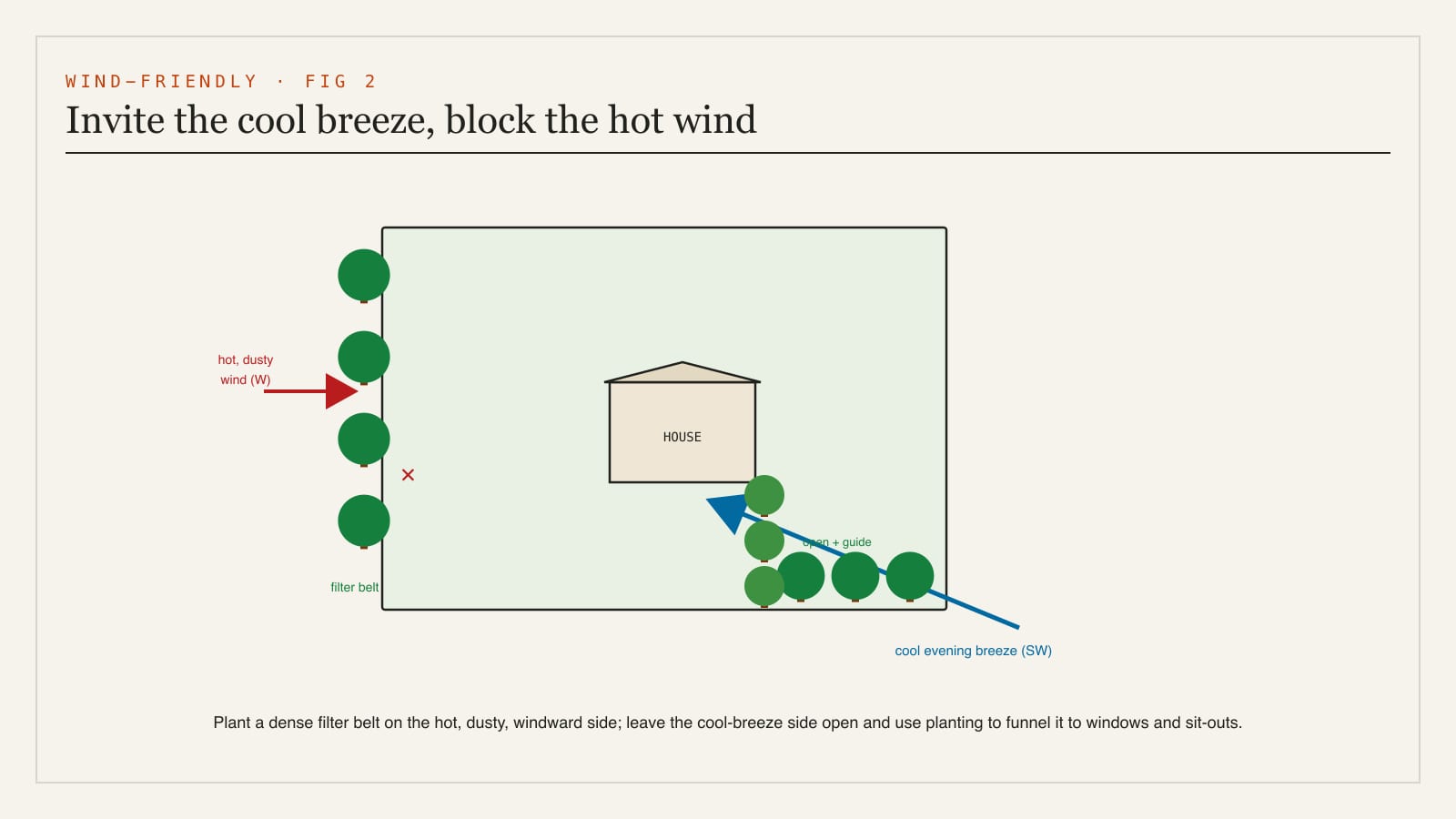
Key landscape moves:
- Open a clear corridor on the breeze side. Identify the direction of the cool evening/monsoon breeze (for most of India, between south and west) and keep that quadrant of the garden low and open — lawn, groundcover, low planting — so air flows unobstructed to the verandah and the windows you open at night. Do not plant a dense belt here; that is for the hostile wind side.
- Use the venturi effect deliberately. Air squeezed between two masses — two tree clumps, a tree mass and a wall, a pair of hedges narrowing toward an opening — speeds up. Funnel a gently converging gap toward a sit-out or a window and the breeze arrives noticeably stronger and cooler. A narrowing of roughly 2:1 from mouth to throat is a good starting geometry.
- Direct the breeze across cooling surfaces. Lead the inflow over a water body, a wet lawn, a mulched bed or a shaded ground plane before it reaches the house, so it picks up evaporative cooling on the way. (Use the water-wise methods in Sustainable Water Management in the Landscape — avoid open ponds that waste water in dry zones.)
- Avoid dead air. Enclosed courtyards or tight corners with no inlet/outlet trap stale, humid air — uncomfortable and a mosquito haven in monsoon India. Always give a planted enclosure a low inlet and a high outlet, or a through-gap, so air can move.
- Raise the canopy on the breeze side. High-branching trees (tamarind, neem trained up) let air slip beneath the canopy at sitting height while still giving overhead shade — shade without blocking the flow.
Filtering dust and storm wind
For the hostile-wind side — the hot loo, pre-monsoon dust storms, and squall-line gusts — the tool is a green filter belt at the windward boundary, almost always the west and north-west edge across the plains of North and Central India.
A filter belt does three things a wall cannot: it slows the wind (so it carries less dust onward), it physically catches airborne dust and grit on leaves and bark, and it does so without the turbulent back-eddy. A dense, multi-row evergreen belt on the dusty boundary can cut particulate load reaching the house substantially while keeping the air moving. Studies of roadside and field shelter-belts consistently show measurable reductions in dust deposition behind a vegetated belt versus open ground.
Design notes for a filter belt:
- Make it evergreen or near-evergreen so it works in the dry, dusty months (March–June) — deciduous belts that drop their leaves in exactly that window are useless when you need them most.
- Multi-row and dense at the base to catch low-level dust; a thorny or twiggy shrub layer at the windward face is an excellent dust comb.
- Keep it off the cool-breeze quadrant — concentrate density on the dusty/stormy side only.
- In storm- and cyclone-prone zones, avoid brittle, weak-wooded, shallow-rooted trees near the house — they become projectiles. See species notes below.
Windbreak species for India
Species choice decides whether your belt is a 30-year asset or a liability that drops limbs on the roof in the first squall. Match the layer to the job, favour deep-rooted, strong-wooded, evergreen-leaning species on the windward side, and keep anything brittle well away from the house.
| Layer / role | Recommended species | Notes |
|---|---|---|
| Tall canopy (windbreak) | Ashoka / Mast tree (Polyalthia longifolia), Neem (Azadirachta indica), Tamarind (Tamarindus indica), Casuarina (Casuarina equisetifolia) | Ashoka: narrow, dense, classic screen. Casuarina: superb for coastal/sandy, fast, salt-tolerant. Neem & tamarind: tough, deep-rooted, evergreen-ish, strong-wooded. |
| Mid layer (density + filter) | Bamboo (clumping types, e.g. Bambusa), Hibiscus, Murraya (kamini), Duranta, Tecoma | Clumping bamboo gives flexible, fast, porous height. Avoid running/invasive bamboos. Flowering shrubs double as filter + screen. |
| Low windward comb (dust) | Clumping shrubs, Ixora, Carissa (karonda, thorny), Vetiver grass strip | Dense base catches low dust; vetiver also binds soil against wind erosion. |
| Coastal / saline | Casuarina, Coconut, Pongamia (karanj), Screwpine (Pandanus) | Salt- and wind-tolerant; Pongamia is a hardy, deep-rooted shade-cum-shelter tree. |
Species to avoid near the house: brittle, fast-but-weak or shallow-rooted trees that snap or uproot in storms — Eucalyptus (shallow, sheds limbs), Gulmohar and Spathodea/African tulip (brittle), Silver oak (snaps), and any large tree planted closer to the structure than its mature height. Subabul (Leucaena) and similar fast softwoods are fine in a far belt but not as the near tree. Mexican kikar (Prosopis juliflora) is invasive — don't introduce it. For broader species selection beyond wind, see Best Trees for Indian Homes.
Placement and spacing of a shelter-belt
Geometry matters as much as species. The belt must be long enough, dense enough, and far enough from the house.
- Orientation: run the belt perpendicular to the hostile wind, on the windward boundary. In most of plains India that is the west / north-west edge for the loo and dust storms.
- Length: extend the belt well past the ends of the area you want sheltered — wind curls around the ends, so a belt that is only as wide as the house leaves the flanks exposed. Aim for the belt to overshoot the protected zone by at least 1–2H on each side.
- Distance from house: site the house in the calm core, about 2–5H downwind of the belt. Too close (under 2H) and you risk turbulence and you lose light; too far (over 8–10H) and protection fades.
- Within-belt spacing: tall trees roughly 3–5 m apart in a row; stagger 2–3 rows about 2–3 m apart for a continuous porous face. Tighter for a screen, looser for a windbreak — aim for that 40–60% porosity at maturity, not a solid wall.
- Don't over-densify: counter-intuitively, planting a belt too thick makes it act like a solid wall and worsens turbulence. Porosity is the goal.
| Parameter | Guideline | Why |
|---|---|---|
| Distance from house | 2–5H downwind | House sits in calm core, avoids turbulence |
| Belt overshoot at ends | +1–2H beyond protected zone | Wind curls around belt ends |
| Rows | 2–3 staggered | Even floor-to-crown porosity |
| Target porosity | 40–60% | Filters and slows without turbulent crash |
| Tree spacing in row | 3–5 m | Continuous face at maturity |
Coastal and high-wind considerations
On the coast (Konkan, Coromandel, Odisha, Gujarat seaboard) and in cyclone-prone belts, wind comes with salt, sand and, periodically, destructive force.
- Lead with salt-tolerant, flexible species — casuarina, coconut, pongamia, screwpine — set as the outer line to take the salt spray and let inner planting recover.
- Favour flexible over rigid: clumping bamboo and casuarina bend and recover where stiff, brittle trees snap. A belt that flexes survives the storm that fells a stiff one.
- Stake and train young trees deeply, and prefer deep-rooted species; a tree that uproots in a cyclone is more dangerous than no tree. Keep mature heights of large trees away from the roof line.
- Follow the structural-wind provisions of NBC 2016 Part 6 and IS 875 (Part 3) for the building itself; planting reduces the load the structure sees but does not replace engineering in high-wind zones.
The cooling payoff
Wind-friendly landscaping pays back in real, felt comfort and in rupees. Slowing a hot dry wind matters because moving hot air strips moisture and heat from your skin and from the building — cutting wind speed by half across a sheltered courtyard can lift perceived comfort markedly on a loo afternoon, and reduces dust ingress, cleaning effort, and AC infiltration load. Conversely, channelling the cool night breeze across the house can flush out the day's accumulated heat, often removing the need for air-conditioning in the shoulder months and the early part of the night through the hottest months.
The combined effect — afternoon shielding plus evening flushing — is one of the highest-value, lowest-tech interventions available to an Indian homeowner. It costs the price of trees and a few seasons of patience, and it keeps paying every summer. Paired with the shade and water strategies in the companion guides, a wind-aware planting plan turns the garden from a passive decoration into an active part of the home's climate system.
References & further reading
- National Building Code of India 2016 (NBC 2016), Part 8 (Building Services) and Part 11 (Approach to Sustainability), Bureau of Indian Standards — natural ventilation, site planning and landscape provisions.
- IS 875 (Part 3): Design Loads (Wind Loads), Bureau of Indian Standards — wind-load zoning for structures, relevant in high-wind and coastal areas.
- ISOLA (Indian Society of Landscape Architects) — resources and practice guidance on regional landscape design.
- TERI (The Energy and Resources Institute) — publications on passive cooling, natural ventilation and microclimate in Indian buildings.
- ICAR / Central Agroforestry Research Institute (CAFRI), India — shelter-belt and windbreak design, porosity and the 10H sheltered-zone principle.
- India Meteorological Department (IMD) — wind, dust-storm and cyclone climatology by region; basis for identifying prevailing and hostile winds.
Related guides
Export this guide
Related Guides — Deep-dive reading
The Best Trees for Indian Homes
A research-grade guide to choosing and placing trees around an Indian home — the real cooling and clean-air numbers, the right species for shade, flowers, fragrance and fruit, and the placement science that keeps roots out of your walls and drains.
LandscapeUnderstanding Wind Analysis for a Comfortable Home
How to read your site's breeze and design openings that keep an Indian home naturally cool — long before you switch on an air-conditioner.
Site PlanningHow Buildings Can Give Back: Biodiversity and Environmental Health
How an Indian home and its plot can actively improve the ecology and environment around it, not just reduce harm
SustainabilityRelated Tools — Try Free
Cross-Ventilation Analyzer
Estimate airflow and air changes per hour (ACH) from room size, window areas, layout, and local wind — with NBC 2016 Part 8 compliance check.
Ventilation CalculatorGarden Planning Toolkit
Get a tailored garden plan — planting layers, Indian species, features and a checklist — from your climate, space, sun and goals.
PlannerWindow Orientation Planner
Pick the best window type, glass and shading by wall direction — north, east, south and west.
Window Tool