
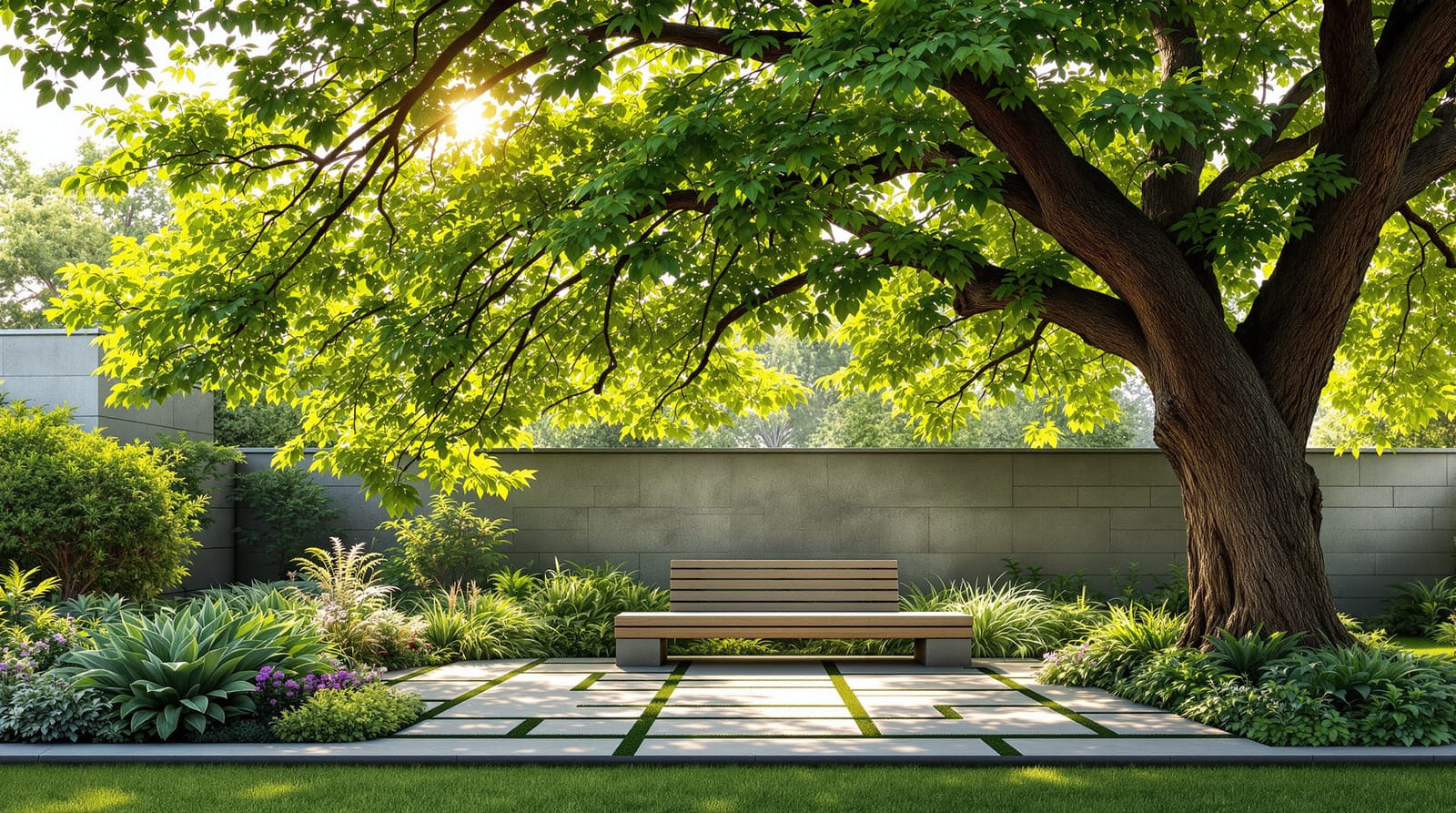
Shade Planning Through Trees — The Cheapest Cooling You Can Plant
Shade as a design strategy: sun angles and seasons, deciduous vs evergreen, placing trees by orientation, the cooling numbers and planning canopy over time
A well-placed tree is the cheapest, most powerful cooling machine you can install on an Indian plot — it runs on sunlight, costs nothing to operate, and gets better every year you own your home. Shade planning is the deliberate use of trees to control the sun: where it falls, when it falls, and how hot your walls and outdoor rooms become. Done well, it can drop a west wall's surface temperature by 15–20°C, shave a meaningful slice off your summer electricity bill, and make a courtyard usable at 4 p.m. in May. This guide is about that strategy — the sun angles, the placement logic, the cooling physics, and the way a canopy grows over a decade. It is not a list of which trees to plant; for that, read our companion guide, Best Trees for Indian Homes. Here, we decide where and why the shade should be — then you choose the species to fill the role.
Why shade is the cheapest air-conditioning in India
In most of India, the enemy is not cold — it is heat and glare. A bare west-facing wall in Nagpur, Ahmedabad or Hyderabad can hit 55–60°C on its surface by late afternoon in May. That heat soaks into the masonry and re-radiates into your bedrooms well past sunset, which is exactly why your air-conditioner labours hardest at night.
A tree intercepts that radiation before it ever reaches the wall. Unlike a wall-mounted chajja or a curtain, a tree cools by two mechanisms at once: it blocks direct sunlight (shading), and it releases water vapour through its leaves (transpiration), which actively chills the air beneath the canopy. The pocket of air under a mature spreading tree can sit 3–5°C cooler than the open street. That is free, silent, year-round cooling that no awning can match.
The strategic payoff is simple: every square metre of sunlit wall, paving or roof you can put into shade is a square metre that stops feeding heat into your home. Shade planning is therefore not gardening — it is passive climate engineering, and it belongs in your thinking from the site-planning stage, alongside orientation and setbacks.
The key insight: sun angles and the seasons
Here is the idea that makes the whole strategy work, and most people get it wrong.
The sun is not in the same place all year. In summer the midday sun rides very high in the sky — across most of India it climbs to 75–85° above the horizon at noon in June. In winter it stays much lower — around 40–48° at noon in December — and tracks further to the south. The morning and evening sun, in every season, comes in almost horizontally and is the hardest of all to block.
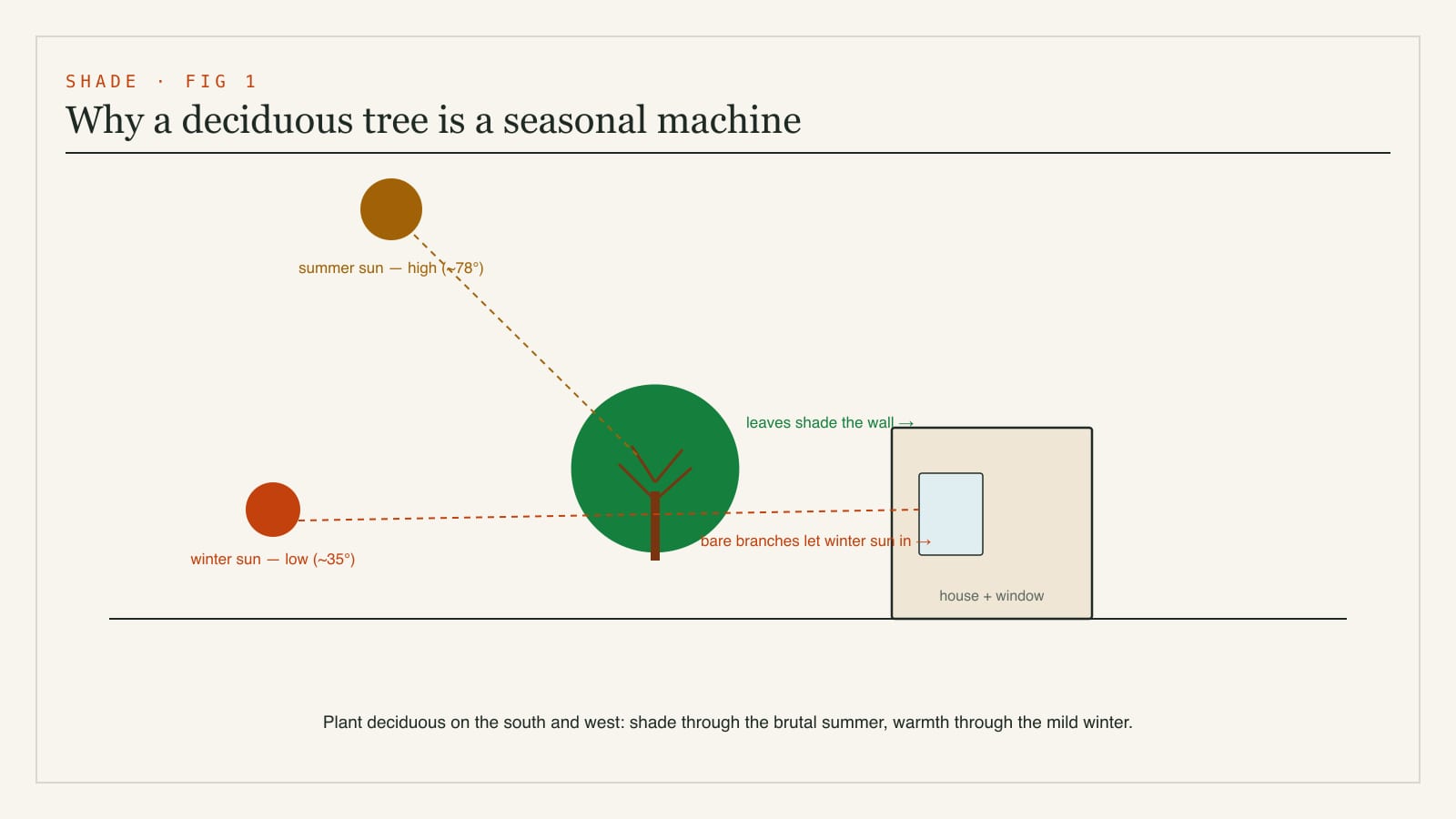
This seasonal swing is why deciduous trees are the secret weapon of shade planning. A deciduous tree — one that drops its leaves in the cool, dry season — carries a dense canopy through the brutal summer, shading your walls and windows when you desperately need it. Then, in the comfortable winter months, it sheds those leaves and lets the gentle, welcome winter sun reach the same walls, warming them and brightening the rooms behind. You get summer shade and winter sun from a single tree. An evergreen in the same spot would block the pleasant winter sun too, leaving rooms gloomy and damp for months.
The rule of thumb:
- Deciduous trees on the south and west, near windows you want bright in winter. Indian examples that lose leaves in the dry season include the silk cotton (semal), kachnar, amaltas (Indian laburnum) and Indian coral tree — but check species behaviour in your specific city, as some are only semi-deciduous in warmer zones.
- Evergreen trees where you want shade and screening all year, regardless of season — for example along a hot western boundary you never need winter sun from, or as a permanent privacy and dust screen.
The high summer sun also means a tree does not need to be enormous to shade a wall — because the sun is overhead, even a tree set a few metres south of the house throws its shadow back onto the building at midday. The low winter and the low east/west sun are the ones that slip under a canopy, which is why orientation matters so much.
Placement by orientation
Where you plant matters more than what you plant. The same tree is a hero on one side of the house and a nuisance on another. Use the compass, not the empty patch of lawn.
| Orientation | What the sun does here | Shade strategy | Conceptual planting |
|---|---|---|---|
| West / South-west | Brutal low afternoon sun (2–6 p.m.); the single worst heat gain in India | Top priority. Block low-angle direct sun on walls and windows | Large, dense, spreading deciduous tree set close enough to cast late-afternoon shadow onto the wall; layer with tall shrubs below |
| South | High summer sun overhead; low, welcome winter sun | Shade in summer, admit sun in winter | Deciduous tree south of main living windows — the classic summer-shade / winter-sun play |
| East | Soft, low morning sun (gentle, often desirable) | Light shade only; do not over-block | Smaller or open-canopy tree; many Indians want morning sun on a verandah or pooja area |
| North | Little direct sun across most of India | Lowest shading priority | Reserve for fruit, screening, or trees that would block views elsewhere |
| Roof / terrace | Intense overhead summer sun on the slab | Hard to shade with trees unless very tall | Use pergolas and creepers; a tall tree only helps a single-storey roof |
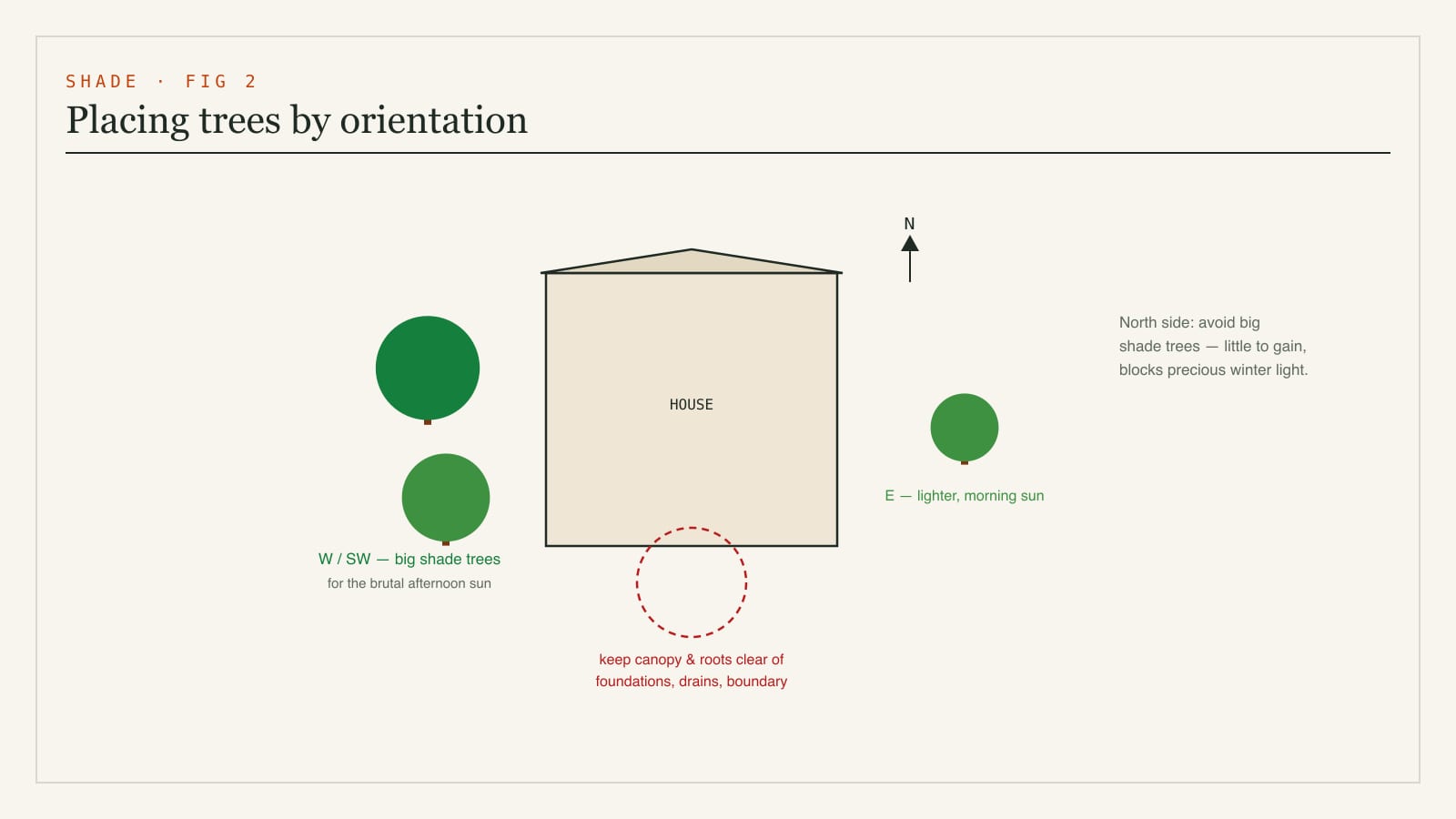
For the typical Indian home, the order of priority is unambiguous: west and south-west first, south second, east a light touch, north last. If you can plant only one shade tree, put it where the afternoon sun hammers your most-used rooms — almost always the western side.
A note for apartment dwellers: you rarely control where trees go, but the same logic governs your balcony. A west balcony needs a dense screen — a tall potted plant, a bamboo blind, or a creeper on a trellis — far more than an east one. Raise the issue of common-area tree planting with your RWA; a row of shade trees along a west-facing society wall benefits every flat behind it.
The cooling numbers
Shade planning earns its keep, and the numbers are worth knowing so you can argue for it (to a spouse, a builder, or an RWA committee).
| Surface or metric | Sunlit | Shaded by tree canopy | Difference |
|---|---|---|---|
| West wall surface (May afternoon) | 50–60°C | 32–38°C | up to ~20°C cooler |
| Paving / driveway surface | 55–65°C | 35–40°C | up to ~25°C cooler |
| Air temperature under canopy | Ambient | 3–5°C below ambient | the transpiration effect |
| Indoor temperature behind shaded wall | — | typically 2–5°C lower | depends on wall, glazing, ventilation |
That 2–5°C indoor reduction is the figure that matters to your wallet. As a working rule, each 1°C you can raise the thermostat (because the room is already cooler) cuts air-conditioner energy use by roughly 4–6%. Well-placed shade on the west and south, combined with a shaded roof, commonly trims 10–25% off cooling load over a hot season — real money on an Indian summer electricity bill, repeating every year, for the price of a sapling and some patience. The US Department of Energy and numerous urban-heat studies put strategically placed shade trees among the highest-return home energy measures there are, and the Indian sun only makes the case stronger.
This is also the practical heart of climate-responsive landscape design: you are not decorating the plot, you are tuning its microclimate.
Plan for the tree you'll have in ten years
The single most common mistake in Indian gardens is planting for today's sapling instead of tomorrow's canopy. A neem you plant as a one-metre stick will, in fifteen years, throw a shadow eight to twelve metres across and reach for the second-floor windows. The shade you are buying is the mature shade — and the problems you are buying are the mature problems.
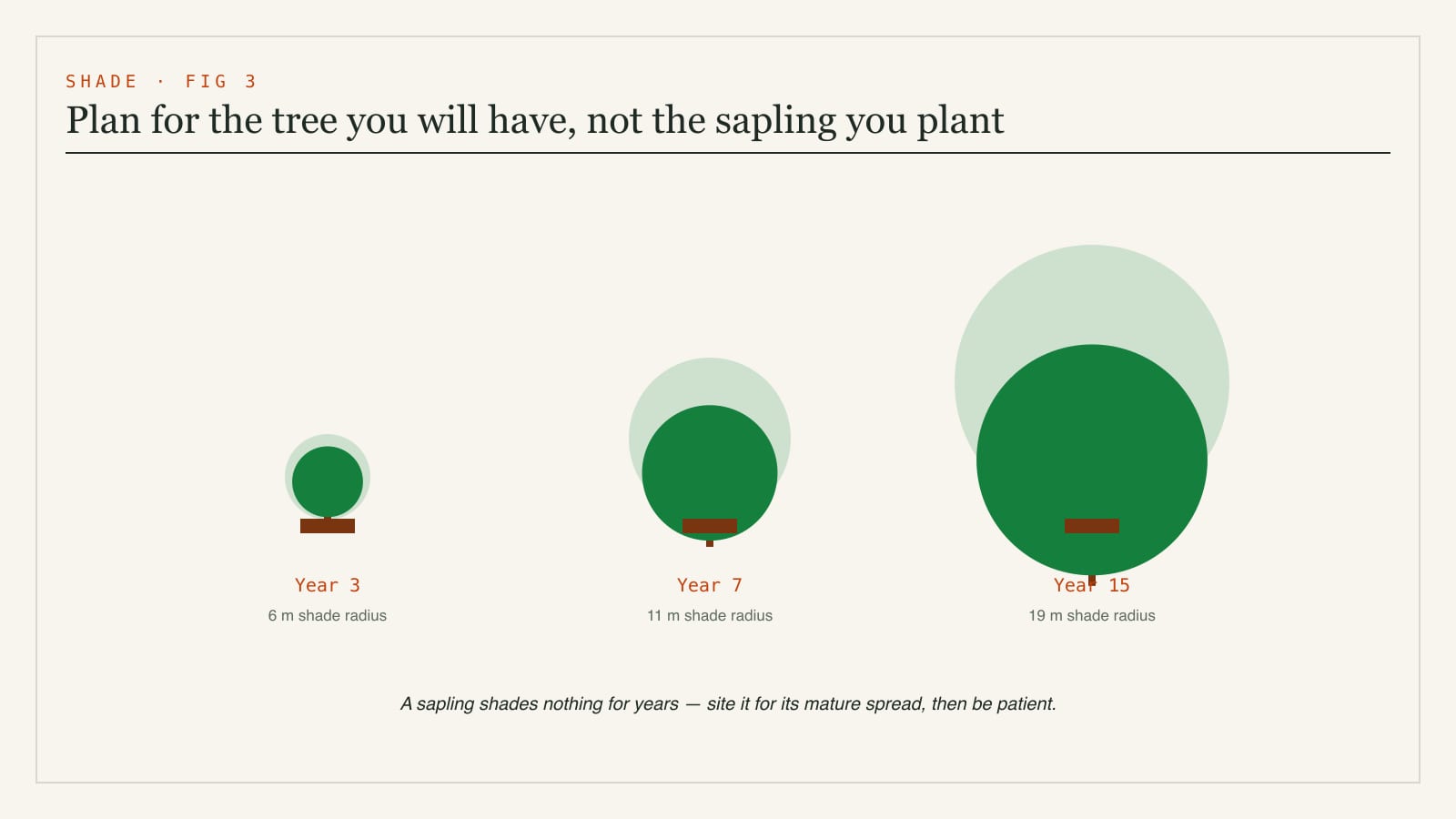
Think in three frames:
- Year 3: A young tree, perhaps 2–3 m tall, with a thin canopy. It barely shades a wall. This is the "did I waste my money?" stage — and it is exactly why people over-plant or plant too close.
- Year 7: The tree is now meaningful — 5–7 m tall on a fast grower, casting genuine shade over a seating area or part of a wall. The form it will keep is becoming clear.
- Year 15: Full effect. The canopy may span 8–12 m, the roots have reached their working radius, and the tree is doing the heavy cooling you planned for — or fouling the drain you forgot about.
Two practical consequences. First, be patient and plant early — the best time to plant a shade tree was ten years ago; the second best is this monsoon. Second, size the spacing for the mature canopy, not the sapling, so you do not crowd trees that will fight for the same space. A useful interim trick is to combine a fast but short-lived "nurse" planting (or a pergola, see below) for shade now with a slower, long-lived tree for shade later.
Safe distances: roots, foundations, drains and wires
A tree placed for perfect shade but in the wrong relationship to your structure will eventually cost you far more than it saved. Roots seek water and oxygen, not your foundation specifically — but a thirsty large tree near a leaking drain or a shallow foundation in expansive (black-cotton) soil can cause real trouble through soil movement and moisture changes.
Sensible minimum distances from the trunk for a large, spreading tree (scale down for small ornamental trees):
| Element | Suggested minimum distance | Why |
|---|---|---|
| House foundation / wall | 4–6 m (more on black-cotton soil) | Avoid root pressure, moisture-driven soil heave/shrinkage, and overhanging branches on the roof |
| Underground drain / sewer line | 3–5 m | Roots aggressively invade cracked or leaking pipes |
| Septic tank / soak pit | 4–6 m | Same root-invasion risk, plus contamination concerns |
| Plot boundary / neighbour's wall | Half the mature canopy radius, and check local rules | Overhanging branches and roots crossing a boundary cause disputes; many municipalities and societies regulate this |
| Overhead power lines | Plant only species that stay well below the line, or keep clear | Branches in lines are a fire/outage and pruning headache |
| Borewell / water tank | 4–5 m | Roots and falling debris |
A few India-specific cautions. Avoid planting large, aggressive-rooted species (the classic example being certain ficus/peepal types) close to any structure, paving or drain — they are magnificent shade trees in a park and a slow disaster beside a compound wall. Check your municipal and society by-laws before planting near boundaries and roads; many cities require permission to plant (and to fell) trees, and the boundary tree that drops leaves into your neighbour's yard is a classic RWA dispute. When in doubt, set the tree a metre further out and let the canopy do the reaching — that is what canopies are for.
Layering shade: tree + pergola + creeper + shrub
A single tree shades from above, but the low morning and evening sun comes in sideways, under the canopy. The professional answer is to layer your shade vertically so something blocks the sun at every angle — the same multi-storey logic that drives a healthy biophilic landscape.
- Canopy (upper): the shade tree, handling the high overhead sun and the bulk of the cooling.
- Mid layer — pergola or trellis: a built structure clothed in a fast creeper (madhumalti/rangoon creeper, bougainvillea, money plant, passion fruit, or a seasonal gourd) gives you usable shade in two seasons while the tree matures, and catches the low sun a tree misses. This is the best way to shade a terrace or a west wall now.
- Shrub layer (lower): tall shrubs and hedges along the western and south-western boundary intercept the lowest, most horizontal afternoon rays before they hit the wall — the rays no overhead canopy can stop.
- Ground layer: grass, groundcover or planting beds instead of bare paving keep the ground itself cool and cut reflected heat and glare bouncing up onto the wall.
Layering also buys you time: the pergola-and-creeper combination delivers shade in a single season, covering you through the years your tree spends getting tall.
Shading outdoor rooms and the west wall
Two payoffs deserve their own attention.
Outdoor living areas. A courtyard, otla, deck or outdoor wellness space lives or dies by its shade. Place the seating in the pool of afternoon shade — typically to the east of a west-shading tree, so the long evening shadow falls across it. A dappled canopy is more pleasant than a solid roof: it cools without making the space dark or stuffy, and the moving light is part of the charm. For a villa courtyard, a single well-grown specimen tree over a seating cluster does more for comfort than any number of fans.
The west wall. This is the highest-value target in Indian shade planning. A west wall left bare bakes all afternoon and re-radiates into the house all night. The full toolkit: a deciduous tree set to throw late-afternoon shadow onto the wall, a creeper-clad trellis held a few centimetres off the masonry (the air gap matters — it lets the wall breathe and ventilate), and a band of tall shrubs at the base. Together these can keep a west wall 15–20°C cooler and turn your worst room into a tolerable one.
Maintenance and the honest downsides
Shade is not free of effort, and anyone who tells you otherwise has not raked an October driveway.
- Leaf fall. Deciduous trees drop heavily in the dry season — exactly the windy, dusty months. Expect to sweep, and keep heavy-litter trees away from open water tanks, pools and gutters. Some species also drop messy fruit, flowers or pods that stain paving.
- Pruning. A shade tree needs occasional thinning and crown-lifting to stay safe, keep branches off the roof and lines, and let some light through. Budget for a professional prune every 2–4 years; expect roughly ₹1,500–₹6,000 per session for a mid-size tree depending on city and access.
- Watering, early on. A new tree needs regular water for its first two or three monsoons until established. After that, a well-chosen native is largely self-sufficient — pair this with sensible water management so the tree is fed by harvested rain, not the municipal tap.
- Roots and paving. Even a well-placed tree can lift nearby paving over decades; use flexible edges and root barriers near hard surfaces if needed.
- Permissions. Remember that in many Indian cities a grown tree is legally protected — you may need permission to fell or even heavily prune it later. Plant where you will still want it in twenty years.
None of this outweighs the benefit. It simply means choosing the right tree for the right spot — which is precisely where you hand off to species selection. Use this guide to decide the role each tree must play; then choose the actual plants from Best Trees for Indian Homes, matching habit, leaf behaviour, size and litter to the job you have defined here.
References & further reading
- ISOLA (Indian Society of Landscape Architects) — professional guidance and project references on landscape design in the Indian context.
- ICAR–IIHR (Indian Institute of Horticultural Research), Bengaluru — horticulture and tree-establishment guidance for Indian conditions.
- U.S. Department of Energy, "Energy Saver: Landscaping for Shade" — well-documented evidence on tree placement and home cooling-energy savings (principles transfer directly to hot climates).
- Royal Horticultural Society (RHS) — practical guidance on tree spacing, root systems and safe planting distances from buildings.
- Thompson, J. William & Sorvig, Kim, "Sustainable Landscape Construction" — principles of planting, microclimate and site engineering.
- Randhawa, M. S., "Flowering Trees" (National Book Trust, India) — a classic Indian reference on tree habit, leaf behaviour and growth form.
Export this guide
Related Guides — Deep-dive reading
The Best Trees for Indian Homes
A research-grade guide to choosing and placing trees around an Indian home — the real cooling and clean-air numbers, the right species for shade, flowers, fragrance and fruit, and the placement science that keeps roots out of your walls and drains.
LandscapeUnderstanding Sun Path Analysis for Your Home
How the sun actually moves over an Indian site through the day and the year — and why that single fact quietly decides where your kitchen, bedroom and living room should sit.
Site PlanningDesigning a Naturally Energy-Efficient Indian Home
Comfort first, gadgets last — passive design, orientation, insulation, ventilation and the climate wisdom that cuts Indian energy bills
SustainabilityRelated Tools — Try Free
Cross-Ventilation Analyzer
Estimate airflow and air changes per hour (ACH) from room size, window areas, layout, and local wind — with NBC 2016 Part 8 compliance check.
Ventilation CalculatorBrise-Soleil Visualizer
Interactive horizontal-louvre cut-off angle calculator — sun altitude, louvre depth, and spacing inputs with a live shadow preview. Computes θ = arctan(spacing/depth) for façade shading, ECBC envelope compliance, hospital daylight design, and tropical sun-control detailing.
Sun Shading ToolGarden Planning Toolkit
Get a tailored garden plan — planting layers, Indian species, features and a checklist — from your climate, space, sun and goals.
Planner