

Understanding Building Height Restrictions in India
Why your city caps how tall you can build, how road width, fire-ladder reach and airport zones decide your real height limit, and how to find your plot's number before you design
You have a plot, a dream and a builder telling you "we can easily put four floors here." Maybe you can. Maybe you cannot. The number of floors you are allowed to build is not your decision, your builder's decision, or even your architect's decision. It is fixed by law, and that law looks at things you may never have thought about: the width of the road outside your gate, how far the nearest fire engine ladder can reach, and in many cities, whether an aeroplane might pass overhead.
This guide explains, in plain language, why your city caps how tall you can build, how that cap is actually worked out in India, and how to find your own plot's real height limit before you commit money to a design. Height rules exist to keep the house standing, the neighbourhood liveable and the people inside it alive in an emergency. Understanding them means you build the right house once, instead of a wrong one twice.
1. Why there is a limit at all
A height cap is not red tape for its own sake. Several genuine safety and fairness reasons sit behind it, and they pull in the same direction.
The most immediate is fire-fighting. If a fire breaks out on an upper floor, people are rescued and the blaze is fought from outside using a fire engine and its turntable ladder. That ladder only reaches so high. Beyond a certain height a building can no longer be saved from the outside, so it must save itself from the inside, with pressurised staircases, water risers, sprinklers and dedicated firefighter lifts. The law therefore treats "tall" buildings as a different, more demanding category. The height where that switch happens is one of the most important numbers in this whole subject, and we come back to it in section 4.
The other reasons stack on top:
- Structural and natural-hazard safety. A taller building catches more wind and behaves very differently in an earthquake. Going higher demands deeper foundations, stronger frames and proper structural design, so codes limit height to what a given plot, soil and design can safely carry.
- Light and air for neighbours. A tall wall on a small plot steals sunlight and breeze from the houses around it. Height limits, working together with setbacks (the open margins you leave on each side), keep streets and homes from being boxed into permanent shadow.
- Aircraft safety. Near airports and under flight paths, buildings must stay below an invisible sloping surface so aircraft taking off and landing have clearance. This is governed separately and strictly, covered in section 5.
- Heritage and neighbourhood character. In old precincts and around protected monuments, extra-low height limits protect skylines, sightlines and the feel of a place.
- Infrastructure load. Every extra floor adds people, vehicles, water demand and sewage. Roads, drains and water lines in an area are sized for a certain density, and height limits are one of the levers that keep demand within what the local infrastructure can bear.
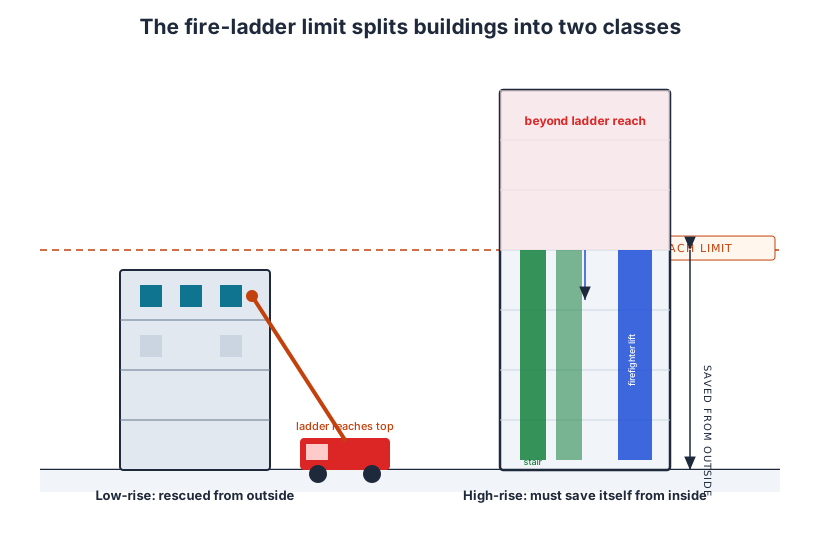
| What limits your height | Why it exists |
|---|---|
| Fire-engine ladder reach | Tall buildings cannot be rescued from outside, so they need costly internal fire systems |
| Wind and earthquake safety | Height multiplies structural loads; the design and foundation must carry it safely |
| Light and air to neighbours | Stops tall walls from blocking sun and breeze on adjoining plots and streets |
| Airport and flight-path clearance | Keeps structures below the surfaces aircraft need for safe take-off and landing |
| Heritage precinct character | Protects skylines and sightlines around monuments and historic areas |
| Infrastructure load | Roads, water and drainage are sized for a planned density per area |
2. The road outside your gate sets your ceiling
Here is the single idea that surprises most homeowners: in India, how tall you can build is tightly linked to how wide the road in front of your plot is.
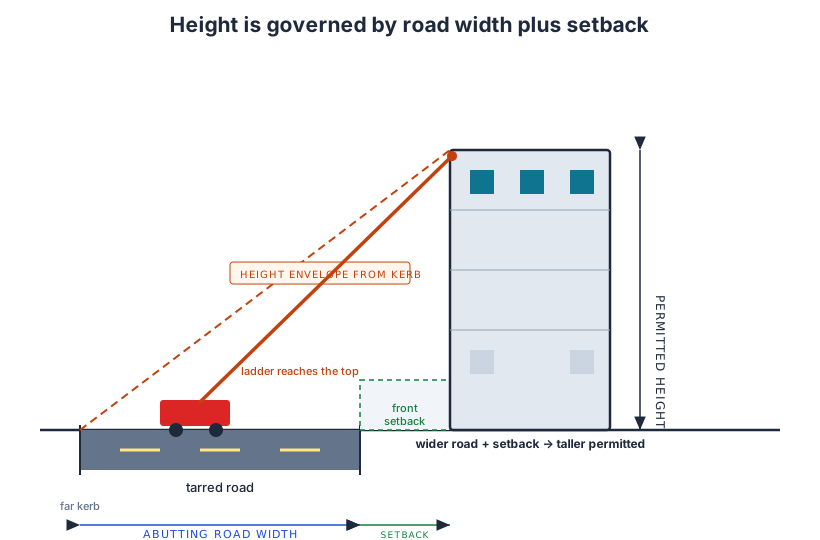
The logic is simple once you see it. A wider road can carry more traffic, can take the extra people a taller building brings, and gives a fire engine the room it needs to set up its ladder. A narrow lane can do none of those things. So a plot facing a 12-metre road is usually allowed to go considerably higher than the identical plot facing a 6-metre lane.
Many Indian development control rules express this as a ceiling tied to road width, often along the lines of a maximum height of roughly one and a half times the width of the abutting road (sometimes the road width plus the front setback). The exact multiplier and method differ from city to city, so treat that "one and a half times" only as the shape of the rule, not a number to design with. The practical takeaway is firm and universal: measure your road, because it is probably the biggest single thing deciding your height.
Setbacks come into this too. As you are permitted to go higher, most rules also demand larger open margins around the building, so a tall, slim block on a small plot is often impossible not because of one rule but because height and setback tighten together. A plot on a broad road can spread out and rise; a plot on a narrow lane is pushed to stay low.
3. FAR, floors and height are three different limits
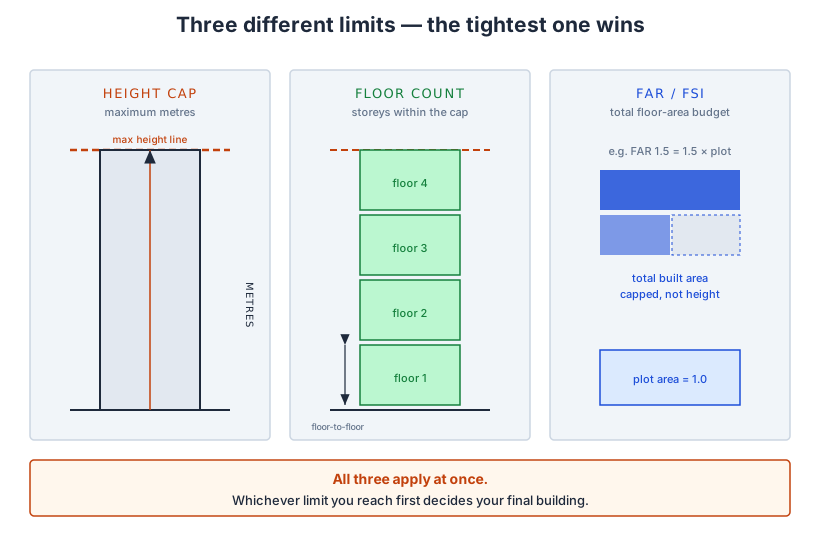
This is the confusion that costs homeowners the most, so slow down here. Three separate limits decide your final building, and they are not the same thing.
- Height limit. The maximum height of the building in metres, driven by road width, zone, fire rules and airport zones, as above.
- Number of floors. How many storeys you stack. This is a consequence, not an independent right; it depends on the height limit divided by your floor-to-floor height.
- FAR / FSI. The Floor Area Ratio (also called Floor Space Index) caps the total floor area you may build across all floors, as a multiple of your plot area. It is your floor-area budget.
These work together, and the tightest one wins. You might have enough FAR for four floors but a height limit that only allows three. Or you might have height for four floors but run out of FAR after two and a half. You must satisfy all three at once.
A worked intuition, with illustrative numbers only. Suppose your rules allow a height that comfortably fits a stilt plus three floors. Floor-to-floor height matters here: at a generous 3.3 metres per floor you fit fewer floors into the same cap than at a tighter 3.0 metres, which is why a low parapet or an extra mumty can quietly push you over the line. Separately, your FAR might cap total floor area at one and a half times your plot. If your footprint after setbacks is small, you may need every floor the height allows just to use up your FAR; if it is large, FAR may run out first. The point is not the numbers, which are yours to verify; it is that height and FAR are different taps and the first to run dry stops you.
To understand the area side properly, read the companion guides on how FSI/FAR is computed (height caps interact with FAR) and FAR vs FSI: development rights.
4. The high-rise threshold and what it triggers
There is a height at which your building stops being an ordinary house and legally becomes a "high-rise," and crossing it changes everything about cost, approvals and design.
Under the National Building Code (NBC) 2016, height bands are used to decide how much fire and life-safety provision a building needs. As broad working bands, low-rise buildings up to roughly 15 metres are treated most simply; a middle band, often described from about 15 metres up to around 30 metres, brings in more fire provisions; and buildings above the high-rise threshold (a figure your state and the current code define, and which has been the subject of revision in recent years) attract the full package. Do not memorise an exact figure from a brochure; confirm the current threshold and band for your state, because this single line decides whether your project is simple or serious.
Once a building crosses into high-rise territory, the law typically requires a far heavier set of features:
- A separate fire NOC (no objection certificate) from the fire service, in addition to the normal building approval.
- Two staircases instead of one, often pressurised, so escape is always possible if one is blocked by smoke.
- A firefighter's lift and wet or dry risers (built-in water pipes) so the fire service can fight a blaze from inside.
- Refuge floors or refuge areas at intervals, safe zones where occupants gather and wait during a fire.
- Sprinklers, smoke detection, alarm systems, an underground and overhead water reserve for firefighting, and assured fire-engine access around the building.
All of this is expensive and space-consuming. This is precisely why so many individual homes are deliberately designed to stay just below the high-rise threshold: crossing it can transform a straightforward family house into a regulated tower with a much larger compliance burden. If your builder is nudging you "just a bit taller," ask explicitly whether that pushes you over the high-rise line, because the answer can change your budget dramatically.
5. Airports, flight paths and the height NOC
If your plot is anywhere near an airport, a second, completely separate height ceiling applies, and it can be stricter than every local rule combined.
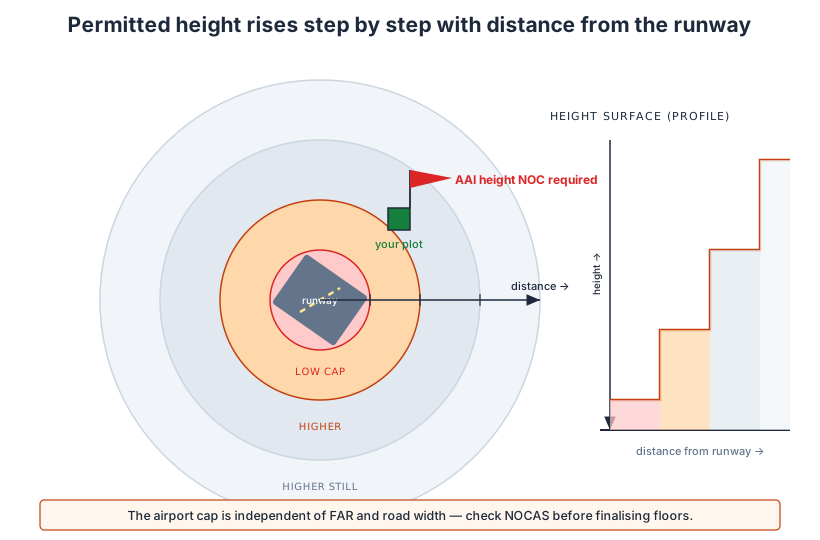
Aircraft taking off and landing need a clear sloping volume of air around an airport, free of obstacles. To protect it, the Airports Authority of India (AAI) restricts how tall structures can be within a wide radius of an aerodrome. Roughly speaking, an inner zone closest to the airport allows only modest heights, and the permitted height increases gradually with distance out to a radius of many kilometres, beyond which an NOC may still be needed even where no fixed cap applies. The exact surfaces are technical; what you need to know is that proximity to an airport can override a generous local height limit entirely.
Clearance is handled through AAI's online system, NOCAS (the No Objection Certificate Application System, at the AAI website). You submit your site's precise location coordinates and ground elevation, and the system either clears your proposed height automatically or routes it for review. Many cities also publish colour-coded zoning maps (CCZMs) for their airports: if your plot falls in certain zones you must obtain an AAI height NOC before your building can be sanctioned, and your sanctioned plan must certify that your height stays within the mapped limit.
What this means in practice:
- If you are within roughly twenty kilometres of an airport, assume an AAI height NOC may be required and check early, before you finalise floors. Treat that radius as an alert, not a precise legal boundary, and confirm against the current rules.
- The airport limit is independent of FAR and road width. You can have the FAR and the road for four floors and still be capped lower by the flight path.
- Apply for the NOC well in advance. A height that is fine on paper but not cleared by AAI cannot be legally built or occupied.
6. How to find your plot's permitted height
Do not design to a number from memory, a neighbour or a brochure. Find the figure that governs your specific plot, the same disciplined way you would for FAR.
1. Identify your local planning authority, your municipal corporation, development authority or town and country planning department.
2. Find that authority's current building bye-laws or Development Control Regulations (DCR / DCPR). Many are online as PDFs.
3. Look up the height provision for your zone, land use and, crucially, your abutting road width. Height is usually given against road width, sometimes alongside the front setback.
4. Check the high-rise threshold in your state and confirm whether your intended height crosses it and triggers a fire NOC and the extra norms in section 4.
5. Check airport proximity. If you are anywhere near an aerodrome, check the colour-coded zoning map and AAI's NOCAS system, and apply for a height NOC if required.
6. Cross-check with a licensed architect or the authority's help desk before you finalise the design. A correct reading early is far cheaper than a wrong house and a refused Occupancy Certificate later.
Height interacts with setbacks at almost every step, so also read building setbacks across India, why setbacks matter, and, because density rules travel together, why parking rules matter. For state-by-state context, the India Regulatory Atlas is a good starting map.
7. Common misunderstandings that catch homeowners
A few mistakes appear again and again. Learn them once.
- "More FAR means I can go taller." No. FAR caps total floor area, not height. You can exhaust your FAR in two wide floors or three slim ones; the height limit is a separate ceiling decided mainly by road width, zone and airport rules.
- "Floors are what is regulated." Not directly. The law usually caps height in metres, and your floor count falls out of that divided by your floor-to-floor height. A taller floor-to-floor or an extra parapet, mumty or water tank can quietly tip you over the limit.
- "The cap is the same across my city." It is not. Two plots on the same street can have different limits if they face roads of different widths, sit in different zones, or fall inside different airport zones.
- "We can regularise an extra floor later." This is the dangerous one. A floor built above your sanctioned height is unauthorised. It can cost you the Occupancy Certificate, trigger penalties or demolition, and make a home loan or resale very hard. An extra room is never worth losing your OC.
- "The airport is far, so it does not matter." Airport height surfaces extend a long way out, and the cap can be lower than your local rule. Always check NOCAS proximity before finalising floors.
What this means for you
Strip away the jargon and your height limit comes down to three honest questions. How wide is the road in front of my plot, because that usually sets the ceiling? Does my intended height cross the high-rise threshold, because crossing it brings a fire NOC, two staircases, a firefighter lift and refuge floors? And am I near an airport, because the flight path can override everything else through an AAI height NOC. Answer those three against your own city's current bye-laws and the airport rules, not against a builder's optimism, and you will know your real, buildable height before you spend a rupee on design.
Get the height right and the floors, the approvals, the loan and the eventual resale all rest on solid legal ground. Get it wrong and even a beautiful house can be stuck without an Occupancy Certificate. The difference is one afternoon of checking the right documents.
Sources
- National Building Code of India (NBC) 2016, Bureau of Indian Standards, Part 3 (Development Control Rules and General Building Requirements) and Part 4 (Fire and Life Safety): height classifications, high-rise provisions, refuge floors, staircases and firefighting requirements.
- Airports Authority of India, No Objection Certificate Application System (NOCAS), nocas2.aai.aero: online height-clearance applications, aerodrome proximity zones and procedure.
- Airports Authority of India, Guidelines for Colour Coded Zoning Maps (CCZM): how mapped zones determine when an AAI height NOC is required and the permitted-height surfaces around aerodromes.
- State and city Development Control Regulations and building bye-laws (for example MCGM / DCPR for Mumbai, DDA Unified Building Bye-Laws for Delhi, BBMP / BDA bye-laws for Bengaluru, and state DCRs such as Jaipur and Tamil Nadu): height tied to abutting road width, setback relationships and absolute caps.
- Ministry of Civil Aviation, rules on the height of structures around aerodromes (GSR notifications): basis for AAI height restrictions and NOC requirements.
Export this guide
Related Guides — Deep-dive reading
Compound Wall Regulations in India: Height Limits, Setbacks and Bye-Laws (2026)
A regulatory-literacy guide to the rules that govern a boundary wall in India — the things municipal bye-laws and development-control regulations typically cover, from maximum height and the open-grille front-wall rule to setbacks, corner-plot sight lines, gate swing, fire-tender access and neighbour law — and, most importantly, a plain method for finding and confirming the rule that actually applies to YOUR plot.
Compound WallsUnderstanding Building Bye-Laws in India: A Homeowner's Guide
What municipal building bye-laws are, who makes them, and how to find and read the ones that actually govern your plot
Building Regulations & ComplianceWhy Building Rules Exist in India: A Homeowner's Guide
What setbacks, FAR, height limits and certificates quietly protect — and why following them pays you back
Building Regulations & ComplianceRelated Tools — Try Free
Cross-Ventilation Analyzer
Estimate airflow and air changes per hour (ACH) from room size, window areas, layout, and local wind — with NBC 2016 Part 8 compliance check.
Ventilation CalculatorBuilding Plan Approval Roadmap
Step-by-step building plan approval process by city with documents, timelines, and fees.
ArchitectAIProperty Tax Calculator — 10 Indian Cities
Estimate annual municipal property tax across BBMP / MCD / MCGM / GHMC / GCC / KMC / PMC / AMC / TMC / PCMC — with self-occupied, tenanted, and age-rebate adjustments.
Property Tax