
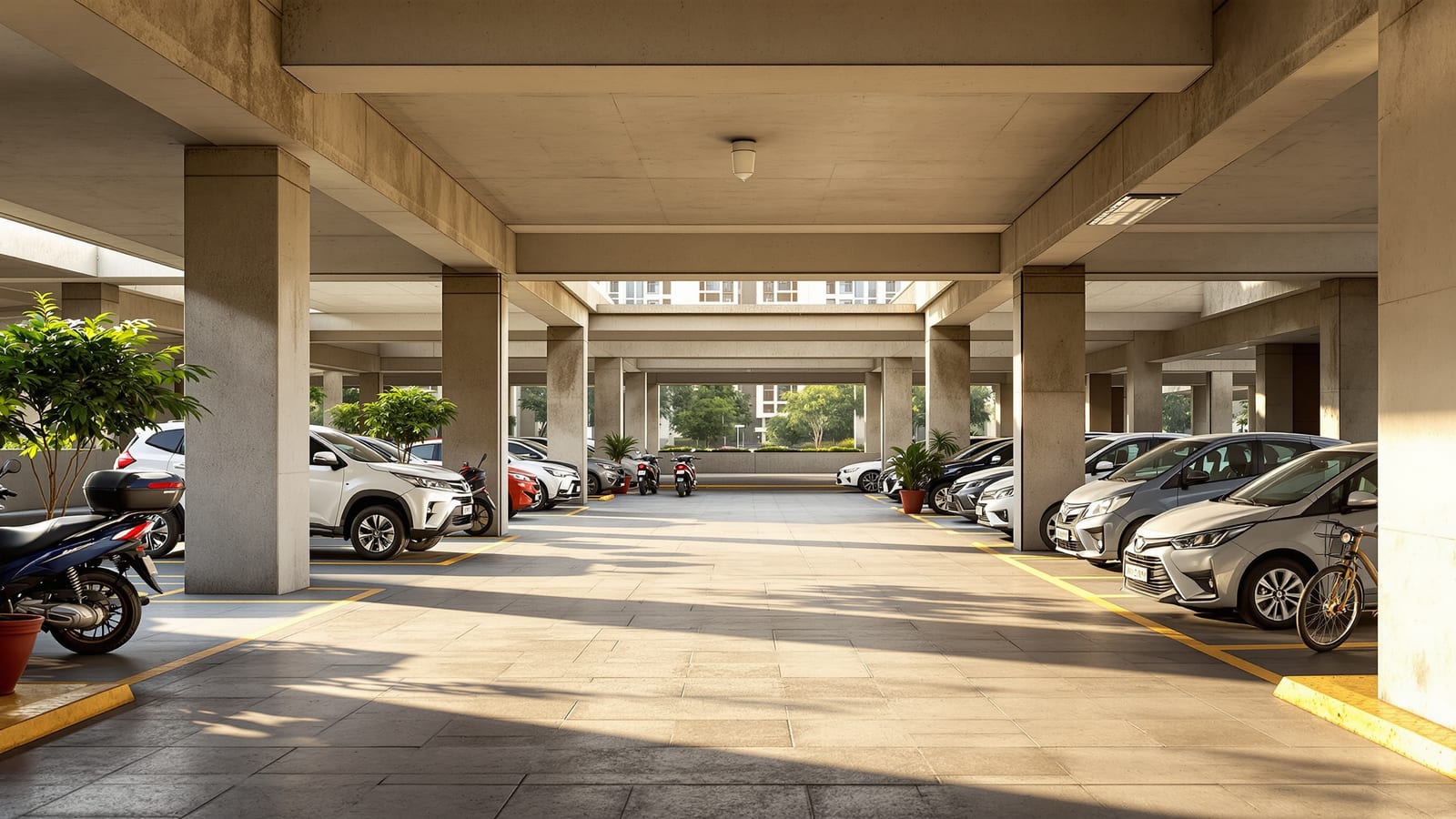
Why Parking Rules Matter: How India's Off-Street Parking Norms Work
Why building rules force your home to provide its own parking, how the numbers are set, and what a buyer or self-builder should check before committing
When you buy or build a home in an Indian city, somewhere in the fine print of the sanctioned plan is a number that quietly shapes the whole project: how many cars and two-wheelers the building must be able to park on its own land. It is easy to ignore. It is also one of the rules most likely to cause you real trouble later, from a refused completion certificate to a permanent fight with your neighbours over a single bay.
This guide explains, in plain language, why parking rules exist, how the numbers are worked out, the different ways a building can hold its vehicles, and what you as a homeowner or buyer should actually check before you commit. Parking norms vary a lot between cities and building types, so treat every figure here as a typical range and verify the exact requirement against your local building bye-law or Development Control Regulation (DCR).
1. Why the rules exist at all
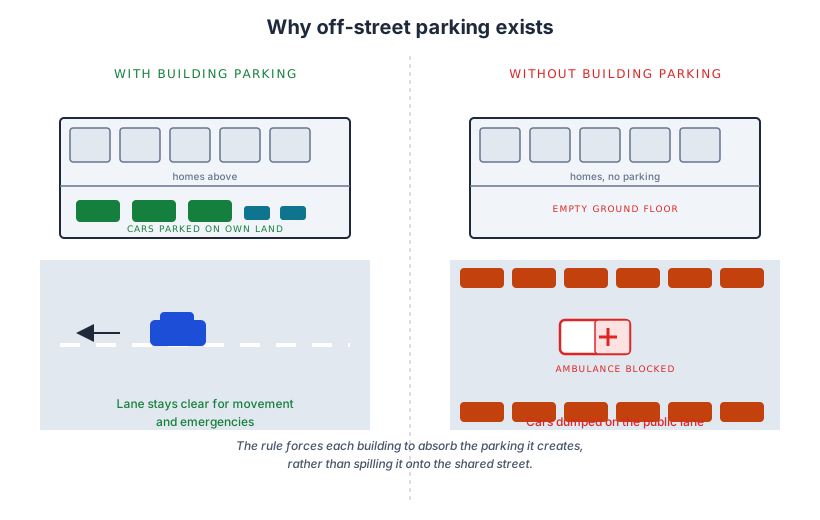
The simplest way to understand parking rules is to ask what happens without them. If a building provides no parking, its residents do not stop owning cars. They park on the public road instead. Multiply that across a street, and the lane that fire engines, ambulances, delivery vehicles and pedestrians depend on becomes a single crawling file of parked cars.
So the core intent of off-street parking norms is to keep private vehicles off public lanes. The logic runs roughly like this:
- Streets are shared public space. They exist for movement, not for free private storage of cars.
- Emergency access matters. A blocked lane can cost minutes that matter in a fire or medical emergency.
- Pedestrians and cyclists need room. Cars parked on footpaths push people into traffic.
- Fairness. If your building generates the demand for parking, the cost of meeting it should sit with your building, not be dumped on every taxpayer who funds the road.
This is why the rule is a condition of permission to build, not a polite suggestion. The planning authority is, in effect, saying: you may add these homes only if you also absorb the parking they will create.
2. How the required number is set
There is no single national parking number you can memorise, because the requirement is calculated, not fixed. Authorities use three broad methods, sometimes in combination.
Per dwelling unit. The crudest method ties parking to the number of homes, for example one car space for every two small flats, scaling up to one or more spaces per larger flat. The National Building Code of India (NBC) 2016 illustrates this kind of ratio, with smaller flats sharing spaces and larger flats requiring their own.
Per unit of built-up area. A more common modern method scales parking to floor area, on the reasonable assumption that bigger homes house wealthier households who own more vehicles. The Model Building Bye-Laws guidance, for instance, expresses residential parking as a number of car spaces per 100 square metres of built-up area.
Equivalent Car Space (ECS). To compare cars, two-wheelers, basement bays and open bays on one scale, planners use a unit called the Equivalent Car Space. One ECS represents the area a single car needs once you include the room to drive in, turn and reverse out, not just the painted box. Because a basement bay needs more ramp and circulation room than an open bay, the same parked car can count as a different amount of floor area depending on where it sits. Requirements are then written as a number of ECS that the building must provide. The exact ECS area and the required ratio differ by city, so do not assume a figure you read for one city applies to another.
A useful mental model: the bye-law tells you how many ECS you must supply, the building type and city tell you how many square metres one ECS consumes, and the two together decide how much of your plot disappears into parking.
| How norms are measured | What it ties parking to | Strength | Weakness |
|---|---|---|---|
| Per dwelling unit | Number of homes | Simple to count and check | Ignores that a large flat owns more cars than a small one |
| Per built-up area | Floor area built | Scales with likely affluence and demand | Two small homes and one large home of equal area treated alike |
| Equivalent Car Space (ECS) | A common area-based unit | Lets you compare cars, scooters, open and basement bays fairly | Harder for a lay buyer to verify without help |
Verify the method and the exact ratio in your own bye-law or DCR. Two neighbouring cities can use different methods entirely.
3. The types of parking, and how each is treated
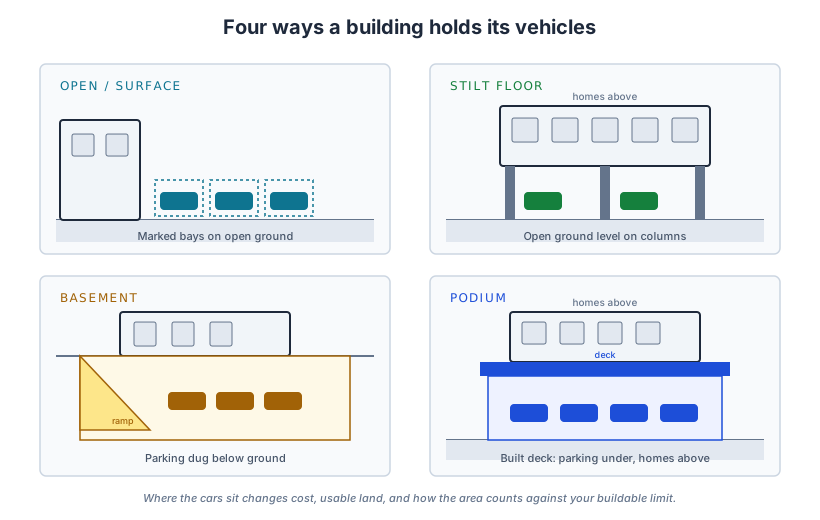
Not all parking is equal in the eyes of the bye-law. Where the building puts its cars affects cost, usable land, and crucially how the area is counted against your buildable limit.
| Parking type | What it is | Pros | Cons |
|---|---|---|---|
| Open / surface | Marked bays on open ground | Cheapest, easy to build, no structure | Eats plot area you could landscape; cars exposed to weather |
| Stilt | Open ground floor on columns, building raised above | Protects cars; often treated favourably in area rules | Reduces ground-floor habitable space; legality conditions apply |
| Basement | Parking dug below ground | Frees the surface for greenery or amenities | Expensive, needs ramps, ventilation, drainage and waterproofing |
| Podium | A built deck with parking under and homes above | High capacity on tight urban plots | Costly structure; can feel cut off from the street |
| Mechanical / puzzle | Lifts and stackers that store cars in stacked trays | Fits many cars into little land | Maintenance, queues at peak hours, dependence on power |
Mechanical or puzzle parking is increasingly common on small, expensive urban plots where there simply is not room for a ramp and aisles. Some cities allow it to count toward the requirement; others limit how much of the obligation it can satisfy, precisely because a broken stacker can strand cars. Check whether your city counts mechanical bays fully, partly, or not at all.
4. How parking interacts with FAR and stilt floors
This is where parking rules become financially interesting, and where a lot of confusion lives.
Floor Area Ratio (FAR), also called FSI, caps how much total floor space you may build on a plot. Every square metre of saleable, habitable floor area counts against that cap. Parking, by contrast, is usually treated as a service area, and in many cities the area used purely for parking and its circulation is exempt from FAR, or counted at a reduced rate. The reasoning is that the city wants you to provide parking and does not want to punish you by making every parking bay eat into your buildable home area.
The stilt floor is the classic example. A stilt is an open ground level standing on columns, with the building raised above it, used for parking. In many Indian cities a properly open stilt used for parking is excluded from FAR and sometimes not counted as a full storey for height purposes, which is exactly why developers love it. But the exemption is conditional. Typically the stilt must be genuinely open on the required sides and used only for parking; enclose it, or convert it into rooms or shops, and it can lose its exemption and become unauthorised construction.
These exemptions are not uniform. The share of basement allowed, whether podium parking counts, and how generously stilts are treated all vary by city and by the size and use of the building. Our companion guide on stilt parking in India (FSI exemptions and legality) goes into the conditions in detail, and FAR vs FSI development rights explains the buildable-area cap itself.
5. Visitor parking and the spaces nobody owns
A requirement buyers routinely overlook is visitor parking. Bye-laws for group housing usually mandate that a slice of the total parking, often expressed as a small percentage, be set aside for visitors and kept common, not sold or assigned to any flat.
This matters for two reasons. First, it is why your guests should have somewhere to park instead of blocking the gate or the road. Second, it is a frequent source of disputes: in many projects the visitor bays quietly get occupied by residents with second cars, and the genuine visitor ends up on the street, which is the precise outcome the rule was meant to prevent.
It is worth knowing that in much of India the law treats common parking, including stilt and visitor areas, as collective property of the housing society once the building is handed over, rather than something the builder can sell separately as a unit. The details turn on local rules and your sale agreement, so read what you are actually buying: an assigned right to use a numbered bay is not the same as owning a separate parking unit.
6. The honest policy debate
It would be dishonest to present minimum parking rules as settled wisdom. Among planners and economists they are genuinely contested, and a homeowner deserves both sides.
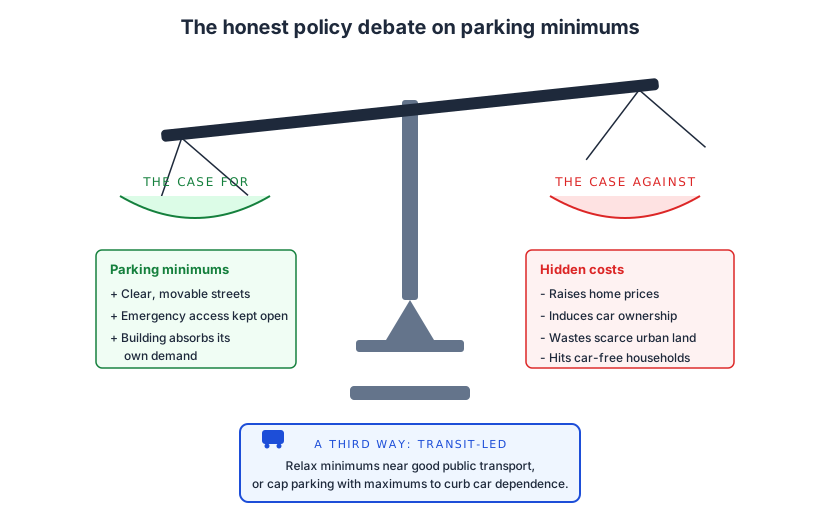
The case for minimums is the one this guide opened with: without a mandate, buildings push their parking onto public streets, congesting lanes and blocking emergencies. A rule forces each building to internalise its own demand.
The case against is subtler and growing louder. Critics argue that minimum-parking mandates:
- Raise the cost of housing. Every mandatory bay, especially in a basement or podium, is expensive to build, and that cost is baked into the price of every home whether or not the buyer owns a car.
- Induce car ownership. When a parking space comes bundled, more or less free, with every home, people are nudged toward owning a car they might otherwise have done without, which adds to the very congestion the rule was meant to ease.
- Waste scarce urban land on stored vehicles that sit idle most of the day, land that could hold homes, shops or greenery.
- Hit car-free and lower-income households hardest, since they pay for parking they do not use.
In response, some cities and planners around the world, and increasingly in policy conversations in India, are rethinking the approach: relaxing minimums near good public transport, or even replacing minimums with maximums that cap how much parking a building may build, to discourage car dependence. There is no Indian consensus yet, and norms still lean firmly toward minimums. The point for you is simply to understand that the number in your plan reflects a policy choice that is being actively debated, not a law of nature.
7. What a parking shortfall actually costs you
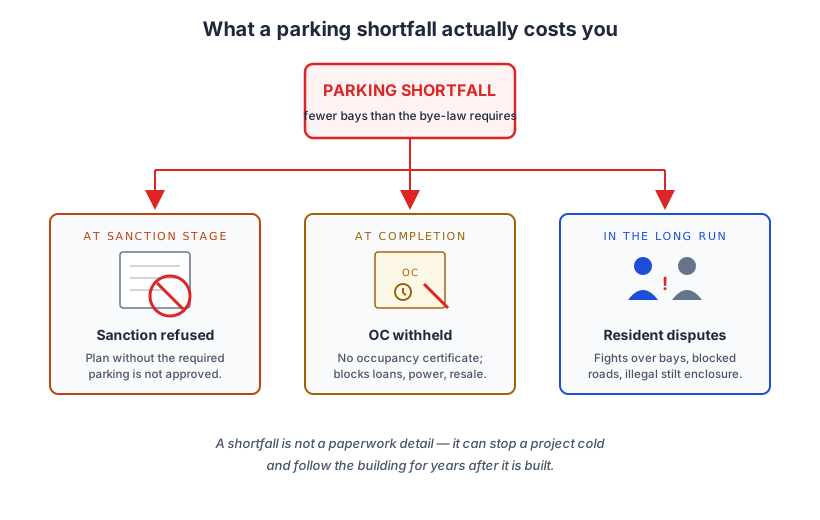
The reason to take all this seriously is that a parking shortfall is not a paperwork detail. It can stop your project cold.
At sanction stage, if the submitted plan does not show the required parking, the authority can simply refuse to sanction it. You cannot legally start.
At completion, the bigger trap. Even a sanctioned building is inspected before it gets its occupancy or completion certificate. If the parking that was promised on paper was never actually built, or was quietly converted into shops or rooms, the certificate can be withheld. Without that certificate the building is not legally fit for occupation, which can block loans, registrations, water and power connections, and resale. Our guide on the occupancy certificate explains why this document is the one that turns a finished building into a legal home.
In the long run, a building that was always short of parking generates years of friction: residents fighting over assigned bays, visitors blocking the road, encroached visitor parking, and pressure to illegally enclose the stilt for more space, which then risks the FAR exemption and invites action against the whole society.
8. What a homeowner or buyer should check
Whether you are building your own home or buying into an apartment project, a few specific checks save a great deal of grief.
- Read the sanctioned plan, not the brochure. Confirm the parking shown matches the number the bye-law requires for the building's area and use.
- Match plan to reality. Walk the actual parking before you buy. Count the bays. Check that the stilt or basement is being used for parking and has not been enclosed or converted.
- Ask what you are buying. Is the bay assigned to your flat, common society property, or sold separately, and what does your agreement say.
- Check the occupancy certificate. A valid OC strongly suggests the parking was actually delivered as sanctioned.
- Look at visitor parking. Confirm it exists and is not already swallowed by residents.
- For a self-build, design parking early. It shapes your stilt, your setbacks and your usable ground floor. Plan it before you finalise the layout, not after.
- Verify the exact local norm. Use a tool like the building bye-law checker and confirm against your city's current DCR or municipal bye-law.
What this means for you
Parking rules are not bureaucratic clutter. They are the mechanism by which your home is forced to take care of its own cars instead of dumping them on a public lane that everyone else shares. For you, the practical consequences are concrete: the requirement quietly consumes part of your plot, it shapes whether your building uses a stilt, a basement or a stacker, it interacts with how much home you are allowed to build, and a shortfall can cost you a sanction, an occupancy certificate, or years of peace with your neighbours.
You do not need to memorise ratios. You need to do three things: find out the exact parking norm that applies to your plot and building type, check that the plan genuinely meets it, and check that what was promised on paper was actually built. Because parking norms differ sharply by city, use, and building size, always verify against your current local bye-law or DCR rather than any general figure, including the ranges in this guide.
To see how this rule sits among the others that govern your plot, read how urban regulations shape cities, building height restrictions explained, and understanding building bye-laws. For the rules that apply in your own state and city, browse the India Regulatory Atlas.
Sources
- Bureau of Indian Standards, National Building Code of India (NBC) 2016, Part 3 Development Control Rules and General Building Requirements (parking standards and dimensions).
- Ministry of Housing and Urban Affairs (formerly Ministry of Urban Development), Model Building Bye-Laws 2016 (residential parking provisions, Equivalent Car Space and visitor parking guidance).
- State Development Control Regulations / Development Control and Promotion Regulations (for example Maharashtra, Delhi, Karnataka), which set city-specific parking ratios, ECS areas and stilt/basement treatment.
- Town and Country Planning Acts and municipal corporation building bye-laws of individual cities, which are the binding rules for any given plot.
- Wikipedia, Parking mandates, for an overview of the international policy debate on minimum and maximum parking requirements.
- University of Chicago, research on minimum parking requirements and housing costs, for the affordability side of the debate.
Export this guide
Related Guides — Deep-dive reading
Understanding Building Bye-Laws in India: A Homeowner's Guide
What municipal building bye-laws are, who makes them, and how to find and read the ones that actually govern your plot
Building Regulations & ComplianceBuilding By-laws & Your Roof: Height, Setbacks, Terrace & Mumty Rules (India)
The municipal layer that shapes what you can build on top of your home — how local by-laws treat building height, setbacks and roof projections, open versus enclosed terraces and FSI, the mumty, lift machine-room and overhead tank above the height line, and parapet height for a usable roof. India-grounded, and always “confirm with your local authority.”
RoofingFAR vs FSI: Understanding Your Development Rights in India
What Floor Area Ratio and Floor Space Index mean, how they decide how much house you can build, and the traps every Indian homeowner should avoid
Building Regulations & ComplianceRelated Tools — Try Free
Apartment Video Door System Planner
Enter flats, entrances, floors and guard desk for a first-pass building intercom plan — door stations, indoor monitors, guard station, the right architecture and an indicative cost band.
Building PlannerCross-Ventilation Analyzer
Estimate airflow and air changes per hour (ACH) from room size, window areas, layout, and local wind — with NBC 2016 Part 8 compliance check.
Ventilation CalculatorVisitor Access Planner
Size visitor handling at a gate or reception — lanes needed at peak and the temporary-pass pool.
Visitor Flow