

FAR vs FSI: Understanding Your Development Rights in India
What Floor Area Ratio and Floor Space Index mean, how they decide how much house you can build, and the traps every Indian homeowner should avoid
You have bought a plot, or you are about to. The first question every homeowner asks is simple: "How big a house can I actually build here?" The answer hides behind two intimidating abbreviations that you will see on every approval drawing, sanction letter and builder brochure: FAR and FSI.
Here is the good news. They are not two different rules you have to learn. They are the same rule wearing two different name-tags. Once you understand that single number, you understand the legal limit on the size of your home better than most buyers ever do. This guide explains, in plain language, what FAR and FSI mean, how to do the simple maths yourself, how they connect to setbacks and height, and the traps that catch homeowners every year.
1. FAR and FSI are the same thing
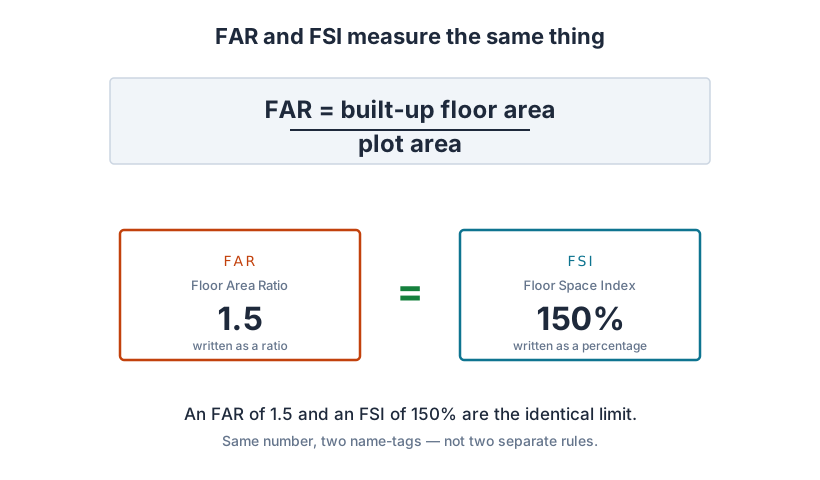
FAR stands for Floor Area Ratio. FSI stands for Floor Space Index. They measure exactly the same thing: how much total floor area you are allowed to build, compared to the size of your plot.
The only real difference is the way the number is written down:
- FAR is usually written as a plain ratio, like 1.5.
- FSI is often written as a percentage, like 150 percent.
An FAR of 1.5 and an FSI of 150 percent are identical. Delhi and most international writing prefer "FAR." Mumbai, Pune and Bengaluru tend to say "FSI." Your sanction documents may use either word, sometimes both on the same page. Do not let the two names fool you into thinking they are separate limits.
The formula is the same either way:
FSI = total built-up floor area / plot area
Rearranged, the number that matters to you:
Buildable floor area = FSI x plot area
That is the whole idea. Everything else is detail.
2. A worked example you can copy
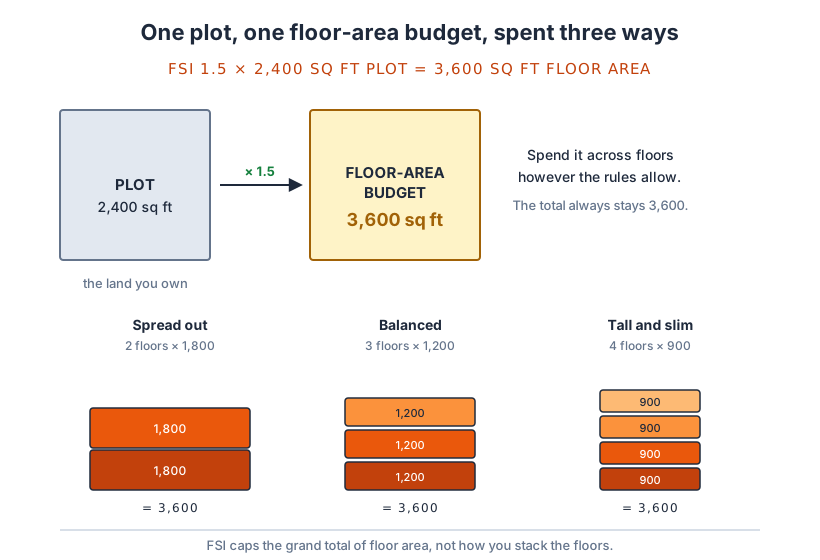
Numbers make this concrete. Imagine you own a plot of 2,400 sq ft, and your local rules permit an FSI of 1.5. (This number is illustrative only; your real figure depends on your city and is covered in section 6.)
Total floor area you may build = 1.5 x 2,400 = 3,600 sq ft.
That 3,600 sq ft is your budget of "floor space." You can spend it across floors however the other rules allow. A few ways the same budget could be arranged:
| Layout option | Footprint per floor | Number of floors | Total floor area used |
|---|---|---|---|
| Spread out, low | 1,800 sq ft | 2 | 3,600 sq ft |
| Balanced | 1,200 sq ft | 3 | 3,600 sq ft |
| Tall and slim | 900 sq ft | 4 | 3,600 sq ft |
Notice that the total stays at 3,600 sq ft in every row. FSI does not care how you stack the floors. It only caps the grand total of floor area. What decides whether you can actually go to three or four floors is two other limits, ground coverage and height, which we look at next.
3. FSI is not the same as ground coverage or height
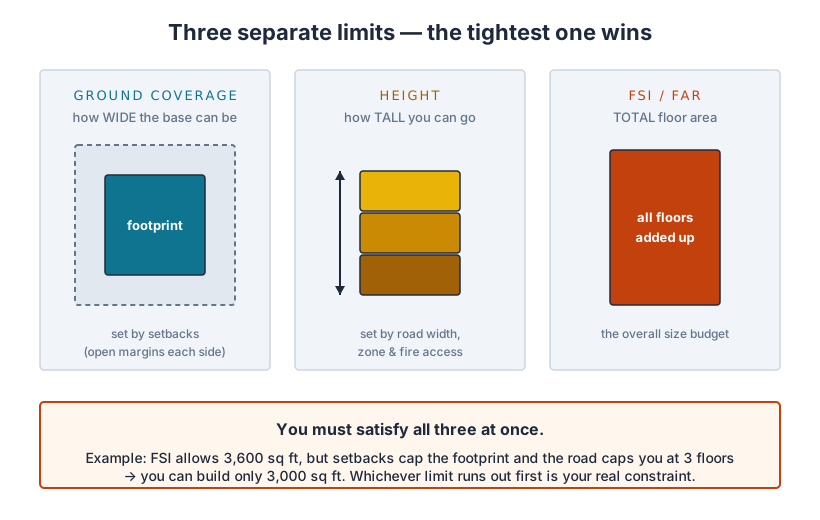
Three separate limits work together to shape your house. Confusing them is the single most common homeowner mistake.
- FSI / FAR: the total floor area across all floors. The size budget.
- Ground coverage: how much of the plot the building footprint can cover at ground level, usually written as a percentage (for example 50 percent or 60 percent). This is set by setbacks, the mandatory open margins you must leave on each side.
- Height limit: the maximum height of the building, driven by the width of the road in front, airport zones, fire-access rules and city bye-laws.
Think of it like this. Ground coverage decides how wide your base can be. Height decides how tall you can go. FSI decides how much floor area you can pour into that box overall. You must satisfy all three at once. Whichever runs out first is your real constraint.
| Control | What it limits | Typical units | Mainly driven by |
|---|---|---|---|
| Ground coverage | Building footprint | Percent of plot | Setbacks, plot size |
| Height | How tall | Metres or floors | Road width, zone, fire rules |
| FSI / FAR | Total floor area | Ratio or percent | City, zone, road width, plot size |
A practical example of the clash: your FSI might allow 3,600 sq ft, but if setbacks limit your footprint to 1,000 sq ft and your road width caps you at three floors, you can only physically build 3,000 sq ft. The remaining 600 sq ft of FSI is simply unusable on that plot. The reverse also happens, where you could fit more floors but FSI stops you. Always check all three.
This is why two plots with the same FSI can produce very different houses. A plot on a narrow road with deep setbacks may be forced into a tall, slim form, while a wider plot on a broad road can spread out comfortably. The FSI number alone never tells you the shape of the home you can build; it only tells you the maximum floor area. The lived-in shape comes from how FSI, ground coverage and height pull against each other on your particular plot.
4. Why the FSI number changes from plot to plot
Two plots on the same street can have different permitted FSI. The figure is not a single national number; it is set locally and depends on several factors.
- City and state: each state frames its own building bye-laws and development control rules. Mumbai, Delhi and Bengaluru all use different systems and numbers.
- Zone and land use: residential, commercial and mixed-use zones get different FSI. A redevelopment or transit-oriented zone near a metro line often gets much higher FSI than an old low-rise colony.
- Width of the abutting road: this is a big one. Plots facing a wider road are usually allowed more FSI and more height, because the road can handle more traffic and provides fire access.
- Plot size: in several cities smaller plots are allowed a slightly higher FSI ratio than very large plots, to make small homes viable.
- Building type: an individual house, a group-housing project and a commercial building follow different FSI tables even in the same area.
The national reference, the National Building Code (NBC) 2016, sets the framework and definitions, but the actual numbers are filled in by your local authority. That is why you should never rely on a number a neighbour or a broker quotes from memory.
As a rough sense of scale, base residential FSI in Indian cities often sits somewhere in the range of about 1.0 to 2.5, with redevelopment and transit zones going higher, but please treat that as illustrative context, not a figure to design with. The only number that governs your plot is the one printed in your own authority's current table for your zone, road width and plot size.
5. What "development rights" really means
When planners say FSI, they often mean your "development rights," your legal entitlement to build. Beyond the basic FSI, a homeowner may meet a few extra concepts, especially in big cities. You do not need to master them, but you should recognise them.
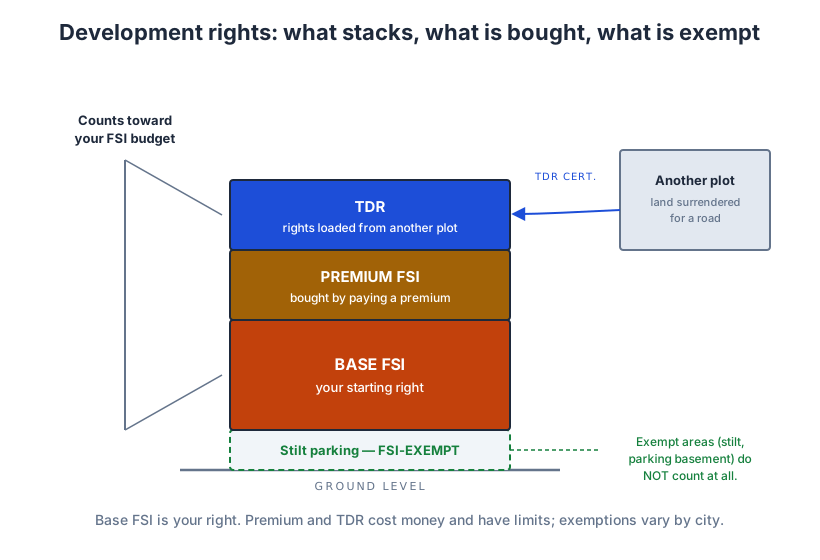
- Premium or chargeable FSI: extra FSI above the base, which you can buy from the authority by paying a premium charge (often linked to the area's official land rate). It is legal and tied to your own plot. In Mumbai this sits inside DCPR 2034.
- TDR (Transferable Development Rights): unused building rights from one plot (for example, land surrendered for a road) issued as a certificate that can be loaded onto another plot to build more there. Mostly a developer and redevelopment tool, but worth recognising on brochures.
- Fungible FSI: a Mumbai-specific extra (commonly described as up to 35 percent over the base) used for balconies, flower beds, passages and similar spaces, available on payment of a premium, and given free to existing society members during redevelopment.
- FSI-exempt areas: some spaces do not count toward your FSI budget at all. Commonly this includes stilt parking (open on the sides, low height) and basements used only for parking and services. Exactly what is exempt varies a lot by city and changes over time, so never assume.
The takeaway: your basic FSI is your starting right. Cities provide legal ways to build a bit more, and legal carve-outs that do not count. Both vary, so confirm before you plan on them.
6. How to find your plot's permitted FSI
Do not guess, and do not trust a brochure. Find the official number for your specific plot.
1. Identify your local planning authority. This is your municipal corporation, development authority or town planning department (for example DDA and MCD in Delhi, BBMP and BDA in Bengaluru, MCGM in Mumbai).
2. Find the building bye-laws or Development Control Regulations (DCR / DCPR) for that authority. Many are published online as PDFs.
3. Look up the table for your zone, your land use, your plot size and your road width. FSI is usually given in a grid against these factors.
4. Cross-check with the sanctioned layout or khata or property card, which often states the permissible FSI directly.
5. When in doubt, ask a licensed architect or the authority's help desk. A small fee for a correct reading is far cheaper than a wrong house.
You can also get a quick first estimate with the Studio Matrx FAR / FSI calculator and read how professionals handle the full computation in how architects compute FSI/FAR in India. Treat both as a starting point, then verify against your local DCR or bye-law.
7. Common confusions and costly traps
A few mistakes catch homeowners again and again. Learn them once.
- Carpet vs built-up vs super built-up: carpet area is the usable floor inside walls. Built-up area adds the walls and ducts. Super built-up adds a share of common areas like lobbies and stairs, and is a marketing figure, not a legal one. FSI is generally calculated on built-up floor area as defined in your local rules, not on the inflated super built-up number a brochure shows. When you compare what you are paying for with what you can build, make sure you are comparing the same kind of area.
- Buying "extra FSI" carelessly: premium FSI and TDR are real, but they cost money, have ceilings on how much you can load, and follow strict rules. Never assume you can simply purchase your way to a bigger house. Confirm eligibility and limits with the authority first.
- Assuming exemptions apply: people often plan a stilt or basement assuming it will not count, then discover the local rule treats it differently, or that it is only exempt if built exactly as specified. Verify the exact conditions.
- Building beyond your sanctioned FSI: this is the dangerous one. Floors or rooms built over your permitted FSI are unauthorised. They can cost you the Occupancy Certificate (OC), trigger penalties or demolition, and make resale and home loans difficult. An extra room is never worth losing your OC.
- Trusting a verbal number: FSI changes by zone, road and plot size. The figure your neighbour used may not apply to you. Always read your own plot's entry.
What this means for you
Strip away the jargon and FSI / FAR is just your floor-area budget: multiply your plot area by the permitted FSI and you know roughly how much house you can legally build. Remember three things and you will avoid most problems. First, FAR and FSI are the same number written two ways. Second, FSI works alongside ground coverage and height, and the tightest of the three wins. Third, the only number you can trust is the one in your own city's bye-laws for your own plot, so verify before you design or buy.
Get the FSI right and the rest of the project, the floors, the rooms, the approvals, the resale, all stand on solid legal ground.
To go deeper, see the companion guides: how architects compute FSI/FAR in India, why setbacks matter, building height restrictions explained, and understanding building bye-laws. Run your own quick estimate with the FAR / FSI calculator, and explore rules state by state in the India Regulatory Atlas.
Sources
- National Building Code of India (NBC) 2016, Bureau of Indian Standards: definitions of floor area ratio, ground coverage and development control.
- Municipal Corporation of Greater Mumbai, Development Control and Promotion Regulations (DCPR) 2034: base FSI, premium FSI, fungible FSI and TDR provisions.
- Delhi Development Authority (DDA), Master Plan for Delhi and Unified Building Bye-Laws: FAR, ground coverage and plot-size and road-width relationships.
- BBMP / BDA building bye-laws and revised master plan documents, Bengaluru: FSI, premium FAR and TDR.
- Wikipedia, "Floor area ratio": general definition and international usage of FAR / FSI.
Export this guide
Related Guides — Deep-dive reading
Understanding Building Bye-Laws in India: A Homeowner's Guide
What municipal building bye-laws are, who makes them, and how to find and read the ones that actually govern your plot
Building Regulations & ComplianceUnderstanding Building Height Restrictions in India
Why your city caps how tall you can build, how road width, fire-ladder reach and airport zones decide your real height limit, and how to find your plot's number before you design
Building Regulations & ComplianceHow Urban Regulations Shape Cities in India
How the abstract rulebook of FAR, setbacks, height, parking and zoning literally builds the streets, skylines and neighbourhoods you live in
Building Regulations & ComplianceRelated Tools — Try Free
Property Tax Calculator — 10 Indian Cities
Estimate annual municipal property tax across BBMP / MCD / MCGM / GHMC / GCC / KMC / PMC / AMC / TMC / PCMC — with self-occupied, tenanted, and age-rebate adjustments.
Property TaxStamp Duty Calculator — All Indian States
Stamp duty + registration charges for all 28 states and 8 UTs — gender concessions, urban/rural variants, metro cess built in.
Stamp DutyApartment Video Door System Planner
Enter flats, entrances, floors and guard desk for a first-pass building intercom plan — door stations, indoor monitors, guard station, the right architecture and an indicative cost band.
Building Planner