
Rainwater Harvesting Guide for India: Catchment, Storage, Recharge & Bye-laws
The section pillar for rainwater harvesting — why it matters for water security and groundwater, the full catchment-to-store-or-recharge chain, the two paths of using rain versus recharging aquifers, indicative yield and sizing, first-flush and filtration, maintenance, and the mandatory-RWH reality in Indian cities.
Rain that falls on your roof is the cleanest, cheapest water you will ever get — and in most Indian homes it runs straight down the downpipe and into the storm drain, gone. Rainwater harvesting (RWH) is simply the practice of catching that water instead: either to store and use it, or to let it soak back down and recharge the groundwater your borewell depends on. This is the section pillar for RWH in the Studio Matrx Plumbing Knowledge Hub — the wide-angle map that every deeper rainwater guide links back up to.
RWH is the mirror image of drainage. Where stormwater drainage is about getting rain away from a building safely, RWH is about capturing that same rain before it leaves. Many Indian cities now require both.
Why bother? Three reasons stack up. Water security — a monsoon roof can supply a household for weeks. Groundwater — recharge slows the fall of the water table that feeds your borewell. And the law — RWH is now mandatory for most new and many existing plots across Indian cities, tied to your building plan sanction and completion certificate.
Why rainwater harvesting matters in India
India receives most of its rain in a handful of monsoon months, then goes dry. Groundwater — pumped from borewells and open wells — fills the gap, and in city after city the water table is falling year on year as extraction outruns natural recharge. Chennai's "Day Zero" summers, Bengaluru's dependence on distant Cauvery water, and dropping borewell yields across the Deccan are all symptoms of the same problem: rain arrives, but we let it run off instead of soaking in.
RWH tackles this at the plot scale. A single 100 m² roof in a city with 800 mm of annual rain can capture well over 60,000 litres a year. Multiply that across a colony and the effect on the local aquifer is real. For the individual home it means a fuller sump in the monsoon, a borewell that recovers faster, and a smaller tanker bill in summer.
The system chain: catchment to store or recharge
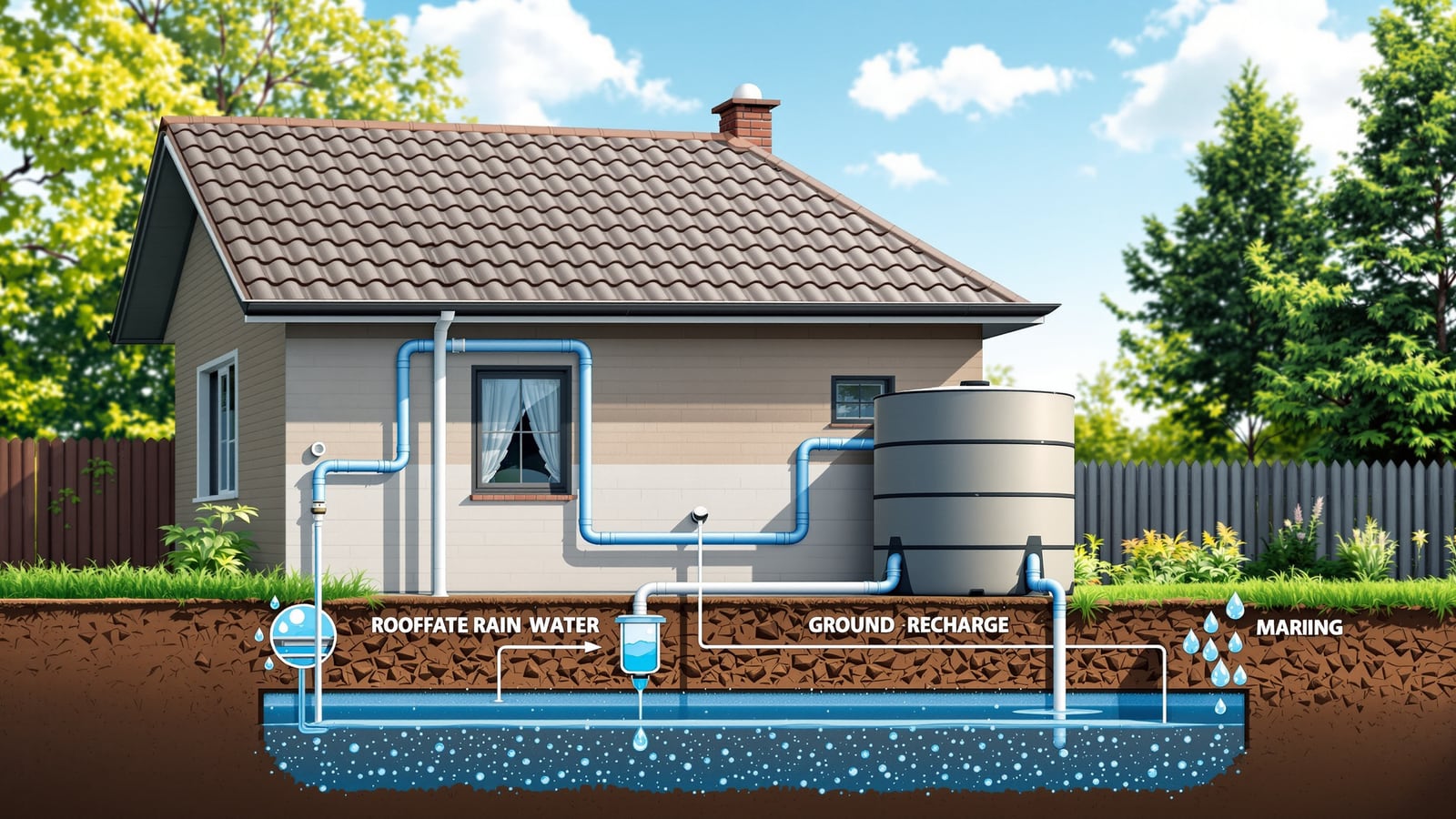
Every RWH system, from a single house to a campus, is the same chain of parts. Rain lands, is collected, is cleaned of the first dirty flush, is filtered, and then goes one of two ways.
- Catchment — the surface rain falls on. A roof is the best catchment: large, clean and elevated. Paved courtyards and driveways can be harvested too, but that water is dirtier and usually sent to recharge, not storage.
- Gutters and downpipes — the conveyance that gathers roof runoff and drops it to ground level. Size them generously; an undersized downpipe overflows in the heaviest ten minutes of the year, which is exactly when you want the water.
- First-flush diverter — a simple device that discards the first few minutes of a storm, which carries the dust, leaves and bird droppings washed off the roof. Skipping this is the single most common reason harvested water goes bad.
- Filter — removes the remaining silt and organic matter before water enters a tank or a recharge structure.
- Store or recharge — the fork in the road, covered next.
The two paths: store for use, or recharge groundwater
Every drop that clears the filter goes to one of two destinations. Most well-designed Indian homes do both — store what a clean roof yields, and send overflow plus courtyard runoff to recharge.
Path 1 — Store for use
Harvested roof water is piped into a sump or tank and used like any other supply — flushing, gardening, washing, and after proper treatment, even drinking. Storage suits cleaner roof catchments and places where surface water is scarce. The limit is volume: you can only use what you can hold, so storage is sized against both roof yield and daily demand. For the tanks themselves — materials, sizing and placement — see the water storage tanks guide, and for what harvested water can safely be used for, see rainwater reuse.
Path 2 — Recharge groundwater
Instead of holding the water, you let it soak back into the ground through a recharge pit, trench or recharge well so it replenishes the aquifer. Recharge suits high-rainfall areas, large paved catchments, and any site whose storage is already full. It needs no tank and almost no maintenance beyond keeping the filter media clean — but you cannot pump the water back on demand; it becomes part of the shared groundwater. Design details, media layers and sizing live in the recharge pit guide.
Rule of thumb: store the clean roof water you can actually use; recharge everything else — the overflow, the paved-area runoff, and roof water beyond your storage capacity. Very few plots should choose one path to the total exclusion of the other.
Catchment yield at a glance
How much water a roof can give follows one indicative relationship:
Yield (litres) ≈ Catchment area (m²) × Annual rainfall (mm) × Runoff coefficient
The runoff coefficient accounts for losses — an RCC roof gives back around 0.80–0.85, sloping tiled roofs a little less, and unpaved ground far less. The table below is indicative for a 100 m² RCC roof (coefficient 0.80); use it to picture the scale, then run your own roof through the rainwater tank sizer for a real number.
| City | Indicative annual rainfall (mm) | 100 m² RCC roof, coeff 0.80 | Rough harvestable per year |
|---|---|---|---|
| Delhi | ~800 | 100 × 800 × 0.80 | ~64,000 L |
| Pune | ~700 | 100 × 700 × 0.80 | ~56,000 L |
| Bengaluru | ~970 | 100 × 970 × 0.80 | ~77,600 L |
| Chennai | ~1,400 | 100 × 1,400 × 0.80 | ~1,12,000 L |
| Mumbai | ~2,200 | 100 × 2,200 × 0.80 | ~1,76,000 L |
Even the driest city on that list captures enough from a small roof to matter. Rainfall figures are long-run averages and vary year to year — treat them as indicative and check your own district's data.
First-flush and filtration
Clean water in means clean water out, and two components do that work. The first-flush diverter throws away the opening dirty minutes of each storm; a common indicative allowance is to divert roughly the first 0.5 mm of rainfall over the catchment — a few tens of litres for a house roof — before letting the rest through. After that, a filter takes out silt and fine organics.
Filter types range from a simple charcoal-gravel-sand pot filter to proprietary cartridge and cyclonic filters that self-clean. The right choice depends on catchment cleanliness and whether the water is going to storage (needs cleaner water) or recharge (more forgiving). The full comparison, media layers and maintenance intervals are in the rainwater filtration guide.
Recharge structures at a glance
If you are recharging, the structure is sized to the catchment and the soil's ability to absorb water. These are indicative starting points — a soil percolation test and, for many plots, the municipal template will set the real dimensions.
| Structure | Indicative size | Best for |
|---|---|---|
| Recharge pit | 1,000–2,000 mm dia, 2,000–3,000 mm deep | Small to medium roof catchments |
| Recharge trench | 500–1,000 mm wide × 1,000–1,500 mm deep, run to length | Long roof edges, boundary walls |
| Recharge pit + borewell | Pit as above with a 100–150 mm perforated pipe to aquifer | Deep water tables, poor topsoil percolation |
All recharge structures share the same fill logic — boulders at the bottom, gravel in the middle, coarse sand on top — so silt is caught near the surface where it can be cleaned out. Full design guidance is in the recharge pit guide.
Maintenance
RWH is low-maintenance, not no-maintenance, and neglect is why so many systems silt up and get abandoned.
- Before every monsoon: clean the roof, clear gutters and downpipes of leaves, and check that the first-flush diverter drains and resets.
- During the monsoon: rake out the top sand layer of filters and recharge pits if inflow slows — that is silt clogging the surface.
- Once a year: desilt the pit's top layer, inspect storage tanks and sumps, and confirm overflow paths still carry excess to recharge rather than flooding the plot.
- Keep the first-flush volume tuned to your roof; too little defeats the purpose, too much wastes good water.
The mandatory-RWH reality
For most Indian city plots, RWH is no longer optional. It is written into municipal and development-authority building bye-laws and the model building bye-laws that many states follow, and it is typically enforced at two gates: your building plan sanction and your completion / occupancy certificate. Fail to provide the specified RWH structures and the plot can be denied sanction or the certificate withheld.
The specifics differ by city and are the part you must verify locally — bodies such as the BBMP and BWSSB in Bengaluru, the Chennai Metropolitan authorities in Tamil Nadu (where RWH was mandated statewide), and various state development authorities each set their own plot-size thresholds, required structure counts and, in some cities, penalties or higher water tariffs for non-compliance. Do not rely on a clause number you read online — thresholds and templates are revised, and enforcement is city-specific.
Treat mandatory RWH as a floor, not a ceiling. The bye-law minimum keeps you compliant; a system sized to your actual roof and rainfall — checked on the rainwater tank sizer — is what actually secures your water.
Where this connects
RWH sits at the meeting point of supply and drainage. It feeds your storage and your borewell, and it relieves the storm drains. To go deeper from here:
- Rooftop rainwater harvesting — the roof-first system in detail.
- Rainwater recharge pit — designing and sizing recharge structures.
- Rainwater filtration — first-flush and filter selection.
- Rainwater reuse — what harvested water can safely do.
- Water storage tanks — holding the stored path.
- Stormwater drainage — the discard side of rain, so you know what RWH is replacing.
References
- Central Ground Water Board (CGWB) — guidance on artificial recharge and rainwater harvesting.
- CPHEEO Manual on Water Supply and Treatment — Ministry of Housing and Urban Affairs.
- Model Building Bye-laws — provisions on mandatory rainwater harvesting (verify the current version adopted by your city or state).
- Your local municipal / development-authority bye-laws — the binding thresholds, structure requirements and enforcement for your plot.
Export this guide
Related Guides — Deep-dive reading
Rooftop Rainwater Harvesting in India: Catching Rain Off Your Roof for Storage or Recharge
A homeowner's guide to rooftop rainwater harvesting — using the roof as a catchment, sizing gutters and downpipes for your area and rainfall, first-flush and filtration, and where the water finally goes: a storage sump for use or a recharge structure for the ground.
PlumbingRooftop Rainwater Harvesting
The rain that lands on your roof is a free water supply and, in most Indian cities, a legal duty. What a rooftop rainwater harvesting system is, the two paths (store it for reuse or recharge the groundwater), the parts that make it work, how much a roof can actually collect, and the maintenance that keeps it honest. Plain language, India-grounded.
RoofingRainwater Harvesting Regulations Across India
Where harvesting rain is the law, not just a good idea: city-by-city rules, thresholds, penalties and how to get signed off
Building Regulations & ComplianceRelated Tools — Try Free
Rainwater Tank Sizer
How big should your rainwater tank be? Computes annual harvest, recommended tank capacity in litres, water-bill savings, and payback — for 10 Indian cities.
RWH CalculatorProperty Tax Calculator — 10 Indian Cities
Estimate annual municipal property tax across BBMP / MCD / MCGM / GHMC / GCC / KMC / PMC / AMC / TMC / PCMC — with self-occupied, tenanted, and age-rebate adjustments.
Property TaxRainwater Harvesting Calculator
Estimate how much rainwater a roof can harvest in a year from its area, your annual rainfall and a collection coefficient.
Plumbing Calculator