
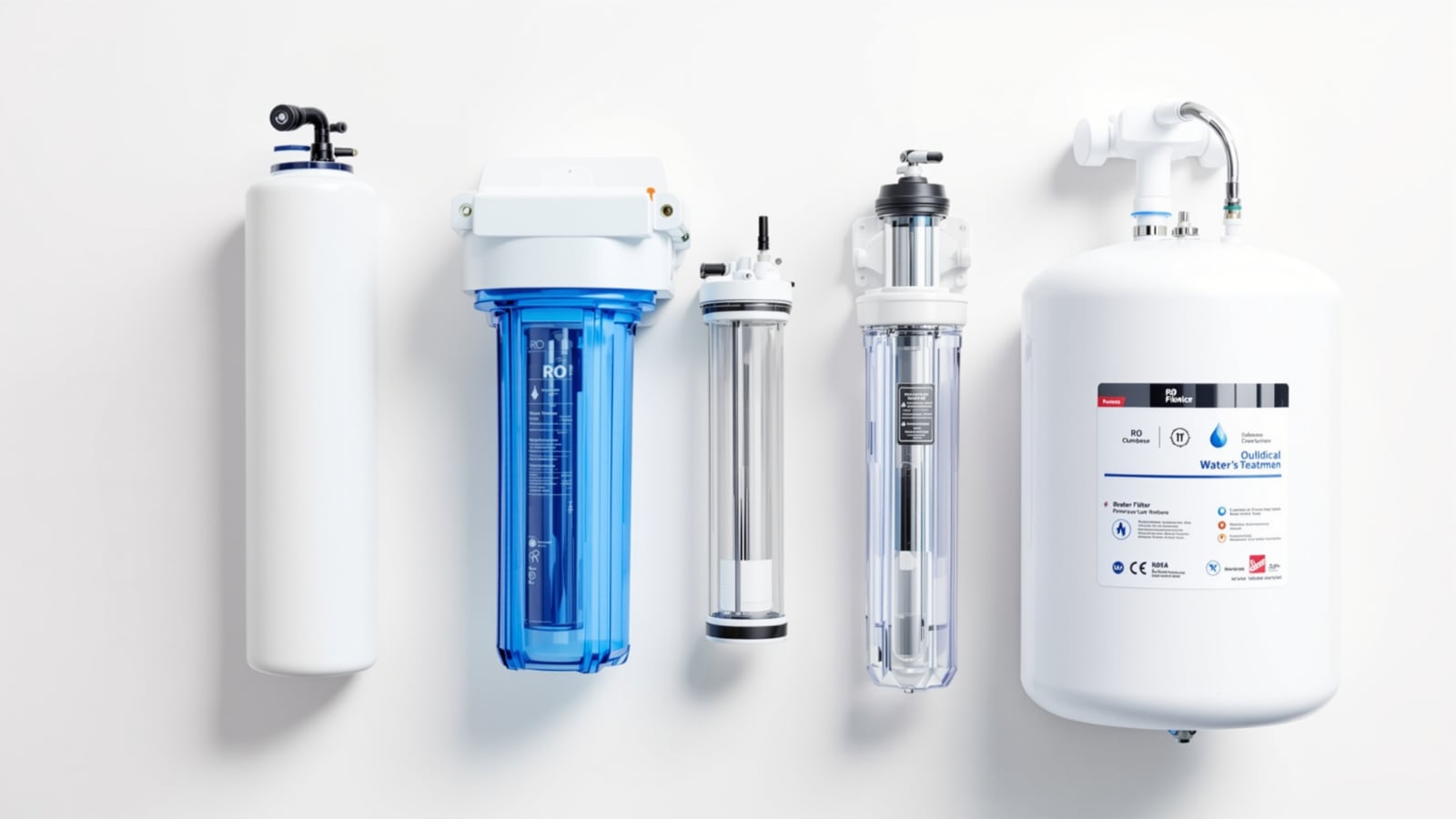
Domestic Water Treatment Guide for Indian Homes: Test First, Then Treat Right
A master overview of treating the water coming into an Indian home — how to test first, match each contaminant to the right treatment, choose point-of-use versus point-of-entry, build a treatment train in the correct order, avoid over-treating, and budget for maintenance and running cost.
Water treatment is not one machine you bolt to the inlet. It is a decision — which of the many things wrong with your particular water are worth fixing, and in what order — followed by the right combination of hardware. Get that decision right and a modest setup delivers safe, pleasant water for years. Get it wrong and you either drink unsafe water despite spending lakhs, or you strip perfectly good municipal water of everything and wonder why it tastes flat.
This is the section pillar for domestic water treatment inside the Studio Matrx Plumbing Knowledge Hub. It stays firmly on the fresh, incoming drinking-water side of the house. Treating sewage or greywater is a different world — see the sewage treatment plant guide for that. Here the job is simple to state and worth doing carefully: make the water entering your home clean and safe to use.
The single most expensive mistake in home water treatment is buying the machine before testing the water. Every good decision below starts from one lab report — not a salesperson's demo jar.
Test first — always
Before you choose anything, get your water tested against IS 10500, the Bureau of Indian Standards specification for drinking water. A demonstration where a probe turns your water cloudy proves nothing; a NABL-accredited lab report proves everything. We cover this in depth in the water quality testing guide, but the short version is: spend one thousand rupees on a test before spending fifty thousand on a machine.
A test tells you which problems you actually have. The right treatment for a coastal borewell at 2,000 mg/L TDS is nothing like the right treatment for a Bengaluru apartment on filtered Cauvery supply — and no single product suits both. Water quality also changes: a borewell that was sweet in the monsoon can turn brackish by summer, and a fresh RO membrane will read differently from a two-year-old one. Treat the report as a snapshot, retest yearly, and retest immediately if the taste, colour or smell of your water shifts.
| Parameter | IS 10500 acceptable limit (indicative) | What high readings suggest |
|---|---|---|
| E. coli / coliforms | Not detectable in 100 ml | Microbial contamination — needs disinfection (UV/boiling) |
| Turbidity | 1 NTU | Suspended sediment — needs a sediment filter |
| Total hardness (as CaCO3) | 200 mg/L | Scaling, white deposits — consider a softener |
| Total dissolved solids | 500 mg/L | Salty/bitter taste, scaling — may need RO if very high |
| Iron | 0.3 mg/L | Reddish stains, metallic taste — needs iron removal |
| Fluoride | 1.0 mg/L | Dental/skeletal risk — needs defluoridation |
Note the word indicative: read the numbers as targets, and always trust your own dated lab report over any table.
The contaminant-to-treatment map
Almost every home treatment problem maps to one of a handful of technologies. Match the problem to the tool — don't buy a tool and hunt for a problem.
- Sediment, sand, turbidity → sediment filter. A cartridge or backwashing filter that physically strains out suspended particles. Always the first stage, because it protects everything downstream.
- Hardness (calcium/magnesium scaling) → water softener. Ion-exchange resin swaps hardness minerals for sodium, stopping scale in geysers, taps and tiles. See the water softeners guide.
- Microbes (bacteria, viruses) → UV disinfection. Ultraviolet light inactivates pathogens without chemicals or taste change — but only in already-clear water. See the UV water purifiers guide.
- High dissolved salts / high TDS → reverse osmosis (RO). A semi-permeable membrane rejects dissolved salts, heavy metals and much else, for genuinely brackish or high-TDS supply. See the RO water systems guide.
- Iron / manganese → iron-removal (oxidation-filtration). Oxidises dissolved iron so it can be filtered out, clearing reddish water and stains.
- Fluoride → defluoridation. Activated alumina, bone char or RO reduces excess fluoride — a real concern in parts of Rajasthan, Andhra Pradesh, Telangana and Gujarat.
- Bad taste, odour, chlorine → activated carbon. Adsorbs chlorine, organics and smells; polishes taste. Common as a pre-stage before RO/UV. See the domestic water filtration guide.
Point-of-use vs point-of-entry
Where you treat matters as much as how.
- Point-of-use (POU) treats water at a single tap — typically the kitchen RO/UV unit that fills your drinking bottle. It treats only the litres you actually drink and cook with, so it is cheap to run and the sensible default for drinking-quality fixes like RO and UV.
- Point-of-entry (POE), or whole-house treatment, sits on the main inlet and treats every drop entering the home. It is the right home for problems that damage the whole plumbing system — hardness that scales your geyser, iron that stains every basin, or sediment that clogs every aerator.
A useful rule: treat drinking problems at the point of use, and plumbing-wide problems at the point of entry. A softener belongs on the whole house (POE); an RO belongs under the kitchen sink (POU). Many Indian homes end up with both — a POE softener protecting the bathrooms and geyser, plus a POU RO+UV for the drinking tap. This split is also the cheapest one: you pay to purify only the fifteen-odd litres a day you actually drink, while the cruder, higher-volume protection of the plumbing runs on low-cost media and salt. For how this fits the wider potable line, see the drinking water systems guide.
Building a treatment train
When water has several problems, you stage the treatments in a train — a fixed sequence where each stage protects the next. Order is not optional; the wrong order destroys expensive components.
The standard order is: sediment filter → softener → activated carbon → RO / UV.
1. Sediment first, so grit never reaches the softener resin or the RO membrane.
2. Softener next, so hardness scale never fouls the RO membrane (a hard-water RO membrane can fail in months).
3. Carbon third, to strip chlorine — which oxidises and destroys RO membranes — and to polish taste.
4. RO and/or UV last, as the final barrier. UV always goes at the very end so nothing recontaminates the water after disinfection.
Not every home needs every stage. A soft-water municipal supply may need only sediment and carbon; a hard, high-TDS borewell may need the full train. Design the train around your test report, not a template.
When NOT to over-treat
More treatment is not better treatment. The commonest error in urban India is bolting an RO onto water that never needed it.
- Don't RO low-TDS municipal water. If your supply is already below roughly 300 mg/L TDS, RO strips out beneficial minerals (calcium, magnesium), flattens the taste, and — worst of all — wastes water: many domestic RO units send two to three litres to the drain for every litre they deliver. On safe municipal water, a good carbon filter plus UV is often all you need.
- Don't run UV on cloudy water. UV needs clear water to work; turbidity shields microbes. Always precede UV with proper sediment/carbon filtration.
- Don't soften your drinking water needlessly. Softening adds sodium; the drinking tap usually takes RO instead. Soften the plumbing supply, not the glass.
- Don't buy oversized whole-house RO for a hardness-only problem — that is a job for a softener at a fraction of the cost and zero reject water.
If you have RO reject water, use it. Divert the drain line to your floor-mop bucket, toilet cisterns or garden. Reject water at moderate TDS is perfectly fine for cleaning and most plants.
Maintenance overview
Every treatment stage is a consumable, not a fit-and-forget appliance. Skipping maintenance quietly turns a purifier into a contamination source.
- Sediment / carbon cartridges: replace every 3–6 months (sooner on dirty supply).
- RO membrane: typically every 2–3 years, sooner on hard or high-TDS feed.
- UV lamp: replace roughly every 12 months — it keeps glowing long after it stops disinfecting, so track the date.
- Softener salt: top up regularly and let it regenerate on schedule; run out of salt and hardness passes straight through.
- Iron-removal media: backwash as specified and replace media per the maker's cycle.
Indicative costs
Figures below are indicative all-India ranges for 2026 — get local quotes, and let your test report, not the price tag, drive the choice.
| Stage / system | Indicative price | Typical running cost |
|---|---|---|
| Sediment / pre-filter | ₹1,500 – ₹6,000 | Cartridge ₹300 – ₹800 every 3–6 months |
| Point-of-use RO + UV (kitchen) | ₹12,000 – ₹25,000 | Service ₹2,000 – ₹4,000 / year + membrane |
| Whole-house water softener | ₹25,000 – ₹80,000 | Salt ₹300 – ₹1,000 / month |
| Iron-removal unit (POE) | ₹20,000 – ₹60,000 | Periodic media / backwash |
| Whole-house sediment + carbon (POE) | ₹15,000 – ₹40,000 | Cartridge / media changes |
For app-connected filters that track cartridge life and TDS, keep it brief and see the smart water purifier guide; if your source is a borewell, start with the borewell water system guide before choosing treatment.
The short version
Test your water against IS 10500. Map each real problem to its matching treatment. Fix drinking problems at the point of use and plumbing-wide problems at the point of entry. Stage multiple treatments in the correct train — sediment, softener, carbon, then RO/UV. Resist over-treating clean municipal water, and budget for the consumables from day one. Do that, and treatment stops being a guess and becomes a plan.
References
- IS 10500 — Bureau of Indian Standards, Drinking Water Specification (acceptable and permissible limits for drinking water quality).
- World Health Organization — Guidelines for Drinking-water Quality (general reference for treatment principles).
Export this guide
Related Guides — Deep-dive reading
RO Water System for Indian Homes: How Reverse Osmosis Works, When You Need It, Reject Water and Cost
The point-of-use purifier that strips dissolved salts, TDS and heavy metals from high-TDS borewell and brackish water — how the membrane and cartridge train actually work, when RO is right (and when it just wastes water and strips minerals), how to reuse reject water, and what it costs to run in India.
PlumbingRO vs UV Water Purifier: Which One Does Your Home Need? (India)
A fair, India-first head-to-head decided by one number — your feed-water TDS. RO strips dissolved salts and heavy metals for hard borewell water; UV only kills microbes and suits already-clear, low-TDS municipal supply. What each removes, water wastage, running cost, and a verdict by measured TDS.
PlumbingDomestic Water Filtration in India: Sediment & Carbon Filters for a Home
The first stage of almost every home water-treatment train — how sediment and activated-carbon filters strip out sand, silt, rust, chlorine, taste and odour, where to fit them (whole-house vs under-sink), how to pick a micron rating, when to replace a cartridge, and what filtration cannot remove.
PlumbingRelated Tools — Try Free
RO Water Wastage Calculator
See how much water a domestic RO purifier rejects for the purified water you use, from your daily use and recovery ratio.
Plumbing CalculatorWindow Cleaning Cost Calculator
Estimate professional window cleaning cost per visit and per year by access and frequency.
Window CalculatorApartment Video Door System Planner
Enter flats, entrances, floors and guard desk for a first-pass building intercom plan — door stations, indoor monitors, guard station, the right architecture and an indicative cost band.
Building Planner