
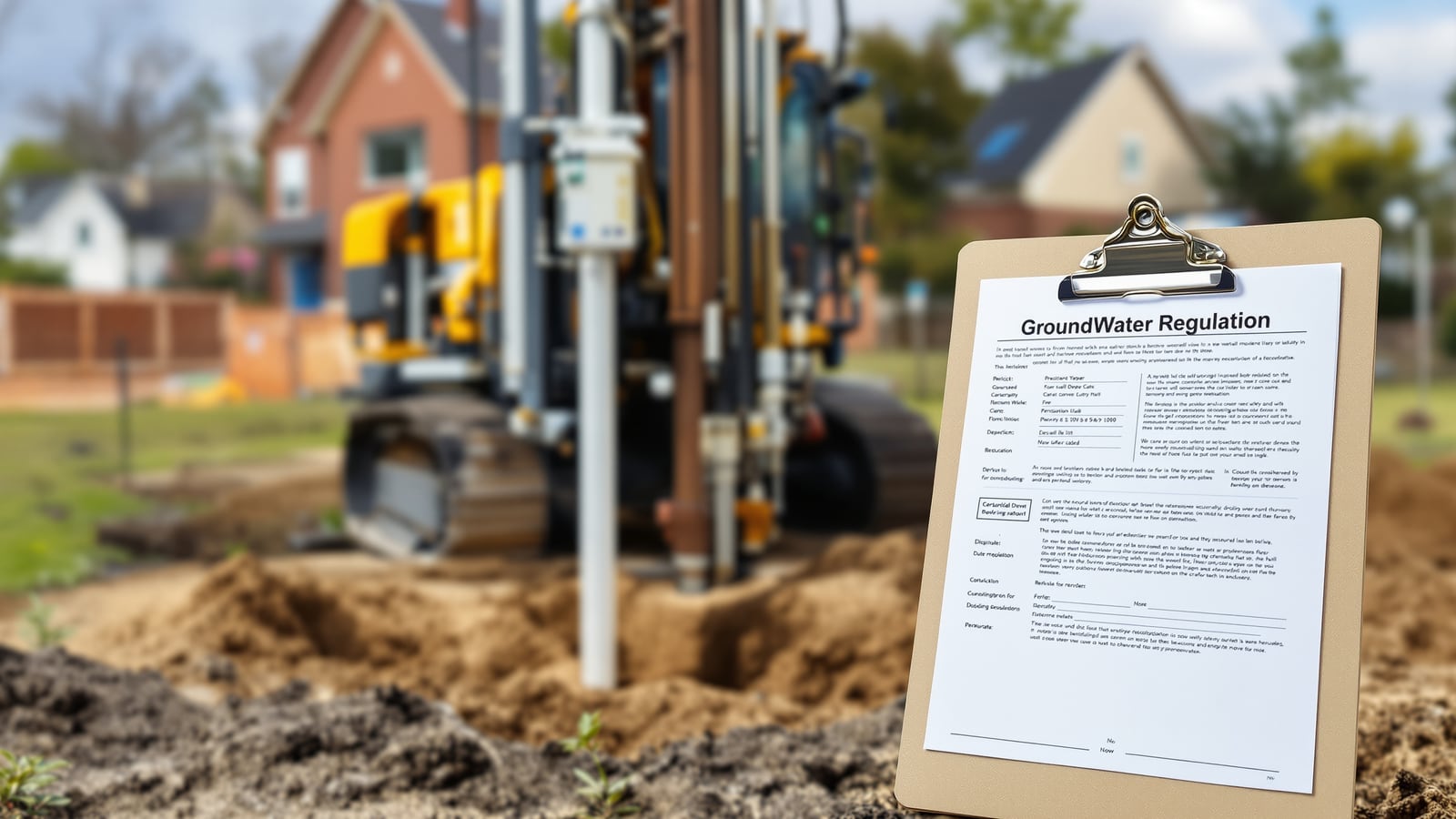
Borewell Regulations in India: Permissions, Registration, Recharge and Capping Rules Explained
Drilling a borewell and pumping groundwater is a regulated act in India, not a free-for-all on your own plot. This plain-English guide explains who governs groundwater, when you may need permission from the Central Ground Water Authority or your state groundwater authority, why the rig and the borewell often have to be registered, the recharge conditions many local bodies attach, and the legal duty to cap abandoned borewells — while stressing that the rules vary sharply by state and area and change often.
Most homeowners imagine that because a borewell is drilled on their own plot, it is entirely their own business how deep they go and how much water they draw. That is not how Indian law treats groundwater. The water under your plot is a shared, increasingly stressed public resource, and drilling a borewell to tap it is a regulated act — sometimes needing formal permission, often needing registration, and almost always carrying duties around recharge and safety. This guide explains, in plain terms, what those rules are about, who issues them, and how to find out what actually applies to your plot.
This is a regulations guide inside the Studio Matrx Plumbing Knowledge Hub. It sits under the plumbing regulations and standards pillar; for how a borewell physically works, see the borewell water system guide, for the trade-offs against a piped connection see municipal vs borewell water, and for the money side see borewell plumbing cost in India.
The single most important sentence in this guide: borewell rules vary by state, by city, and by whether your area is officially "notified" or over-exploited for groundwater — and they change. Nothing here is a substitute for confirming the current, local position with your state groundwater authority, the Central Ground Water Authority, and your municipal body before the rig arrives.
Why groundwater is regulated at all
India draws more groundwater than any other country on earth, and in large parts of the country the water table is falling year on year because extraction outruns natural recharge. To slow that, groundwater has been brought under regulation at two levels:
- Central regulation. The Central Ground Water Authority (CGWA), constituted under environmental law and working alongside the Central Ground Water Board (CGWB), regulates and controls groundwater development and management across the country. It classifies assessment units (blocks, mandals, talukas) by how stressed they are — commonly described as safe, semi-critical, critical, or over-exploited — and applies tighter controls where groundwater is over-drawn.
- State regulation. Many states have their own groundwater legislation and their own state ground water authority or department, which can register borewells and drilling rigs, require permission to sink new wells in notified areas, and set local conditions. Where a state has its own regime, that is often the body a homeowner deals with first.
The practical upshot for a homeowner: whether you need permission depends heavily on where your plot is and how stressed that area is classified to be. In a "safe" area, domestic borewells are frequently far simpler to sink than in a notified or over-exploited area, where fresh drilling can require an explicit No Objection Certificate (NOC) or permit — and may be restricted altogether.
Who governs what — and where to verify it
Because two levels of government are involved, the honest answer to "who do I ask?" is "possibly both, and definitely your local body." The table below maps the players by name. Treat every "what it can require" cell as may apply, verify locally — the specifics differ by state and change over time.
| What may apply | Who issues / governs it | Where to verify |
|---|---|---|
| Groundwater extraction control; NOC in notified / over-exploited areas | Central Ground Water Authority (CGWA), with the Central Ground Water Board (CGWB) | CGWA / CGWB official portal; the NOC framework for your category of use |
| State-level permission to drill; borewell and rig registration | Your state ground water authority / department (where the state has its own law) | State groundwater department / board office and website |
| Building-plan conditions, mandatory rainwater harvesting, borewell notification | Municipal corporation / development authority / local body | Your city's municipal bye-laws and building rules |
| Categorisation of your block/area as safe or over-exploited | CGWB assessment, adopted by state and central authorities | Ask the state groundwater office which category your area falls in |
Domestic use is frequently treated more leniently than commercial, industrial or bulk extraction — but "more leniently" does not automatically mean "no rules." In a notified area even a household borewell can require permission or registration. Confirm your category rather than assuming exemption.
Permission and NOC — when do you actually need one?
There is no single national answer, and that is the point. What you may encounter, depending on your state and area:
- In "safe" (not notified) areas, a domestic borewell is often allowed with light-touch requirements — but your state or municipal body may still require the borewell to be registered or notified, and building-plan conditions can still apply.
- In notified / over-exploited areas, sinking a new borewell frequently requires an explicit permission or NOC — from the CGWA and/or the state groundwater authority — and the authority may impose conditions, restrict new extraction, or decline it. Commercial and bulk use faces the tightest scrutiny; even domestic use can require approval.
- Registration of the drilling rig and the driller is required in a number of states, so that borewells are only sunk by known, registered agencies. A reputable local driller will usually know the local requirement and hold the necessary registration — but that does not remove your responsibility to confirm the plot is cleared to drill.
The broad pattern of how much friction you face is easier to see side by side. Every cell below is a typical tendency, not a rule — your state and local body set the actual position, so verify it.
| Requirement | In a "safe" (not notified) area | In a notified / over-exploited area |
|---|---|---|
| Permission / NOC to drill | Often light-touch for domestic use | May be required; may be restricted or refused |
| Borewell / rig registration | May still apply — check locally | Commonly required and enforced |
| Recharge / rainwater harvesting | Frequently required by local bye-laws | Frequently required and more strictly enforced |
| Commercial / bulk extraction | Scrutinised | Tightest scrutiny |
| Capping abandoned borewells | Always a duty | Always a duty |
Because thresholds — such as which areas are notified, what depth or use triggers a permit, and what fee applies — are set locally and revised over time, this guide deliberately does not print specific figures. Ask the authority directly. A single wrong number copied from the internet is exactly how people end up with an unauthorised borewell.
Recharge and rainwater harvesting conditions
A recurring theme across Indian groundwater rules is that if you take water out, you should help put water back. Many local bodies and state authorities attach rainwater-harvesting or artificial-recharge conditions to borewell permissions or building approvals — for example, requiring a recharge pit or structure so that rooftop and surface runoff percolates back into the ground rather than draining away.
- Where such a condition applies, it is typically a condition of the approval, meaning the borewell or building permission is contingent on the recharge structure being provided.
- The trigger, the design and the size of the required structure are set by the local body / state rules and vary widely — verify the current requirement for your plot with your municipal corporation or development authority.
- Beyond compliance, recharge is genuinely in your own interest: it helps stabilise the water table your borewell depends on. See the borewell water system guide for the physical side of recharge.
Capping and sealing abandoned borewells — a life-safety duty
This is the rule no homeowner should ever treat as optional. An abandoned or failed borewell left open is a narrow, deep, uncovered shaft — and children falling into open borewells has caused repeated, avoidable tragedies across India. In response, authorities and courts have pressed hard on the duty to cap, seal or fill open and abandoned borewells, and this obligation typically falls on the landowner, occupier or the person who had the borewell drilled.
- If a borewell fails, runs dry, or is no longer used, it must not be left as an open hole. It should be sealed, capped or filled so it cannot swallow a child, animal or debris.
- The duty commonly applies during drilling too — a bore being sunk should not be left open and unattended.
- Local bodies may require you to inform them of borewells being sunk or abandoned, precisely so open shafts can be tracked and closed.
Treat capping an abandoned borewell as non-negotiable and immediate, not a "someday" job. It is both a legal duty and a moral one. If you buy a plot with an old borewell of unknown status, check it and seal it.
What happens if you skip the rules
The consequences vary by state and area, but broadly: an unauthorised borewell in a notified area can attract penalties and enforcement action, unfulfilled rainwater-harvesting conditions are increasingly enforced by municipal bodies, and an open abandoned borewell exposes the landowner to serious legal liability if it causes harm. Compliance is not bureaucratic box-ticking — it protects your neighbours' shared water, your own approvals, and lives.
How to verify and stay compliant
Because everything above turns on your specific state and area, the compliance path is really an information-gathering path. Do this before you commit to drilling:
- Find out your area's category. Ask your state ground water department / authority whether your block/area is safe, semi-critical, critical or over-exploited (notified). This single fact drives most of what follows.
- Check the CGWA position. Look at the Central Ground Water Authority / CGWB framework for whether an NOC is required for your category of use in your area.
- Ask your municipal corporation / development authority for the building bye-laws and any borewell, registration or rainwater-harvesting conditions that apply locally.
- Use a registered driller and confirm they hold the required rig / agency registration for your state — and get the borewell registered where required.
- Provide any required recharge structure as a condition of approval, not an afterthought.
- Cap or seal any abandoned borewell on the plot immediately, and never leave a bore being drilled open and unattended.
- Keep every document — permission, NOC, registration, plan approval — on file.
Rules and thresholds change. Whatever you confirm today, re-verify with the authority before the next borewell — and never rely on a fee, depth or threshold figure quoted second-hand online.
References
- Central Ground Water Authority (CGWA) and the Central Ground Water Board (CGWB) — central regulation and control of groundwater development, notified/over-exploited area classification, and the NOC framework for extraction.
- State ground water authorities / departments — state groundwater legislation, permission to drill in notified areas, and registration of borewells and drilling rigs (where a state has its own regime).
- Municipal corporations and development authorities — building bye-laws, borewell notification, and mandatory rainwater-harvesting / recharge conditions.
This guide explains the framework in plain language; it does not state the binding rule for your plot. The categorisation of your area, whether a permission or NOC is required, registration requirements, recharge conditions, fees and penalties all vary by state and local body and change over time. Confirm the current, authoritative position with your state groundwater authority, the CGWA and your municipal body — and use a registered driller — before you drill.
Export this guide
Related Guides — Deep-dive reading
Plumbing Regulations in India: A Plain-English Map of the Rules
The Regulations pillar for the Studio Matrx Plumbing Knowledge Hub — how NBC 2016 Part 9, BIS/IS standards, CPHEEO manuals, state PHED norms, local municipal bye-laws, rainwater-harvesting mandates, groundwater permissions and building-plan approvals fit together, who issues what, and why the binding rules are almost always your local bye-laws.
PlumbingRainwater Harvesting Rules in India: When RWH Is Mandatory & How to Comply
A plain-English guide to India's mandatory rainwater-harvesting rules for homeowners — why so many states and cities require RWH for buildings above a certain size, how it becomes a condition for plan sanction and completion certificate, and why the exact trigger, structure and rebate always come from your own local bye-laws.
PlumbingRainwater Harvesting Regulations Across India
Where harvesting rain is the law, not just a good idea: city-by-city rules, thresholds, penalties and how to get signed off
Building Regulations & ComplianceRelated Tools — Try Free
Rainwater Tank Sizer
How big should your rainwater tank be? Computes annual harvest, recommended tank capacity in litres, water-bill savings, and payback — for 10 Indian cities.
RWH CalculatorBuilding Plan Approval Roadmap
Step-by-step building plan approval process by city with documents, timelines, and fees.
ArchitectAIStamp Duty Calculator — All Indian States
Stamp duty + registration charges for all 28 states and 8 UTs — gender concessions, urban/rural variants, metro cess built in.
Stamp Duty