
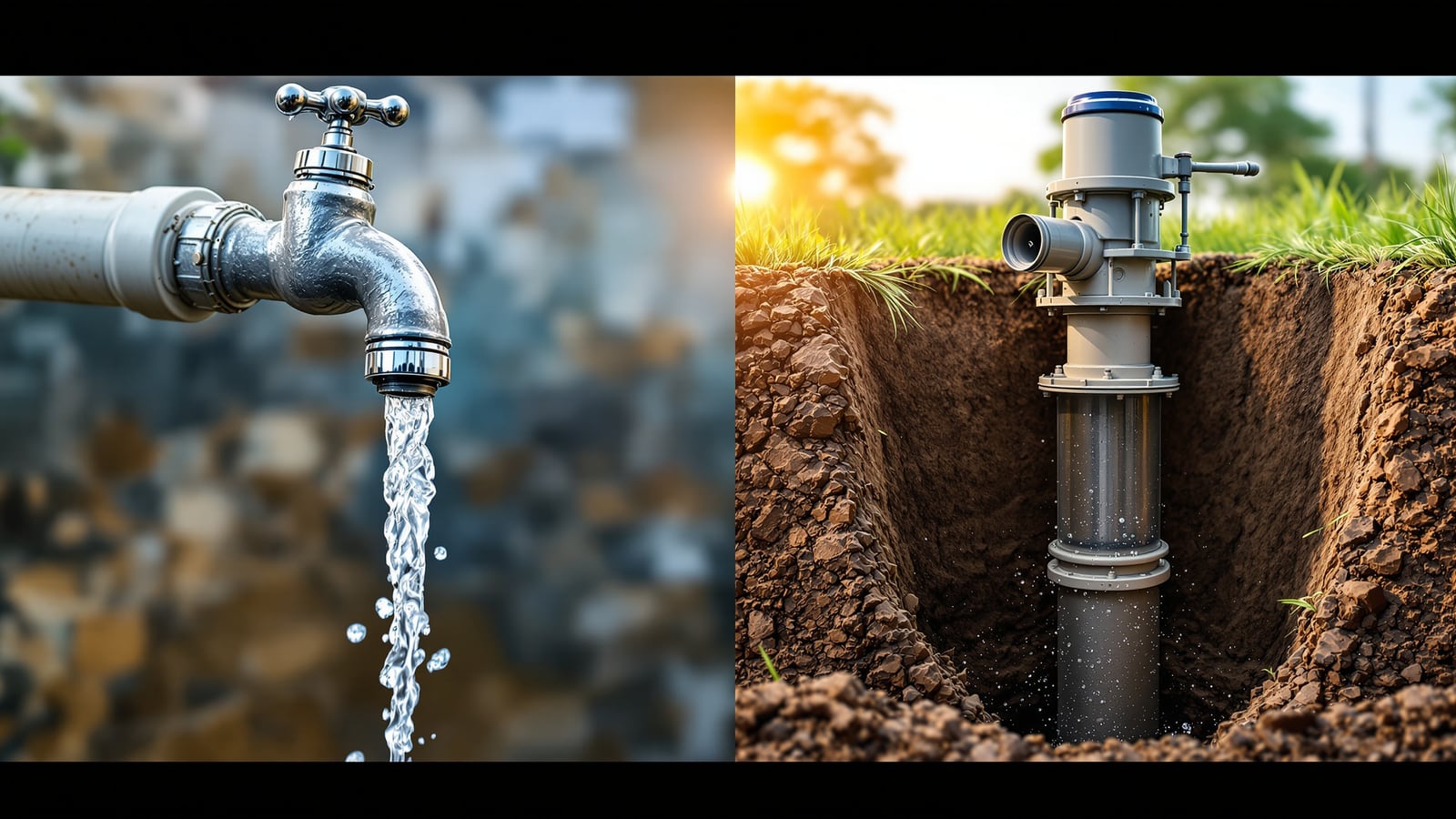
Municipal Water vs Borewell: Which to Rely On for an Indian Home?
A fair, India-first head-to-head: corporation (municipal) supply is treated and cheap to run but comes for a few hours a day, while a borewell gives you your own 24x7 groundwater at an upfront drilling cost — with hardness and a falling water table to manage. When to pick each, and why most homes end up keeping both.
Ask any Indian homeowner where their water comes from and the honest answer is usually "a bit of both". The corporation line runs for a couple of hours in the morning; the borewell fills the gaps. This guide is the fair head-to-head between the two so you can decide which should be your primary source — and whether you genuinely need the other as backup.
Neither is "better" outright. Municipal water is treated, cheap to run and legally simple, but it is intermittent and outside your control. A borewell is your own round-the-clock supply, but it costs a lot upfront, usually needs treatment for hardness, and draws on a groundwater table that is falling in most Indian cities. The right choice is decided by your locality's supply reliability and your groundwater quality — not by a slogan.
For how each system actually works, read the two technical guides on their own: Municipal Water Supply (India) and Borewell Water System (India). For the whole picture of how a home's water is sourced and stored, go up to the pillar, Water Supply Systems (India). This article stays on the direct comparison and the verdict.
The one difference that frames everything
Municipal water is supplied by your city corporation or water board. It is drawn from a river, reservoir or wellfield, treated at a plant (coagulation, filtration, chlorination) and piped to you. You do not own it, you do not treat it, and you do not control when it arrives — most Indian cities run intermittent supply, a few hours on fixed days. So municipal water is really "treated water, on someone else's timetable, that you must store".
Borewell water is groundwater you reach yourself by drilling a bore and installing a submersible pump. It is yours, available 24x7, and independent of the corporation's schedule. But it comes up untreated and unmetered, its chemistry (hardness, iron, TDS, sometimes fluoride or nitrate) depends entirely on your local geology, and the water table it draws from is a shared, depleting resource.
That is the crux: municipal = treated but intermittent and not yours; borewell = yours and always-on but raw and finite. Everything below is a consequence of that one line.
Reliability and availability
- Municipal — reliable in quality the moment it reaches you, but unreliable in timing. Intermittent supply is the norm, which is precisely why every Indian home on corporation water needs an underground sump plus an overhead tank to bridge the dry hours. In a drought or a pipe-burst, the whole street goes dry together.
- Borewell — reliable in timing (pump on, water flows) but vulnerable in yield. A bore can drop in output through a bad summer, or run dry as neighbourhood pumping lowers the table, forcing a deeper re-drill. It also depends on grid power or an inverter for the pump.
The honest summary: municipal gives you water you can trust but must wait for; a borewell gives you water on demand that you cannot fully count on lasting.
Quality and treatment — the biggest practical gap
This is where the two diverge most, and where cost quietly moves.
- Municipal water arrives already treated and chlorinated. In most cities it is fit for general use straight from the tap; many households still add a point-of-use RO/UV purifier for drinking, mainly as insurance against contamination picked up in old distribution lines or your own storage tank. Its quality is broadly consistent because a plant controls it — though it varies city to city and can dip during monsoon.
- Borewell water is a lottery set by geology. In much of peninsular and northern India it is hard (high calcium and magnesium), leaving white scale on taps, geysers and tiles and shortening the life of every appliance it touches. It can also carry iron (reddish stains, metallic taste), high TDS, or in specific belts fluoride or nitrate. Raw borewell water frequently needs a water softener, an iron-removal filter, and RO for drinking — that treatment is a real, recurring cost that a municipal-only home largely avoids.
Do not assume either source is potable without checking. Get a lab test done before you commit to a borewell as your main supply, and re-test municipal water if you notice a change. See Water Quality Testing (India) for the parameters that matter (TDS, hardness, iron, coliform).
Cost — upfront versus recurring
The money story is the mirror image of each source's nature.
- Municipal water has a low upfront cost — a one-time connection charge and a meter — and a low recurring cost, a metered tariff that is heavily subsidised for domestic use in most cities. You mostly pay the corporation and your storage/pumping electricity. Little to no treatment cost.
- Borewell water has a high upfront cost — drilling the bore (depth-dependent), casing, a submersible pump, wiring and often a treatment train — and a recurring cost in pump electricity, pump servicing every few years, and softener salt or filter media. There is no water tariff, but treatment and power are not free.
| Factor | Municipal (corporation) | Borewell |
|---|---|---|
| Upfront cost | Low — connection + meter | High — drilling + casing + pump |
| Recurring cost | Metered tariff (usually subsidised) | Pump power, servicing, softener/filter |
| Water treatment | Done at plant; POU purifier optional | Softener + iron/RO often needed |
| Availability | Intermittent — a few hours/day | 24x7 (subject to yield & power) |
| Quality consistency | Fairly steady, plant-controlled | Varies with geology; can be hard/iron |
| Storage needed | Yes — sump + overhead tank | Tank useful; can pump on demand |
| Legality | Straightforward connection | Many areas need permission to drill |
| You control it | No — corporation schedule | Yes — your pump, your bore |
| Best for | Reliable-supply localities, drinking | Poor/no supply, gardens, backup |
Indicative only — drilling depth, pump size and treatment needs swing the borewell figure widely. For real numbers on the borewell side, see Borewell Plumbing Cost (India).
Legality and permissions
This is a genuine, and often overlooked, point in the borewell column.
- Municipal connections are legal and routine — you simply apply to the water board, pay the charges and get a metered line.
- Borewells draw on groundwater, which is a regulated resource. Rules differ by state and city, and many states and municipalities require permission from the local body and/or the groundwater authority before drilling — especially in notified or over-exploited zones where new bores may be restricted, and rainwater harvesting is frequently made a condition of approval. Treat this as a real step, not a formality, and check your own city's current rules before you drill. Do not assume a borewell is automatically permitted.
We deliberately do not quote specific rules or figures here because they vary and change — confirm locally with your municipal body or state groundwater authority.
The water-table reality
A borewell is only as good as the aquifer under you. Across much of urban India the water table is falling as more homes pump more groundwater than the rain replenishes. Practically, that means a bore can yield less each summer, or need re-drilling deeper over the years — a cost and a risk that municipal supply does not carry. Rainwater harvesting to recharge the ground is both good practice and, in many places, a legal condition of drilling. Borewell water should be treated as a shared, finite resource used responsibly, not a free unlimited tap.
Why many homes keep BOTH
Here is the pattern that most Indian homes actually settle into, and it is a sound one:
- Municipal water as the primary source — treated, cheap, used for drinking and cooking (through a purifier) and general use, stored in the sump for the hours it does not flow.
- Borewell as the backup and bulk source — covering the long gaps in municipal timing and handling high-volume, non-drinking loads like gardening, car washing, flushing and cleaning, where hardness matters less.
This dual arrangement gives you municipal's clean, low-cost water when the corporation flows, and borewell's independence when it does not — the reliability of two sources instead of the single point of failure of one. The two feeds are plumbed to a common sump or overhead tank with the right non-return valves so they never cross-contaminate. That whole design is its own topic: read Dual Water Supply (India) for how to combine the two safely.
The verdict
Decide by your locality, not by preference:
- Reliable corporation supply in your area → make municipal your primary source. It is treated, cheap to run, legally simple and steady. Store it in a sump and overhead tank to ride out the intermittent hours, and use a point-of-use purifier for drinking. This is the lowest-cost, lowest-hassle setup.
- Poor, low-pressure or no municipal supply → a borewell is your primary source — but budget for the drilling and pump, get the water lab-tested, and add a softener plus RO if it comes up hard or iron-heavy. Confirm you are permitted to drill before you start.
- You want reliability and can invest → keep both. Municipal for drinking and everyday use, borewell for the gaps and for high-volume outdoor and flushing loads. This dual setup is what most established Indian homes converge on, and it removes the single-source risk entirely.
- Hard, high-TDS or contaminated groundwater with decent municipal supply → lean firmly on municipal and use the borewell, if at all, only for gardening and washing where quality matters least.
Bottom line: municipal water wins on cost, treatment and legality; a borewell wins on availability and independence — so let a reliable corporation line be your everyday source and a borewell be the backup that keeps the taps running when it is not, and you get the strengths of both without betting your whole home on either.
For a broader map of these decisions, see the Plumbing Comparisons Guide (India).
References
- CPHEEO Manual on Water Supply & Treatment, Ministry of Housing and Urban Affairs, Government of India — municipal water sourcing, treatment and distribution practice.
- BIS IS 10500 — Drinking Water Specification — acceptable and permissible limits for TDS, hardness, iron, fluoride and other parameters.
- National Building Code of India (NBC) 2016, Part 9 — Plumbing Services (water supply, storage and distribution within buildings).
- Central Ground Water Authority (CGWA) and state groundwater departments — regulation of groundwater abstraction and borewell permissions (rules vary by state and city; verify locally).
Export this guide
Related Guides — Deep-dive reading
Overhead vs Underground Water Tank: Which Do You Need in India?
A fair, India-first head-to-head: an overhead tank gravity-feeds your taps but holds little; an underground sump stores huge volumes from erratic supply but needs a pump. Capacity, pressure, cost, cleaning, contamination — and why most Indian homes quietly run both.
PlumbingBorewell Water System for Indian Homes: How It Works, Depth, Rules, Water Quality and Cost
The private-borewell setup that supplies millions of Indian homes — how the borehole, casing and water table actually deliver water, how the submersible pump lifts it to your tank, how deep you may need to drill, the groundwater permissions to know about, why borewell water is often hard, and what it costs to run.
PlumbingWater Supply Systems in India: How Water Reaches Every Tap in Your Home
The complete map of how water gets into an Indian home and out to every fixture — the sources it comes from, the sump-pump-overhead-tank storage model that buffers intermittent supply, how gravity and pressurised distribution differ, and the demand figures that size the whole thing.
PlumbingRelated Tools — Try Free
Rainwater Tank Sizer
How big should your rainwater tank be? Computes annual harvest, recommended tank capacity in litres, water-bill savings, and payback — for 10 Indian cities.
RWH CalculatorBefore vs After — Cost Reality Check
Compare what you expected to pay vs what you actually paid, category by category.
Reality CheckBuilding Plan Approval Roadmap
Step-by-step building plan approval process by city with documents, timelines, and fees.
ArchitectAI