
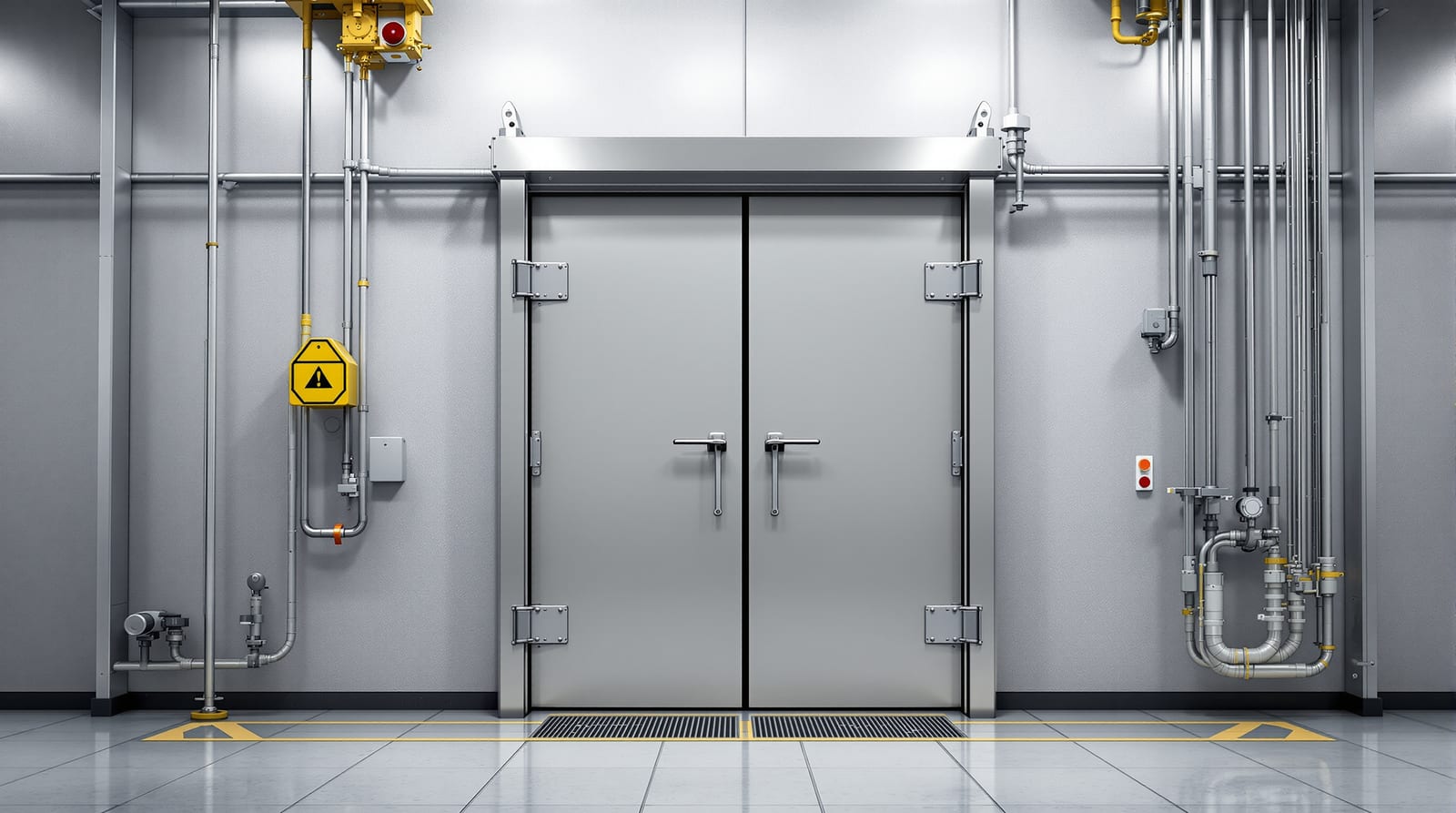
Blast-Resistant Doors: Overpressure Ratings & Cost India 2026
How blast-proof doors are rated by peak reflected overpressure, impulse and rebound — plus where they are used and what they cost in India.
Blast-resistant doors are project-engineered steel assemblies designed to survive a defined explosion pulse without failing, fragmenting, or releasing the latch. Unlike a fire door, a blast door is not specified by a single time rating — it is specified by the peak reflected overpressure it must resist, the impulse (area under the pressure-time curve) it must absorb, and its behaviour on rebound when the pressure wave reverses. In India these doors protect petrochemical control rooms, refinery blast zones, defence installations, ammunition stores and increasingly hardened data centres. This guide explains how a blast rating is correctly specified, the construction that delivers it, and what blast-proof doors actually cost in 2026.
What a blast load really is
An explosion produces a shock wave that arrives almost instantaneously, spikes to a peak pressure, then decays — and crucially drops below ambient into a negative (suction) phase. A door facing the blast experiences reflected pressure, which is several times higher than the free-field incident pressure because the wave is brought to rest against the rigid leaf.
Three parameters define the demand on the door:
- Peak reflected overpressure — the maximum pressure on the leaf, quoted in kPa (or bar; 100 kPa = 1 bar = ~14.5 psi). This is the headline number people fixate on, but it is incomplete on its own.
- Impulse — the integral of pressure over time, quoted in kPa·ms (or bar·ms / psi·ms). A short, sharp pulse and a long, sustained pulse can share the same peak yet impose very different demand. Impulse is what governs how much energy the leaf and frame must absorb.
- Duration / load history — whether the pulse is impulsive, dynamic or quasi-static relative to the door's natural period decides the response regime.
Because peak and impulse together describe the load, a credible specification reads like "peak reflected overpressure 70 kPa, impulse 700 kPa·ms, with rebound" — never just "blast-rated". Pressure-impulse (P-I) diagrams are the standard tool for relating a given threat to a chosen response level.
Response levels and rebound
Blast doors are usually specified to a target response level describing how much permanent damage is acceptable after the design event:
| Response level | Description | Typical use |
|---|---|---|
| Category I — Low | Essentially no permanent deformation; door remains operable | Control rooms, occupied refuges |
| Category II — Medium | Minor permanent set; door survives but may need inspection/repair | Plant boundary, equipment rooms |
| Category III — High | Significant deformation permitted; leaf stays in the opening, no fragmentation | Sacrificial / blast-relief locations |
A Category I door must keep the occupants behind it safe and let them open it afterwards — a far costlier proposition than a door merely required to stay in its frame.
Rebound is the trap that catches non-specialists. After the positive phase, the negative phase and the door's own elastic recoil try to throw the leaf back outward. A door designed only for inward pressure can spring open or shear its hinges on rebound. Genuine blast doors therefore use anti-rebound detailing — latching and hinges that resist both directions, and frames anchored to take reversed load. Confirm the rebound figure (often a percentage of peak) is in the specification, not just the inward pressure.
How the door is built
Blast resistance comes from mass, stiffness and a controlled load path into the structure:
- Heavy-gauge steel leaf — typically 3–6 mm face plates, sometimes thicker, double-skinned.
- Stiffened or honeycomb core — internal vertical/horizontal ribs or a steel honeycomb fill the leaf so it acts as a deep, stiff plate rather than bending like a panel.
- Multi-point latching — bolts engaging the frame on multiple edges (often all four), so load transfers around the full perimeter instead of concentrating at one latch.
- Heavy hinges or pivots rated for both positive and rebound load.
- Robust frame and anchorage — the door is only as strong as its fixing into a properly designed reinforced-concrete or steel surround; the frame design and embedment are part of the engineering, not an afterthought.
- Blast-rated vision panels (laminated/polycarbonate build-ups) only where essential, since glazing is the weak link.
Where blast-resistant doors are used
Blast doors appear wherever a credible explosion threat coexists with occupied space or critical assets:
- Petrochemical plants and refineries — control rooms, substations and occupied buildings inside the plant boundary, sized against a vapour-cloud-explosion blast load from a facility siting study.
- Oil & gas / LNG and chemical storage — process buildings near pressurised or flammable inventory.
- Defence and ordnance — magazines, ammunition stores and command bunkers, often to defence-specific quantity-distance criteria.
- Data centres and critical infrastructure — hardened cores protecting against external or accidental blast, complementing the data centre door and server room door specifications.
- Public and high-security buildings — embassies, mints and similar facilities with a defined threat basis.
The blast load itself is not chosen by the door vendor — it comes from a facility siting / consequence study (common in process industries) or a security threat assessment, which produces the peak overpressure, impulse and rebound the door must meet.
How a blast rating is specified
A defensible blast-door specification states all of the following — guess at any one and the door may be wrong:
| Parameter | What to specify | Typical band |
|---|---|---|
| Peak reflected overpressure | kPa or bar at the door face | ~20–200+ kPa (0.2–2+ bar) |
| Impulse | kPa·ms (area under pressure-time curve) | ~150–2000+ kPa·ms |
| Rebound | % of peak the door must resist outward | often 25–100% of peak |
| Response level | Category I / II / III (allowable damage) | per occupancy |
| Opening direction & function | inward/outward, single/double, must remain operable? | per use |
| Frame & anchorage design | embedment into RC/steel surround | engineered |
| Hardware & seals | blast-rated latching, vision panel, gas-tight seals if required | per use |
Where the door also needs gas-tightness (toxic release in process plants) or a fire rating, those are additional requirements layered on the blast spec — never assume one covers the other. Specialty assemblies that combine functions are covered in the broader specialty doors overview and the fire door ratings guide.
To size the demand before you go to a vendor, run the inputs through the blast door load calculator, and benchmark budgets with the specialty door cost estimator. These are planning aids — the binding values come from the siting study and the vendor's engineered submittal.
Cost bands in India 2026
Blast doors are custom, low-volume products with long lead times, so prices are bands, not catalogue figures. As a rule of thumb:
| Door class | Indicative load | Supply-only band (per door) |
|---|---|---|
| Light blast (entry-level) | ~20–35 kPa, low impulse | ₹15,000–40,000 |
| Medium blast (typical control room) | ~35–70 kPa | ₹40,000–80,000 |
| Heavy / high response level | ~70–150+ kPa, high impulse, full rebound | ₹80,000–1,00,000+ |
| Special (gas-tight + blast, large, double-leaf) | engineered | ₹1,00,000+ (project-priced) |
These are supply-only; installation, the engineered frame and its anchorage, blast glazing, certification testing and freight add materially — often 20–40% on top. GST at 18% applies. Lead times of several weeks to a few months are normal because each door is engineered to the project's pulse. For lower-threat security needs, a bullet-resistant door or burglar-resistant door may be the right product instead — do not over-specify blast where the threat is intrusion.
For the full door programme and how these specialty types fit the wider portfolio, see the complete door guide and the industrial door types overview.
Frequently asked questions
What is the difference between overpressure and impulse on a blast door?
Overpressure is the peak pressure the wave exerts on the leaf (in kPa or bar); impulse is the total over time (kPa·ms), representing the energy delivered. Two pulses can share a peak but differ in impulse, so a blast door must be specified against both — a peak figure alone is not a rating.
Why does rebound matter so much?
After the positive pressure phase, the negative (suction) phase and the door's elastic recoil push the leaf back outward. A door built only for inward load can spring open or fail its hinges on rebound. Genuine blast doors use anti-rebound latching and hinges and a frame anchored for reversed load.
Does a blast door also stop fire or gas?
Not automatically. Blast, fire and gas-tightness are separate requirements. A door can be engineered to meet two or three together, but each must be specified and tested for that function — assume nothing is covered unless it is stated and certified.
Where does the blast load value come from?
From a facility siting / consequence study (common in petrochemical and process plants) or a security threat assessment — not from the door vendor. That study gives the peak reflected overpressure, impulse and rebound the door must resist. Use the blast door load calculator to translate those inputs into a clear specification.
How much does a blast-resistant door cost in India?
Supply-only bands run roughly ₹15,000–40,000 for light-duty, ₹40,000–80,000 for medium control-room doors, and ₹80,000–1,00,000+ for heavy or high-response-level doors, plus 18% GST. Installation, engineered frame anchorage and certification add 20–40%. Because each door is project-engineered, treat these as planning bands and obtain a vendor's engineered quotation.
Can blast doors be installed in any wall?
No. A blast door is only as strong as its frame and the structure it anchors into. The frame embedment and the reinforced-concrete or steel surround are part of the blast engineering. Retrofitting into a weak partition defeats the door — the supporting structure must be designed for the same load by a qualified engineer.
Export this guide
Related Guides — Deep-dive reading
Bullet-Resistant Doors in India: A Specifier's Guide (India 2026)
How ballistic doors are built, where they belong, and how to specify the right UL 752 or EN 1522 threat level for Indian banks, vaults and VIP rooms.
Home Doors & EntrancesEmergency Exit Planning in India (2026): Number of Exits, Travel Distance & Two-Way Escape
The building-scale means of egress that a home escape plan sits inside: why you need two independent, remote exits, how travel distance and exit width scale with occupant load, and why exits must open outward, discharge to safety, and never be locked.
SecurityBurglar-Proof Doors in India: What Actually Stops a Break-In (2026)
A burglar-resistant main door is a system — solid leaf, anchored frame, multipoint lock, anti-saw bolts and visibility — not just an expensive lock. Here is how each layer works and what it costs to upgrade.
Home Doors & EntrancesRelated Tools — Try Free
Window Hardware Cost Calculator
Estimate window hardware cost — hinges, handles, locks, rollers and multipoint gears.
Window CalculatorDoor Cost Calculator
Estimate the all-in cost of a door — leaf, frame, hardware, fitting and GST — by type, material and size.
Door CalculatorHealing View Impact Calculator
Evidence-Based Design dashboard quantifying the recovery impact of nature view + daylight factor on analgesic use, length of stay, and HCAHPS patient-experience uplift. Calibrated against Ulrich 1984 (Science), Park & Mattson 2008, and the CHD EBD evidence base.
EBD Calculator