
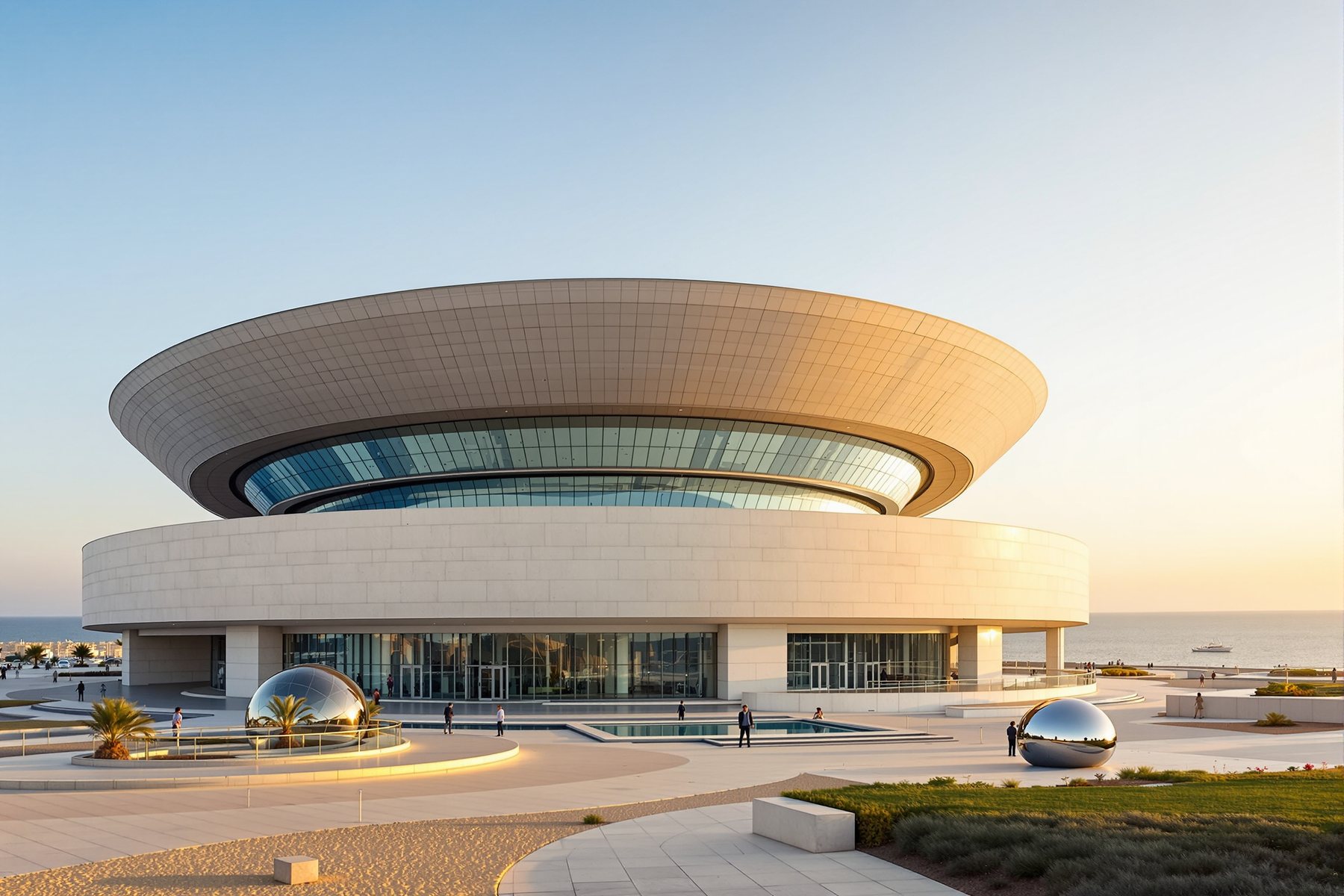
Bibliotheca Alexandrina: A Lost Wonder, Reborn in Our Time
How a young Norwegian practice won a global competition to bring the legendary Library of Alexandria back to life — as a vast tilted disc rising from the Mediterranean like a second sun, wrapped in a wall carved with all the world's writing. The series' first modern wonder, and proof its great theme is alive today.
Every wonder in this series so far has been old — most of them ancient. We close the journey with one that opened in 2002, and it is here for a reason that gathers up the whole series in a single building. The other Alexandria wonders we visited are about _loss_: Fort Qaitbey rose from the rubble of the lost lighthouse; Pompey's Pillar is the last stone standing of the lost library's world. The Bibliotheca Alexandrina is about the opposite — about _bringing something back_. It exists to resurrect the Library of Alexandria, the greatest library of antiquity, lost two thousand years ago, and to do it on the same Mediterranean shore.
It is the only modern building in this collection, and it proves that the deepest theme we have followed — architecture as memory, as a way of refusing to let precious things vanish — is not a thing of the past. It is alive, and being built, right now.
This is the seventeenth article in our Architectural Wonders series.
1. A second sun on the shore
The building announces its single, audacious idea from a distance. It is, in essence, one enormous tilted disc — a circular roof 160 metres across, leaning up toward the sea, rising about 32 metres on the seaward side and diving some 12 metres down into the ground on the landward side. From across the harbour it reads as a vast sun rising out of the Mediterranean — or a great sundial, or a tilted eye turned on the world.
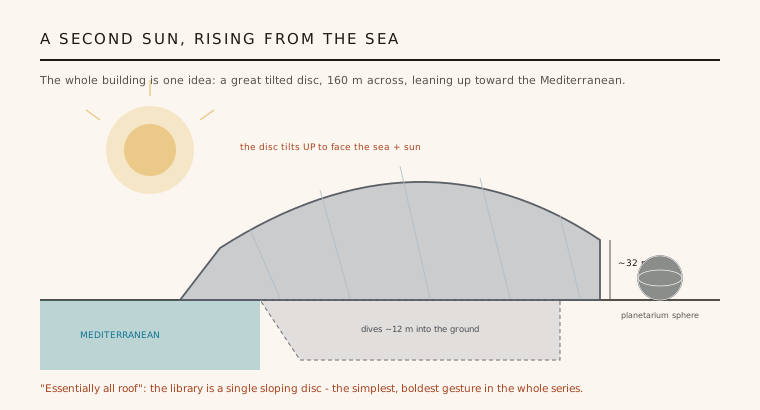
Architects describe it, accurately, as "essentially all roof": the building _is_ the disc. Beside it on the plaza sits a separate sphere — a planetarium — like a small planet next to the sun. It is the same instinct we admired at Konark and Kailasa: one clear, total governing image, carried without compromise. Only here the image is rendered not in carved sandstone but in glass, aluminium and granite, in the language of our own age.
2. A lost wonder, deliberately reborn
To understand why it looks the way it does, you have to feel what it is _for_. The ancient Royal Library of Alexandria was the most famous repository of knowledge in the ancient world — and its loss has haunted civilisation as the supreme symbol of knowledge destroyed.
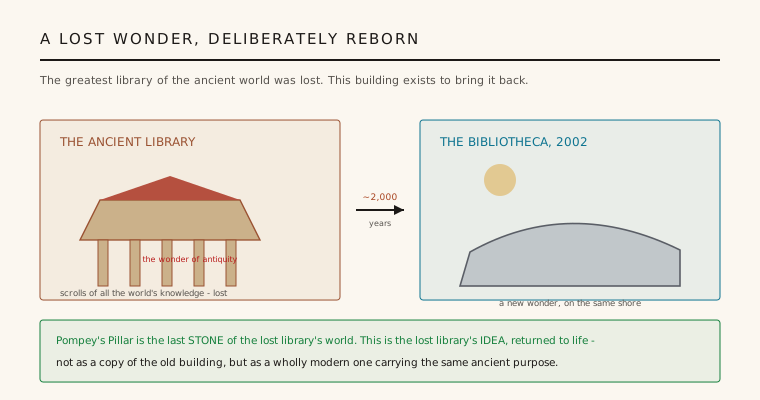
In 1989, Egypt and UNESCO resolved to bring it back — not as a museum-piece reconstruction, but as a living, working library for the 21st century, on the same shore as its legendary ancestor. The choice they made about _how_ to honour the past is the heart of the matter, and we will come back to it: they chose not to imitate an ancient building, but to build a wholly new one carrying the same ancient purpose. Pompey's Pillar is the last physical stone of that lost world of learning; the Bibliotheca is its idea, returned to life in a new body.
3. A wall made of all human writing
If the roof is the building's one big gesture, its wall is its one unforgettable detail — and it tells you, in the most literal way imaginable, exactly what the building holds.
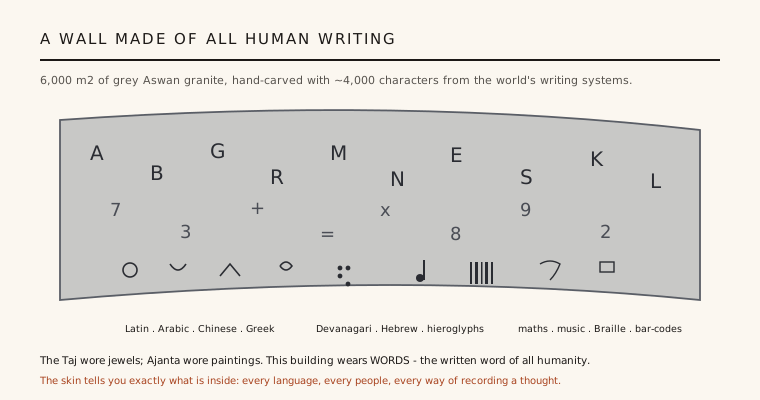
The great curved outer wall is 6,000 square metres of grey Aswan granite — the same eternal Egyptian stone as Pompey's Pillar and the Pharos — and it is hand-carved with around 4,000 characters drawn from across human history: letters from Latin, Arabic, Chinese, Greek, Devanagari, Hebrew and Egyptian hieroglyphs, alongside musical notes, mathematical symbols, Braille, and bar-codes. It is one of the largest pieces of carved-stone art in the modern world, and it is the perfect emblem of a library: a building whose very skin is made of writing. The Taj Mahal wore jewels; Ajanta wore paintings; the Bibliotheca wears words — the written word of all humanity, every script a culture ever used to keep a thought from being lost.
4. A room built for daylight
Step inside and the tilt of that great roof reveals its real purpose. Beneath it spreads the main reading room — at 20,000 square metres, seating 2,000 readers, the largest of its kind on earth — stepped down the slope in a series of cascading terraces toward the sea.
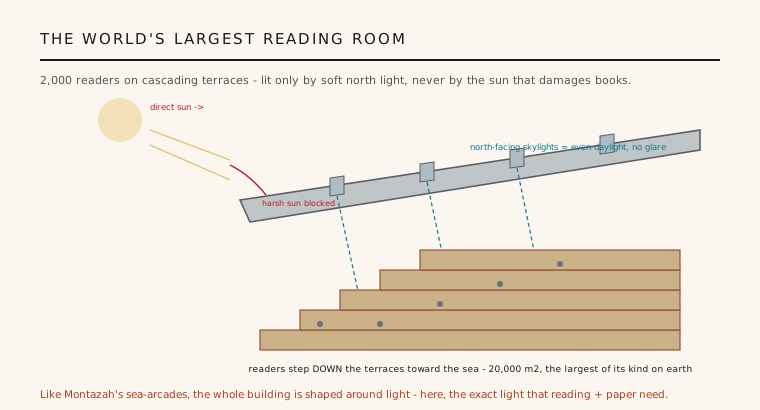
And the roof is a precise instrument for light. Set into its slope are rows of vertical, north-facing skylights — angled so the room is flooded with soft, even, indirect north daylight, while the harsh southern sun, which fades and cracks books and manuscripts, is kept out entirely. The whole gigantic form — the tilt, the orientation, the saw-tooth glazing — exists to deliver the one exact quality of light that reading and the preservation of paper require. Just as Montazah's sea-arcades were tuned to the Mediterranean breeze, the Bibliotheca is tuned, at the scale of a city block, to the Mediterranean light. It is climate-responsive architecture of the most sophisticated kind.
5. The newest wonder, and an old, alive idea
How it was made matters as much as how it looks — because it, too, is a story about reaching across the world.
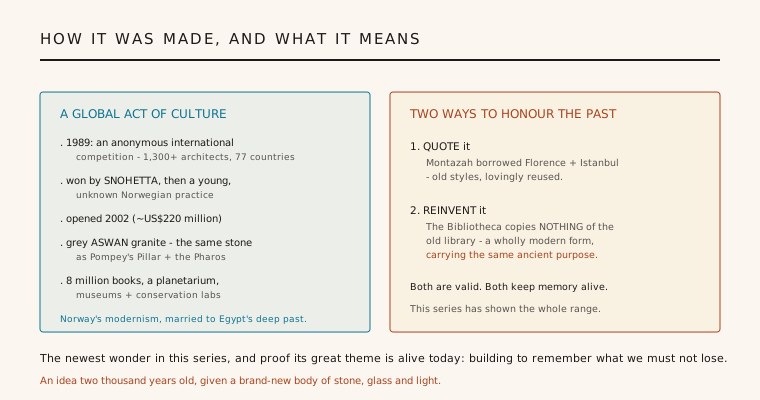
The design was chosen by an anonymous international competition in 1989 — over 1,300 architects from 77 countries entered — and it was won by Snøhetta, then a young, unknown Norwegian practice, who built their whole future on it. The library opened in 2002 at a cost of around US$220 million; it holds shelf space for eight million books, plus a planetarium, museums, and manuscript-conservation labs. Norway's cool modernism, married to Egypt's deep granite past.
And it offers the final lesson of this whole series, by completing a pair. There are two ways to honour the past. You can quote it — as Montazah did, lovingly borrowing the towers of Florence and Istanbul. Or you can reinvent it — as the Bibliotheca does, copying nothing of the ancient library's appearance while carrying its exact purpose into a radically new form. Both are valid; both keep memory alive; and across seventeen wonders, ancient and modern, carved and built, ruined and reborn, this series has shown the whole range of how human beings build to remember. That the most contemporary wonder of all is a library raised to replace a lost one is the most hopeful note this collection could end on.
6. What a modern architect can learn from the Bibliotheca Alexandrina
- Memory can generate the new, not just preserve the old. The most forward-looking building in this series exists to honour the most ancient idea in it. Reaching back is not nostalgia; done well, it is one of the most powerful engines of original design.
- One bold idea still wins. A single tilted disc, "essentially all roof," carried without hedging — modern architecture is no different from Konark or Kailasa in this. Find the one true image and commit to it completely.
- Let the skin say what the building is. A wall of the world's writing tells every passer-by, instantly and wordlessly, what lies inside. The most eloquent buildings make their surface carry their meaning.
- Design around the light your function needs. North skylights, the precise tilt — everything serves the exact daylight that reading and paper demand. Start from how a space must feel and perform, and let the form follow the light. (It is the whole argument of our climate-responsive design course.)
- To reinvent is also to honour. You do not have to copy the past to respect it. A wholly new form can be the truest tribute of all — which is, in the end, exactly the spirit in which this series, and Studio Matrx, have been built.
References & further reading
1. Snøhetta — Bibliotheca Alexandrina (project archive). https://www.snohetta.com/projects/bibliotheca-alexandrina
2. Bibliotheca Alexandrina — official site. https://www.bibalex.org/en/default
3. ArchDaily — AD Classics: Bibliotheca Alexandrina / Snøhetta. https://www.archdaily.com/592824/ad-classics-bibliotheca-alexandrina-snohetta
4. UNESCO — Revival of the Library of Alexandria. https://www.unesco.org/
Last verified 2026-06-30. Dimensions, dates, costs and counts follow standard architectural and institutional reference sources and are given as widely accepted approximations; the 1989 international competition won by Snøhetta, the 2002 opening, the Aswan-granite wall carved with the world's writing systems, and the building's purpose as a revival of the ancient Library of Alexandria follow the established record.
Export this guide
Related Guides — Deep-dive reading
Bibliotheca Alexandrina: How Snøhetta Tilted a Library Toward the Sea
Snøhetta's 2002 library in Egypt answers a two-thousand-year-old ghost with a single tilted granite disc — a sun-dial roof, a carved wall of every human script, and a terraced reading room that turned an unknown young Oslo practice into a global office. A case study in how one civic building manufactures public life, and the politics it cannot escape.
The Future of ArchitecturePompey's Pillar: One Stone, Wrongly Named, Still Standing
How the Romans raised a single 285-ton monolith of red Aswan granite over Alexandria — the last great monument of a vanished temple and its lost library — and why the most famous thing about it, its very name, is a mistake.
Architectural WondersBeijing City Library: The Forest That Holds Up the Roof
Snøhetta's library in Tongzhou puts a whole reading landscape under a canopy carried by 144 tree-like columns — each one quietly doing the work of structure, roof, daylight, climate and acoustics at once. A study of the world's largest climate-controlled reading hall, its record self-supporting glass wall, and the robots reading in the dark beneath it.
The Future of ArchitectureRelated Tools — Try Free
Window Orientation Planner
Pick the best window type, glass and shading by wall direction — north, east, south and west.
Window ToolHealing View Impact Calculator
Evidence-Based Design dashboard quantifying the recovery impact of nature view + daylight factor on analgesic use, length of stay, and HCAHPS patient-experience uplift. Calibrated against Ulrich 1984 (Science), Park & Mattson 2008, and the CHD EBD evidence base.
EBD CalculatorCross-Ventilation Analyzer
Estimate airflow and air changes per hour (ACH) from room size, window areas, layout, and local wind — with NBC 2016 Part 8 compliance check.
Ventilation Calculator