
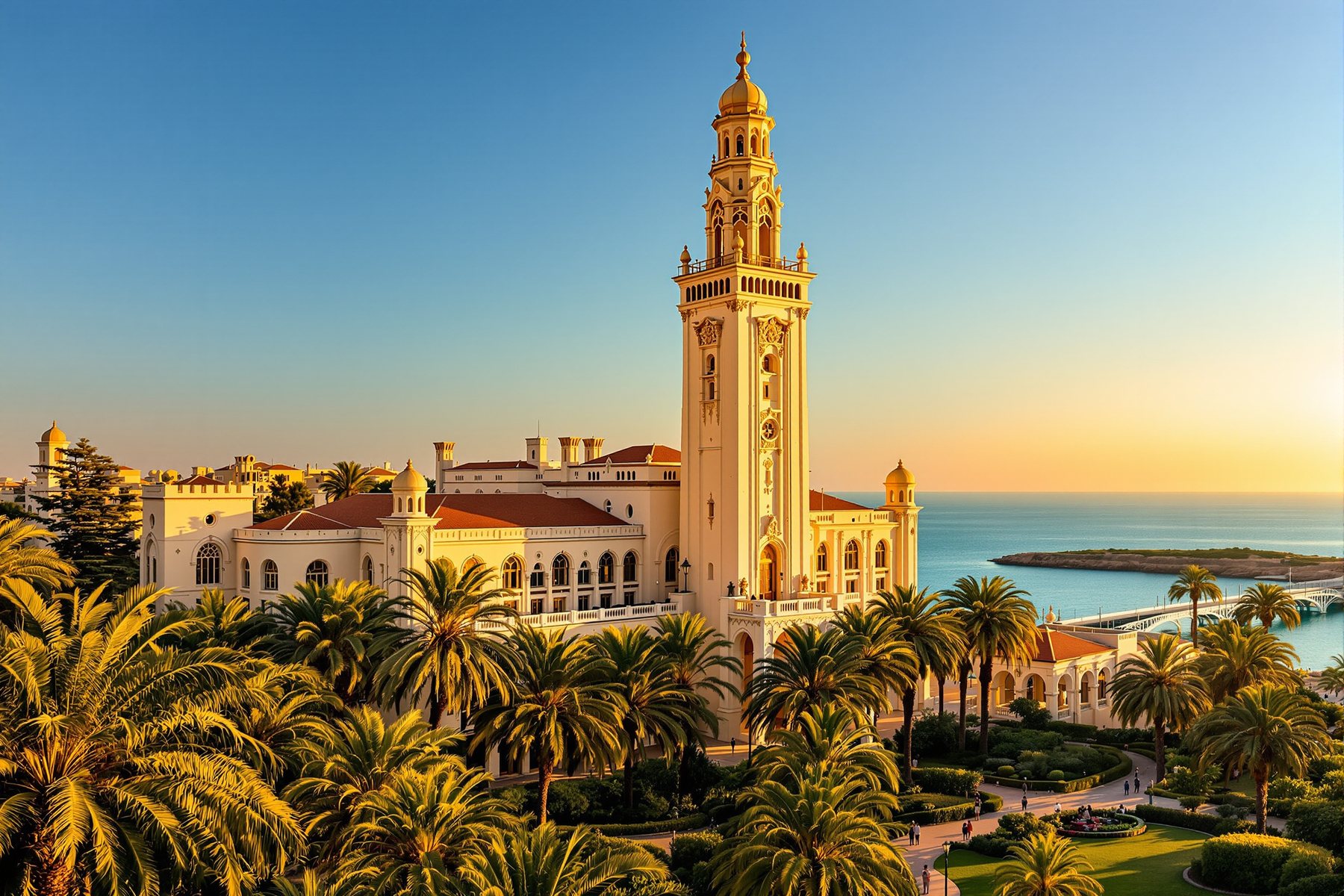
Montazah: The Palace That Is Really a Garden
How Egypt's royal house built a summer palace on the Alexandria shore that quotes Florence, Istanbul and the Moorish world in one joyful eclectic building — set in 350 acres of gardens running down to the sea, with a tower built not to fight but to delight, and a private royal paradise that became everyone's park.
After a fortress built from a wonder's bones, this article changes mood completely. We stay on the Alexandria shore — a few kilometres east of Fort Qaitbey — but leave war behind entirely. Montazah is a pleasure palace, the summer home of Egypt's royal family, set in a vast garden running down to the Mediterranean. It is the first building in this series made not to defend, or to worship, or to guide ships, but simply for delight — and it is the first whose true subject is not a building at all, but a landscape.
It is also the most _cosmopolitan_ wonder we have visited: a single palace that cheerfully quotes Florence, Istanbul and the Moorish world in one breath, built by a dynasty that looked out at the Mediterranean and borrowed freely from every shore it could see.
This is the thirteenth article in our Architectural Wonders series.
1. A palace, a garden, and the sea — as one work
The first thing to understand about Montazah is that the palace is only one part of the wonder. It sits on a low plateau on the eastern edge of Alexandria, inside royal grounds of more than 350 acres — gardens, woods, palm avenues and beaches — that sweep down to the shore of a beautiful bay.
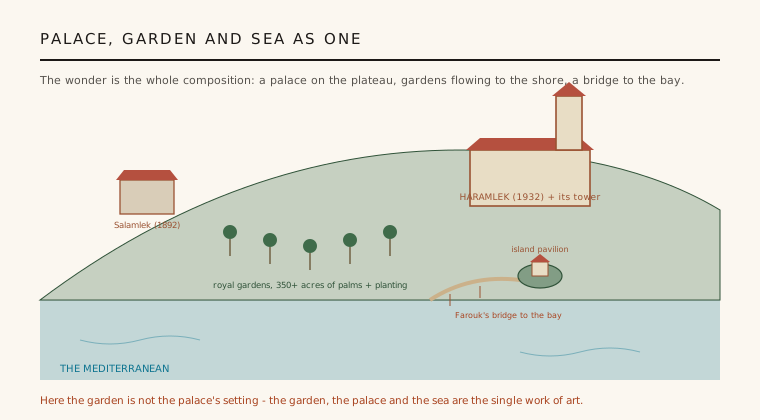
The composition is the point. The palace, the garden and the sea were designed to be read together — a single sweep from the high tower, down through the planted grounds, across the beaches, out to the water and a bridge that reaches into the bay. This is a way of thinking we have not yet met in this series: architecture as the orchestration of a whole place, where the building is the climax of the landscape, not an object dropped into it.
2. Many traditions in one building
Now the palace itself. The grand Haramlek, built in 1932, is described in exactly the phrase it deserves: a mixture of Ottoman and Florentine styles — often nicknamed "Turco-Florentine." And that eclecticism is its whole personality.
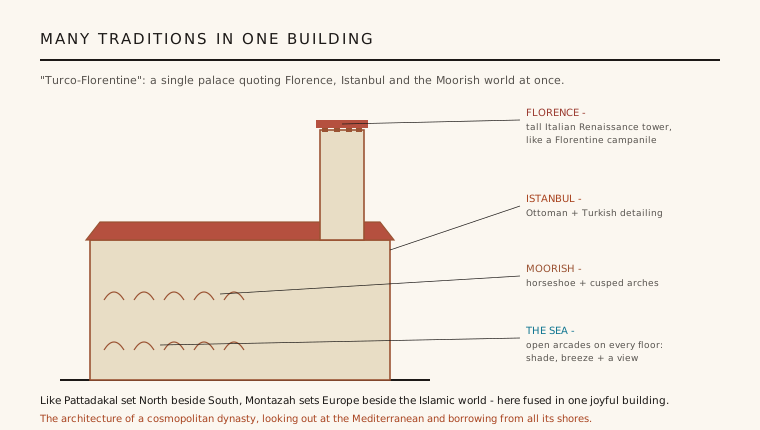
In one building you find a tall, elaborate Italian Renaissance tower — so Florentine in feeling that it is often likened to the campanile of a great Florence palazzo — sitting above Ottoman and Turkish detailing, Moorish arches, and long open arcades facing the sea on every floor to catch the shade and the Mediterranean breeze. To a strict purist this is "impure"; to everyone else it is gloriously alive. It is the architecture of a cosmopolitan moment — the Belle Époque, when Alexandria was one of the most international cities on earth — and of a dynasty confident enough to gather beauty from Europe and the Islamic world alike and fuse it into something unmistakably its own. We saw Pattadakal set the North of India beside the South; Montazah does the same trick across the whole Mediterranean, and melts the borrowings into one warm, ornamented whole.
3. Two palaces, and a tower built for delight
There are really two palaces in the grounds, built forty years apart by the Muhammad Ali dynasty that ruled Egypt.
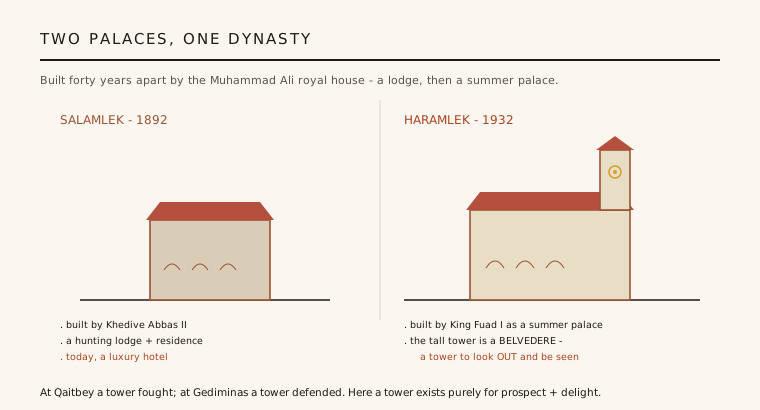
The older, smaller Salamlek was built in 1892 by Khedive Abbas II — originally a hunting lodge and private residence, and today a luxury hotel. The grand Haramlek was added in 1932 by King Fuad I as the family's summer palace, and it is the one with the famous tower.
And that tower is worth pausing on, because of what it tells us about this whole building. At Fort Qaitbey a tower was made to fight; at Gediminas' Tower a tower was made to defend. The Montazah tower does neither. It is a belvedere — literally a "beautiful view" — a tower built purely to look out from and to be looked at: to survey the gardens and the glittering sea, and to crown the palace with a romantic silhouette. The same ancient vertical element, turned at last entirely toward pleasure. A tower, here, is a piece of joy.
4. The garden composed like a building
Step out of the palace and into the grounds, and you find the real masterpiece: a designed landscape of the first order.
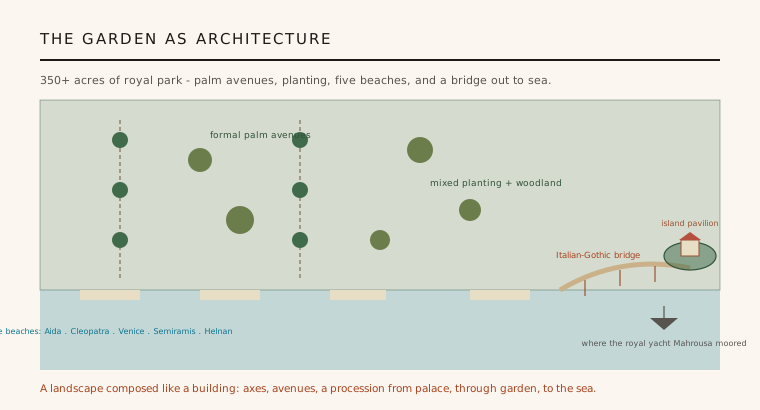
The gardens are not a green backdrop; they are architecture in plants. Formal avenues of tall date palms lay down axes and processions; a great variety of species fills the woods and beds; and the whole park is composed as a journey — from the palace, down through the planting, to a shoreline of five beaches (Aida, Cleopatra, Venice, Semiramis and the Helnan strand). And reaching out into the bay is the most romantic gesture of all: a curving Italian-Gothic bridge, built under King Farouk, crossing to a small island pavilion where the royal yacht, the Mahrousa, once moored. A garden, at this level, is shaped with exactly the tools of a building — axis, sequence, framing, climax — only its materials are palm and water and light. For anyone who cares about the bond between architecture and landscape, Montazah is a masterclass.
5. From kings to the public
Montazah's last chapter is the gentlest in the whole series. For decades it was the private summer paradise of Egypt's kings, right up to King Farouk — the Belle Époque world of cosmopolitan Alexandria at its most golden.
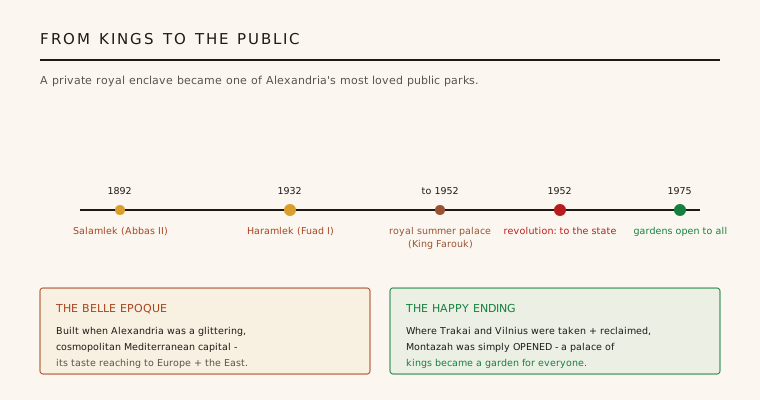
Then came the Egyptian Revolution of 1952, the fall of King Farouk, and the end of the monarchy. The palace passed to the Egyptian state — and rather than being lost or locked away, it was eventually opened up: the gardens were given to the public in 1975, the Salamlek became a hotel, and the grounds became one of Alexandria's best-loved recreational spaces, where ordinary families now picnic in a garden once reserved for kings.
It is a quietly moving counterpoint to the rest of this series. Konark and Hampi were lost; Trakai and Vilnius were taken and reclaimed; Qaitbey rose from a wonder's ruin. Montazah's transformation is the happiest of all: a private royal pleasure-ground that simply became everyone's. Sometimes the best afterlife a great building can have is to throw open its gates.
6. What a modern architect can learn from Montazah
- Design the place, not just the building. Montazah's genius is the orchestration of palace, garden and sea into one experience. The grounds are not the setting for the architecture — they _are_ the architecture. Always design the whole site as one composition. (It is the very heart of our landscape and garden writing.)
- Eclecticism can be joy, not confusion — if it is confident. Florence, Istanbul and the Moorish world live happily in one palace because the borrowing is wholehearted, not timid. Quotation works when it is fused with conviction into a coherent character of its own.
- A garden is built with an architect's tools. Axis, sequence, framing, procession, climax — the palm avenue and the bridge are composed exactly like rooms and corridors. Treat landscape as seriously, and as structurally, as building.
- Tune leisure architecture to its climate. Open sea-facing arcades on every floor, deep shade, the breeze, the prospect — Montazah is a machine for enjoying a Mediterranean summer. Comfort and delight are legitimate, designable goals, not afterthoughts. (The instinct our climate-responsive design course is built on.)
- The best afterlife may be to open the gates. A building's meaning can grow, not shrink, when a private treasure becomes a public one. Architecture serves most people when it is, finally, _shared_.
References & further reading
1. State Information Service, Egypt — El Montaza Palace. https://sis.gov.eg/Story/168300/El-Montaza-palace?lang=en-us
2. Encyclopaedia Britannica — Alexandria and the Muhammad Ali dynasty. https://www.britannica.com/place/Alexandria-Egypt
3. Egypt Ministry of Tourism and Antiquities — Montaza Palace and Gardens. https://egymonuments.gov.eg/
4. Bibliotheca Alexandrina — Alexandria in the Belle Époque. https://www.bibalex.org/
Last verified 2026-06-30. Dates, builders and stylistic descriptions follow standard historical and museum reference sources and are given as widely accepted approximations; the 1892 Salamlek under Abbas II, the 1932 Haramlek under Fuad I, the "Ottoman and Florentine" style, and the post-1952 transfer to the state and opening of the gardens to the public follow the established historical record.
Export this guide
Related Guides — Deep-dive reading
The Lighthouse of Alexandria: The Wonder That Became a Word
How Ptolemy's Egypt raised a 100-metre tower of light on the island of Pharos — the tallest building on earth after the Great Pyramid, the model for every lighthouse since, and so famous its island's name became the word for 'lighthouse' itself — which stood 1,600 years, fell to earthquakes, and was reborn as a fort and a field of ruins on the sea floor.
Architectural WondersBibliotheca Alexandrina: A Lost Wonder, Reborn in Our Time
How a young Norwegian practice won a global competition to bring the legendary Library of Alexandria back to life — as a vast tilted disc rising from the Mediterranean like a second sun, wrapped in a wall carved with all the world's writing. The series' first modern wonder, and proof its great theme is alive today.
Architectural WondersSigiriya: The Sky Palace a Guilty King Built on a Rock
Fifteen hundred years ago in Sri Lanka, a king who had murdered his way to the throne fled his own guilt and fear to the top of a sheer 200-metre rock, and there built one of the most breathtaking places on Earth: symmetrical water gardens whose fountains still run, a cliff painted with celestial maidens, a gateway shaped as a colossal lion, and a pleasure-palace in the clouds. A paradise built out of terror. The seventh article in our chapter on the palaces and pleasures of worldly power.
Architectural WondersRelated Tools — Try Free
Garden Planning Toolkit
Get a tailored garden plan — planting layers, Indian species, features and a checklist — from your climate, space, sun and goals.
PlannerConcept Generator
Get 3 AI-generated design concepts for any room with style, materials, and cost estimate.
DesignAIDesign Style Finder Quiz
Answer 10 visual questions to discover your Indian interior style profile with materials and colours.
Interactive Quiz