
Pompey's Pillar: One Stone, Wrongly Named, Still Standing
How the Romans raised a single 285-ton monolith of red Aswan granite over Alexandria — the last great monument of a vanished temple and its lost library — and why the most famous thing about it, its very name, is a mistake.
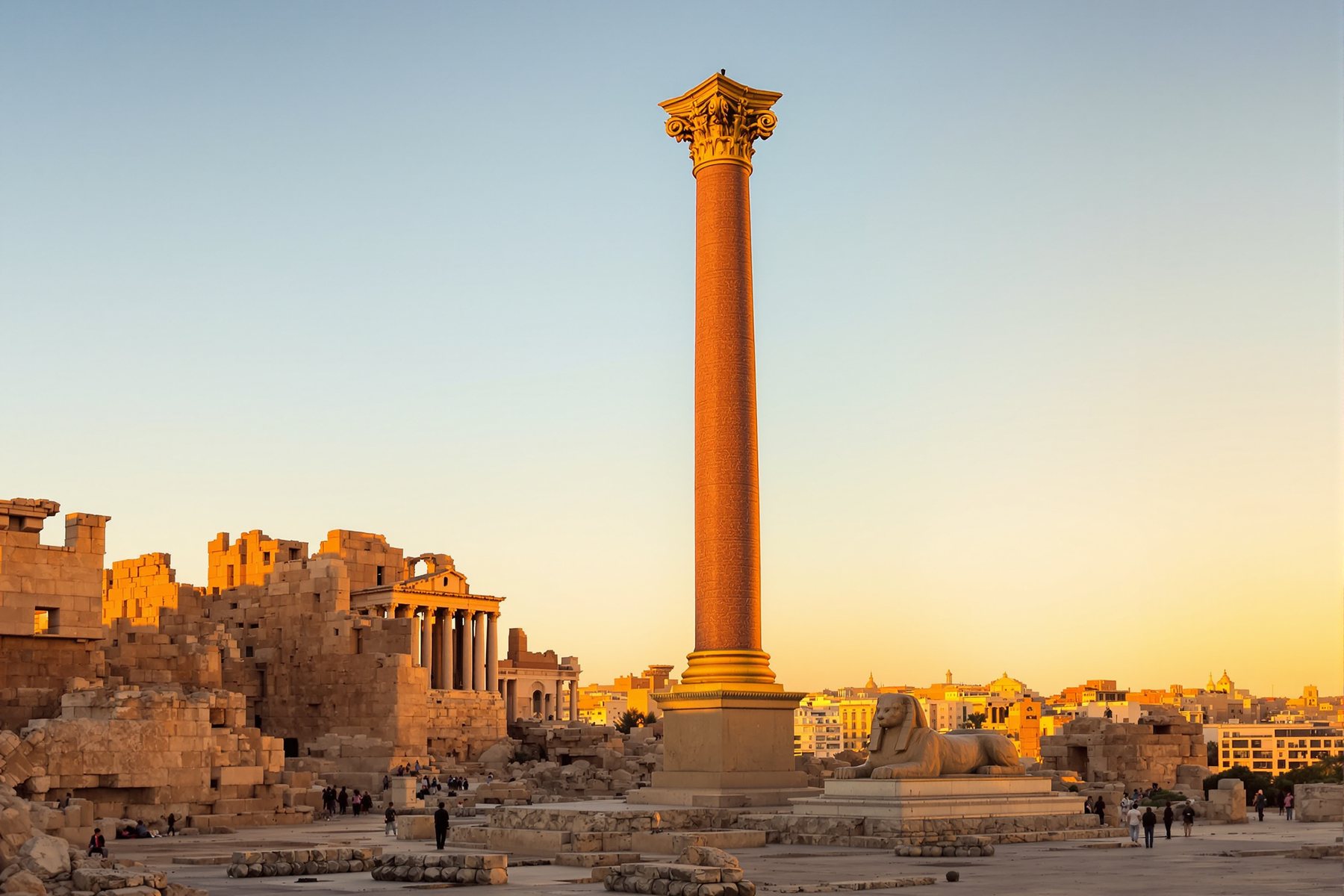
For three articles we have lingered in Alexandria — the fort built from a lighthouse, the palace that is really a garden. End the visit at the city's oldest survivor, and one of the strangest wonders in this whole series: a single, colossal column standing alone on a low hill of rubble. No temple around it, no roof above it, nothing it holds up. Just one enormous stone, pointing at the sky, where it has pointed for more than seventeen hundred years.
It is called Pompey's Pillar — and almost everything that name tells you is wrong. The wonder of it is threefold: it is a feat of raising a single impossible stone; it is the last thing left standing of one of antiquity's great sanctuaries; and it is the most famous case of mistaken identity in architecture.
This is the fourteenth article in our Architectural Wonders series.
1. One stone, two hundred and eighty-five tons
Begin with the sheer object. The pillar is a Roman triumphal column, and its shaft is a single monolith — one unbroken piece of red Aswan granite, about 20.5 metres tall and 2.7 metres across, weighing an estimated 285 tons. With its base and Corinthian capital it stands about 27 metres high, and it was once crowned by a colossal porphyry statue of the emperor in armour, long since lost.
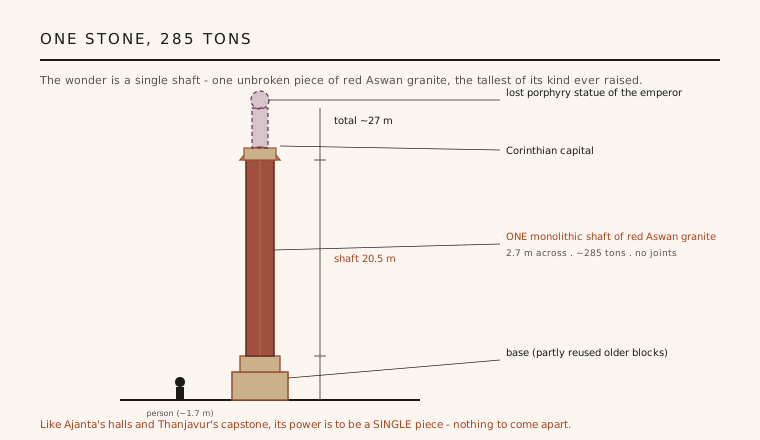
That word — monolith — is the whole point. We have admired single stones before in this series: the carved-from-one-rock halls of Ajanta, the 80-tonne capstone of Brihadeeswara. A monolith has a power no built-up column can match: with no joints and no courses, there is nothing to come apart, nothing for time to prise open. It is also, by the same logic, monstrously hard to make — which is the next part of the wonder.
2. Quarry it, float it, stand it up
To raise this pillar, the Romans had to solve three colossal problems in sequence, with nothing but muscle, water, ramp and rope.
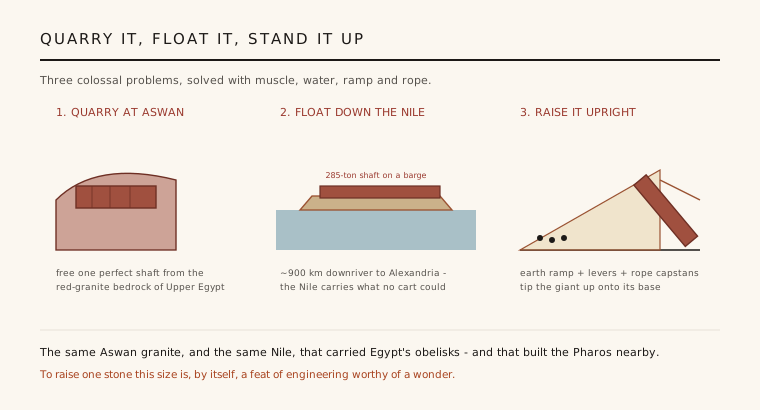
First, quarry it: free one flawless 285-ton shaft from the red-granite bedrock of Aswan, in the far south of Egypt. Then move it: float that impossible weight some 900 kilometres down the Nile on a barge, because no cart or road could ever carry it — the river does the work. Then, hardest of all, raise it: drag the giant onto the site, and with earthen ramps, levers and rope-pulled capstans, tip it slowly upright onto its base without snapping it. It is the same Aswan granite, floated down the same Nile, that built Egypt's obelisks and the nearby Pharos lighthouse. To raise a single stone of this size is, on its own, an achievement worthy of a wonder — the engineering _is_ the architecture.
3. It is not Pompey's pillar
Now the famous mistake. For centuries this column has been called Pompey's Pillar, after Pompey the Great, the Roman general who was murdered in Egypt after fleeing Julius Caesar — and it has nothing whatever to do with him.
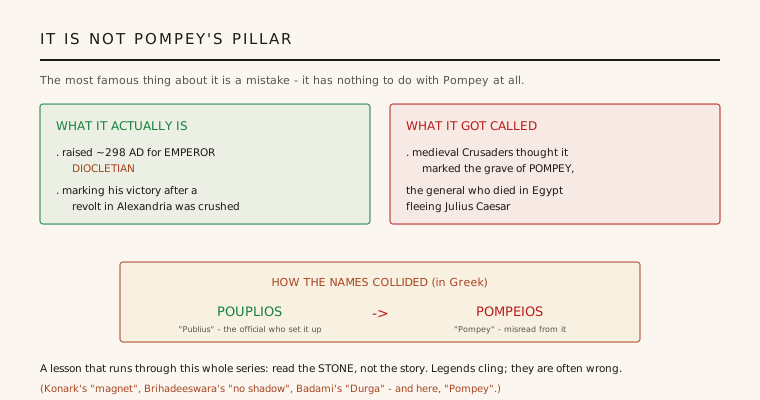
The column was in fact raised around 298 AD in honour of the Emperor Diocletian, most likely marking his victory after a revolt in Alexandria was crushed. The name went wrong in the Middle Ages: the inscription on the base named the official who set it up — a Publius, in Greek ΠΟΥΠΛΙΟΣ — and European Crusaders misread that into ΠΟΜΠΗΙΟΣ, _Pompey_, and decided the column marked the great general's grave. The error stuck, and stuck, until the wrong name became the only name anyone knew.
There is a lesson here that has run quietly through this entire series: read the stone, not the story. We have met Konark's "magnetic" tower, Brihadeeswara's "shadowless" noon, Badami's "Durga" temple named for a fort — and now a Roman emperor's column wearing a dead general's name. Legends and labels cling to old buildings like barnacles; the honest task is always to go back to the evidence and ask what the thing actually _is_.
4. The last survivor of the Serapeum
Why does this one column stand alone on a hill of rubble? Because everything around it is gone. The pillar was raised at the Serapeum of Alexandria — the great temple of the god Serapis, the largest and most magnificent sanctuary in the Greek quarter of the city, which also held lecture halls and a library, a celebrated "daughter" of the legendary Library of Alexandria.
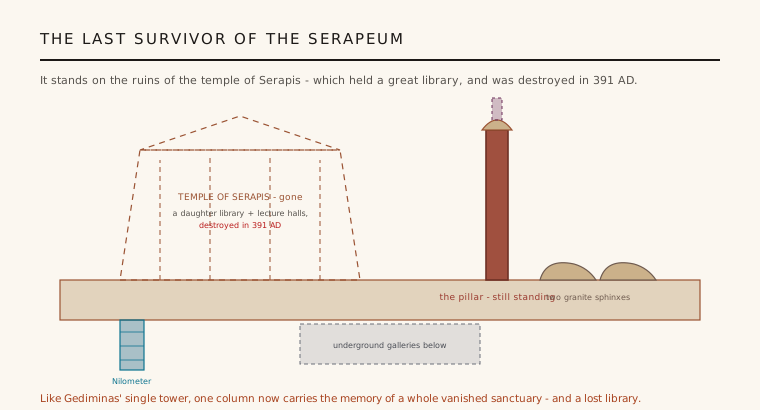
In 391 AD, by the decree of the Emperor Theodosius I that closed the pagan temples, the Serapeum was destroyed — and with it, much of its library. Today only fragments remain: two granite sphinxes, a Nilometer (an ancient gauge for the Nile's flood), some underground galleries — and, towering over all of it, the pillar. It is the last great monument standing of the whole sanctuary, and indeed it is the only ancient monument in Alexandria still standing in its original place. Like Gediminas' Tower, one survivor now carries the entire memory of a vanished world — here, a world that included a great library, burned for the crime of believing differently.
5. The stone that outlasts everything
Stand back and what the pillar really teaches is the strange permanence of the right material in the right form. Ancient Alexandria was one of the wonders of the world — the Library, the Pharos lighthouse, the palaces of the Ptolemies. Earthquakes, fires, decrees and the sea took almost all of it. What is left, standing exactly where it was raised, is one column of Aswan granite.
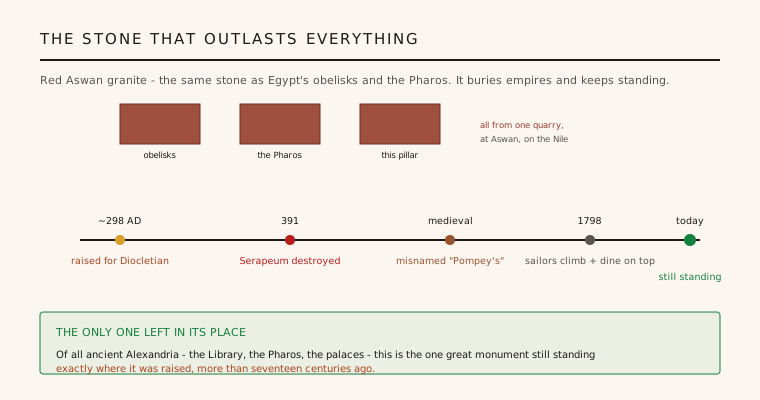
(It has had its lighter moments, too: by the 18th and 19th centuries, climbing the pillar had become a sport — in 1798 British sailors are said to have flown a kite over the top, hauled up ropes, and climbed up to dine on the capital, and many travellers carved their names there.) But the deep point is sober. The empires that raised it, mis-named it, fought over it and climbed it have all passed; the granite has not moved. Stone, in the right shape, keeps a kind of patient faith with time that almost nothing human does.
6. What a modern architect can learn from Pompey's Pillar
- The monolith is the ultimate durability — and the ultimate difficulty. One unjointed piece can never come apart, but it must be quarried, moved and raised against brutal odds. Knowing when a single great element is worth its enormous cost — and when assembly is wiser — is a real design judgement.
- The engineering can be the architecture. This column has almost no "design" in the usual sense; its wonder is purely the feat of making and raising it. Sometimes the structure, the logistics and the act of building _are_ the work — and worth celebrating as such.
- Read the stone, not the story. A monument's reputation can be entirely wrong for a thousand years. Whether you are conserving an old building or assessing a site, go to the evidence; never trust the label without checking the thing.
- A single element can carry an enormous load of meaning. One vertical marker stands for a lost temple, a burned library and a whole civilisation. The most economical architecture — a column, an obelisk, a single tower — can hold more memory than a hundred rooms.
- Choose materials that keep faith with time. Almost everything around it perished; the granite endured. When something is meant to last, the patient choice of a durable, local, time-proven material is the quietest and surest design decision of all. (It is the long view our structural safety and materials writing always argues for.)
References & further reading
1. Encyclopaedia Britannica — Alexandria: Pompey's Pillar and the Serapeum. https://www.britannica.com/place/Alexandria-Egypt
2. Egypt Ministry of Tourism and Antiquities — Pompey's Pillar (Serapeum). https://egymonuments.gov.eg/
3. Bibliotheca Alexandrina — The Serapeum of Alexandria. https://www.bibalex.org/
4. History Hit — Pompey's Pillar: History and Facts. https://www.historyhit.com/locations/pompeys-pillar/
Last verified 2026-06-30. Dimensions, weight, dating and attributions follow standard archaeological and museum reference sources and are given as widely accepted approximations; the dedication to Diocletian around 298 AD, the Publius-to-Pompey misnaming, and the destruction of the Serapeum in 391 AD follow the established historical record.
Export this guide
Related Guides — Deep-dive reading
The Palace of Sennacherib at Nineveh: The Palace Without Rival
Twenty-seven centuries ago, on the Tigris opposite modern Mosul, an Assyrian king built a palace so vast he named it, in his own words, 'the Palace that has no rival' — and lined its walls, room after room, with miles of carved stone panels telling the story of his wars. It is the birthplace of narrative art, the home of the winged guardian, and a wonder destroyed not once but twice. The second article in our chapter on the palaces of worldly power.
Architectural WondersBibliotheca Alexandrina: A Lost Wonder, Reborn in Our Time
How a young Norwegian practice won a global competition to bring the legendary Library of Alexandria back to life — as a vast tilted disc rising from the Mediterranean like a second sun, wrapped in a wall carved with all the world's writing. The series' first modern wonder, and proof its great theme is alive today.
Architectural WondersBrihadeeswara: The Chola Tower That Never Fell
How an 11th-century Tamil emperor raised a 216-foot tower of solid granite — with no mortar, no iron and no machine — and why this colossal corbelled mountain has stood for over a thousand years where Konark's fell. The engineering, the 80-tonne capstone, and the lesson.
Architectural WondersRelated Tools — Try Free
Material Decision Framework (M-Score)
Score 30+ Indian construction materials across cost, durability, climate fit, maintenance, and sustainability.
MaterialsBefore & After Studio
Generate AI before-and-after renders to preview how your redesign could look.
DesignAICircadian Light Meter
Patient-centric circadian lighting visualizer for Indian healthcare design — time-of-day × intensity → CCT, melanopic lux (EML / mEDI), melatonin suppression, and an alertness curve. Calibrated against WELL v2 L03 Circadian Lighting Design, CIE S 026:2018, Brainard 2001, and Lucas et al. 2014.
Circadian Tool