

Single Phase vs Three Phase Lift Systems (India): Which Supply Does Your Lift Need?
What 230 V single-phase can drive, what needs a sanctioned 415 V three-phase connection, and a clear method to decide for your Indian home.
When you start specifying a home lift, one early question quietly decides a lot about cost, install effort and even which lift you can buy: does it run on single-phase or three-phase power? Most Indian homes have a single-phase connection by default. Many compact home lifts are happy with that. But step up to a faster, heavier, smoother traction lift and you may need a three-phase supply your home does not yet have, which is a separate sanctioned connection from your DISCOM with its own paperwork and standing charges.
This guide is a focused single phase vs three phase lift comparison: what each supply can drive, the Indian home-supply reality, and a clear method to decide. It deliberately stays in its lane. For the full picture of connected load, cable sizing, MCB/RCBO selection and earthing, read the companion lift power requirements guide — we link rather than repeat it here.
The short version: pick the lift first, let the lift tell you the supply it needs, and only then worry about whether your home has that supply.
What "single-phase" and "three-phase" actually mean
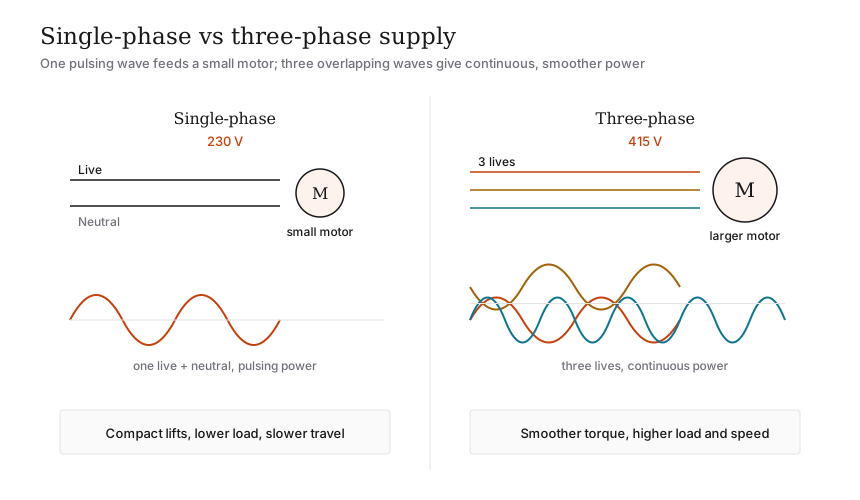
In an Indian home, the socket and lighting circuits run on single-phase power: one live conductor plus neutral, at a nominal 230 volts. It is the default connection for almost every independent house and apartment.
Three-phase power delivers three live conductors, each offset in timing, at a nominal 415 volts between phases. It is the standard supply for workshops, larger buildings and any motor that needs steady, high torque. A three-phase motor runs smoother because power arrives continuously across the three phases rather than pulsing, which matters for a lift that should start and stop without a jolt.
You do not get three-phase automatically. It is a separate sanctioned connection you apply for from your electricity distribution company (DISCOM), and it carries its own connection cost and monthly fixed/demand charges whether or not the lift is running. That economic fact, not just the engineering, often drives the decision.
What a single-phase (230 V) supply can drive
Single-phase is genuinely enough for a large share of home lifts, especially compact, low-rise, lower-capacity machines. As a rule of thumb it suits:
- Compact pneumatic vacuum elevators (PVE). These panoramic air-pressure lifts (Nibav being the best-known India-grown brand) are designed around easy retrofit and typically run on a normal single-phase home supply. They carry roughly 2 to 3 persons and draw more on the ascent, descending by controlled release.
- Small hydraulic lifts. A modest piston/ram lift over 2 to 3 floors at low capacity can be configured single-phase. Smooth and quiet, with a small power pack in an adjacent cabinet.
- Small gearless (MRL) traction lifts. Some compact machine-room-less gearless models for low capacity and modest speed are offered in single-phase versions, helped by efficient gearless motors and VVVF drives.
The appeal is obvious: no new DISCOM connection, no extra fixed charges, simpler install. The lift plugs into the supply your home already has (on its own dedicated, correctly rated circuit, never an ordinary socket). For a single-family home that wants a small, slow, comfortable lift, single-phase is often the whole answer.
The trade-off is at the top of the range. A single-phase motor pulses power twice per cycle rather than continuously, so for the same job it tends to draw higher current and runs a little less smoothly than its three-phase equivalent. That is fine for small, slow cars and becomes limiting as capacity and speed climb.
What needs a three-phase (415 V) supply
Three-phase becomes necessary, not just nicer, once the lift gets larger, faster or smoother than a single-phase motor can comfortably deliver. You are likely to need three-phase when you choose:
- Higher capacity — larger cabs (think 6 to 8 persons / 480 to 630 kg) whose motors need the steady torque three-phase provides.
- Higher speed — faster traction lifts for taller homes; speed and capacity together push the motor past single-phase comfort.
- Smoother torque and start/stop — three-phase delivers continuous power, so a heavier car accelerates and levels more gently, with less current draw for the same work.
- Larger traction machines generally — most mid-to-large geared and gearless traction lifts are specified three-phase as standard.
If you want a lift that feels like the one in a good apartment building — quiet, smooth, quick enough that you do not notice the wait, comfortably carrying several people or a wheelchair and attendant — you are usually in three-phase territory. The catch is the supply itself.
Three-phase is not an upgrade you bolt onto the lift. It is a supply your home either has or has to apply for, with cost and standing charges attached.
The Indian home-supply reality
Here is the practical knot. Most Indian homes are single-phase by default. A three-phase lift assumes a supply many homes simply do not have at the meter.
Getting three-phase means a sanctioned three-phase connection from your DISCOM: an application, a load sanction, often a new meter and service line, a connection charge, and ongoing fixed / demand charges billed every month regardless of how little the lift runs. None of that is exotic — many homes with heavy loads already have it — but if yours does not, it is a real line item and a real lead time, and it belongs in your budget and schedule, not as a surprise on commissioning day.
So the question is rarely "single or three-phase in the abstract." It is: the lift I want needs supply X; does my home have X, and if not, what does getting it cost and how long does it take? A small single-phase PVE sidesteps the whole issue. A smooth six-person traction lift may oblige you to arrange three-phase first.
(All electrical work — dedicated circuit, cable, protective devices, earthing, supply stability — is covered in the lift power requirements guide. Coordinate the exact ratings with your vendor and a licensed electrician.)
Head-to-head: single-phase vs three-phase home lifts
The heart of the decision in one table. Figures are indicative — confirm capacity, speed and supply needs with your vendor and electrician.
| Aspect | Single-phase (230 V) | Three-phase (415 V) |
|---|---|---|
| Nominal voltage | 230 V, one live + neutral | 415 V across three lives |
| Typical lift fit | Compact PVE, small hydraulic, small gearless MRL | Higher-capacity / faster traction, larger gearless and geared |
| Capacity sweet spot | Lower (PVE 2 to 3 persons; small cars) | Higher (up to 6 to 8 persons and beyond) |
| Speed | Lower / slower travel | Supports faster travel |
| Motor torque / smoothness | Power pulses; fine for small loads | Continuous power; smoother start, stop and levelling |
| Current draw for same work | Higher | Lower |
| Supply most homes already have | Yes (default) | No — needs a sanctioned DISCOM connection |
| Extra DISCOM cost | None beyond your existing supply | Connection charge + monthly fixed / demand charges |
| Install effort | Simpler — uses existing supply | Add new connection + lead time first |
| Best when | Small, slow, low-rise home lift | Larger, faster, smoother lift in a multi-storey home |
Note what the table does not decide for you: the lift type. Hydraulic, screw, gearless traction and PVE each have their own size, pit and headroom story (see how home lifts work). Phase follows from the model and rating you pick within a type, so settle the lift first.
A decision method that actually works
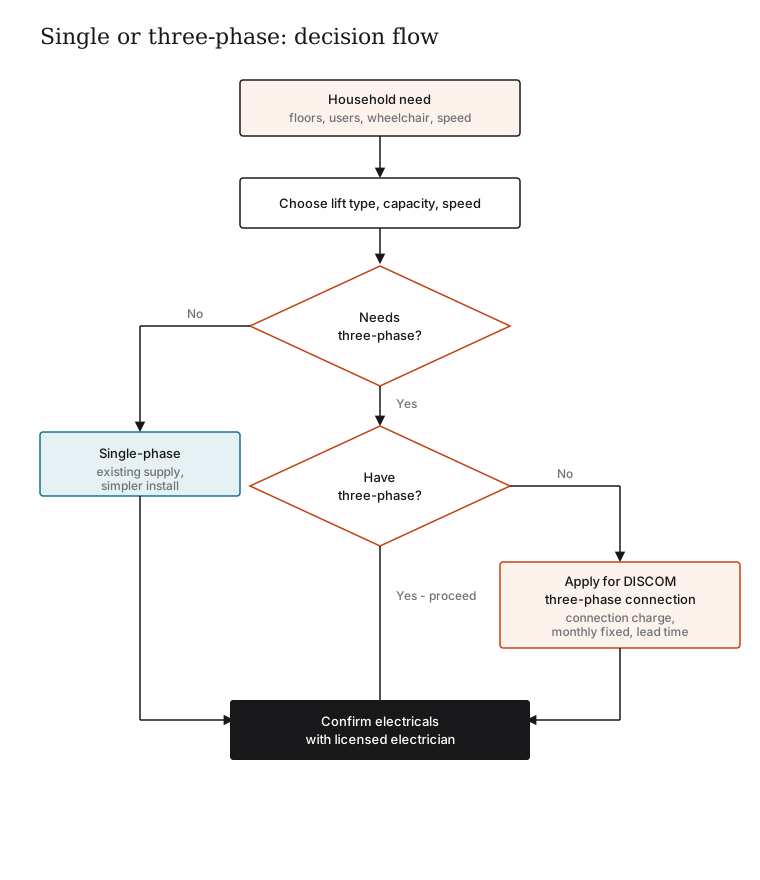
The reliable order is lift-first, supply-second. Do not start from "I have single-phase, so what lift fits"; start from the lift the household needs and let it tell you the supply.
1. Define the need. Floors served, who uses it (a wheelchair plus attendant changes everything), and how patient you are about speed. This sets capacity and speed.
2. Shortlist lift types that meet that need within your space (pit, headroom, shaft) and budget.
3. Ask each vendor the supply question directly: does this exact model, at this capacity and speed, run on single-phase or does it require three-phase? Get it in writing on the quotation.
4. Check what your home has. Single-phase only, or an existing three-phase connection? Your latest electricity bill and meter tell you.
5. If the lift needs three-phase and you do not have it, price the DISCOM connection plus monthly fixed charges, and the lead time, and add both to your decision — sometimes a single-phase-capable model that meets the same need is the better-value choice.
6. Lock the electricals with a licensed electrician per the lift power requirements guide — dedicated circuit, cable, MCB/RCBO, earthing, supply stability.
A quick note on backup, which people often conflate with phase: regardless of which supply you choose, an Automatic Rescue Device (ARD) runs off its own small battery to bring the car to the nearest floor and open the doors on a power cut. A full lift UPS that keeps a three-phase lift running on battery generates a three-phase output during the cutover. Both are part of the power requirements and battery-backup story, not the phase choice itself.
What it looks like at the meter
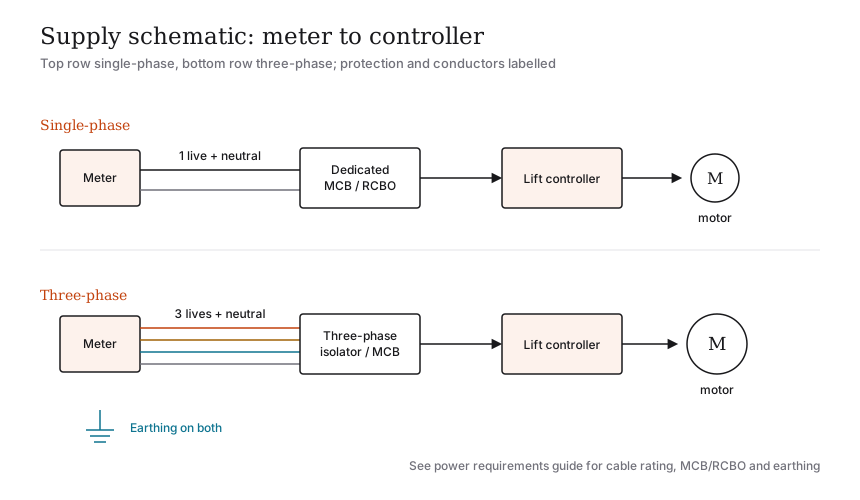
To make it concrete, here is how each supply reaches the lift. Single-phase brings one live and neutral to a dedicated circuit; three-phase brings three lives (and neutral) to a three-phase isolator and the lift controller. The protective devices, cable rating and earthing differ accordingly — all detailed in the power guide.
The verdict
Single-phase is fine if…
- You want a compact lift — PVE, a small hydraulic, or a small gearless MRL — for a low-rise home.
- Lower capacity (roughly 2 to 4 persons) and slower, gentle travel suit the household.
- You would rather not add a new DISCOM connection and its monthly charges.
- Your home has only single-phase and you want the simplest install.
You need three-phase if…
- You are choosing a higher-capacity car (6 to 8 persons) or a wheelchair-plus-attendant accessible cabin.
- You want faster travel in a taller, multi-storey home.
- Smoother torque, gentle start/stop and quiet levelling matter to you.
- The specific traction model your vendor recommends is specified three-phase — and in that case, sort the sanctioned supply before you commit.
The decision is not single-versus-three in the abstract. It is: choose the lift the household actually needs, ask the vendor in writing which supply that exact model requires, then check what your home has and price the gap. Get the model and the supply matched on paper, with a licensed electrician confirming the electricals, and the phase question stops being a surprise and becomes a planned line in your budget.
For the wider picture, see the residential elevator buyer's guide, how home lifts work and the lift power requirements guide.
References
- IS 14665 (Part 1) — Electric Traction Lifts, Outline Dimensions (BIS): https://law.resource.org/pub/in/bis/S05/is.14665.1.2000.pdf
- IS 14665 (Part 2) — Code of practice for installation, operation and maintenance (BIS): https://law.resource.org/pub/in/bis/S05/is.14665.2.1-2.2000.pdf
- National Building Code of India 2016, Part 8 (Building Services), Section 5 — Installation of Lifts, Escalators and Moving Walks (BIS): https://www.bis.gov.in/standards/technical-department/national-building-code/
- Nibav — machine-room-less (MRL) home elevator: https://www.nibavlifts.com/machine-room-less-mrl-home-elevator/
- Renutron — lift UPS / inverter / backup (India): https://www.renutron.com/lift-inverter-india-lift-backup-lift-ups.php
Standards are cited by name; electrical and supply figures are indicative — confirm capacity, speed, phase and the DISCOM connection with your vendor, a licensed electrician and your local distribution company.
Export this guide
Related Guides — Deep-dive reading
Home Lift Planning Checklist (India): Everything to Decide Before You Buy
A printable, ten-stage checklist that takes you from the first family conversation to a signed handover.
Home Lifts & AccessibilityTypes of Home Lifts in India (2026): Complete Comparison and How to Choose
All seven home-lift options on one comparison table, plus a five-question decision framework to pick the right one
Home Lifts & AccessibilityResidential Elevator Buyer's Guide (India 2026): Types, Cost, Sizing, Regulation & How to Choose
Everything an Indian homeowner needs to choose, size, budget, license and maintain a home lift the right way.
Home Lifts & AccessibilityRelated Tools — Try Free
Home Lift Comparison Tool
Compare hydraulic, traction, pneumatic vacuum and screw lifts side by side for your home.
Lift ComparisonLift Power Requirement Calculator
Connected load, single vs three phase, MCB and cable guidance for a home lift.
Lift CalculatorElevator Capacity Calculator
Pick the right home-lift capacity — 2 to 8 person — with car size and wheelchair fit.
Lift Calculator