
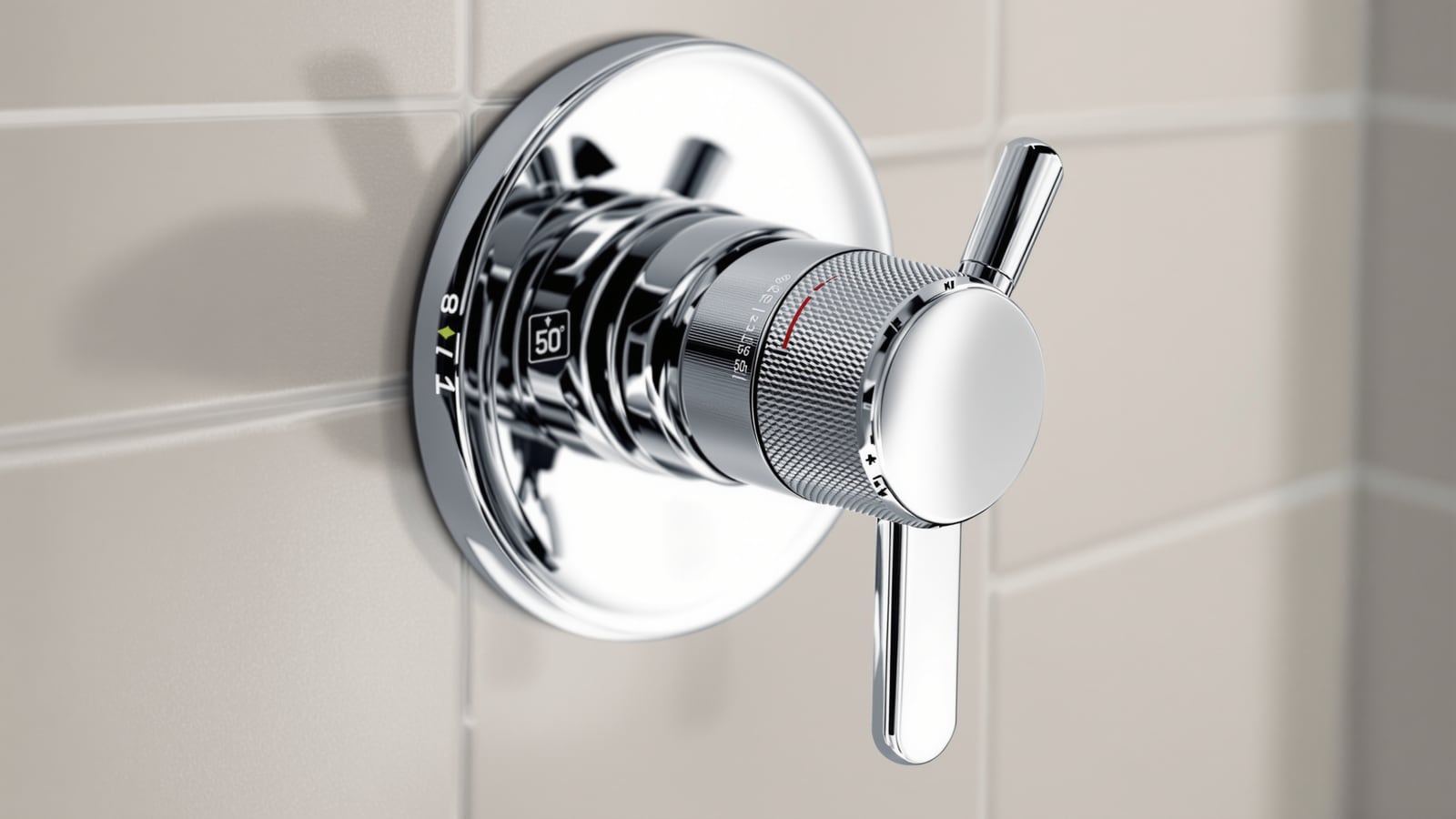
Thermostatic Mixer India: Anti-Scald Showers, Set-Temperature Valves & What They Really Cost (2026)
How a thermostatic mixer holds one safe temperature no matter what happens to the pressure — the wax cartridge explained, why it needs balanced hot and cold supply, geyser vs instant-heater realities, exposed vs concealed, rupee ranges, and exactly who should pay the premium.
Turn on the kitchen tap while someone is in the shower and, on an ordinary mixer, the shower runs suddenly scalding as the cold supply is robbed. Flush a WC and it swings icy. In an Indian home fed by an overhead tank, a small pump and a geyser, this pressure tug-of-war happens several times an hour — annoying for an adult, genuinely dangerous for a toddler or an 80-year-old whose skin burns faster and who cannot jump clear in time. A thermostatic mixer is the valve that ends it: you set a temperature, and it holds that temperature to within a degree or two no matter what the pressure does behind the wall.
This guide is India-first — the plumbing you actually have, rupee ranges you will actually be quoted, and the water-heater realities (geyser vs instant heater, hard water, low-pressure tanks) that decide whether a thermostatic mixer will work brilliantly or disappoint. Read it up to the bathroom faucets guide for India for the wider tap and mixer picture, and alongside the bathroom design guide for India, which covers thermostatic showers as part of the overall scheme.
A thermostatic mixer is a safety device first and a comfort device second. If children, elderly parents or anyone with reduced sensation use the bathroom, treat scald protection as non-negotiable — not a luxury upgrade.
What a thermostatic mixer actually does
An ordinary mixer blends hot and cold in a fixed ratio set by the handle position. It has no idea what temperature is coming out — if the cold pressure drops, the blend runs hot; if the hot runs out, it runs cold. A thermostatic mixer instead controls the outlet temperature directly. You dial, say, 40 degrees; a sensor inside continuously measures the blended water and adjusts the hot:cold mix many times a second to keep it there. If the cold supply fails completely, a good thermostatic valve does the critical safety act: it shuts the flow off within a second or two rather than delivering a scalding jet.
Two numbers define a quality unit:
- A safe maximum / anti-scald limit. Most thermostatic mixers ship with a preset safety stop around 38 degrees C and a button you must deliberately press to override it and go hotter. That stop is the anti-scald feature.
- A fast fail-safe cut-off. On loss of cold supply the outlet temperature must not overshoot dangerously; the valve throttles or closes. This is what protects a child who cannot react.
The relevant Indian and international benchmark is the TMV (thermostatic mixing valve) concept — the same technology used in hospitals and care homes, scaled down for a domestic shower or basin.
How the thermostatic cartridge works
The heart of the mixer is a compact cartridge containing a temperature-sensitive element — traditionally a sealed capsule of specially formulated wax, sometimes a bimetallic strip in cheaper units. Wax expands and contracts sharply with temperature, and that tiny movement is used to slide a shuttle valve between the hot and cold ports.
- Blended water flows continuously over the wax element.
- If the mix drifts too hot, the wax expands, pushes the shuttle to open the cold port wider and close the hot port.
- If the mix drifts too cold, the wax contracts, a return spring slides the shuttle the other way, opening hot and closing cold.
- The whole loop self-corrects in well under a second, which is why the outlet stays steady while the pressure behind it is swinging.
Crucially, temperature is decoupled from flow: a separate control (a second handle, or a concentric ring) sets how much water comes out, while the thermostatic dial sets how hot. That is why you can turn a thermostatic shower down to a trickle without it going cold, and back up to full without it scalding.
The catch: it needs balanced hot and cold pressure
Here is the single most important thing to understand before you buy in India. A thermostatic mixer can only mix what it is fed. It needs hot and cold supply at broadly balanced pressures — as a rule of thumb within about a 10:1 ratio, ideally much closer — and enough of both to work with. Feed it a strong cold main and a feeble gravity-fed hot from a low tank, and it will spend its time nearly shut on the cold side, giving weak, fussy flow. This is where many Indian installations disappoint, and it is a plumbing problem, not a valve fault.
- Both feeds from the same source. Ideally hot and cold both come from the overhead tank (gravity) or both from a pressurised system, so their pressures rise and fall together.
- Adequate head or a pump. Gravity from a terrace tank one floor up gives roughly 0.3 bar — low. A pressure-boosting pump (or a common pump feeding both lines) makes thermostatic mixers behave far better.
- Never one line mains-pressure and the other gravity. A borewell/municipal cold at high pressure against a tank-fed hot is the classic mismatch that starves the mix.
| Supply situation (India) | Thermostatic mixer verdict |
|---|---|
| Both hot & cold from overhead tank, pump-boosted | Ideal — works as intended |
| Both from overhead tank, gravity only (low head) | Works, but flow can be weak; raise the tank or add a pump |
| Hot from tank, cold from high-pressure mains | Poor — unbalanced, mix runs weak/erratic |
| Very low, unequal pressures | Not recommended; fix plumbing first |
Geyser vs instant heater — the India decision
Your water heater changes everything, because a thermostatic mixer needs a steady supply of already-hot water to draw on.
- Storage geyser (10–25 L). The best partner. It holds a tank of hot water at a stable temperature, so the mixer has a reliable hot reservoir to blend from. Set the geyser thermostat to around 55–60 degrees and let the mixer bring it down to a safe 38–40 at the outlet — this also curbs bacterial growth in the tank while the mixer guarantees no one is scalded.
- Instant / instantaneous heater (3–6 kW). Trickier. These heat on demand, and their outlet temperature itself swings with flow rate — turn the mixer down and the instant heater may get hotter or cut out. A thermostatic mixer can fight this, but flow must stay above the heater's minimum activation rate. Pair only with instant heaters that hold temperature reasonably; many budget units will make a thermostatic mixer hunt.
- Solar / heat-pump with storage. Behaves like a storage geyser — good, provided a mixing valve tames the very hot solar water, which can exceed 70 degrees on a sunny day and is a scald risk on its own.
Whatever the source, oversize the geyser slightly and keep hot and cold runs short; long uninsulated pipes waste the stable temperature the mixer depends on.
Exposed vs concealed — and where each type goes
Thermostatic mixers come in the same body styles as ordinary ones.
- Exposed (wall-mounted, pipes visible). Bar valve or two-handle unit sitting on the finished wall. Easier to service — the cartridge is reachable without breaking tiles — and cheaper to fit. Best for renovations and rented flats.
- Concealed (built into the wall). Only the plate, dial and diverter show; the valve body is buried behind the tiles. Cleaner look, essential for a minimal or luxury scheme, but the wall must be chased and waterproofed before tiling, and future cartridge service means access through the plate. Plan it at the waterproofing and first-fix stage, never after.
- Thermostatic diverter. A concealed unit with a built-in diverter to switch between overhead rain shower, hand shower and body jets — all held at the same set temperature.
- Thermostatic basin mixer. Less common at home but valuable at a children's or elderly basin, capping the tap so a child cannot run scalding water over their hands.
| Feature | Exposed thermostatic | Concealed thermostatic |
|---|---|---|
| Look | Utilitarian, pipes visible | Flush, minimal, premium |
| Servicing cartridge | Easy — no tile removal | Through the plate; harder |
| Install stage | Any time, incl. retrofit | Must be first-fix, pre-tiling |
| Waterproofing risk | Low | Needs careful sealing of the recess |
| Typical cost | Lower | Higher (body + fitting labour) |
| Best for | Renovations, rentals, easy access | New builds, luxury, clean walls |
What it costs — and the hard-water tax
Thermostatic mixers carry a real premium over ordinary ones, and India's hard water adds a maintenance cost you must plan for: scale coats the wax element and shuttle, and a limed-up cartridge either sticks hot (dangerous) or hunts and dribbles. Budget to descale or swap the cartridge periodically, and fit inlet filters or a softener where water is very hard.
| Item | Typical India range (2026) | Note |
|---|---|---|
| Ordinary single-lever shower mixer | ₹2,500–₹8,000 | Baseline, no scald protection |
| Exposed thermostatic shower mixer | ₹9,000–₹25,000 | Easiest to service |
| Concealed thermostatic diverter (body + trim) | ₹18,000–₹60,000+ | Premium look, first-fix install |
| Thermostatic basin mixer | ₹12,000–₹30,000 | Caps a child/elderly basin tap |
| Replacement thermostatic cartridge | ₹2,000–₹8,000 | Hard-water wear part |
| Boosting pump (if pressure unbalanced) | ₹6,000–₹20,000 | Often the real enabler |
Is it worth it — and for whom?
- Homes with young children or elderly parents: yes, clearly. Scald burns are a leading bathroom injury for both groups, and the preset limit plus cold-failure cut-off are exactly the protections they need. See the children's bathroom design guide and the elderly friendly bathroom guide.
- Anyone plagued by temperature swings from a shared supply, small pump or busy household: the comfort alone often justifies it.
- Multi-outlet luxury showers (rain head plus jets plus hand shower): a thermostatic diverter keeps every outlet at one steady temperature — a near-requirement, covered in the bathroom design guide for India.
- A single adult, tight budget, and stable pressure: a good pressure-balanced mixer (which evens out pressure swings but does not hold an absolute temperature) is a reasonable, cheaper middle path.
The honest rule: buy thermostatic for safety wherever a vulnerable person bathes, and for comfort wherever your pressure misbehaves — but fix the plumbing balance first, or the cleverest valve will only trickle.
References
- National Building Code of India (NBC 2016) — Part 9 (Plumbing Services) and safety provisions relevant to hot-water supply and scald protection.
- IS 1701 — Mixing valves (fittings for water services): specification relevant to bathroom mixers.
- IS 2556 / IS 774–781 family — sanitary appliances and fittings referenced for bathroom hardware quality.
- CPHEEO Manual on Water Supply & Treatment — guidance on domestic hot- and cold-water supply pressures and pipe sizing.
- BIS / IS standards for water heaters (IS 302-2-35 for instantaneous / storage electric water heaters) — safe hot-water source temperatures behind a mixing valve.
- WHO / national scald-safety guidance — hot-water outlet temperatures around 38–43 degrees C for domestic bathing to limit scald risk.
Export this guide
Related Guides — Deep-dive reading
Thermostatic Shower India: Set-Temperature Valves, Anti-Scald Safety & What They Cost (2026)
How a thermostatic shower holds your temperature when someone opens a tap, the balanced hot-and-cold pressure it needs, geyser vs instant-heater compatibility in India, exposed vs concealed valves, pairing with rain, hand and body jets, and the real rupee premium.
BathroomsBody Jets Shower India: Body Spray Massage Systems, the Flow & Pressure They Really Need, and What It Costs (2026)
Wall-mounted horizontal body jets turn a shower into a spa massage — but every jet is a thirsty extra outlet. How many jets, at what heights, the big pump and geyser they force, the pipe sizing and concealed valves you must plan before tiling, the water and running cost, and exactly who it is worth it for.
BathroomsWater Pressure Booster Pump India: Fix Weak Shower Flow Before You Buy a Rain Head (2026)
Gravity from an overhead tank cannot run a rain shower or body jets — especially on the top floor. This is the honest India-first guide to pressure booster pumps: pressure-switch vs flow-switch, single-fixture vs whole-house sizing by head and LPM, dry-run protection, noise, mounting, electricals and real rupee ranges.
BathroomsRelated Tools — Try Free
Rainwater Tank Sizer
How big should your rainwater tank be? Computes annual harvest, recommended tank capacity in litres, water-bill savings, and payback — for 10 Indian cities.
RWH CalculatorBathroom Renovation Cost Calculator
Cost to renovate an existing bathroom with a replace-vs-keep model — demolition, re-waterproofing, tiles, fittings and the money saved by keeping items.
Bathroom CalculatorShower Water Flow Calculator
Shower water use per shower, day and month by head type, plus a pressure-adequacy check for your tank height or pump and low-flow savings.
Bathroom Calculator