
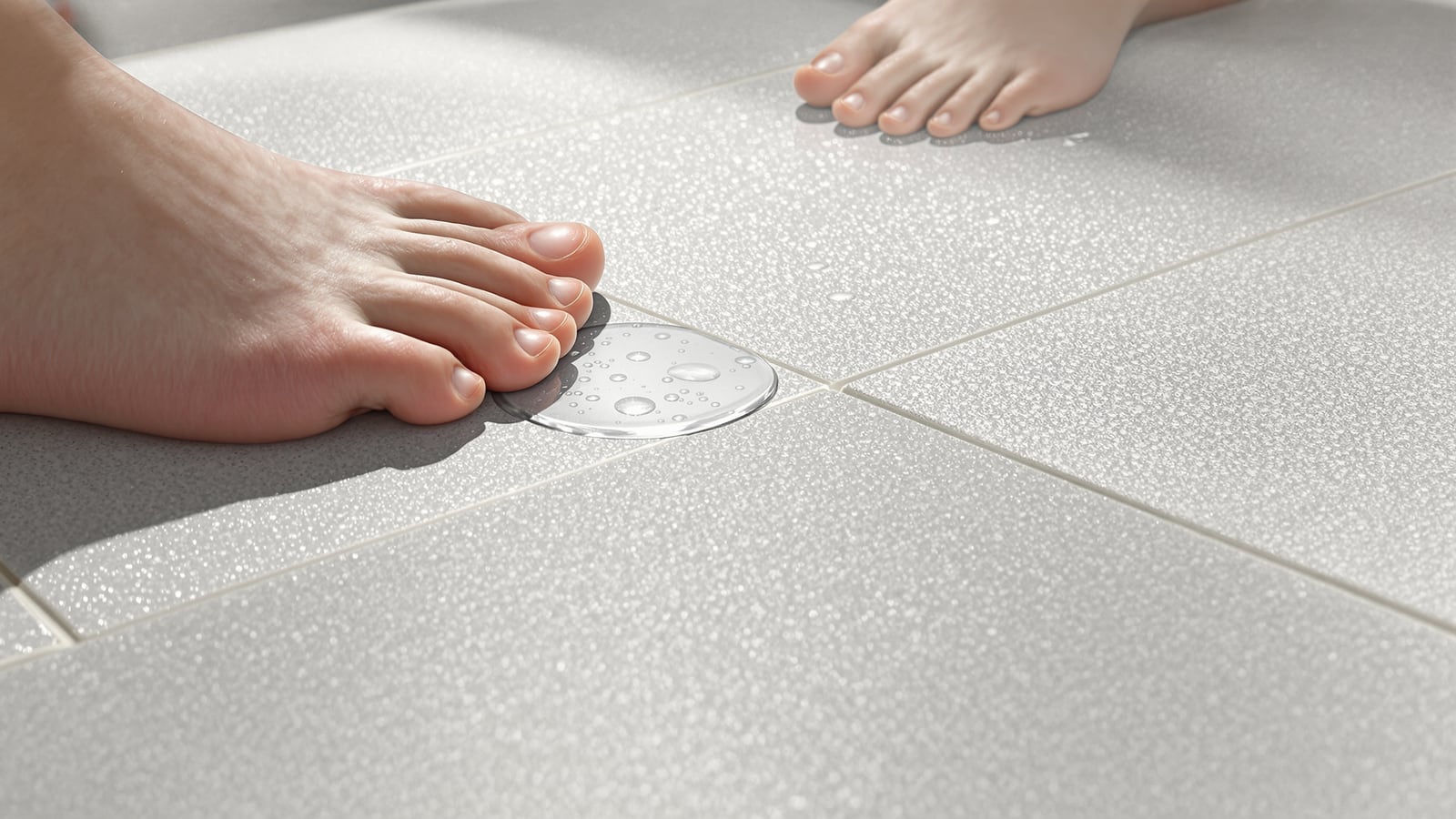
Anti Skid Bathroom Tiles India: R-Rating, DCOF & Where to Use Them (2026)
How slip resistance is really measured — the R9–R13 ramp scale, DCOF ≥ 0.42, and the wet barefoot A/B/C test — plus matte vs glossy, textured surfaces, grout and maintenance, rupee ranges and the Indian standards that back it all.
A wet bathroom floor is the most predictable hazard in an Indian home. Add the health-faucet spray beside every WC, hard-water film, a splash of shampoo and a monsoon that keeps humidity high for months, and an ordinary glossy tile turns into a skating rink. Anti-skid tiles are the fix — but "anti-skid" is a marketing word stamped on boxes with wildly different real-world grip. The number that matters is the slip-resistance rating, and once you can read those ratings you stop buying by the picture on the sample and start buying by evidence.
This guide is India-first: rupee ranges, the sizes and finishes you actually get in local showrooms, and the standards — IS 15622 for ceramic/vitrified tiles and IS 13630 for the test methods — that sit behind the international R and DCOF numbers. Read it alongside the bathroom flooring guide for India for the wider material choice, and use it hand-in-hand with the safety-focused elderly friendly bathroom guide and the accessible bathroom design guide, because slip resistance is where flooring and safety meet.
Slip resistance is not a feature you can see — it is a number you must ask for. If the shopkeeper cannot tell you the R-rating or DCOF of a floor tile, treat it as glossy until proven otherwise.
How slip resistance is actually rated
There is no single global grip number; there are three test systems, and Indian showrooms quote whichever the manufacturer printed. You need to recognise all three.
- R9–R13 (the shod ramp test, DIN 51130). A tester walks up an oil-coated ramp wearing standard boots; the angle at which they slip sets the class. R9 is the lowest useful grip, R13 the highest. This is the number you will see most often on Indian porcelain boxes.
- DCOF ≥ 0.42 (dynamic coefficient of friction, ANSI A137.1 / BOT-3000). A wetted sensor sled is dragged across the tile. 0.42 is the accepted threshold for level interior floors expected to get wet. Higher is grippier; below 0.42 a wet floor is considered unsafe.
- A/B/C (the wet barefoot ramp test, DIN 51097). The same ramp idea but the tester is barefoot on a soapy surface — exactly the bathroom condition. Class A ≈ 12°, B ≈ 18°, C ≈ 24°. This is the most relevant test for a shower or wet zone, and the one least often quoted, so ask for it.
| Test / rating | What it simulates | Use this for | Bathroom target |
|---|---|---|---|
| R9 | Shod, oiled ramp | Dry areas, low risk | Vanity / dry zone only |
| R10 | Shod ramp | General wet-prone floor | Minimum for a wet bathroom floor |
| R11 | Shod ramp | Frequently wet, sloped | Shower / heavy splash zone |
| R12–R13 | Shod ramp | Industrial, very wet | Overkill at home, hard to clean |
| DCOF ≥ 0.42 | Wet dynamic drag | Level interior wet floors | The pass/fail line — insist on it |
| Barefoot A / B / C | Soapy barefoot ramp | Showers, pool decks | B minimum, C for shower base |
A practical shorthand for an Indian home: the general bathroom floor should be R10 and DCOF ≥ 0.42; the shower or health-faucet wet zone should be R11 / barefoot class B–C. Walls do not need slip ratings at all, so you can use grippy floor tiles below and glossy, easy-clean wall tiles above.
Matte, textured and structured — how tiles get their grip
Grip comes from surface texture, not colour. There are three broad routes, and they trade grip against cleanability.
- Matte / unpolished porcelain. A micro-rough fired surface. Comfortable underfoot, hides water spots, typically R9–R10. The default "safe-ish" floor tile, but not all matte tiles clear DCOF 0.42 — check the number.
- Textured / structured surface. A moulded relief — fine grit, sandstone or slate imitation, or a lapatto (semi-polished) finish with textured lows. Reaches R11 and barefoot B–C. This is the right choice for a shower and health-faucet zone.
- Grit / carborundum insert. Aggressive anti-slip strips or full tiles for ramps and thresholds, R12–R13. Very grippy, harder to clean; reserve for a threshold or a genuinely steep wet ramp.
The trade-off is real: the grippier the texture, the more it traps soap scum, hard-water salts and dirt, and the more scrubbing it needs. Glossy tiles are the easiest to clean and the most dangerous when wet — perfectly fine on walls, wrong on a wet floor. This is why the standard Indian detail is glossy walls over matte-to-textured floors, with the texture stepping up inside the shower.
| Finish | Typical rating | Grip when wet | Cleanability | Best use |
|---|---|---|---|---|
| Glossy / polished | R9, DCOF < 0.42 | Poor | Excellent | Walls only |
| Matte / unpolished | R9–R10 | Fair–good | Good | Dry & general floor |
| Textured / structured | R10–R11, barefoot B | Good | Moderate | Wet zone floor |
| Lapatto (semi-polished) | R10 | Good | Good | Whole-floor compromise |
| Grit / carborundum | R12–R13, barefoot C | Very high | Poor | Threshold, steep ramp |
Where anti-skid is essential — zone by zone
Do not pay for R11 grit across the whole flat. Match the rating to the risk.
- Shower and wet zone: the highest-risk patch — soapy, barefoot, standing on one leg. Use R11 / barefoot B–C, and keep tiles small (100–150 mm) so grout lines add grip and the floor can fall to the drain.
- Health-faucet splash beside the WC: wet several times a day. R10–R11 here too.
- General bathroom floor: R10 / DCOF ≥ 0.42 as the baseline.
- Dry vanity zone: R9–R10 is fine if it stays genuinely dry — see the dry bathroom design guide for keeping it that way.
- Elderly or accessible bathrooms: treat the whole floor as a wet zone — R11 / barefoot B minimum everywhere, level access, no glossy patches. Falls in the bathroom are the leading home-injury for seniors, so grip is non-negotiable.
Natural stone behaves differently again — a flamed or leathered finish grips, a polished one is lethal wet; the bathroom stone flooring guide covers honing, sealing and slip for granite, marble and Kota.
Grout, laying and maintenance
The tile is only half the floor. Grout lines are anti-skid infrastructure — narrow joints between small tiles break the water film and give bare feet purchase, which is why 100–150 mm mosaics beat one big 600 mm tile in a shower. Use a good cementitious or, in the constantly-wet shower base, an epoxy grout (IS-conformant, stain- and mould-resistant) so hard water and shampoo do not eat the joints. Lay the floor to fall — 1:50 to 1:80 toward the drain — so water leaves fast; standing water defeats any rating. Bed tiles fully on the adhesive with no hollows, or they crack and lift.
Maintenance keeps grip alive. Anti-skid texture that fills with soap scum and hard-water scale behaves like glass. Clean with a mild acidic or pH-neutral bathroom cleaner and a stiff brush; never wax or polish an anti-skid floor — a "shine" product coats the texture flat and destroys the rating you paid for. Fix leaks and seepage early, because damp promotes slippery biofilm; the bathroom waterproofing guide covers keeping the substrate dry beneath.
| Item | Typical India range (2026) | Note |
|---|---|---|
| Matte anti-skid ceramic floor tile | ₹40–₹80 / sq ft | R9–R10, budget wet-area floor |
| Textured anti-skid porcelain (R11) | ₹90–₹200 / sq ft | Shower & wet-zone grade |
| Anti-skid mosaic (100–150 mm, grippy) | ₹120–₹350 / sq ft | Best barefoot grip in showers |
| Epoxy grout | ₹120–₹300 / kg | For constantly-wet joints |
| Laying labour (tile + grout) | ₹35–₹90 / sq ft | Level/fall and full bedding matter most |
Buying checklist
- Ask for the R-rating and DCOF in writing — no number means treat it as glossy.
- Floor R10 / DCOF ≥ 0.42 minimum; shower R11 / barefoot B–C.
- Small tiles and more grout lines inside the shower; fall to the drain.
- Glossy on walls, grippy on floors — never the reverse.
- For seniors or accessible baths, grip the whole floor, not just the shower.
- Test a sample yourself: wet it, add a drop of soap, and press a bare foot.
References
- IS 15622 — Pressed ceramic tiles: specification (classification, water absorption, characteristics).
- IS 13630 — Ceramic tiles: methods of test (including surface abrasion and friction-related methods).
- IS 15622 / ISO 13006 family — vitrified and porcelain tile classification referenced by Indian manufacturers.
- ANSI A137.1 / A326.3 (BOT-3000) — DCOF AcuTest, source of the ≥ 0.42 wet-floor threshold.
- DIN 51130 (shod R9–R13 ramp) and DIN 51097 (wet barefoot A/B/C ramp) — the ramp classifications quoted on tile datasheets.
- National Building Code of India (NBC 2016) — Part 3 and accessibility provisions relevant to safe, slip-resistant floor finishes.
Export this guide
Related Guides — Deep-dive reading
Anti Slip Flooring for Bathroom and Wet Areas in India: R-Ratings, Finishes and Genuinely Safe Tile Choices
How to choose genuinely safe flooring for bathrooms, kitchens, balconies, pools, entrances and elderly- or child-friendly homes — the R-rating system, finishes that grip wet feet, anti-skid natural stone, slope to drains and the tiles to avoid.
Flooring & SurfacesBathroom Flooring Guide India: Anti-Skid Tiles, Stone, Vinyl & Epoxy Compared
Every bathroom floor material for Indian homes in one place — anti-skid ceramic and vitrified tiles, natural stone, mosaic, vinyl (SPC/LVT) and epoxy — with a full comparison table, slip ratings, ₹/sq ft costs and the safety and slope rules that keep a wet floor from becoming a hazard.
BathroomsBathroom Stone Flooring India: Granite, Marble, Kota, Slate & Sandstone
A practical, India-first guide to natural stone bathroom floors — which stones survive constant water and hard-water scale, how honing and flaming beat slip, the sealing regime porous stone demands, and real ₹/sq ft costs and maintenance.
BathroomsRelated Tools — Try Free
Monsoon-Readiness Checklist
Pre-rain home audit across 9 categories — terrace, drains, waterproofing, electrical, HVAC, pest, vehicles, documents.
Seasonal AuditFlooring Cost Calculator
Estimate the all-in cost of a floor — material, laying, wastage, skirting and GST — by area and material.
Flooring CalculatorChild & Elder Home-Safety Audit
Room-by-room safety audit for households with children or seniors — 10 categories, 70+ checkpoints tagged by audience.
Safety Audit