
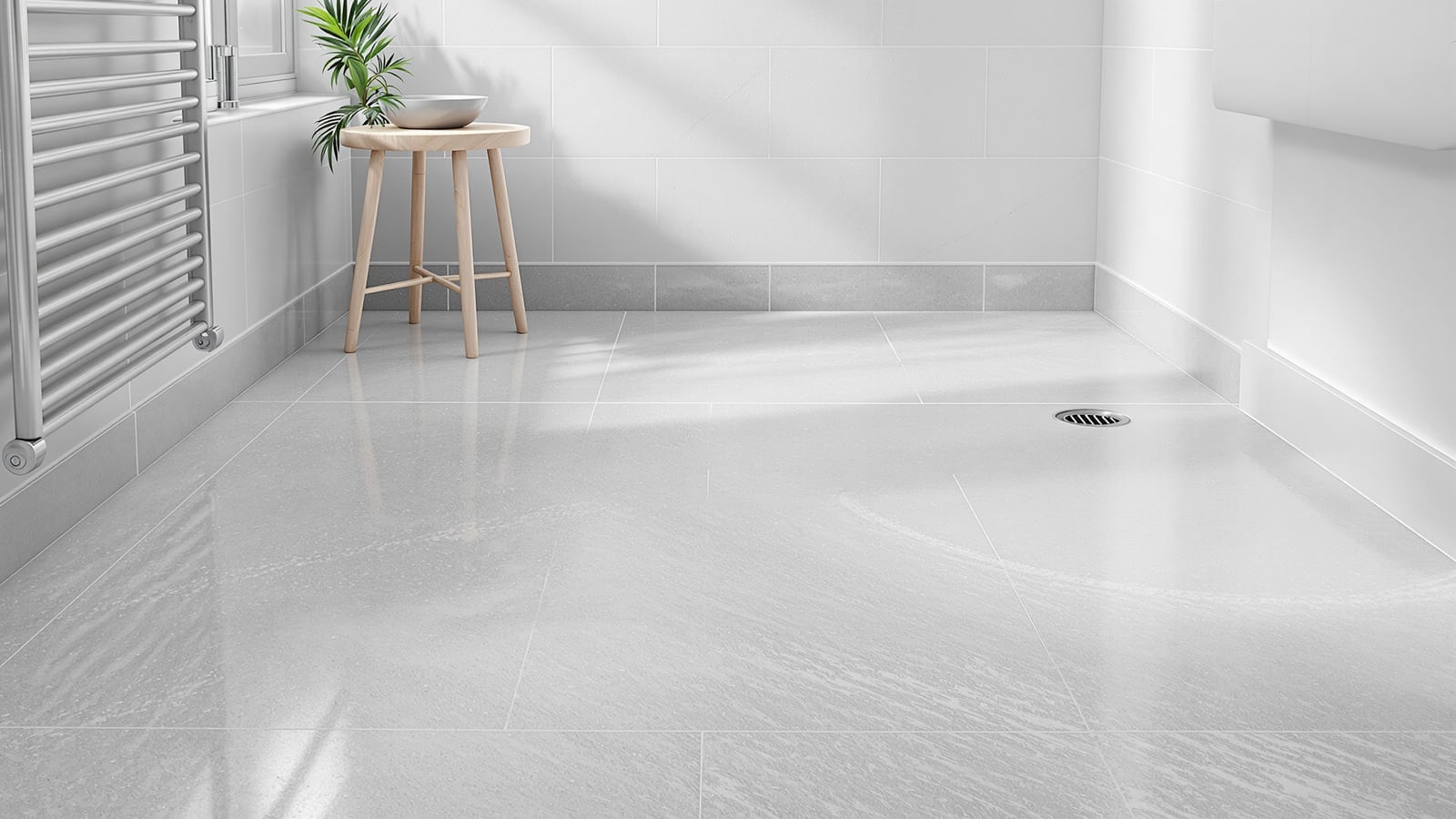
Epoxy Bathroom Flooring India: Seamless Resin Floors, Cost & Slip (2026)
How seamless epoxy and resin bathroom floors work in Indian homes — no grout lines means fully waterproof and hygienic, plus anti-slip additives, colours, curing, the wet-floor slip risk, an IPS comparison, and honest rupee costs per sq ft.
Every tiled bathroom floor in India has a weak spot you cannot see: the grout. Thousands of running feet of cement grout, each line a hairline path for water to creep under the tile, dampen the bed and eventually reach the slab. A seamless epoxy or resin floor removes those lines entirely. It is a liquid poured over the screed that cures into one continuous, jointless sheet — no grout to scrub, no edges for water to find. That single idea, monolithic and non-porous, is why resin floors have moved from factories and hospitals into upmarket Indian bathrooms.
This guide is India-first. It assumes hard water that leaves scale, a health faucet that keeps the floor genuinely wet, monsoon humidity that never lets a surface dry, and an apartment slab shared with a neighbour below. For the wider choice of surfaces read the bathroom flooring guide for India; this page is only about seamless resin. It pairs naturally with a wet room, and if you want warmth and softness underfoot instead, compare vinyl bathroom flooring.
A seamless floor is only as waterproof as the coving at its edges. The magic is not the epoxy in the middle — it is the continuous cove that carries the same membrane 100 mm up the wall.
What "seamless" actually buys you
A resin floor is built up wet, in coats, directly onto a sound cementitious base. Because it is poured and self-levels, it has no joints anywhere on the floor and — done properly — turns up the wall as a coved skirting, so the floor and the lower wall are one unbroken waterproof tray.
- No grout lines means no capillary paths. Water sits on the surface and runs to the drain; it has nowhere to soak in. This is the single biggest hygiene and leak advantage over tiles.
- Non-porous and easy to clean. No grout to blacken with mould, no rough joints to trap soap scum. A squeegee and a mild cleaner keep it clean; hard-water scale wipes off rather than etching into cement grout.
- Thin and light. A floor system is typically 2–4 mm thick, so it adds almost no dead load and only a few millimetres of level — useful in renovations where you cannot afford to raise the floor.
- Seamless coving. The same resin coves up 75–150 mm at every wall and around the drain, giving a tanked tray without a single joint at the most leak-prone line in any bathroom — the floor-to-wall junction.
Epoxy vs polyurethane vs IPS
"Epoxy" is the common shorthand, but the resin family has two main players, and they compete with the old Indian workhorse, IPS (Indian Patent Stone — a monolithic in-situ cement floor).
| Floor | Nature | Feel & finish | Best where |
|---|---|---|---|
| Epoxy resin | Rigid, hard, chemical-resistant | Glossy or matt, very hard | Dry-biased bathrooms, powder rooms, vanity zones |
| Polyurethane (PU) | Slightly flexible, UV-stable | Warmer, matt, forgiving | Wet zones, sunlit floors, over floors that move a little |
| IPS / cement | Cementitious, porous | Rustic, needs sealing | Budget floors, terraces, service areas |
Epoxy is the harder, cheaper, more chemical-proof option but it can yellow in strong sunlight and, being rigid, dislikes a substrate that flexes or cracks. Polyurethane resin costs more but stays colour-stable, tolerates slight movement and generally gives a warmer, less plasticky look — which is why many designers specify a PU or epoxy-PU hybrid topcoat over an epoxy base in bathrooms. IPS is genuinely seamless and cheap, but it is porous cement: it must be sealed, it stains, and it is not waterproof on its own.
The one real weakness: slip when wet
A poured resin floor cured to a gloss is close to a skating rink under a health-faucet spray. This is the single most important thing to get right in an Indian bathroom, where the floor is wet by design, not by accident. Never accept a plain glossy epoxy in a wet zone.
The fix is an anti-slip additive broadcast into the topcoat while it is still wet:
- Fine silica or aluminium-oxide aggregate is scattered onto the wet coat and sealed under a final layer, giving a fine grip texture — the resin equivalent of an anti-slip tile.
- Matt or textured finishes already scatter light and grip better than gloss; specify matt as standard for bathrooms.
- Aim for a wet slip rating in the R11 category (the DIN 51130 ramp scale) or a pendulum test wet value comfortably above 36 for wet, barefoot areas — the same target NBC 2016 and good practice set for any bathroom floor.
- The texture that gives grip also holds a little dirt, so there is a genuine trade-off: the grippier the floor, the more you scrub. Reserve the coarsest grip for the wet zone and keep the dry vanity area smoother.
Colours and finish
Resin floors are pigmented in the pot, so colour is uniform through the top layer — not a printed film that can wear through. You get a wide flat-colour range (greys, off-whites, sand, charcoal, deep colours), plus:
- Flake / chip systems — coloured vinyl flakes broadcast into the coat for a speckled, terrazzo-like, dirt-forgiving look.
- Metallic / marble-effect epoxy — pigments swirled while wet for a poured-stone appearance popular in luxury bathrooms.
- Matt vs satin vs gloss topcoats — matt reads as concrete or micro-cement and hides water spotting best in hard-water areas.
Over concrete: how it goes down
A resin floor lives or dies by the base. It is a coating, not a slab — it faithfully copies every flaw beneath it.
- Sound, dry substrate. The screed must be structurally sound, fully cured (typically 21–28 days for fresh concrete) and dry — moisture below drives blistering and delamination. A damp-proof epoxy primer is used where residual moisture is a risk.
- Prepare mechanically. Grind or shot-blast to open the surface, fill cracks, and prime. Skipping prep is the usual reason a floor peels.
- Fall to the drain. The screed below must already carry the 1:80 to 1:100 fall; resin is thin and will not create a slope. Coordinate this with your wet room drainage.
- Then build the coats — primer, self-levelling body coat, anti-slip broadcast, sealer topcoat.
Curing and downtime
Resin cures by chemical reaction, and the timeline matters in a busy Indian home with one or two bathrooms.
- Between coats: roughly 12–24 hours each, so a full system takes 3–5 days on site.
- Light foot traffic: about 24 hours after the final coat; normal use: 48–72 hours.
- Full chemical cure (before heavy wetting and cleaning chemicals): about 7 days at 25–30°C. Monsoon humidity and cold slow this down — a good applicator checks dew point and substrate moisture before pouring.
Cost in India
Seamless resin is a specialist, labour-and-material job priced by system and area, not a DIY coat of paint. Indicative 2026 supply-and-apply rates:
| System | Typical rate (₹/sq ft) | Notes |
|---|---|---|
| Basic epoxy coating (2 coats) | ₹90–180 | Thin, dry areas, budget |
| Self-levelling epoxy floor | ₹200–350 | The usual bathroom-quality floor |
| Anti-slip broadcast wet zone | ₹250–450 | With aggregate + sealer |
| PU / metallic / decorative | ₹350–700+ | Colour-stable, designer finishes |
| Substrate prep / repair | ₹40–120 add | Grinding, crack fill, DPM primer |
A small 30 sq ft bathroom floor in a good self-levelling anti-slip system therefore lands roughly ₹9,000–15,000 including prep — competitive with a mid-range anti-slip tile once you count grouting labour, and often cheaper over the life of the floor because there is no grout to re-do.
Pros, cons and who it suits
| Pros | Cons |
|---|---|
| Truly seamless — no grout, no capillary leaks | Glossy versions dangerously slippery when wet |
| Non-porous, very hygienic, easy to clean | Needs skilled applicator; DIY usually fails |
| Thin and light — good for renovations | Epoxy can yellow in direct sun |
| Continuous coving tanks the worst leak line | Copies substrate flaws; base must be sound and dry |
| Wide colour and effect range | Repairs to a damaged patch can show a witness line |
Best for: design-led bathrooms and wet rooms where a monolithic, grout-free, easy-clean floor is worth a specialist installer — and where you insist on an anti-slip broadcast in every wet zone. Think twice if: your budget is tight, your substrate cracks, or you cannot vacate the bathroom for a week to cure.
For the full menu of bathroom floors and how resin sits beside tiles, stone and vinyl, return to the bathroom flooring guide for India; for the warm, soft, quick alternative see vinyl bathroom flooring; and for the drainage and tanking a resin floor depends on, read the wet room design guide.
References
- National Building Code of India (NBC) 2016, Part 9 (Plumbing Services) and Part 3 — bathroom floor falls, drainage and non-slip finishes.
- IS 15622 — Pressed ceramic tiles: the anti-slip and wet-area benchmark resin floors are specified against.
- IS 4457 — Ceramic unglazed vitreous acid-resisting tiles; useful reference for chemical-resistant flooring in wet areas.
- DIN 51130 (R-rating) / BS 7976 pendulum — internationally used wet slip-resistance ramp and pendulum tests referenced by Indian specifiers.
- CPWD Specifications — cementitious / IPS flooring and screed practice for the substrate beneath resin systems.
- IGBC Green Homes / GRIHA — indoor material, low-VOC and hygiene criteria relevant to resin floor selection.
Export this guide
Related Guides — Deep-dive reading
Epoxy Grout vs Cement Grout for Tiles in India: Which to Specify (2026)
A plain-English guide to tile grouts for Indian homes: what grout does, how cementitious grout compares with epoxy grout on cost, stain and water resistance, hygiene and durability, and exactly where each one belongs - kitchens, bathrooms, pools, dry rooms and more.
Building MaterialsBathroom Flooring Guide India: Anti-Skid Tiles, Stone, Vinyl & Epoxy Compared
Every bathroom floor material for Indian homes in one place — anti-skid ceramic and vitrified tiles, natural stone, mosaic, vinyl (SPC/LVT) and epoxy — with a full comparison table, slip ratings, ₹/sq ft costs and the safety and slope rules that keep a wet floor from becoming a hazard.
BathroomsEpoxy Floor Application in India: Substrate Prep, Coats and Curing Step-by-Step
How a resin epoxy floor is actually laid in India — moisture testing and mechanical grinding, crack repair, primer, self-leveling vs broadcast vs coating systems, mixing ratios, pot life, coats and a full 7-day cure.
Flooring & SurfacesRelated Tools — Try Free
Bathroom Floor Slope Calculator
Work out the floor fall to the drain and screed depth from the run and slope ratio — with a drains-properly verdict.
Bathroom CalculatorMonsoon-Readiness Checklist
Pre-rain home audit across 9 categories — terrace, drains, waterproofing, electrical, HVAC, pest, vehicles, documents.
Seasonal AuditBefore vs After — Cost Reality Check
Compare what you expected to pay vs what you actually paid, category by category.
Reality Check