
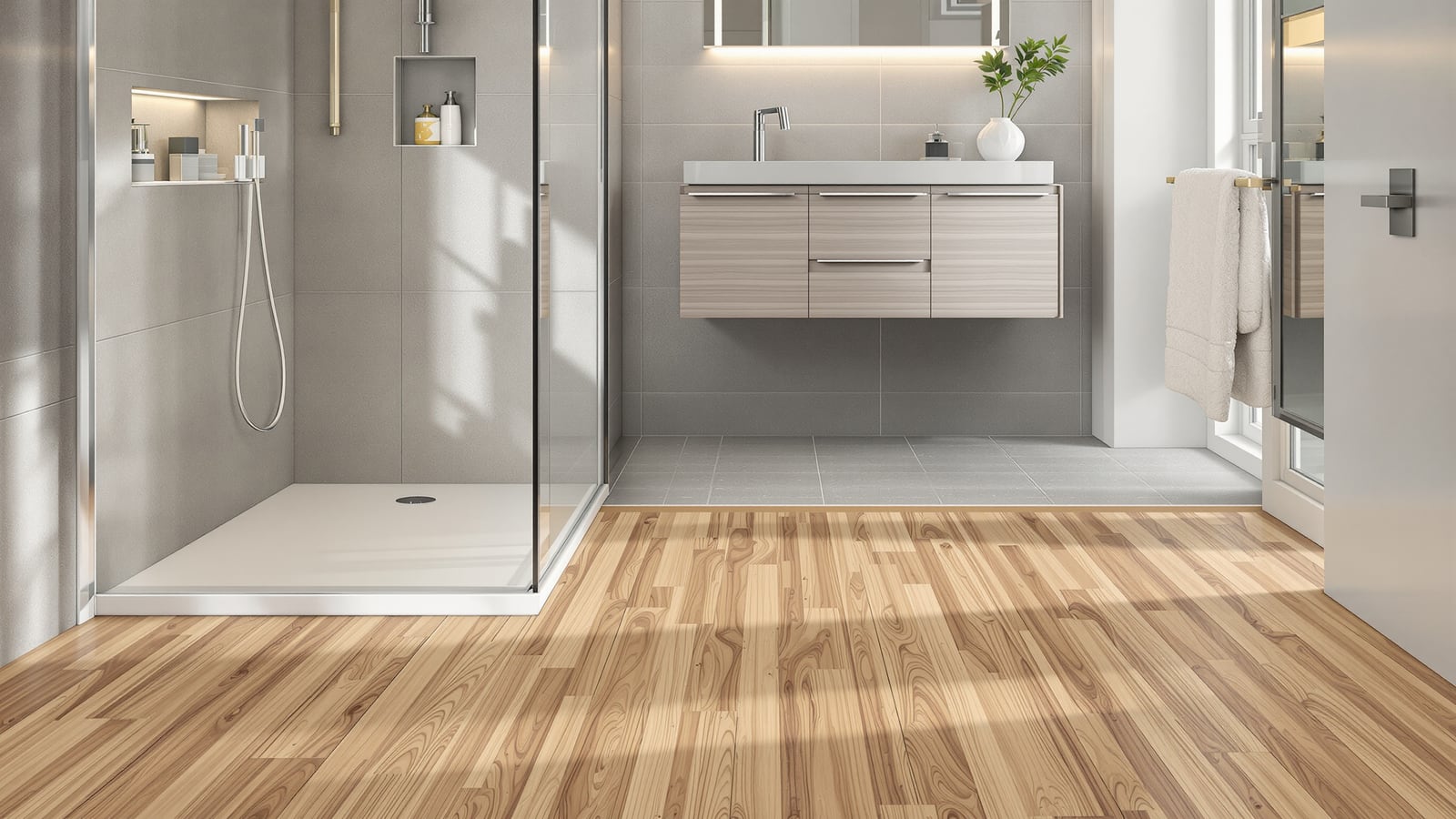
Vinyl Bathroom Flooring India: SPC, WPC & LVT — Waterproof Claims vs Reality
Where rigid-core vinyl (SPC/WPC) and LVT actually belong in an Indian bathroom — the truth about waterproof edges and seams, subfloor moisture, warmth underfoot, cost in rupees, and how to install it as a dry-zone or renovation overlay without a leak.
Walk into most Indian bathrooms barefoot on a January morning and the tiles bite cold. Vinyl flooring promises the opposite — wood warmth underfoot, a soft, quiet step, and a click-together plank you can lay over your old floor in an afternoon. The marketing word plastered on every box is waterproof. That single claim is why homeowners keep asking whether they can throw out tiles and floor the whole bathroom in vinyl.
The honest answer is: sometimes yes, often no, and it depends entirely on which part of the bathroom and which type of vinyl. This is the vinyl-flooring chapter of the Studio Matrx bathroom hub. Read it alongside the complete bathroom flooring guide for India for the full material comparison, the broader flooring guide for how vinyl behaves across the home, and — if you are chasing a seamless, genuinely wet-safe finish — the epoxy bathroom flooring guide.
A vinyl plank is waterproof. A vinyl floor is not. Water does not go through the plank — it goes around it, through the seams and down to a subfloor that has no drainage. That distinction decides where vinyl belongs.
The three types you will be sold
"Vinyl" covers several very different products. Getting the acronyms straight is the first defence against a bad buy.
| Type | Full name | Core | Feel underfoot | Best bathroom use |
|---|---|---|---|---|
| LVT / LVP | Luxury vinyl tile / plank | Flexible PVC, often glue-down | Thin, firm, follows subfloor | Dry zone over a sound screed |
| WPC | Wood-plastic composite | Foamed PVC + wood filler | Warmest, softest, cushioned | Dry zone; forgiving over minor unevenness |
| SPC | Stone-plastic composite | Dense limestone + PVC, rigid | Firm, stable, most dimensionally stable | Dry zone; the pick for Indian heat & humidity |
For Indian conditions — 45°C attic heat, monsoon humidity, and slabs that expand and contract — rigid-core SPC is usually the safest choice. Its stone-composite core barely moves with temperature, so click seams stay tight where a cheaper flexible LVT would gap or lift at the edges. WPC trades a little stability for more warmth and cushion. Thin flexible LVT is the least forgiving in a bathroom and is best glued down fully onto a flawless screed.
The waterproof claim, unpacked
A rigid-core plank genuinely will not absorb water — you can leave a puddle on an SPC board for a week and it will wipe off. So where does the reputation for water damage come from? Three places the plank never protects.
- The seams. Click-lock joints are tight, and premium ranges add a wax or coating on the profile, but they are not a welded, continuous membrane. Standing water and jet-spray from a health faucet find the joint, wick down by capillary action, and reach the subfloor. The plank above stays perfect; the trouble is invisible, underneath.
- The perimeter. Floating floors need a 8–10 mm expansion gap at every wall, hidden by skirting or beading. That gap is an open edge. In a room that gets sprayed daily, water runs straight into it.
- The subfloor. Under the vinyl is your cement screed or slab. Indian bathrooms carry water below the tiles too — from a failed tanking layer, a leaking concealed pipe, or rising damp. Vinyl is vapour-tight, so any moisture trapped underneath cannot dry upward. It pools, breeds mould, and can debond a glue-down floor. This is the same failure mode covered in the bathroom leak-prevention guide.
So vinyl over a properly tanked, dry subfloor, in an area that only gets occasional splashes, performs beautifully. Vinyl in the direct spray path of an Indian shower or health faucet, or over a subfloor that is already damp, is a slow-motion failure.
Where vinyl genuinely suits an Indian bathroom
Match the material to the zone and vinyl earns its place. Push it into the wet zone and it lets you down. The wet-and-dry zone layout guide and the dry bathroom design guide explain how to draw that line.
- The dry zone of a wet-and-dry bathroom. Vanity and WC area, behind a glass partition, out of the spray path — vinyl's ideal home. Warm, quiet, easy on the feet.
- A renovation overlay. SPC click-lock can float straight over old, sound ceramic tiles — no chipping, no debris, no re-tanking — turning a two-week retile into a two-day upgrade. The floor rises only 4–6 mm, so doors usually still clear.
- Powder rooms and guest toilets with a basin and WC but no shower. Minimal water, maximum comfort — a strong vinyl candidate.
- Rental and resale refreshes where you want a modern wood look fast and cheap without demolishing a working floor.
And where it does not belong: the shower enclosure or any full wet room, over a subfloor you suspect is damp, or as a whole-bathroom floor in a traditional single-drain Indian bathroom where the health faucet wets everything.
Warmth, comfort and slip — the real advantages
Where vinyl clearly beats tile is underfoot. The PVC core is a poor conductor, so a vinyl floor sits near room temperature — no cold shock on bare feet, a real comfort in North Indian winters. It is quieter and softer to stand at the basin, and a dropped glass or phone is far likelier to survive. Textured, wood-embossed vinyl also gives useful grip when dry.
The catch: like any smooth resilient floor, vinyl can be slippery when wet, which is exactly why it does not belong in the spray zone. For any surface that will meet water, look for an anti-slip rating of R10 or better and choose a textured, matte finish over a glossy one.
Vinyl vs tiles: an honest side-by-side
| Factor | Rigid vinyl (SPC/WPC/LVT) | Ceramic / vitrified tile |
|---|---|---|
| Truly wet-safe | Dry zone only | Whole bathroom, incl. shower |
| Warmth underfoot | Warm, comfortable | Cold, especially in winter |
| Comfort / noise | Soft, quiet | Hard, echoey |
| Water at seams | Vulnerable — floats over subfloor | Grout sealed onto tanked bed |
| Install speed | Very fast; overlay possible | Slow — screed, set, grout, cure |
| Repair | Swap a plank | Chip out and re-tile |
| Heat resistance (India) | SPC good; cheap LVT can gap | Excellent |
| Lifespan in a bathroom | 8–15 yrs (dry zone) | 20+ yrs |
| Resale perception | Improving | Still the default expectation |
What it costs in India
Prices vary with wear-layer thickness, core density and brand. The wear layer (measured in mil) matters most for durability — aim for 12 mil / 0.3 mm or more for a bathroom.
| Item | Typical range (₹) | Notes |
|---|---|---|
| LVT glue-down | ₹70–150 / sq ft | Needs a flawless screed |
| WPC click plank | ₹120–220 / sq ft | Warm, cushioned |
| SPC rigid click | ₹110–250 / sq ft | Best for Indian heat/humidity |
| Underlay / IXPE pad | ₹15–35 / sq ft | Sometimes pre-attached |
| Installation labour | ₹25–60 / sq ft | Floating floor is DIY-friendly |
| Skirting / beading | ₹40–90 / running ft | Hides the expansion gap |
A typical 35–40 sq ft dry zone in SPC lands around ₹8,000–14,000 all-in — comparable to good vitrified tile, but far quicker and cleaner to fit over an existing floor.
Installing it without a leak
- Prove the subfloor is dry. Tape a 1 m plastic sheet down overnight; condensation underneath means the slab is still giving off moisture — stop and fix the tanking first. See the bathroom waterproofing guide.
- Level it. Rigid vinyl needs flatness within about 3 mm over 2 m; grind high spots and fill hollows so click seams stay closed.
- Acclimatise the planks 48 hours in the bathroom so they reach the room's temperature before locking together — this is what prevents summer gapping.
- Keep the 8–10 mm expansion gap at every wall and around the WC pedestal, and seal the perimeter with a silicone bead before fitting skirting, so splash water cannot enter the edge.
- Silicone every penetration — pipe collars, the WC flange, the door threshold — turning the vinyl's open edges into closed ones.
Vinyl bathroom flooring is not a shortcut around waterproofing — the tanking still has to be right underneath. But used in the dry zone, as a renovation overlay, or in a splash-only powder room, SPC and WPC deliver a warm, quiet, fast and forgiving floor that a cold tile never will. Keep it out of the spray, tank the subfloor, seal the edges, and it will serve for a decade.
References
- National Building Code of India (NBC) 2016, Part 9 (Plumbing Services) and Part 3 — bathroom drainage, dampness and floor finishes.
- IS 15600 — Unbacked flexible PVC flooring: specification and test methods.
- IS 15622 — Pressed ceramic tiles (for the tile comparison and wet-zone finishes).
- IS 3462 — Unbacked flexible PVC flooring, quality requirements.
- BIS — Bureau of Indian Standards, for current product marking and slip/wear-layer references.
- CPWD Specifications — flooring and skirting workmanship norms used in Indian building practice.
Export this guide
Related Guides — Deep-dive reading
Bathroom Flooring Guide India: Anti-Skid Tiles, Stone, Vinyl & Epoxy Compared
Every bathroom floor material for Indian homes in one place — anti-skid ceramic and vitrified tiles, natural stone, mosaic, vinyl (SPC/LVT) and epoxy — with a full comparison table, slip ratings, ₹/sq ft costs and the safety and slope rules that keep a wet floor from becoming a hazard.
BathroomsBathroom Leak Prevention India: Detailing the Junctions That Stop Water Reaching the Flat Below
Bathroom leaks almost never come from a broken pipe — they come from a badly detailed junction. Here is how to get the wall-floor corner, pipe penetrations, floor trap, nahani trap and door threshold right, plus the flood test that catches a leak before you tile.
BathroomsEpoxy Grout vs Cement Grout for Tiles in India: Which to Specify (2026)
A plain-English guide to tile grouts for Indian homes: what grout does, how cementitious grout compares with epoxy grout on cost, stain and water resistance, hygiene and durability, and exactly where each one belongs - kitchens, bathrooms, pools, dry rooms and more.
Building MaterialsRelated Tools — Try Free
Monsoon-Readiness Checklist
Pre-rain home audit across 9 categories — terrace, drains, waterproofing, electrical, HVAC, pest, vehicles, documents.
Seasonal AuditWindow Material Comparison Tool
Compare uPVC, aluminium, wood, steel and composite windows on cost, life, upkeep and insulation.
CompareDoor Material Comparison Tool
Compare 2–4 door materials on cost, durability, maintenance, security and moisture resistance.
Comparison Tool