
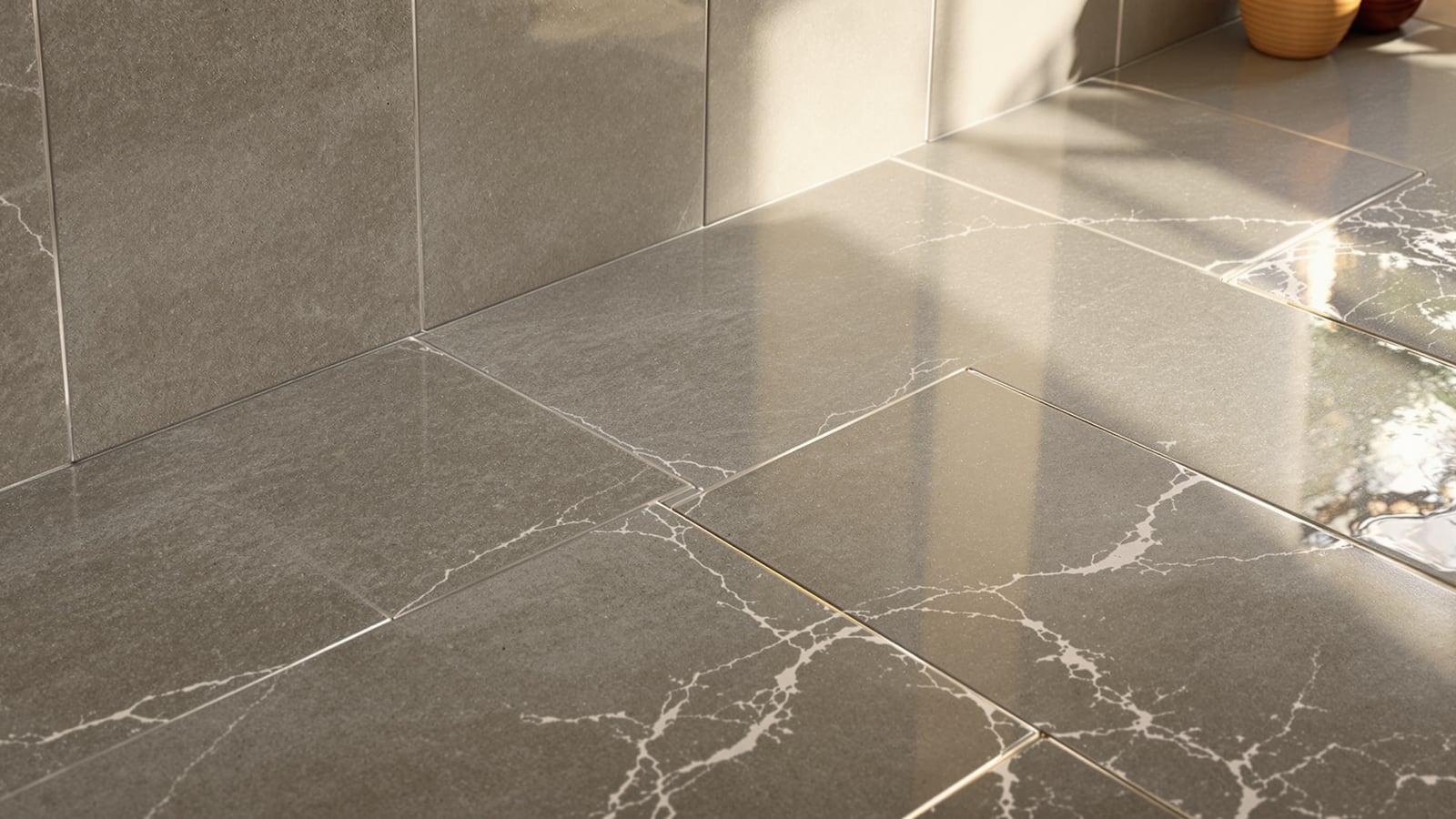
Bathroom Stone Flooring India: Granite, Marble, Kota, Slate & Sandstone
A practical, India-first guide to natural stone bathroom floors — which stones survive constant water and hard-water scale, how honing and flaming beat slip, the sealing regime porous stone demands, and real ₹/sq ft costs and maintenance.
Natural stone gives an Indian bathroom a depth and permanence that no ceramic tile quite matches — a honed kota floor or a flamed granite threshold reads as solid, cool underfoot, and ages into character rather than wearing out. But stone is not tile. It is porous to varying degrees, it reacts to the hard, alkaline water that runs through most Indian taps, and a polished finish that looks stunning in the showroom can turn into a skating rink the moment a health-faucet oversprays it. Getting stone right in a wet room is a specification problem, not a shopping one.
This guide is the material-level companion to our bathroom flooring guide for India. It covers the five stones you will actually be offered — granite, marble, kota, slate and sandstone — and how each behaves against water, slip, staining and Indian hard-water scale. If you want the safety numbers in isolation, read anti-skid bathroom tiles for India; if you are running the same stone up the walls, see bathroom stone cladding in India.
Why stone behaves differently in a bathroom
Three properties decide whether a stone survives a wet area:
- Porosity / water absorption. How much water the stone drinks. Granite absorbs almost nothing (well under 0.5%); marble and slate sit in the low single digits; kota and many sandstones are thirstier. Porous stone that stays wet grows dark patches, mildew and salt bloom.
- Acid sensitivity. Marble, kota and limestone are calcareous — they react with acids. Every acidic cleaner, lime-scale remover, or even a splash of lemon or toilet-bowl acid etches them, leaving a dull ring the sealer cannot prevent because etching is a chemical burn, not a stain.
- Surface friction when wet. A polished floor loses most of its grip under a film of water and soap. The finish — polished, honed, flamed, leathered or riven — matters more than the stone type for slip.
The single most common stone-floor mistake in Indian bathrooms is specifying a polished (mirror) finish for the wet zone. Polished stone is for dry walls and vanities. Wet floors want honed, flamed or naturally riven surfaces — every time.
The five stones, compared
Indian bathrooms are almost always floored with domestically quarried stone — Rajasthan and Andhra granite, Makrana or imported marble, Kota (Rajasthan) limestone, Indian slate from Himachal and Andhra, and Dholpur/Jaisalmer sandstone. Here is how they stack up for a wet floor.
| Stone | Water absorption | Acid / hard-water risk | Best wet-area finish | Slip when wet | Typical ₹/sq ft (material) |
|---|---|---|---|---|---|
| Granite | Very low (<0.5%) | Very low — inert | Flamed or honed/leathered | Good (flamed) | 80–250 |
| Marble | Low–med (0.2–2%) | High — etches, stains | Honed only | Poor–fair | 120–600+ |
| Kota (limestone) | Med (1–5%) | Moderate — etches, needs seal | Honed / natural | Fair–good | 35–90 |
| Slate | Low–med (0.4–3%) | Low | Natural riven / cleft | Very good | 60–160 |
| Sandstone | Med–high (2–8%) | Low, but very porous | Natural / honed | Good | 45–130 |
Prices are material-only, mid-2020s, and vary sharply with block quality, thickness (16–20 mm floor slabs), and city. Add roughly ₹40–90/sq ft for laying, and more for edge polishing, skirting and nosings.
Granite — the safe default
Granite is the workhorse for Indian wet floors and for good reason: it is effectively non-porous, chemically inert (hard water and acid cleaners do not etch it), and extremely hard-wearing. Never use it polished on a floor. Specify a flamed (thermal) finish for the wettest zones — the torched surface is grippy and forgiving — or a honed/leathered finish for a softer, matte look with decent grip. Granite still benefits from a light impregnating sealer to keep water and grime out of the micro-pores around feldspar crystals, but it is the lowest-maintenance stone here.
Marble — beautiful, demanding
Marble delivers the luxury look but is the highest-risk floor material in this list. It is calcareous, so hard water leaves scale, and any acid — lime-scale remover, some floor cleaners, even prolonged contact with acidic toiletries — etches it into visible dull marks. It also stains readily (oils, dyes, iron from hard water). If a client insists on marble underfoot, restrict it to the dry zone, specify a honed (never polished) finish, seal it on a strict schedule, and brief the household to use only pH-neutral stone soap. For most Indian bathrooms, marble belongs on the vanity top and feature wall, not the shower floor.
Kota — the honest Indian workhorse
Kota stone — a greenish-grey to blue limestone from Rajasthan — is arguably the most sensible value choice for Indian bathrooms and balconies. It is cheap, locally available, cool underfoot, and its natural (unpolished) surface has genuinely good wet grip. Because it is a limestone it is mildly acid-sensitive and moderately porous, so it must be sealed and kept off harsh acidic cleaners. Avoid the mirror-polished "Kota polish" finish for wet floors; use the honed or natural rough surface. Kota develops a lived-in patina — embrace it rather than fighting for a factory sheen.
Slate — grip built in
Riven (naturally cleft) slate has a textured surface that is one of the most slip-safe natural finishes available, which makes it a strong shower-floor candidate. Indian slate comes in slate-grey, black, green and multicolour. It is a metamorphic stone, low in acid reactivity, but some slates flake or "spall" thin layers and iron-rich varieties can rust-stain — buy graded material and seal it. Its texture traps grime, so it needs regular brushing, but it hides water film and small stains well.
Sandstone — warm but thirsty
Sandstone (Dholpur beige, Jaisalmer yellow, Agra red) gives warmth and is common on outdoor and terrace bathrooms. Its weakness is porosity — it drinks water and can hold moisture, mildew and efflorescence if the substrate below is not properly tanked. Reserve it for well-drained, well-sealed floors, ideally in outdoor or terrace bathrooms, and seal it thoroughly.
Finishes and slip resistance
Slip is a safety issue, not an aesthetic one — Indian bathrooms are wet-floor bathrooms because of the health faucet and bucket-and-mug habit, so the floor is wet daily. Match the finish to the zone.
For a specifier, the useful benchmark is the pendulum test value (PTV) used in IS/BS wet-floor testing: a wet floor should read PTV ≥ 36 (low slip potential). Flamed granite and riven slate clear this easily; polished stone does not. Keep the wet-zone floor to small formats — 300 mm square or strip — so more grout/joint lines add grip and the fall to the drain is easy to achieve (1:50 to 1:80 gradient).
Sealing: the non-negotiable step for porous stone
Except for good granite, every stone here needs sealing, and it is the single job most site teams skip. Use a penetrating / impregnating sealer (silane–siloxane or fluoropolymer), not a topical "gloss" coat — a surface film on a wet floor peels and turns slippery. The sealer soaks in, lines the pores, and buys you time to wipe a spill before it stains. It does not stop etching on marble/kota (that is chemical), and it wears at high-traffic and constant-wet spots, so it is a maintenance item, not a one-time fix.
A workable sealing regime for Indian bathrooms:
- Seal before grouting and before use — a fresh, dry stone takes sealer best; also protects against grout haze.
- Two thin coats of penetrating sealer, wiping off residue before it dries.
- Re-test annually with the water-drop test: drop water on the floor; if it darkens/soaks in within a few minutes rather than beading, re-seal.
- Re-seal the wet zone every 1–2 years, dry zone every 2–4 years. Slate and sandstone at the shorter end; granite rarely.
Critically, sealing the stone is not waterproofing the room. Stone sits on top of a proper tanked membrane — read bathroom stone cladding in India and the site's waterproofing guide for the layer below the finish. Porous stone laid straight onto screed with no membrane is a leak and a damp-ceiling complaint waiting to happen in the flat below.
Hard water: staining, etching and scale
Most Indian municipal and borewell supply is hard — high in calcium and magnesium — and that is what quietly ruins stone floors:
- Scale / white film. Evaporating hard water leaves a chalky lime deposit, worst around drains and where the health faucet sprays. On dark stone it shows as a persistent grey haze.
- Etching on marble and kota — dull spots where acidic cleaners (or DIY lime-scale acid used to fight the scale) burn the surface. It is a vicious circle: hard water leaves scale, people attack it with acid, the acid etches the calcareous stone.
- Iron staining on some slates and sandstones, and rust rings from steel buckets or corroding fixings — brown blooms that need poulticing to lift.
The fixes: squeegee or wipe the wet-zone floor after heavy use, use only pH-neutral stone cleaners (never acids or generic bathroom-tile cleaner on marble/kota), and on badly scaled homes consider a point-of-entry water softener. For a stone that must resist all of this with least fuss, granite wins outright.
Cost and maintenance at a glance
| Factor | Granite | Kota | Slate | Marble | Sandstone |
|---|---|---|---|---|---|
| Material ₹/sq ft | 80–250 | 35–90 | 60–160 | 120–600+ | 45–130 |
| Sealing frequency | Rare | 1–2 yr | 1–2 yr | 1–2 yr | 1 yr |
| Hard-water tolerance | Excellent | Fair | Good | Poor | Fair |
| Wet-zone verdict | Best (flamed) | Good (honed) | Best (riven) | Avoid on floor | Outdoor/terrace |
| Upkeep effort | Low | Medium | Medium | High | Medium–high |
Installed, expect roughly ₹140–380/sq ft for kota, ₹180–450 for granite, ₹150–350 for slate, and ₹300–900+ for marble once laying, edge work, sealer and wastage are counted. Against porcelain anti-skid tiles, stone is usually dearer and needier — you pay for the character and the cool, solid underfoot feel. For the full floor-material trade-off including tile, vinyl and microcement, go up to the bathroom flooring guide for India, and see the site-wide flooring guide for how bathroom floors relate to the rest of the home.
Specifying stone right — a checklist
- Wet zone: flamed granite or riven slate; kota natural finish acceptable. Never polished.
- Dry zone: honed granite, kota or slate; marble only if the household will maintain it.
- Falls: 1:50–1:80 to a linear or point drain; smaller formats hold grip and gradient better.
- Membrane first: tank the floor and turn it up the walls before the stone goes down.
- Seal before use: two coats penetrating sealer; annual water-drop test; re-seal wet zone every 1–2 years.
- Cleaning brief for the household: pH-neutral stone soap only; no acids, no bleach on marble/kota; wipe hard-water spray.
- Buy 8–10% extra from the same block/lot for colour match on future repairs.
References
- National Building Code of India (NBC) 2016, Part 9 (Plumbing Services) and Part 6 (Building Materials) — wet-area floor falls, drainage and material requirements.
- IS 1130: Marble (Blocks, Slabs and Tiles) — Specification, Bureau of Indian Standards.
- IS 3316: Structural Granite — Specification and IS 14223 (Polished building stone), Bureau of Indian Standards.
- IS 1237: Cement Concrete Flooring Tiles and IS 15622 (ceramic/vitrified tiles) — for comparison of anti-skid and wet-floor performance benchmarks.
- IGBC / GRIHA rating references — regionally quarried natural stone and low-water finishes for material and water credits.
- CPWD Specifications (stone flooring, cladding and pointing) — laying, thickness and finish standards for Indian public works, a useful contractor reference.
Export this guide
Related Guides — Deep-dive reading
Flooring & Finishes Specification for Indian Architects
Performance Criteria, IS Codes, and Detailing for Residential Floors and Wall Finishes
Materials & FinishesNatural Stone vs Tiles for Bathrooms: Which Is Better? (India)
A fair, India-first head-to-head between natural stone (granite, marble, kota) and ceramic/vitrified tiles for bathroom floors and walls — porosity, hard-water and stain resistance, slip, luxury, ₹ cost and real maintenance effort — with a verdict by budget.
BathroomsAnti Slip Flooring for Bathroom and Wet Areas in India: R-Ratings, Finishes and Genuinely Safe Tile Choices
How to choose genuinely safe flooring for bathrooms, kitchens, balconies, pools, entrances and elderly- or child-friendly homes — the R-rating system, finishes that grip wet feet, anti-skid natural stone, slope to drains and the tiles to avoid.
Flooring & SurfacesRelated Tools — Try Free
Monsoon-Readiness Checklist
Pre-rain home audit across 9 categories — terrace, drains, waterproofing, electrical, HVAC, pest, vehicles, documents.
Seasonal AuditMaterial Schedule Generator
Generate a room-wise finish schedule — walls, floors, ceilings, trim, and joinery by location.
Material ScheduleBathroom Floor Slope Calculator
Work out the floor fall to the drain and screed depth from the run and slope ratio — with a drains-properly verdict.
Bathroom Calculator