
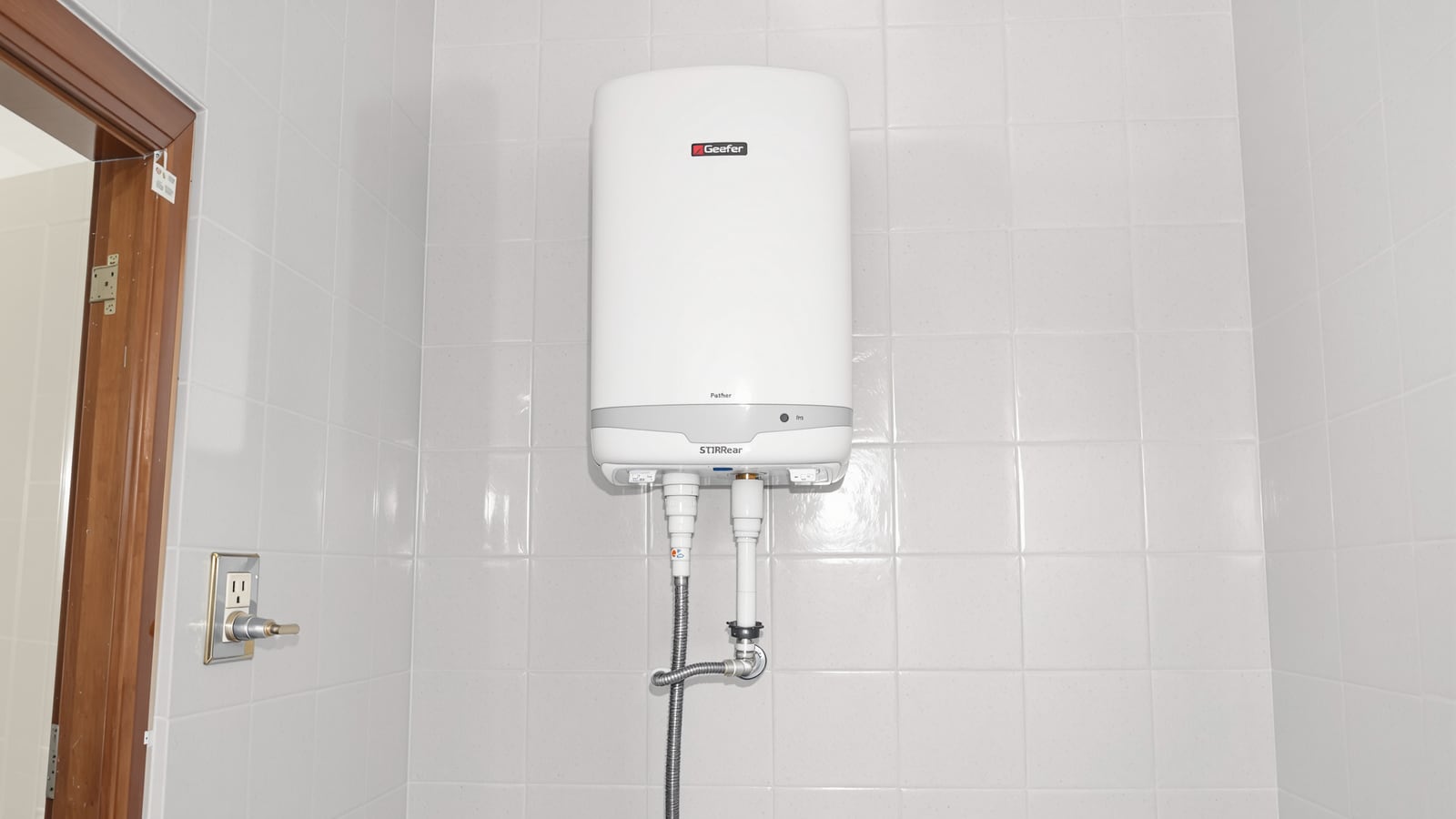
Geyser for Bathroom India: Water Heater Types, Sizing, Star Rating & Safe Wiring (2026)
How to choose a bathroom water heater in India — storage vs instant vs gas vs solar, the right litres for a bucket bath or shower, BEE star rating and running cost, why hard water needs an anode and descaling, pressure rating for showers, and the dedicated electrical point and safety it must have.
In most of India the geyser is switched on more days of the year than people admit — not just through a north-Indian winter, but every morning in Bengaluru, Pune and the hills, and any time someone wants a warm bucket for a child or an elder. It is also the single highest-wattage appliance in the bathroom, sitting on a wet wall, fed by hard water, and often wired to whatever spare point the electrician found. Get the type, the litres and the electrics right and it heats quietly for a decade. Get them wrong and you have cold showers, tripping breakers, scale-choked heating elements, or worse.
This guide is the practical, India-first way to choose. It covers the four families — storage, instant, gas and solar — how many litres you actually need for a bucket bath versus a shower, what the BEE star rating does to your electricity bill, why our hard water makes the anode rod and descaling non-negotiable, the pressure rating that decides whether it can feed an overhead shower, and the dedicated electrical point and safety it legally and sensibly requires. Read it alongside the bathroom plumbing guide for India, and cross-check the supply and wiring detail in the linked sibling guides.
Size the geyser to the bath you actually take, not the biggest tank in the showroom. A right-sized 15–25 L storage heater on a good star rating costs less to buy, less to run, and heats faster than an oversized one.
The four types — what each is really for
"Geyser" in Indian usage means any water heater, but the choice splits into four clear families.
- Storage (electric) water heater — the familiar wall tank, 6 to 50 L, with an insulated tank and a thermostat. Heats a tankful and holds it warm. The default for showers and full bucket baths.
- Instant (electric) water heater — a small 1–3 L tank with a high-wattage element that heats water as it flows. Good for a quick handwash or a single bucket; struggles to run a continuous hot shower.
- Gas water heater — an LPG or piped-gas instant unit that heats water on demand with no electricity for heating. Cheap to run where gas is available, but must be installed with proper flue and ventilation.
- Solar water heater — a rooftop collector (flat-plate or evacuated-tube) with a storage tank, usually with an electric backup element for cloudy days. Highest upfront cost, near-zero running cost, best for independent houses.
Storage vs instant — the decision that trips most people
An instant geyser is tempting because it is small and cheap, but a 3 kW instant unit can only raise the temperature of a thin flow. In winter, when incoming water is coldest, that same unit delivers either warm water slowly or a trickle at bath temperature. For a shower you almost always want a storage heater; keep instants for handwash points, a maid's bathroom, or a kitchen sink.
| Type | Typical capacity | Best for | Buy cost (₹) | Running cost | Watch-outs |
|---|---|---|---|---|---|
| Storage electric | 6–50 L | Showers, full bucket baths | 6,000–18,000 | Moderate; star rating matters | Tank scaling, heat-loss if oversized |
| Instant electric | 1–3 L | Handwash, single quick bucket | 3,000–7,000 | Low per use, high wattage | Weak for continuous shower |
| Gas (LPG/PNG) | Instant, on-demand | Where gas is cheap, high daily use | 6,000–14,000 | Lowest where gas available | Needs flue + ventilation, no bathroom-interior install |
| Solar (ETC/FPC) | 100–300 L | Independent houses, high usage | 22,000–60,000+ | Near zero | Roof space, plumbing run, backup needed |
How many litres do you actually need?
This is where money is wasted. Litres should match the hottest single draw you take, not the family's total daily use — the tank refills and reheats between baths.
- Handwash / kitchen only: a 1–3 L instant unit.
- One bucket bath (about 15–18 L of water, mixed hot and cold): a 6 L instant or a small 10–15 L storage heater is plenty, because you dilute with cold.
- A comfortable bucket bath or a short shower for one adult: 15 L storage.
- A relaxed shower, or two people back-to-back, or a hard-water home where you want margin: 25 L storage.
- Bathtub fill or a large family manifold: 35–50 L, or move to solar with an electric backup.
Remember you rarely use pure hot water — you blend it. A 15 L tank at 60 °C mixed down to a comfortable 40 °C gives you noticeably more than 15 L of usable warm water. Oversizing just means you heat and re-heat water you never draw, wasting the standby energy the star rating is trying to save.
Star rating and what it costs to run
Storage water heaters carry a BEE (Bureau of Energy Efficiency) star rating, one to five stars. The rating measures standby heat loss — how much energy the tank wastes keeping water warm between uses — because that is where a storage heater quietly burns money. A 5-star 15 L heater can use 15–20% less electricity over a year than a 1–2 star tank of the same size.
The heating element is typically 2,000 W (2 kW). Heating one tankful from cold costs the same regardless of star rating; the rating saves the standby loss. Two habits cut the bill further than any rating: switch it on 10–15 minutes before the bath and off after, and set the thermostat to about 55–60 °C rather than maximum. Hotter water scales faster and loses more heat to the room.
| Metric | Practical guidance |
|---|---|
| Element wattage | ~2 kW (storage); 3–4.5 kW (instant); higher trips weak wiring |
| Thermostat set point | 55–60 °C — comfort, less scale, lower loss |
| Star rating to buy | 4–5 star for a heater used daily |
| Energy per bath | ~0.7–1.2 units to heat a 15 L tank from cold |
| Habit that saves most | Timer / manual switch — never leave a storage heater on all day |
Hard water: the anode rod and descaling
Most of India runs on hard, mineral-rich water, and inside a hot tank those minerals precipitate as scale on the heating element and tank wall. Scale insulates the element so it runs hotter, takes longer, uses more power, and eventually burns out. It also, with oxygen in the water, corrodes the steel tank.
Two defences matter:
- The sacrificial anode rod — a magnesium (or aluminium) rod inside the tank that corrodes instead of the tank steel. In hard water it is consumed in 2–4 years; if it is fully eaten away the tank starts rusting. Have it inspected and replaced periodically — a ₹300–800 rod is far cheaper than a new geyser.
- Descaling — every 12–24 months, an authorised technician opens the tank, removes scale from the element and walls, and checks the thermostat and gasket. In very hard water, add a point-of-entry softener or at least accept a shorter service interval.
Glass-lined or titanium-enamel tanks and incoloy/copper elements resist scale better and are worth the premium in hard-water regions. See the broader hard-water discussion in the bathroom water supply guide.
Pressure rating — will it feed your shower?
This catches people who move from a bucket to an overhead rain shower. A storage heater has a pressure rating (often given in bar or as "maximum working pressure"), and it must match how the water reaches it.
- Overhead tank, gravity fed: most Indian homes run on a rooftop tank giving low pressure (typically well under 1 bar per ~10 m of head). A standard low-pressure geyser is fine, but a big overhead or rain shower may feel weak — that is a supply pressure problem, not the geyser's fault.
- Pump / pressurised supply: if you add a pressure pump or are on a pressurised line, the geyser must be rated for that pressure and fitted with a pressure-relief / multi-function valve. Fitting a low-pressure tank on a high-pressure line risks tank rupture.
Match the geyser's pressure rating to your shower system before you buy the shower. The shower systems guide covers the flow-and-pressure side in detail.
Electrical: the point it must have
This is the part that is most often done badly. A 2 kW storage geyser draws around 9 A; an instant unit at 3–4.5 kW draws far more. It is a wet-location, high-load appliance and needs its own supply.
- Dedicated point. A separate circuit from the distribution board with adequately rated cable (typically 2.5–4 sq mm copper for storage; heavier for instants) — never spurred off a light or 5 A socket.
- RCBO / RCCB protection. Earth-leakage protection (30 mA) is essential on a heater sitting on a wet wall; an RCBO combines this with overload protection on the dedicated circuit.
- Proper earthing and a double-pole isolator switch outside the wet zone, so the whole appliance can be switched off, both live and neutral.
- IS 302 — water heaters should conform to the safety standard IS 302-2-201 (IS 302 Part 2/Section 201) for stationary electric water heaters; buy an ISI-marked unit.
Wire it to the guidance in the bathroom electrical safety guide and IS 732 for wiring. Never let a geyser share a socket circuit.
Placement and safety
- Mount high and firm — on a solid wall (not a thin partition), above head height, clear of the shower spray. A full tank is heavy; use the manufacturer's brackets and wall anchors rated for the load.
- Never install a gas water heater inside the bathroom. Gas units need ventilation and a flue; a closed bathroom risks carbon-monoxide build-up. Mount them in a ventilated utility or balcony and run hot water in.
- Fit the multi-function / pressure-relief valve on the inlet and let its drain discharge safely — it protects against over-pressure and thermal expansion.
- Keep the electrical connection dry, isolator outside the splash zone, and get a licensed electrician to certify the point.
- Service annually in hard water — anode check, descale, valve and thermostat test.
For water and energy savings across the whole room, pair a right-sized, well-timed geyser with the choices in the eco-friendly bathroom guide — a shorter, warmer shower on a 5-star heater is the biggest single lever you have.
The short version
Choose storage for showers and full baths, instant only for handwash or a single bucket, gas where it is available and can be safely vented, and solar for an independent house that will keep it for years. Size to a single draw — 15 L for one adult, 25 L for a shower or two people or hard water. Buy 4–5 star, set it to 55–60 °C, and run it on a timer. In hard water, protect it with the anode rod and yearly descaling. And wire it properly: a dedicated point, RCBO, earthing and an ISI-marked IS 302 unit — because this is the one bathroom appliance where cutting a corner is genuinely dangerous.
References
- Bureau of Energy Efficiency (BEE) — Standards & Labelling programme, star rating for electric storage water heaters.
- IS 302-2-201 — Safety of household and similar electrical appliances: particular requirements for stationary storage water heaters, BIS.
- IS 2082 / IS 12933 — Electric storage-type water heaters, performance and construction requirements, BIS.
- IS 732 — Code of practice for electrical wiring installations, BIS.
- National Building Code of India (NBC) 2016 — Part 8 (Building Services) for plumbing and electrical installation practice.
- Ministry of New and Renewable Energy (MNRE) — Solar water heating systems guidance and standards for domestic installations.
Export this guide
Related Guides — Deep-dive reading
How to Choose a Geyser in India: Buyer's Guide to Size, Type, Star Rating & Price (2026)
A buyer's decision guide to picking a bathroom geyser in India — sizing instant vs storage by family and use, storage vs instant vs gas vs solar, BEE star rating and running-cost maths, glass-lined vs stainless tank for hard water, pressure rating, warranty, good-better-best price tiers, the IS 302 safety mark, and how to spot a refurbished unit.
BathroomsSolar vs Electric Water Heater: Which to Choose for Your Home in India
The energy-source decision for whole-home hot water — a solar water heater's high upfront cost and near-free running against an electric geyser's cheap install and steep monthly bill. Upfront vs running cost, payback, roof needs, seasonal reliability, and a clear verdict by household.
PlumbingResidential Electrical Systems: The Complete Guide for Indian Homes
How the electricity in an Indian home actually works — from the utility supply and meter through the distribution board, circuits, wiring, earthing and protection, to lighting, safety, energy efficiency, smart controls, solar and backup — written so a homeowner can understand, plan and judge it, and know exactly where a licensed electrician must take over.
Electrical & WiringRelated Tools — Try Free
Electrical Safety & Load Audit
Home electrical audit — 10 categories, 65+ checkpoints across earthing, RCCB, MCB, wiring, switchboards, appliance circuits, DG/inverter backup.
Safety AuditGeyser Size Calculator
Find the right water-heater capacity (litres) or instant kW for your bathroom and household, with an indicative running-cost note.
Bathroom CalculatorRainwater Tank Sizer
How big should your rainwater tank be? Computes annual harvest, recommended tank capacity in litres, water-bill savings, and payback — for 10 Indian cities.
RWH Calculator