
Bathroom Electrical Code India: IS 732, IS 3043, CEA 2010 & Zone Rules
The standards reference a designer or electrical contractor actually needs — IS 732 (wiring), IS 3043 (earthing), the CEA Safety Regulations 2010, the IP-rated zone concept aligned with IEC 60364-7-701, mandatory 30 mA earth-leakage protection, and the placement, bonding and isolation rules that make a bathroom compliant.
A bathroom is, in code terms, a "special location" — a place where the ordinary rules of an electrical installation are tightened because water has collapsed the body's natural resistance and put earthed metal within arm's reach. Indian practice does not hand you a single glossy bathroom rulebook; instead the requirements are distributed across the wiring code, the earthing code, a statutory safety regulation, and the National Building Code, all broadly harmonised with international practice. This guide pulls those threads into one professional reference: which standard governs what, the numbers that matter, and how the pieces assemble into a compliant installation. It is the electrical-standards companion to our bathroom building regulations guide; for the buildable wiring layout see the bathroom electrical guide.
Codes are revised and local electricity boards and municipal bye-laws add their own conditions. Treat everything here as an orientation, and verify the current edition of each standard and your state's supply rules with a licensed electrical contractor before you rely on it.
The framework: which document governs what
Four instruments carry most of the weight, plus supporting appliance standards.
- IS 732 — Code of Practice for Electrical Wiring Installations. The core installation standard, harmonised with the IEC 60364 series. It sets protection against electric shock, the requirement for 30 mA additional protection, and the treatment of locations containing a bath or shower.
- IS 3043 — Code of Practice for Earthing. Governs the earthing system, conductor sizing, electrode design and the equipotential bonding that a bathroom specifically needs.
- CEA (Measures relating to Safety and Electric Supply) Regulations, 2010. The statutory instrument under the Electricity Act, 2003. It makes earthing, protection and the use of a licensed electrical worker/contractor a matter of law, not just good practice.
- National Building Code of India (NBC) 2016, Part 8 Building Services. Ties the electrical installation into the building approval framework and cross-refers to IS 732 and IS 3043.
These sit on top of product standards — geysers, switches, cables, RCDs — each with its own IS number and the ISI mark as evidence of conformity.
The reference table: code to requirement
The single most useful thing a specifier can carry is a map from each document to the concrete requirement it imposes on a bathroom.
| Standard / regulation | What it covers | Key bathroom requirement |
|---|---|---|
| IS 732 (Wiring Code, per IEC 60364) | Whole installation: circuits, protection, special locations | 30 mA RCD additional protection for socket-outlets and bathroom circuits; zoning of the bath/shower location; supplementary bonding |
| IS 3043 (Earthing) | Earthing system, conductor sizing, bonding | Every exposed metal part earthed; supplementary equipotential bonding of pipes, taps, geyser body |
| CEA Regs 2010 | Statutory safety & supply measures | Earthing of appliances and metalwork; work by a licensed electrical worker/contractor; protective devices required |
| IEC 60364-7-701 | Locations containing a bath or shower (basis of the zone concept) | Zones 0/1/2; SELV (12 V) limits in Zone 0/1; minimum IP by zone |
| NBC 2016, Part 8 | Building services, electrical installation | Compliance with IS 732 / IS 3043 as part of building services design |
| IS 302 / IS 2082 (appliances) | Household appliance / storage water heater safety | ISI-marked geyser, thermal cut-out, earth terminal |
| IS 3854 / relevant switch IS | Switches and accessories for domestic use | Rated, marked accessories; IP-appropriate enclosures in wet zones |
Where a precise clause is decisive for a submission, read the current edition itself rather than a summary — clause numbering shifts between revisions, and BIS periodically amends these codes.
The zone concept, aligned with IEC 60364-7-701
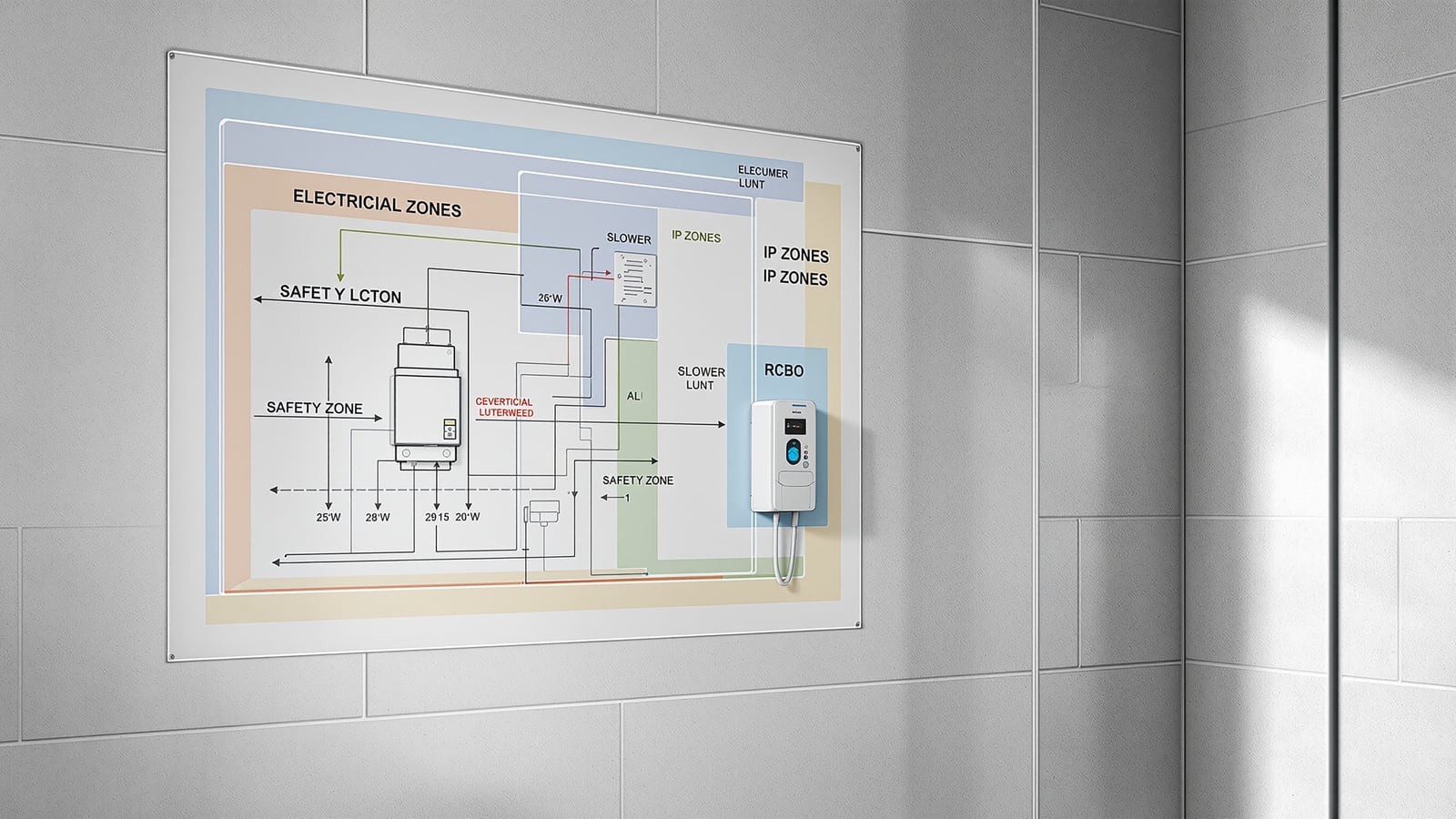
The zoning that Indian practice uses for bathrooms follows the international model for locations containing a bath or shower. The room is divided by proximity to water, and each zone constrains both the voltage permitted and the minimum IP (Ingress Protection) rating of any fitting. The second IP digit — protection against water — is the one that governs here.
| Zone | Extent | Voltage limit | Minimum IP |
|---|---|---|---|
| Zone 0 | Interior of the bath tub or shower basin | SELV 12 V only | IP67 (immersion) |
| Zone 1 | Above Zone 0 up to 2.25 m; the shower volume | SELV, or 30 mA-protected fixed equipment rated for the zone | IP65 (jets) typical |
| Zone 2 | 0.6 m horizontally beyond Zone 1 | 30 mA-protected fixed equipment; shaver socket to isolating-transformer standard | IP44 minimum |
| Outside zones | Remainder of the room | Normal circuits, still 30 mA-protected sockets | IP20–IP44 |
In Indian bathrooms the health-faucet habit — hosing walls and floor down — pushes real-world exposure up, so specifying IP65 anywhere a jet can reach is sound engineering even where IP44 would technically pass. Fitting selection by zone is worked through in our waterproof bathroom lights guide.
Mandatory earth-leakage protection: the 30 mA rule
The provision with no discretion attached is 30 mA residual current protection. IS 732, following IEC 60364, requires this "additional protection" for socket-outlets in general use and for circuits serving bathroom locations. The 30 mA threshold is chosen deliberately below the level at which mains current across the chest causes ventricular fibrillation.
- A 30 mA RCD must disconnect within 300 ms at rated residual current, and far faster — typically under 40 ms — at higher fault currents.
- Distinguish the devices precisely on a schedule: an MCB protects the cable against overload and short circuit only; an RCCB provides earth-leakage protection only; an RCBO combines both in one pole-set. Best practice is a dedicated 30 mA RCBO per bathroom circuit, and certainly a separate one for the geyser, so a fault does not black out the whole location.
- An RCD is not fit-and-forget: its test button must be exercised periodically, and trip current and time confirmed with an instrument at commissioning and on periodic inspection.
The shock-safety reasoning behind this device is covered in depth in our bathroom electrical safety guide.
Socket and switch placement rules
Placement is where the code turns into millimetres on a drawing.
- Switches inside the wet zones are avoided. The compliant default is the light and geyser switch on the wall outside the door or on the dry side clear of Zones 1 and 2. A ceiling pull-cord switch — the operator touches only an insulated cord — is the accepted way to switch inside.
- General 6 A/16 A socket-outlets have no place in the wet zones. Where a socket is genuinely required near the basin, it is a shaver socket to isolating-transformer standard, in Zone 2, at least 0.6 m horizontally from the shower or bath edge, mounted high (around 1,200–1,300 mm).
- Any accessory that stays inside must carry an IP rating appropriate to its zone — a gasketed, splash- or jet-proof enclosure, not a bare modular plate.
- Never extend a portable board or extension lead into the bathroom; it defeats every zone and IP provision above.
Earthing, bonding and isolation
Protection only works if a fault has a defined path and every metal surface sits at one potential.
- Earthing (IS 3043 / CEA 2010). Every exposed conductive part — geyser body above all — carries a dedicated protective (earth) conductor back to the earth bar, sized per IS 3043. The CEA Regulations make earthing of appliance metalwork a statutory duty.
- Supplementary equipotential bonding. IS 732 calls for local bonding in the bath/shower location: geyser body, metal water and waste pipes, taps, mixer and any structural metal are tied together with a green/yellow conductor so no two surfaces can differ in voltage. With modern CPVC/PVC plumbing acting as an insulator, this bonding is what re-establishes a common potential — do not treat a plastic pipe run as an earth path.
- Isolation and disconnection. Each circuit needs a means of isolation so it can be worked on dead. A geyser is best fed from its own way in the distribution board with a local double-pole isolator, disconnecting both live and neutral.
Commissioning, competence and compliance
The CEA Regulations 2010 require that installation and testing be carried out by a licensed electrical worker or contractor, and that the completed work be verified before energising. In practice that means: continuity of protective and bonding conductors confirmed, earth electrode resistance measured, insulation resistance tested, and every RCD's trip current and time proven with an instrument — with the results recorded. For any new build or major renovation these tests fold into the NBC building-services sign-off; slot the electrical scope into the wider bathroom renovation programme so the DB and the earthing go in before tiling closes the walls.
The one non-negotiable: 30 mA RCD protection on every bathroom circuit, a solid earth on the geyser, and supplementary bonding of the metalwork. Everything else is refinement around those three.
Because these codes are periodically amended and state supply conditions differ, confirm the current edition of each standard and your local electricity board's rules with a licensed professional before signing off a design.
References
- IS 732: Code of Practice for Electrical Wiring Installations (harmonised with the IEC 60364 series) — additional 30 mA protection, bath/shower locations and supplementary bonding — BIS.
- IS 3043: Code of Practice for Earthing — earthing systems, conductor sizing and equipotential bonding — BIS.
- Central Electricity Authority (Measures relating to Safety and Electric Supply) Regulations, 2010 — Government of India, under the Electricity Act, 2003.
- National Building Code of India (NBC) 2016, Part 8 Building Services, Section 2 Electrical and Allied Installations — BIS.
- IEC 60364-7-701: Requirements for special installations or locations — locations containing a bath or shower (basis for the Indian zoning approach).
- IS 302 / IS 2082: Safety and construction requirements for household electrical appliances and storage water heaters — BIS.
Export this guide
Related Guides — Deep-dive reading
Bathroom Electrical Safety India: 30 mA RCD/RCBO, IP Ratings & Waterproof Switches
Wet skin plus mains voltage is the deadliest combination in an Indian home. This is a practical safety guide — why the 30 mA RCD/RCBO that trips in milliseconds is non-negotiable, the IP44/IP54/IP65 rating your fittings need by zone, waterproof switches and sockets (or better, switches outside the door), proper earthing and bonding, avoiding the classic geyser-shock scenario, how to test the RCD, and what to fix in an old bathroom — all per IS 732 and IS 3043.
BathroomsBathroom Electrical India: Loads, IP Zones, RCD Protection & the Complete Wiring Plan
The complete guide to bathroom electrical planning for Indian homes — the loads and points (geyser on a dedicated 16 A circuit, exhaust, mirror and lights, shaver socket, smart WC), the IP zones 0/1/2 that fix where fittings can sit near water, mandatory 30 mA RCD/RCBO earth-leakage protection, earthing, keeping switches outside the wet zone, cable sizing and getting conduits right before plastering — all per IS 732 and NBC 2016.
BathroomsBathroom Plumbing Code India: NBC 2016 Part 9, UPC-I & the IS Standards That Govern Pipework
A professional reference to the codes and standards that govern bathroom plumbing in India — the National Building Code (NBC 2016) Part 9 on Plumbing Services, the Uniform Plumbing Code India (UPC-I), the CPHEEO Manual, and the IS standards for water supply, drainage, trap seals, pipe sizing, slopes and venting — with a caveat to always verify the current code and your local authority.
BathroomsRelated Tools — Try Free
Electrical Safety & Load Audit
Home electrical audit — 10 categories, 65+ checkpoints across earthing, RCCB, MCB, wiring, switchboards, appliance circuits, DG/inverter backup.
Safety AuditEarth Conductor Size Calculator
Find the minimum protective (earth) conductor size for a circuit from its phase conductor size, using the standard IS 732 / IEC 60364 rule.
ElectricalRenovation vs New Build Calculator
Compare renovating vs building new interiors city-wise across 13 work scopes with GST and per-sqft rates.
Cost Comparison