
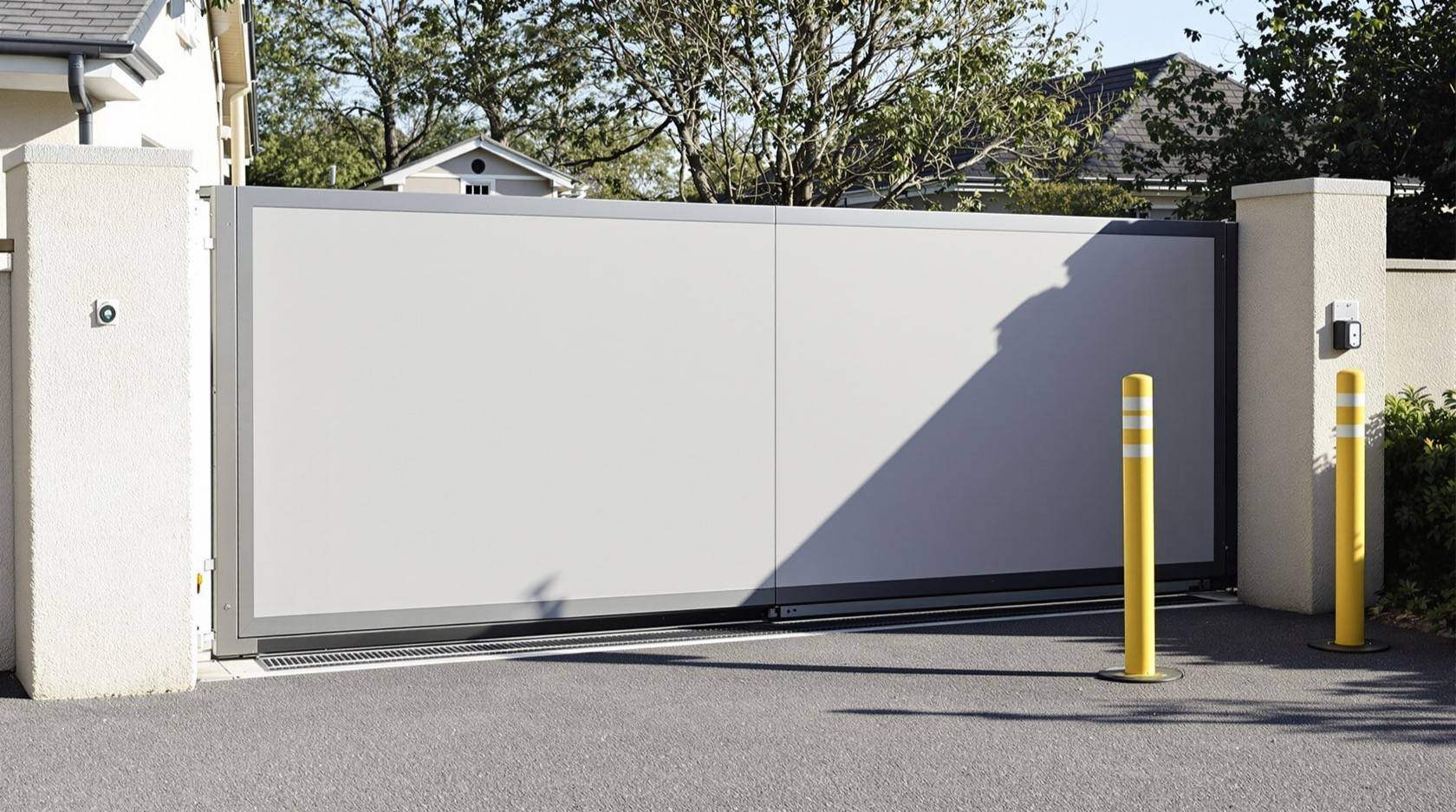
Automatic Gate Systems in India (2026): The Security and Safety Lens on Motorised Gates
A motorised gate is only an asset if it stays closed by default, opens only for authorised traffic, and can be released by hand in a power cut — here is the security-and-safety view of automatic gates.
A powered gate feels like an upgrade the moment it is installed: no stepping out into the rain, no guard heaving a heavy leaf, a fob-tap and the gate slides open. But the motor changes the gate's job in two ways owners rarely think through. It makes the gate a security control point — something that can be opened remotely, tied to access control, and kept shut by default — and it makes the gate a powered machine that can crush, trap or injure if the safety systems are missing. Automatic gate systems in India are too often sold and installed for convenience alone: the automation works, but the security discipline and the life-safety devices that a motorised gate legally and morally needs are skipped. This guide is the security-and-safety lens on that gate.
This guide is part of Studio Matrx's perimeter security library and sits under the pillar overview. It deliberately does not re-teach the automation mechanics — swing operators, sliding-rack motors, sizing, wiring and commissioning are covered in depth in the companion motorised gate automation guide. Here the focus is narrower and, frankly, more important: what makes a motorised gate a genuine security asset, and the safety systems that are simply non-negotiable on any gate that moves under power.
Scope, safety and the law. This guide helps you plan, decide and coordinate an automatic gate — assess the risk, specify the security and safety devices, and route the mains-electrical, structural and gate-machinery work to licensed professionals. It is strictly about making a controlled opening safe and hard to defeat, never a how-to for bypassing one. Three hard rules for this topic: a powered gate must have working safety photocells or safety edges that stop and reverse on an obstruction; it must have a manual override / emergency release so it can be opened by hand in a power cut; and it must never block the fire-tender or ambulance route or trap people or vehicles. Mains power, gate machinery and structural fixing are for licensed trades. This is educational guidance, not legal advice.
Types at a glance (kept brief — the detail lives in the automation guide)
Enough on gate types to make the security-and-safety choices sensibly; the mechanical selection sits in the motorised gate automation guide.
- Sliding / cantilever gates. The gate travels sideways on a track (ground-rail) or, in a cantilever design, spans the opening on rollers with no ground track and no floor obstruction. Popular for wide driveways and where a swing leaf would foul a slope or traffic. The moving leaf creates a shear and trap hazard along the wall it slides into — the classic child-crush risk.
- Swing gates. One or two leaves hinged at the posts, driven by arm or underground operators. Elegant and common for homes, but they need clear swing space and their leaves can trap a person or vehicle in the arc.
- Telescopic sliding gates. Two or more overlapping panels that stack to clear a wide opening in a short run-back — used where there is not enough side space for a single full-width sliding leaf. Multiple moving edges mean multiple pinch points to guard.
Whatever the type, the security-and-safety requirements below apply to all of them: the physics of a moving powered mass is the same.
The security value: closed by default, open only for the authorised
A manual gate's security depends entirely on the guard or resident who opens it. Automation lets you move that decision into a controlled, auditable system — but only if you configure it for security, not just convenience. The single most important setting is the one owners most often get wrong.
Keep the gate closed by default
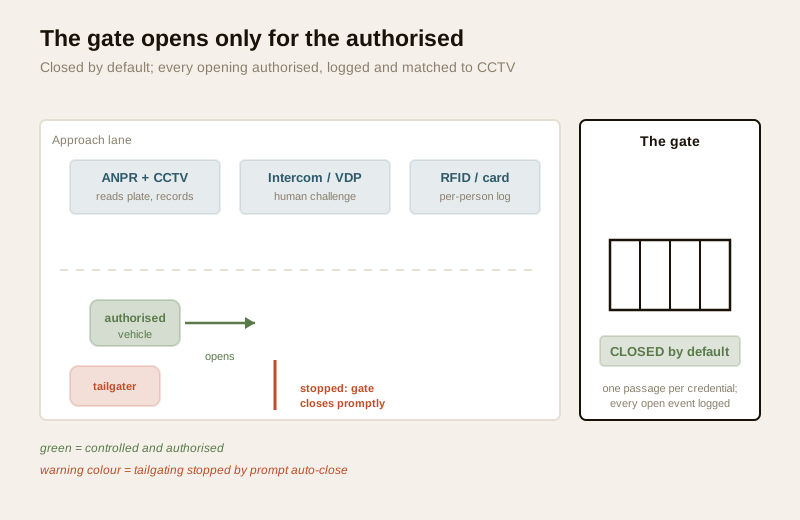
A motorised gate earns its keep only when its resting state is shut. The convenience trap is leaving the gate on auto-open during busy hours, or propping it open "because deliveries keep coming" — at which point you have spent money to make an open, unmanned opening. A secure automatic gate closes promptly after each authorised passage and holds closed until the next authorisation. This is the whole premise of a controlled opening, and it is the discipline the gate security guide treats as the number-one rule of the boundary.
Controlled, access-driven opening
Because the gate opens on a signal, you can decide what is allowed to send that signal:
- Intercom and video door phone (VDP). A visitor is seen and spoken to before the gate moves — the resident or guard makes the call. Pair the gate with an intercom or video door phone so the decision to open is a human one for unknown callers.
- Access control — RFID, card, biometric, app. Residents and staff pass on a credential, giving a per-person, time-stamped record of who came and went. This is the domain of gated-society access control.
- ANPR (number-plate recognition). For resident and registered vehicles, an ANPR (automatic number-plate recognition) camera can open the gate on a whitelisted plate — fast, hands-free, and logged — while unknown plates fall back to intercom challenge.
- CCTV overwatch. A camera on the approach and the opening ties every gate event to footage. The gate control and the CCTV should share a timeline so an opening can always be matched to who triggered it.
- Alarm and perimeter integration. The gate state can feed the perimeter alarm: a gate forced or held open too long becomes an alert, not an unnoticed gap.
Anti-tailgating: the timing is the control
The most common defeat of an automatic gate needs no skill at all — a second vehicle or person simply follows the authorised one through before the gate closes. The defence is timing and single-passage discipline: the gate should close promptly after one vehicle clears the safety beam, not sit open on a long timer, and the access-control logic should authorise one passage per credential. Where the risk is higher, a second detection loop or a challenge on a following vehicle catches the tailgate. Note the tension with safety here — you want the gate to close quickly to stop tailgating, but never so fast that it strikes the very vehicle it just admitted; the safety photocell (below) is what reconciles the two. This is exactly where a boom barrier is often added in front of the gate for traffic control; the boom barriers guide explains why a boom alone is not a security barrier.
| Security function | How the automatic gate delivers it | Cross-reference |
|---|---|---|
| Closed by default | Gate rests shut; auto-close after each passage; no permanent auto-open | Gate security |
| Authorised-only opening | Intercom / VDP for visitors; RFID / card / biometric / app for residents | Access control |
| Hands-free resident entry | ANPR whitelisted plate opens and logs | Gated-society access control |
| Accountability | Every open event tied to CCTV footage and an access log | Perimeter alarm |
| Anti-tailgating | Prompt auto-close, one passage per credential, second-vehicle challenge | Boom barriers |
The safety systems: non-negotiable on a powered gate
This is the part of the specification that convenience-led installs cut, and it is the part that has killed and injured people. A powered gate is a heavy moving mass driven by a motor strong enough to overcome wind, friction and a stuck wheel — which means it is strong enough to crush a child, a pet, a hand or a car. Powered gates have caused fatal crushing injuries to children worldwide. The safety devices below are not optional extras; they are what makes a motorised gate lawful and moral to run. Specify them to the applicable machinery and gate-safety standard (verify the current requirement) and have a competent installer commission and test them.
Safety photocells and safety edges — stop on an obstruction
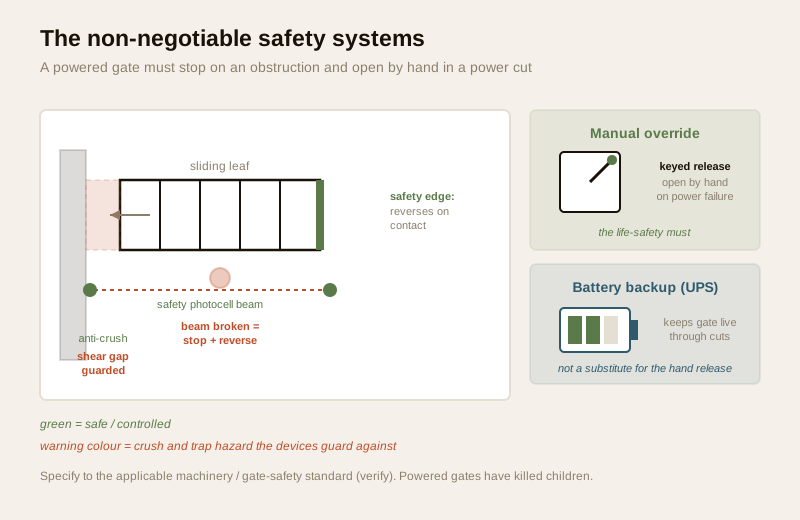
- Photocells (safety beams). An infrared beam across the opening (and often a second beam) detects anything in the gate's path. If the beam is broken while the gate is closing, the gate stops and reverses — it must not close onto a person or vehicle. Beams should cover the closing line and the danger zone, not just the centre.
- Safety edges (sensitive edges). A pressure-sensitive strip along the leading and, on sliding gates, the trailing edge that stops and reverses the gate the instant it touches an obstruction. Photocells catch what is in the beam; the safety edge catches what the beam misses when the gate makes contact.
- Force limitation. The operator itself should be set so the closing force is limited — an anti-crush setting — so that even on contact the gate cannot exert a dangerous force. Force testing is part of proper commissioning.
Guard the shear and trap points
A sliding gate creates a lethal gap between the moving leaf and the wall or post it slides into, and telescopic gates create several. The gap must be guarded — by a mesh infill that removes the reach-through gap, physical guards over the pinch points, and photocells on the trap side — so a child cannot put a hand, head or body into the closing gap. Swing gates need their hinge and closing edges considered the same way.
Manual override / emergency release — the life-safety must
Here is the device that separates a professional install from a dangerous one, and the one India most often lacks: every automatic gate must have a manual override — an emergency release — that lets it be opened by hand without power. In a power cut (a daily reality in much of India), a motor failure, or an emergency, someone must be able to release the operator and move the gate by hand in seconds. If the only way through is electric and the electricity is out, you have built a trap: vehicles cannot leave, people cannot get out, and a fire tender cannot get in. The release is usually a keyed lever or clutch on the operator; residents and guards must know where it is and how to use it, and it must be reachable, not padlocked away.
Battery backup — because the power will fail
A battery backup (UPS) on the gate operator is not a luxury in India; it is how the gate keeps working through the routine power cuts that would otherwise force everyone onto the manual release several times a day. Backup power keeps the gate — and its safety devices — functioning during an outage, and buys time before anyone needs the manual override. It does not replace the manual override: batteries also die, and the hand release is the ultimate fail-safe.
| Safety device | What it prevents | Status |
|---|---|---|
| Safety photocells / beams | Gate closing onto a person, pet or vehicle in the path | Non-negotiable |
| Safety edges (sensitive edges) | Crushing on contact when the beam is missed | Non-negotiable |
| Force limitation / anti-crush | Dangerous closing force even on contact | Non-negotiable |
| Shear-point guarding / mesh infill | A hand or child entering the closing gap | Required |
| Manual override / emergency release | Being trapped when power or the motor fails | Life-safety must |
| Battery backup (UPS) | Loss of function during India's routine power cuts | Strongly recommended |
The emergency and life-safety rule: never trap, keep the route clear
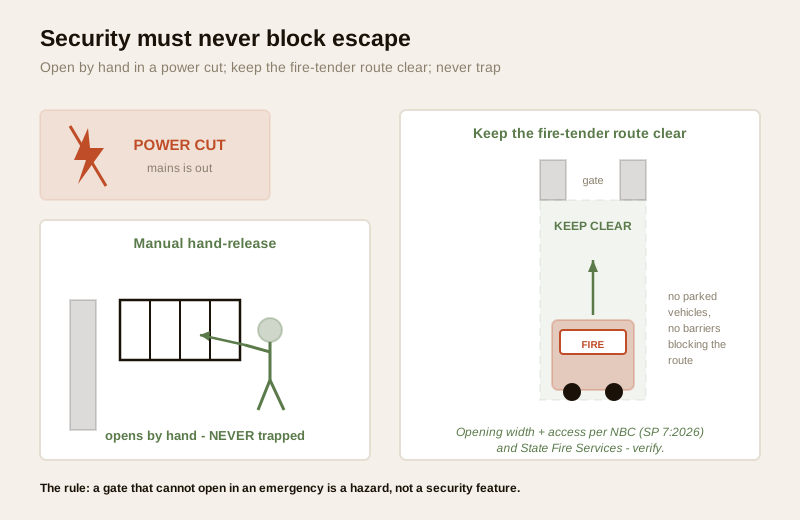
The security instinct — keep the gate shut, make it hard to open — must always yield to the life-safety instinct in an emergency. A gate that cannot be opened in a fire, medical emergency or power cut is a hazard, not a security feature. Three rules hold it together:
- Fail-safe by hand on power loss. With the power off, the manual override must open the gate quickly and without tools a resident does not have. Guards and residents should be drilled on it; the release must not be locked in an office no one can reach at 2 a.m.
- Keep the fire-tender route usable. The gate opening must be wide enough for the fire tender and ambulance your local State Fire Services and municipal bye-laws require, and the gate must be openable — automatically or by hand — to admit them. Coordinate the gate line, opening width and setback with the National Building Code (SP 7:2026) and local development-authority rules, and never park or barrier the emergency route.
- Never trap people or vehicles in. Egress must always be possible. An exit loop, a push-to-exit inside, or at minimum the manual release means no one is ever held inside by the gate. This is the same life-safety principle the compound wall guide applies to a secured boundary: security must never defeat escape.
The mains supply, the operator wiring, earthing and any electric-gate power belong with a licensed electrician — route that work through the Studio Matrx electrical hub — and the structural fixing of posts and tracks with a competent installer.
India realities: the ways automatic gates go wrong
Name the failure patterns so you can design them out. These are the ones seen again and again on Indian sites.
- No manual override — or one stuck in a power cut. The gate has no emergency release, or it is padlocked in the guardroom, so when the power fails everyone is stranded on the wrong side. The most dangerous and most common fault.
- No safety photocell or edge. The gate closes with full force onto whatever is in the way. This is how children and pets are hurt. If a quote does not itemise photocells and edges, it is not a complete gate.
- Left in auto-open. The society gate parked open all day for convenience, undoing the entire point of automation — a powered but permanently open opening.
- Tailgating unaddressed. A long open timer or a per-vehicle timer with no single-passage logic lets a second vehicle slip in behind every resident. See the gate security guide.
- No battery backup. In a region of daily power cuts, the gate is on the manual release constantly, and the safety devices are dead whenever the mains is.
- Automation on a weak gate. A motor on a flimsy leaf that can be lifted off its track or forced — the gate must be as strong as the wall it sits in before automating it is worth anything.
To pressure-test a specific site, the site perimeter security assessment and the anti-vehicle barrier selector walk through where a controlled opening is genuinely weak, and the home security risk scorecard covers the residential case.
Safety, liability and when to bring in a professional. Specify the gate and its security logic yourself, but hand the regulated parts over. A licensed electrician / certified installer handles the mains supply, operator wiring and earthing; the safety devices (photocells, edges, force limitation, shear-guarding) and the manual override must be fitted and commissioned by a competent installer to the applicable machinery and gate-safety standard — verify the current requirement, because a powered gate that crushes carries serious injury and liability. Coordinate the opening width, gate line and emergency access with your local municipal / development-authority bye-laws (NBC SP 7:2026) and State Fire Services, and never let a secured gate block the fire tender or trap people inside. This is educational guidance, not legal advice.
Key takeaways
- Automation is only security if the gate stays closed by default — a motorised gate left on auto-open or propped open is a powered but unmanned opening; specify prompt auto-close and open only on an authorised signal.
- Integrate the opening, do not just motorise it — tie the gate to intercom / VDP, access control, ANPR, CCTV and the alarm so every opening is authorised, logged and matched to footage, and design anti-tailgating into the timing.
- Safety photocells and edges are non-negotiable — a powered gate must stop and reverse on an obstruction, with force limitation and guarded shear points; powered gates have killed children, so an install without these is incomplete and unsafe.
- A manual override on power failure is the life-safety must — every automatic gate must open by hand in a power cut or emergency, with the release reachable and everyone drilled on it, backed by a battery UPS for India's routine outages.
- Security must never block escape or the fire tender — keep the emergency route clear, keep the opening openable by hand, and never trap people or vehicles inside; coordinate with local bye-laws and State Fire Services, and route mains and structural work to licensed professionals.
References
- Applicable machinery and gate-safety / powered-gate standard (the international power-operated gate safety family — for example the EN 12453 / EN 13241 impact-and-safety approach — verify the current requirement and the local equivalent) — governs safety forces, photocells, safety edges and the manual release on automatic gates; a competent installer must confirm and commission to the current standard.
- National Building Code of India (SP 7:2026), Bureau of Indian Standards, with your local municipal / development-authority building bye-laws — govern the gate line, opening width, setback and fire-tender access; verify the current edition and local bye-law via the BIS catalogue: https://www.services.bis.gov.in/
- Relevant State Fire Services / fire-and-emergency-services requirements — for emergency-vehicle access, keep-clear routes and the openability of gates in an emergency; confirm the requirement for your state and occupancy.
- Manufacturer specifications and a licensed electrician / competent gate installer's commissioning report — verify the operator's safety-device compatibility, force settings, battery-backup capacity and manual-release operation for the specific gate and site.
This is an educational overview, not legal advice. It is strictly about making a controlled opening secure and safe and understanding its limits, never about defeating one. Automatic-gate safety devices, mains-electrical work, structural fixing and fire-tender access are governed by machinery/gate-safety standards, local bye-laws and State Fire Services rules that vary and are for licensed professionals — verify any standard's current status via the BIS catalogue and confirm local rules before you install.
Export this guide
Related Guides — Deep-dive reading
Security Gate Automation Integration in India (2026): Making the Entry One Coordinated Control Point
How to tie an automatic gate into the wider security and smart-home system so the entry becomes one coordinated point of access, camera, intercom and automation — with the honest limits, the convenience that is genuinely risky, and the safety and life-safety essentials you must never skip.
SecurityBoom Barriers in India (2026): Traffic Control at the Gate - and What They Do NOT Stop
The rising arm at the society, office and parking entrance controls honest vehicle flow one authorisation at a time - but a boom barrier is not an anti-ram device, and here is how to specify, integrate and make it safe.
SecurityGate Security in India (2026): Making the Main Entrance the Strongest Point, Not the Weakest
The main gate is the one gap in every boundary and the number-one weak point of any perimeter — here is how to make the leaf, the access decision and the discipline around it as strong as the wall it sits in.
SecurityRelated Tools — Try Free
Access-Control Battery-Backup Calculator
Size the standby battery so an access system keeps running through a power cut, with an egress life-safety note.
Battery BackupHome Security Risk Scorecard
Score your home across six security layers — perimeter, entry points, lighting, detection, alarm and habits — and get a prioritised action plan.
Security ScorecardSecurity Backup Power Calculator
Size a UPS/inverter and battery to keep CCTV, NVR, router and alarm running through a power cut — load, Ah, VA and cost.
Backup Power