
Kengo Kuma's Façade Signature: Anti-Object, Particles, and the Timber Lattice as a Jaali
How Kengo Kuma dissolves the heavy wall into a fine, breathing screen of timber, bamboo, ceramic and stone particles — a refined cousin of the Indian jaali and brise-soleil, and what it teaches India about filtering harsh sun softly.
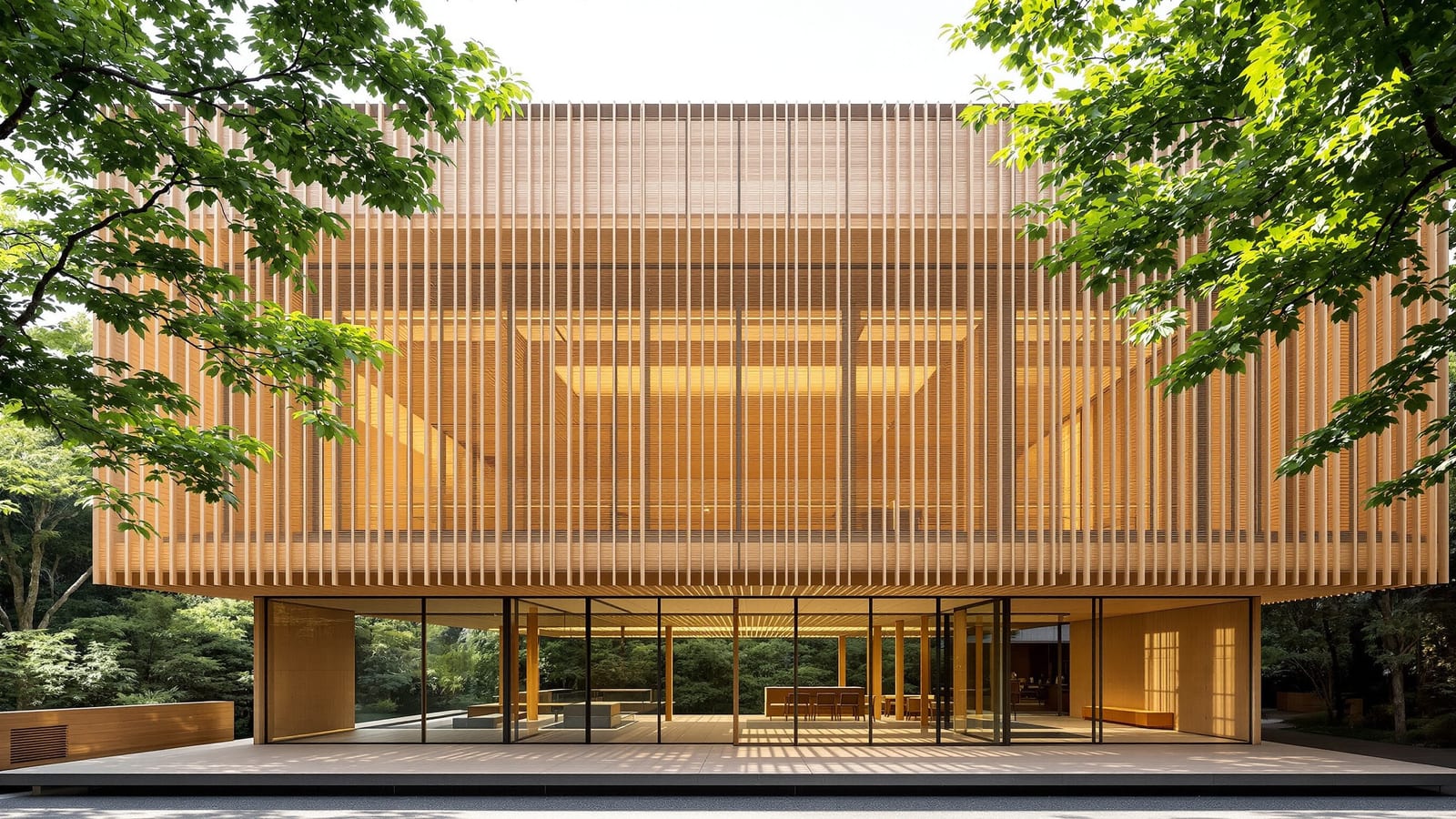
Stand close to a Kengo Kuma building and the wall seems to vanish. There is no slab of glass, no monumental stone face, no proud object announcing itself to the street. Instead there is a haze of thin wooden sticks, a weave of cedar slats, a screen of stone fins or ceramic louvres — hundreds of small members that catch the light, throw a soft moving shadow, and let the breeze drift through. You can almost see the building dissolving into the trees behind it. Kuma calls this his life's work: to erase architecture, to make the heavy building disappear.
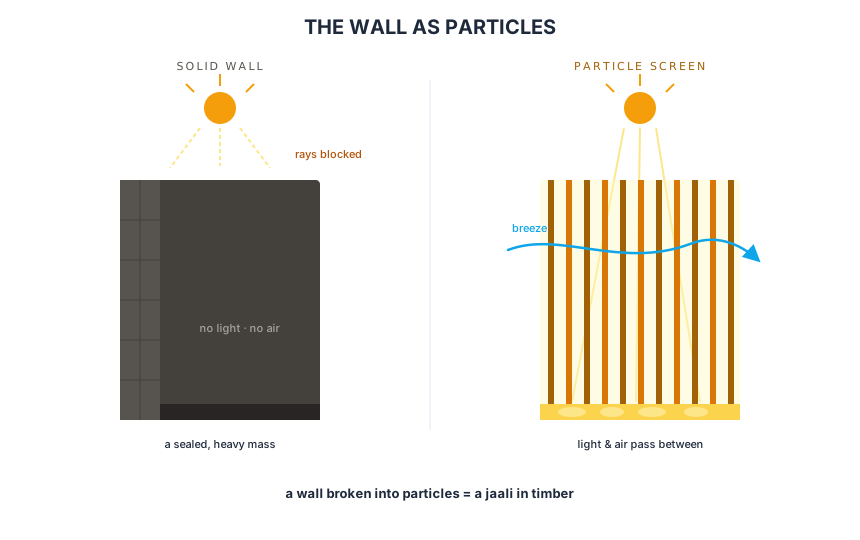
This is a deliberate, philosophical rebellion. For most of the twentieth century, architecture chased the monument — the bold concrete object, the glass tower, the building as a heroic thing cut off from its surroundings. Kuma (born 1954) spent his career arguing the opposite: that a building should be light, porous, gentle, and merged with its place. His method is almost scientific. Take the solid wall, and break it into particles. Once matter is fine-grained enough, light passes through it, wind passes through it, and the wall stops being a mass and becomes a screen.
For an Indian reader, this should feel strangely familiar — because India invented exactly this logic centuries ago and called it the jaali. Kuma's layered timber lattice is, in effect, a refined cousin of the perforated stone screen that already shades our havelis, mosques and palaces. His façade language is a Japanese answer to a problem India knows intimately: how to filter harsh sun into soft, dappled shade while letting the wall breathe.
This is part of our Building Façades series — specifically our Masters of the Façade set, where we study how one great architect designed façades, not their whole life story. For Kuma's biography, his early houses, and his global practice, see his profile, Kengo Kuma. Here we look only at the skin: how Kuma makes a wall disappear, and what an Indian designer can borrow. Read it alongside our jaali and traditional Indian façades guide (his screen is a jaali by another name), our timber and natural façades guide (essential durability caveats before you build any of this in our monsoon), and our brise-soleil and louvre façades guide.
1. Anti-object: the desire to make the building disappear
Kuma's central idea is anti-object — the title of his most important book. An "object", in his definition, is a work of architecture that is expressly cut off from its environment: a self-contained thing you photograph from across the street, admired precisely because it stands apart. Kuma rejects this. He argues that the object-mindset prevents a healthy relationship with the world around us, and that an alternative architecture — one that dissolves into its surroundings — is not only desirable but possible.
The façade is where this fight is won or lost, because the façade is the boundary between the building and the world. A solid, glossy, sealed wall makes a hard edge. A porous, layered, fine-grained wall makes a soft, ambiguous edge — you cannot quite tell where the building stops and the garden begins. Kuma calls this larger ambition erasing architecture: not literally invisible, but visually weightless, so the structure recedes and the place comes forward. The wall is no longer the point; the light coming through it is.
2. Particlization: breaking matter into particles
The technical engine of all this is what Kuma calls particlization — breaking matter into particles. Instead of one solid wall, he assembles the façade from many small, thin, repeated members: timber slats, louvres, tiles, stone fins, ceramic baguettes, bamboo culms. The wall is dismantled into a cloud of small parts.
The magic is in what fine-graining does. Below a certain size, a wall built of particles stops reading as mass and starts reading as a permeable screen — light filters between the parts, air moves through the gaps, and the eye reads texture and shadow rather than weight. The same cedar that would feel heavy as a plank feels light as a comb of slats. Particlization is why almost every Kuma façade is a field of repeated small elements: louvres, slats, lattices, weaves. It is the opposite of the monolith. And it is, structurally and visually, the exact logic of a jaali — a wall that is mostly absence, held together by a fine, repeated solid.
3. The layered timber lattice and the louvre screen
Kuma's most recognisable façade is the layered timber lattice — fine wooden battens assembled into a brise-soleil-like screen. A brise-soleil (French for "sun-break") is a fixed array of fins or louvres that shades a wall from direct sun while letting in indirect light and air. Kuma takes that idea and refines it to a far finer grain, then layers it — often eave over eave, slat over slat — so the screen has depth and the shadow it throws is soft and gradated rather than a hard line.
These screens do real work. They filter harsh sun into dappled light — the soft, broken, shifting light you get under a tree — and they cast a moving shadow that changes through the day and the seasons. They let breeze pass through, so the façade breathes. And because they are timber, they are warm, tactile and human in scale, not slick or corporate. This is the heart of his signature, and we will see how it is built in the dedicated section below.
4. Japanese craft and joinery, reinterpreted
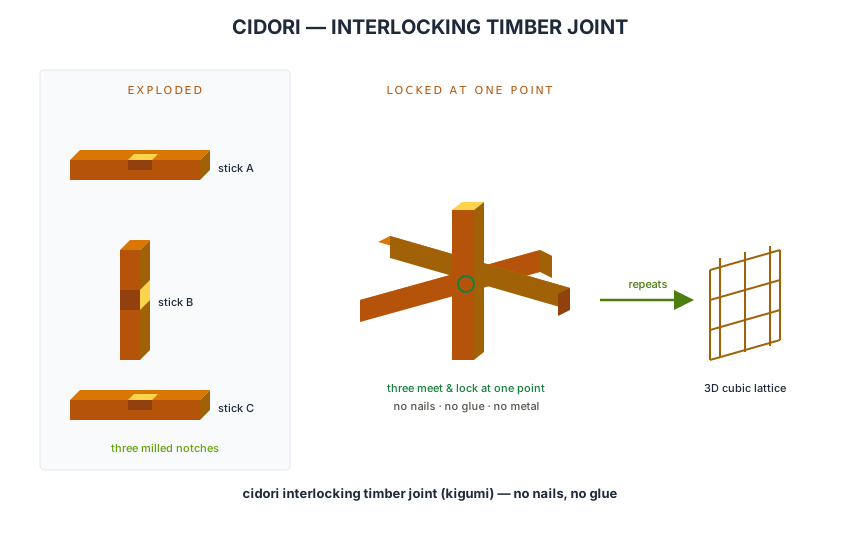
Kuma does not invent these screens from nothing; he mines traditional Japanese craft and reinterprets it. The key is kigumi — Japanese timber framing in which wood members interlock through cut joints, traditionally without nails or glue. His favourite source is cidori (also spelled chidori), an old Japanese children's toy from the mountain town of Hida Takayama: small wood sticks with milled notches that interlock by a simple twist, extendable into an endless three-dimensional lattice. Kuma scaled this toy up into buildings (Section 6).
He borrows other traditional devices too. The engawa is the wooden veranda that wraps a Japanese house — a transitional "in-between" space, neither inside nor outside, shaded by a deep eave. Kuma uses engawa-like layered eaves and verandas to soften the boundary at the façade. And he invokes the shoji — the translucent paper screen — as a model for filtering, not blocking, light, sometimes using washi (handmade Japanese paper) itself as a diaphanous screen layer. The common thread: traditional craft used to make boundaries soft, layered and light-filtering rather than hard and sealed.
5. Natural and local materials, lightly used
Kuma's particles are almost always natural and local materials — timber, bamboo, stone, ceramic, washi paper — chosen for the specific place. He uses cedar where cedar grows, bamboo where bamboo is the local craft, local Ashino stone for a stone museum in stone country. The material is handled lightly: thin, fine, fragile-seeming, never massive. He explicitly prizes wood's "softness", warmth, flexibility and even its fragrance over the hard permanence that modern architecture usually chases.
This is where Kuma's ethics show. He distrusts the heavy, the permanent, the monumental — he has said that an architecture obsessed with stability can express the arrogance of a complacent society. He chooses instead the gentle, the renewable, the locally rooted. For India, this instinct — use what the region makes, handle it lightly, let craft show — maps neatly onto our own deep traditions of stone, lime, timber and bamboo.
6. Weak architecture: softness and human scale
Kuma describes his ideal as weak architecture — and he means it as praise. Weak architecture is gentle, soft, tactile, low, anti-monumental. It does not dominate; it yields. His façades celebrate thinness, translucence, warmth, even fragility and the graceful acceptance of decay. Where a "strong" building shouts permanence, a "weak" one whispers and merges.
Human scale is the mechanism. By varying the frequency and density of the slats — packing them tighter here, spacing them looser there — Kuma keeps a giant building legible at the scale of a hand and a body. The Japan National Stadium's louvre eaves were sized and varied precisely so that a vast Olympic venue still feels gentle and human up close. This is a profoundly humane lesson for a country tempted by the grand gesture: a façade can be large and still feel kind.
7. Light, shadow and the landscape
Underneath everything is light and shadow. Kuma is steeped in Junichiro Tanizaki's classic essay In Praise of Shadows, which mourned the loss of subtle, gradated darkness to harsh modern light — Kuma wrote the foreword to a recent reprint and calls it foundational to his thinking. A Kuma façade is essentially a light-management device: it trades the blunt choice between glare and gloom for a rich gradation of dappled half-light, the kind you feel under foliage or behind a shoji.
And the screen is always in conversation with the landscape. The building is meant to be part of its setting, not an intruder on it: the Bamboo Wall house runs along the ridgeline like the Great Wall itself, the National Stadium's timber eaves echo the forest of the Meiji Shrine beside it. The façade is the membrane through which building and place blur into one another.
The layered particle screen: a jaali in timber
Here is the technical heart, and the reason this matters so much for India. To build a Kuma façade, you start with the wall you would have built — a solid plane — and you break it into particles: many small, thin members, each a fraction of the original mass. Then you assemble those members into a fine, permeable lattice, typically layered to several depths, and let it stand a little off the structure as a second skin.
What that screen then does is exactly what a jaali does. It filters harsh direct sun into soft dappled shade inside. It lets breeze through the gaps, so the wall breathes and the building self-cools. It throws a beautiful, shifting shadow that animates the interior all day. And it dissolves the wall's mass — from the street you read a delicate texture of light and shadow, not a heavy block. The only real difference from a Rajasthani sandstone jaali is the material and the grain: Kuma works the same logic in timber slats, ceramic louvres, stone fins or bamboo culms instead of carved stone.
Three of his buildings show the construction clearly. At the GC Prostho Museum, Kuma scaled up the cidori toy: cedar sticks of 60 × 60 mm in long lengths interlock through milled notches — no nails, no glue, no metal — into a 50 cm cubic grid that is simultaneously structure, façade and display case. The engineer Jun Sato compression-tested the toy joint to prove a children's plaything could carry a building. At SunnyHills in Tokyo, the same cidori principle is woven into a three-dimensional basket: hinoki cypress sticks meet three-at-a-time at 30-degree angles, so the whole shop reads as a delicate latticework cloud. At the Japan National Stadium, ordinary 105 mm cedar — the most common size in Japan — was split into three pieces to make the small louvres lining the underside of the building's layered, overlapping eaves; the spacing was tuned by orientation so the south side catches the summer breeze and the north deflects the winter wind. In every case the move is identical: solid wall to fine particles to a breathing, light-filtering screen.
If you want the deep history and detailing of the screen-that-breathes in our own tradition, read our jaali and traditional Indian façades guide. Kuma's lattice and the jaali are the same idea in different accents.
Kuma's signature façade strategies
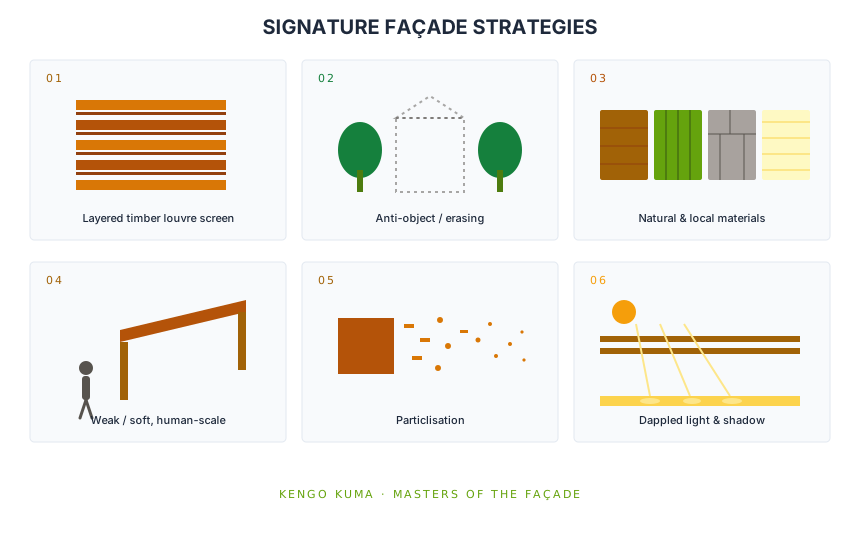
| Strategy | What it is | Signature building | Why it works | India lesson |
|---|---|---|---|---|
| Anti-object / erasing architecture | Dissolving the building's mass so it recedes into its setting | Great (Bamboo) Wall, Beijing | A porous, layered skin makes a soft, ambiguous edge between building and landscape | Stop chasing the monument; let the façade merge with garden, street and sky |
| Particlization | Breaking the solid wall into many small thin repeated members | GC Prostho; SunnyHills | Below a certain grain, a wall reads as a permeable screen of light, not a mass | This is jaali logic — a wall mostly made of gaps |
| Layered timber lattice / louvre screen | Fine cedar battens woven or layered into a deep brise-soleil | Japan National Stadium eaves | Filters sun to dappled shade, breathes, throws moving shadow, stays human-scaled | A timber jaali for our climate — but detail it for monsoon and termites |
| Cidori / kigumi joinery | Traditional interlocking notched timber joints, no nails or glue | SunnyHills Tokyo; GC Prostho | Craft itself becomes the façade; structure and screen are one | Revive our own joinery and bamboo-craft traditions in the screen |
| Natural / local materials, lightly used | Timber, bamboo, stone, ceramic, washi chosen for the place and handled thin | Stone Museum, Nasu | Material rooted in place; warm, tactile, renewable, anti-glossy | Use regional stone, treated timber, bamboo — what India already makes |
| Weak architecture / softness | Gentle, low, tactile, anti-monumental, varied density for human scale | Yusuhara Wooden Bridge Museum | A large building still feels kind and legible at the scale of a hand | A humane antidote to the grand, hard, glass-and-granite gesture |
Real buildings, not renders
These are verified, built projects — not concept renders — and the focus here is strictly on how each façade works.
Japan National Stadium, Tokyo (2019). Built for the 2020 Olympics beside the forest of the Meiji Shrine. Its façade is a stack of overlapping, multi-layered eaves whose undersides are lined with small cedar louvres, using timber sourced from all 47 Japanese prefectures. The louvre density varies by orientation to catch the summer breeze on the south-southeast and deflect winter wind on the north. The effect: a vast stadium that reads as a low, layered, wooden grove echoing the trees beside it.
GC Prostho Museum Research Center, Kasugai (2010). A small museum built entirely from the cidori interlocking timber lattice — 60 mm cedar sticks notched and twisted together into a 50 cm cubic grid with no nails, glue or metal fittings. The lattice is structure, façade and showcase at once, and the whole building glows as a fine wooden cage of light and shadow.
SunnyHills, Minami-Aoyama, Tokyo (2013). A pineapple-cake shop wrapped in a woven cidori "basket" of hinoki cypress. The joints are three-dimensional — three sticks meeting at 30-degree angles — so the façade reads as a soft latticework cloud, the wall almost entirely dissolved into weave and gap.
Yusuhara Wooden Bridge Museum, Yusuhara (2010). A bridge-museum spanning a road and cliff, built by accumulating many small laminated sugi (cedar) members in an overlapping cantilever — a reinterpretation of the traditional to-kyo (square-framing) bracket. Instead of one oppressive beam, a build-up of small timber pieces lets the structure merge into the surrounding forest. The façade is the structure: layered timber brackets fanning outward.
Great (Bamboo) Wall, Beijing (2002). A house near the Great Wall wrapped in tightly woven local bamboo as a second skin. Bamboo strips placed closer or farther apart act as curtain, partition or screen; sunlight filters through them into shifting patterns of light and shade. Kuma insisted on local, inexpensive bamboo and on running the form along the topography — refusing, like the Great Wall itself, to stand apart from the landscape. (The Stone Museum / Stone Plaza, Nasu, 2000, does the same in stone: thin slabs of local Ashino stone stacked as a louvred "stone lattice", with marble inserts that let light filter directly between the stones.)
What it teaches India
The single most useful thing Kuma offers India is permission and a method for the timber-or-bamboo jaali. His layered, fine-grained, natural-material screen is essentially a jaali and a brise-soleil refined to an exquisite grain — and that is exactly the right device for the Indian sun. It filters harsh glare into dappled shade, lets the wall breathe and self-cool, and dissolves mass into texture. We have done this in stone for a thousand years; Kuma shows it can be done just as beautifully in timber, bamboo, ceramic and stone fins. His instinct for local, lightly-handled natural materials suits a country rich in stone craft, regional hardwoods and an abundance of bamboo. And his weak, soft, dissolve-into-landscape ethos is a humane antidote to the hard glass-and-granite monument that too many Indian buildings now copy.
But borrow it honestly. Bare timber in the Indian monsoon, with our humidity and our termites, is a genuine durability problem — not a detail to romanticise. A raw cedar slat that lasts beautifully in dry Japan will rot, warp or be eaten in a Mumbai or Kerala monsoon if you specify it naively. The fix is not to abandon the idea but to engineer it: choose durable or properly treated species (or thermally-modified timber), keep the screen ventilated and rain-shadowed with a deep overhang, detail every junction so water drains and air dries the wood, and consider bamboo (treated against borer), local stone fins or ceramic louvres where timber is risky. Our timber and natural façades guide sets out the real durability rules — read it before you draw a single slat. Remember too that Kuma's work is high-craft and bespoke; the cidori joint is a virtuoso's toy scaled up, not a budget detail. The takeaway is the principle, not a copy: borrow the layered permeable screen and the natural-material softness, and execute it with monsoon-and-termite-robust detailing in treated timber, bamboo, stone or ceramic.
You will notice the same filtering-screen instinct in other masters we cover. Jean Nouvel built a mechanised metal jaali at the Institut du Monde Arabe; Morphogenesis build climate-responsive perforated screens for the Indian sun directly. Kuma's contribution is to make that screen warm, wooden, soft and almost weightless — to turn the brise-soleil into something that breathes.
What this means for you
If you are building in India and you love Kuma's work, do not import his exact cedar lattice and hope. Import the logic. Ask of your own façade: can this wall be broken into particles? Can a solid plane become a permeable second skin that filters our hard sun into dappled shade and lets the building breathe? Can I use a material my region actually makes — local stone, treated regional timber, properly preserved bamboo, terracotta or ceramic louvres — handled thin and light rather than heavy?
Then do the unglamorous engineering Kuma's Japanese climate let him skip: deep overhangs to keep rain off the screen, ventilation gaps so wood dries, drained junctions, durable or treated species, and a maintenance plan. Get that right and you will have the best of both worlds — Kuma's gentle, dissolving, human-scaled screen, built to survive a Pune monsoon. That is the honest path: the jaali your grandmother's haveli already knew, reimagined in timber and bamboo, and detailed for the country you actually live in. For the man behind the method, revisit Kengo Kuma; for the technique in our own tradition, the jaali guide.
Sources
- Kengo Kuma, Anti-Object: The Dissolution and Disintegration of Architecture (AA Publications / Architecture Words 2).
- Kengo Kuma & Associates (KKAA), project pages: Japan National Stadium; GC Prostho Museum Research Center; SunnyHills at Minami-Aoyama; Yusuhara Wooden Bridge Museum; Stone Museum / Stone Plaza, Nasu.
- ArchDaily: "GC Prostho Museum Research Center"; "SunnyHills at Minami-Aoyama"; "Japan National Stadium."
- Designboom and Metalocus coverage of the Japan National Stadium; University of Tokyo, "Designing the National Stadium, making use of wood and natural breezes."
- Arquitectura Viva project records: Great (Bamboo) Wall, Beijing; Stone Museum, Nasu; Yusuhara Wooden Bridge Museum.
- Junichiro Tanizaki, In Praise of Shadows (foreword by Kengo Kuma in recent reprint).
- Kengo Kuma writings on "natural architecture", particlization and "weak architecture."
- Studio Matrx in-house: Kengo Kuma biography, jaali and traditional Indian façades, timber and natural façades.
Export this guide
Related Guides — Deep-dive reading
Charles Correa's Façade Signature: How India's Master Made the Climate-Correct Wall
How Charles Correa eroded the flat sealed wall into deep, shaded, porous layers — verandahs, terraces, pergolas and open-to-sky courts — so the Indian façade filters sun and drives air instead of sealing it out.
Building FacadesJean Nouvel's Façade Signature: The Modern Mashrabiya, Light Screens and the Dissolving Skin
How the Pritzker-winning architect built an entire practice on the building's skin — light-filtering screens, kinetic apertures and dematerialised glass — and what his brilliant, fragile experiments teach a hot, sunny, dusty India.
Building FacadesJaali & Traditional Indian Façades: India's Original Climate-Smart Screen
Guide to the jaali and traditional Indian façades: history from Mughal and Rajasthani stone screens to Hawa Mahal and Sidi Saiyyed, the building physics of daylight, heat, privacy and breeze, materials from sandstone to GRC and metal, the parametric revival at Pearl Academy Jaipur, and how a homeowner can use a jaali.
Building FacadesRelated Tools — Try Free
Brise-Soleil Visualizer
Interactive horizontal-louvre cut-off angle calculator — sun altitude, louvre depth, and spacing inputs with a live shadow preview. Computes θ = arctan(spacing/depth) for façade shading, ECBC envelope compliance, hospital daylight design, and tropical sun-control detailing.
Sun Shading ToolCross-Ventilation Analyzer
Estimate airflow and air changes per hour (ACH) from room size, window areas, layout, and local wind — with NBC 2016 Part 8 compliance check.
Ventilation CalculatorConcept Generator
Get 3 AI-generated design concepts for any room with style, materials, and cost estimate.
DesignAI