

Martha Schwartz
The provocateur who made landscape a fine art
Movements
Signature works
- Bagel Garden, Boston
- Splice Garden, Cambridge
- Jacob Javits Plaza, New York
- Grand Canal Square, Dublin
- Exchange Square, Manchester
In 1979, in the narrow front yard of a townhouse on Boston's Beacon Hill, Martha Schwartz laid down a rectangle of purple-dyed gravel, trimmed two neat hedges of boxwood and arranged a row of ordinary bagels — lacquered with marine varnish to survive the weather — across the surface like beads on an abacus. The "Bagel Garden" cost almost nothing, sat behind a low brick wall, and was meant partly as a joke at her own dinner-party expense. Then it landed on the cover of Landscape Architecture Magazine, and the joke turned into a war.
The profession split down the middle. To some it was an insult — flippant, artificial, an affront to the dignity of a craft rooted in trees, soil and time. To others it was the most interesting thing the field had produced in years: a deliberate, witty provocation arguing that a garden could be an idea, a piece of conceptual art, a thing that made you think rather than merely sit. The woman behind it was an American landscape architect and artist, born in Philadelphia in 1950, trained first as a printmaker and only later in landscape architecture. She would go on to found Martha Schwartz Partners, with offices in London and beyond, and to become the most influential provocateur contemporary landscape architecture has produced.
Martha Schwartz's central conviction is that landscape is a fine art — an intellectual and cultural act that should carry meaning, provoke thought and use any material at all, not a soft green decoration draped politely around the base of a building.
The idea: landscape as fine art
Schwartz came to landscape from the gallery, not the nursery, and it shows in everything she has made. Her early training was in fine art and printmaking, and she absorbed the visual languages that dominated American art in the 1960s and 1970s — Pop Art's love of the everyday object and saturated colour, Minimalism's serial grids and pure geometry, Land Art's ambition to work at the scale of the earth itself. When she turned to landscape, she did not leave those ideas at the door. She brought them in and built with them.
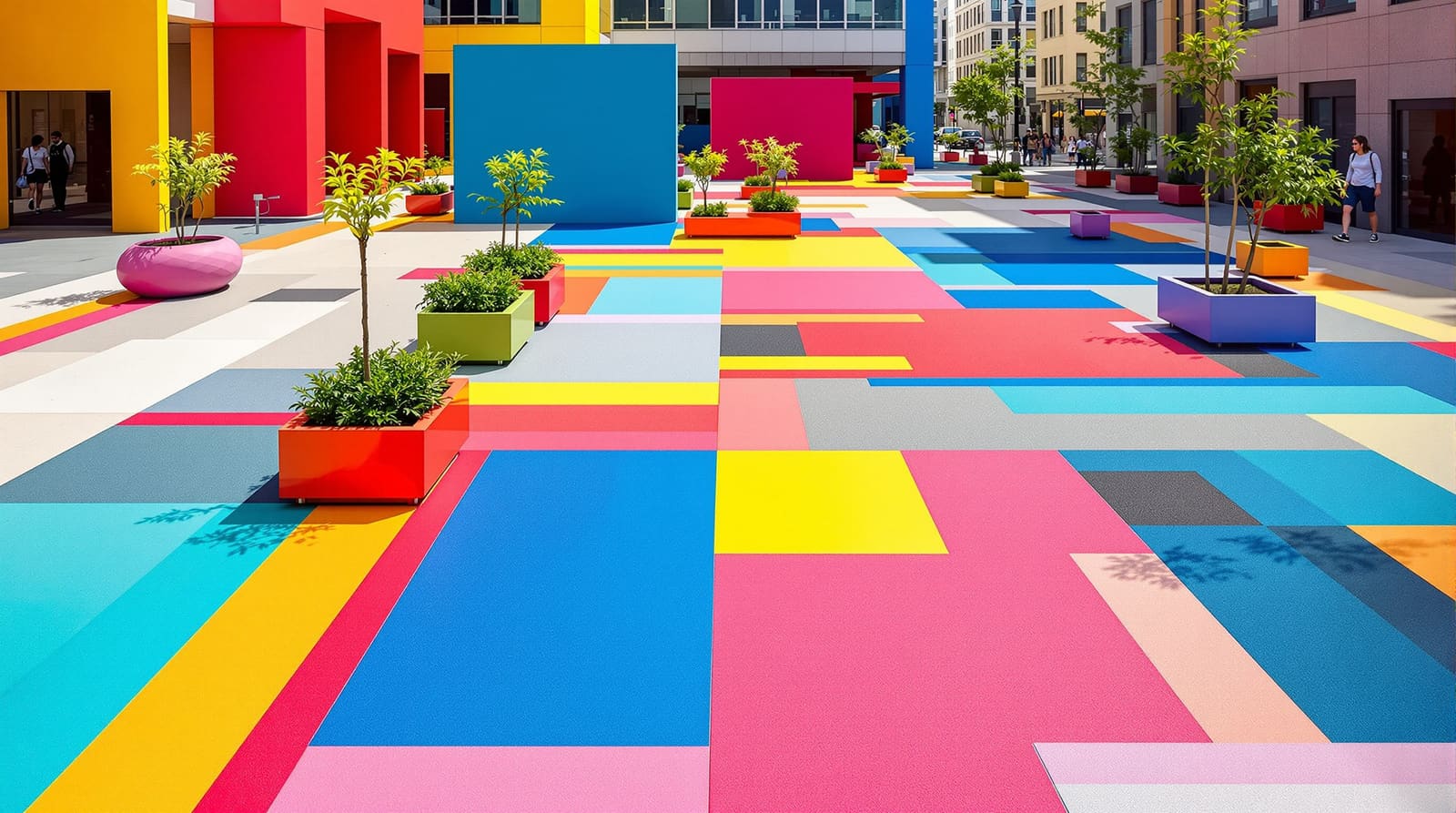
The result is a body of work that treats a plaza or a courtyard the way a painter treats a canvas. Colour is not incidental; it is the point — fields of red, magenta, acid green deployed with the confidence of someone who knows exactly what a single bold hue can do to a grey city. Geometry is explicit and unapologetic: grids, stripes, concentric rings, sharp polygons. Objects are repeated until they become a pattern, and the pattern becomes the composition. And crucially, she refuses to be bound to living material. If plastic, painted steel, glass or coloured gravel says the thing she wants to say, she will use it. Her notorious "Splice Garden" of 1986, a roof garden for the Whitehead Institute in Cambridge, Massachusetts, collaged a French formal garden and a Japanese garden together using no living plants at all — a knowing comment on artifice, on the impossibility of "nature" on a sterile rooftop, and on how much of what we call landscape is really cultural code.
This is the heart of her argument with her own profession. For most of the twentieth century, landscape was understood as the soft, supporting cast — the planting that softened a building, the lawn that filled the space left over after the architects had finished. Schwartz fought that idea her entire career. A landscape, she insisted, can be the main event. It can be smart, funny, beautiful and difficult all at once. It can hold ideas. And it deserves to be judged as art is judged — by what it means, not merely by whether the shrubs are thriving.
Life and path
Born in Philadelphia in 1950, Schwartz studied fine art before crossing into design, eventually taking a degree in landscape architecture at the University of Michigan. That double education — artist first, landscape architect second — is the key to her whole sensibility, and it explains why she has always been more comfortable on the boundary between the two than at the safe centre of either.
The Bagel Garden of 1979 announced her arrival as a deliberate troublemaker, and she never softened the stance. Through the 1980s and beyond she built a practice that took the conceptual energy of those early provocations and scaled it up to real public commissions across the world. Eventually that practice became Martha Schwartz Partners, working internationally from London. Alongside building, she taught — for many years at Harvard's Graduate School of Design — where she pressed generations of students to think of landscape as a serious cultural discipline rather than ornamental gardening.
The body of work that followed was overwhelmingly urban and public: plazas, courtyards, squares and civic spaces in cities from New York to Dublin to Manchester to Arizona. These were not gardens in any cottage sense. They were designed pieces of city — hard-surfaced, boldly patterned, often startlingly coloured, intended to give people in dense urban places something to look at, gather around and remember.
In her later career Schwartz made a pointed turn. She became a vocal campaigner on climate change, arguing that landscape architects carry a particular professional responsibility in the climate crisis. But — and this is important — her version of that turn is not a retreat into meadows and wildflowers. It is about hard urban resilience: the heat of paved cities, the urban heat-island effect, and how designed public spaces can be made to cool, shade and adapt while still working as dense, functional, art-driven city. The provocateur became an activist without ever becoming a romantic about "nature".
The signature works
| Work | Place & dates | Why it matters |
|---|---|---|
| Bagel Garden | Boston, Massachusetts, 1979 | Her own front garden — purple gravel, clipped boxwood & varnished bagels; the cover scandal that launched a career |
| Splice Garden | Whitehead Institute, Cambridge, Massachusetts, 1986 | A French & Japanese garden collaged on a roof using no living plants — a meditation on artifice |
| Jacob Javits Plaza | New York City | A hard civic plaza rethought with sinuous benches & bold form, reclaiming a difficult public space |
| Grand Canal Square | Dublin, Ireland | A red "carpet" of glowing light-stems & a green polygon, turning a waterfront square into civic theatre |
| Exchange Square | Manchester, England | A regenerated city square knitting old & new Manchester with strong geometry & level changes |
| Mesa Arts Center | Mesa, Arizona | Colour, shade & pattern shaping a desert arts campus for an extreme climate |
Grand Canal Square in Dublin is perhaps the clearest distillation of what Schwartz does. The square is split between a red zone and a green zone: the red is a paved expanse studded with tall, angled stems of glowing red light — "glow sticks" planted in the city like an artificial garden — while the green is a tilted polygon of planting. By day it is graphic and confident; by night it becomes pure spectacle. It is unmistakably a designed object, a work of art that happens to be a public square, and people use it precisely because it is unlike anything around it.
Jacob Javits Plaza in New York shows the other side of her practice — the salvage operation. The site had a famously troubled history as a barren, unloved federal plaza. Schwartz's response was not to soften it with trees alone but to give it form and intent, with long sweeping benches and a clear compositional logic, treating a hostile leftover space as a problem of design rather than decoration. The Splice Garden, meanwhile, remains the conceptual keystone: by building a "garden" with no living thing in it, she forced the question that runs through all her work — what is a landscape actually for, and what is it allowed to be made of?
The philosophy
Strip away the colour and the controversy and Schwartz's philosophy is coherent and teachable. A landscape is a composition. It is built from a vocabulary — colour, geometry, repeated objects, hard materials — and arranged to carry an idea and to give people an experience. That vocabulary overlaps directly with the fundamentals we set out in the seven elements of landscape design, and with the broader grammar of the discipline in the principles of landscape architecture. Where Schwartz departs from the gentle tradition is in her insistence that those elements can be pushed to full intensity — that a plaza can be loud, graphic and unapologetic and still be good design.

A garden, she has argued in spirit, is not nature but culture — a set of ideas made physical; landscape is an art form, and its job is to make people think, not merely to please.
Her materials thinking is equally instructive. Schwartz works as comfortably in stone, paving and engineered surface as in planting, which is why her lessons land hardest in the hard, urban end of the discipline — the world of natural stone in landscape design and of paving, plaza and pattern. Even the most reduced, hard-edged of her spaces is composed to be felt, which is why her work also speaks to the quieter question of why some gardens feel peaceful: atmosphere, she shows, is engineered, not stumbled upon.
India
Schwartz never worked in India, yet few masters are more relevant to where Indian cities now stand. India is urbanising at extraordinary speed, and its public realm — the plaza outside the metro station, the forecourt of the mall, the civic square, the campus courtyard — is overwhelmingly hard, paved and improvised rather than designed. This is exactly Schwartz's territory. Her career is one long argument that such spaces deserve serious design attention, that they can be made into landmarks and gathering places with colour, geometry and intent, and that this need not cost a fortune in lawns and irrigation a dry city cannot spare.
Her late climate turn makes the case stronger still. Indian cities are punishingly hot and getting hotter, and the urban heat-island effect bakes precisely the hard, paved public spaces Schwartz specialises in. Her question — how do we keep a dense, hard urban space working as civic art while making it shade, cool and adapt — is the right question for an Indian municipal commissioner to be asking. And her smaller lesson scales beautifully: even a tight, hard-surfaced courtyard or terrace can be composed as a piece of art, an idea that runs straight through small urban garden design.
She belongs in a lineage worth tracing for any Indian designer. Where Roberto Burle Marx painted the ground with sweeping organic colour, Schwartz is his sharper-edged, conceptual descendant — colour and pattern as fine art, but cooler, more ironic, more urban. And where Frederick Law Olmsted argued that great public space is a public good, Schwartz argues the same case in the register of contemporary art for the dense modern city.
Legacy and what we can learn
Martha Schwartz's deepest achievement is legitimisation. Because she fought — loudly, for decades, at real cost to her early reputation — landscape architecture is now widely accepted as a fine art and a serious intellectual discipline, not the decorating crew that arrives after the architects leave. A whole generation of designers works with colour, concept and bold geometry as a matter of course because she made it sayable. Her later activism extends that authority into the climate crisis, insisting that those who shape the hard surfaces of cities also carry responsibility for how those cities will cope with heat.
For an Indian reader the practical takeaway is bracing and freeing: your outdoor space does not have to be a soft green afterthought to be beautiful or meaningful. A courtyard, a terrace, a forecourt, a rooftop — even a small, hard, sun-struck one — can be composed deliberately, with colour, pattern, a strong geometric idea and the right materials, into something that lifts the whole property. That ambition, incidentally, is also good economics, as we explore in landscape design and property value. When you are ready to picture such a space, DesignAI can help you compose a designed outdoor space — to test colour, geometry and material before a single paver is laid.
References
- Tim Richardson, The Vanguard Landscapes and Gardens of Martha Schwartz (Thames & Hudson).
- Martha Schwartz: Transfiguration of the Commonplace — collected essays and projects on her conceptual landscapes.
- Martha Schwartz Partners: Process: Landscape Form — a monograph on the practice's working method and built work.
- Landscape Architecture Magazine, the 1980 cover feature and debate surrounding the Bagel Garden.
- Profiles and interviews on Schwartz's climate-activist turn and her teaching at the Harvard Graduate School of Design.
- Martha Schwartz Partners, project documentation for Grand Canal Square (Dublin), Exchange Square (Manchester) and Mesa Arts Center (Arizona).
Explore the ideas Schwartz championed — landscape as fine art, bold colour and geometry, and public space as designed provocation — alongside fellow masters Roberto Burle Marx and Frederick Law Olmsted, and plan a designed outdoor space of your own with DesignAI.
Philosophies they championed