
Roberto Burle Marx
The painter who invented the modern tropical garden
Photo: aroid, CC BY 2.0, via Wikimedia Commons
Movements
Signature works
- Copacabana promenade
- Sítio Roberto Burle Marx
- Flamengo Park
- Ministry of Education roof garden
- Itamaraty Palace gardens, Brasília
Stand on the seafront at Copacabana in Rio de Janeiro and look down at the pavement. Running for four kilometres between the city and the sand is a black-and-white mosaic of swirling, wave-like bands — a great river of stone that seems to ripple as you walk it. Most visitors take it for an old Portuguese tradition. It is in fact a painting, laid in the ground in the 1970s by a man who treated gardens, promenades, beaches and entire hillsides as canvases. From a hotel balcony above, the curves resolve into a single enormous abstract composition, scaled to the city itself.
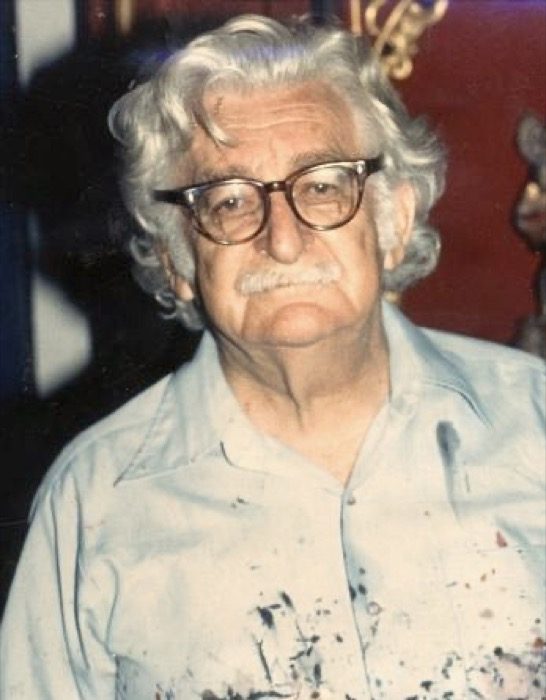
The man who drew those waves was Roberto Burle Marx, born in São Paulo in 1909 and, by the time of his death in 1994, the figure who almost single-handedly invented the modern tropical garden. He trained first as a painter, in Berlin, where — by a strange accident — he discovered the plants of his own country growing in a hothouse, exiled from home and more vivid than anything in the European borders he was being taught to admire. He went back to Brazil and spent sixty years arguing, in colour and in living tissue, that a hot country did not need to imitate the cool clipped gardens of France and England.
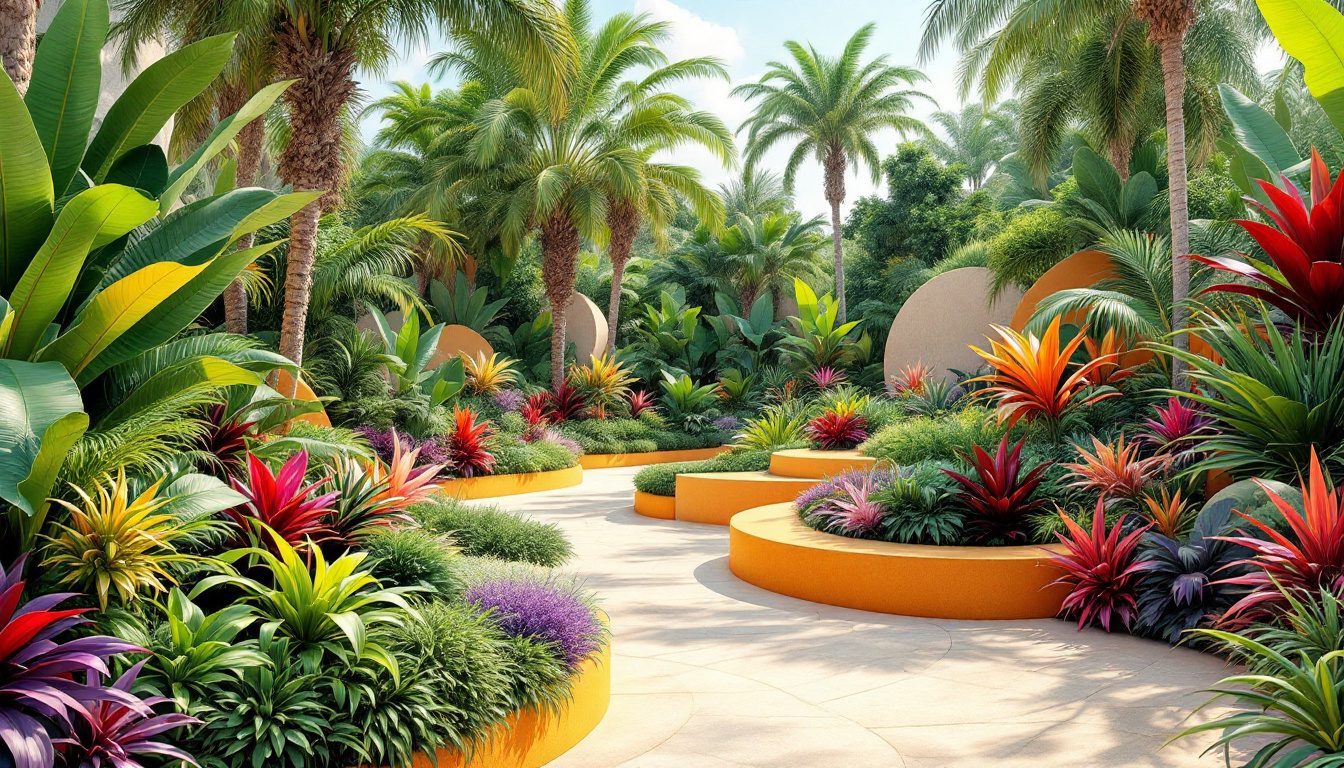
Burle Marx's central idea was that a garden is a work of abstract art made with living plants — composed in bold biomorphic curves and broad masses of colour and leaf — and that in the tropics this art should be built from a country's own native flora rather than borrowed European species. Around that conviction he built a body of work that fused modern painting, botany and ecology, and that made him the founding figure of modernist landscape architecture in the warm world.
The idea: painting with plants
Burle Marx came to landscape from the easel, and he never really left it. He looked at a site the way a painter looks at a blank canvas: as a field of shape, colour, texture and rhythm waiting to be composed. Where the European tradition prized straight axes, clipped hedges and symmetry, he drew long sinuous curves — the biomorphic forms of the modern painters he admired, Arp and Miró and the Brazilian modernists — and filled them with sweeping single-species masses so that a bed of one plant became a stroke of pure colour and another a contrasting block of texture.
The genius of the method was that it used the tropics' own gifts. A temperate garden changes through four seasons and is muted for half the year; a tropical palette is loud, glossy, architectural and evergreen, full of enormous leaves, scarlet bromeliads, silver-backed foliage and violent flowering. Burle Marx saw that this was not a problem to be tamed into European restraint but the very material of a new art. He grouped plants by leaf shape and colour the way a painter groups pigments, and he planned his beds first as flat patterns on paper — gouache paintings, many of which hang in museums today as art in their own right — then translated them into the ground.
This was never decoration for its own sake. By massing plants and reading the garden as one large composition seen from above or along a sweeping promenade, he gave the modern tropical landscape a clarity and calm that fussier, mixed-bed planting never achieves. The same logic explains why his pavements and his planting plans look like the same hand at work — because they were. He composed the hard surface, the water and the living plants as a single abstract field.
Life and path
Roberto Burle Marx was born in 1909 into a cultured São Paulo household — a German-Jewish father and a Brazilian mother who loved music and gardening — and the family soon moved to Rio de Janeiro. He grew up expecting to be a painter and a singer, and in 1928 the family travelled to Berlin so that he could study art and treat a vision problem. It was there, in the glasshouses of the Dahlem botanical garden, that the decisive thing happened: he found whole rooms of Brazilian plants, cultivated as exotic treasures by Europeans, while back home the same species were dismissed as common weeds and the wealthy planted roses and clipped box in imitation of Versailles.
He returned to Rio in 1930 determined to do the opposite of his class. As a young man he began to design gardens around the architecture of Brazil's emerging modern movement, and in 1932 he produced his first commissioned garden. The breakthrough came through his friendship with the architect Lúcio Costa and the young Oscar Niemeyer: when their generation set out to invent a Brazilian modern architecture, Burle Marx became its landscape counterpart, the designer who could give a white concrete building a setting as modern and as Brazilian as itself.

Over the next six decades he designed more than two thousand gardens and landscapes across Brazil and the world, ran a studio that was also a botanical research enterprise, and mounted plant-hunting expeditions deep into the Brazilian interior. He was a painter, a printmaker, a stage designer, a singer and a cook as well as a garden-maker; visitors to his estate remembered enormous lunches, opera on the gramophone and a man who could not stop pointing out the form of a leaf. He worked almost until his death in Rio in 1994, by which time he was recognised everywhere as the father of the modern tropical garden.
The signature works
Burle Marx worked at every scale, from a private patio to a four-kilometre seafront, and across painting, pavement, planting and pure botany. A handful of works carry the whole argument.
| Work | Place & dates | Why it matters |
|---|---|---|
| Ministry of Education roof garden | Rio de Janeiro, 1938 | One of the first modern roof gardens; biomorphic native planting crowning the Costa–Niemeyer–Le Corbusier landmark of Brazilian modernism. |
| Sítio Roberto Burle Marx | Barra de Guaratiba, Rio, from 1949 | His own estate and living plant collection — over 3,500 species, many he discovered; now a museum and UNESCO World Heritage Site. |
| Copacabana promenade | Rio de Janeiro, completed 1970 | A four-kilometre black-and-white-and-red mosaic of rolling waves — an abstract painting laid into the city's seafront. |
| Flamengo Park (Parque do Flamengo) | Rio de Janeiro, 1960s | A vast reclaimed-land public park along Guanabara Bay, planted as great sweeping masses of Brazilian flora. |
| Gardens for Brasília | Brasília, 1960s onward | Landscapes for Niemeyer's new capital, including the Itamaraty Palace water gardens, setting modern monuments in tropical planting. |
| Plant expeditions & new species | Brazil, across his life | Field collecting that brought unknown Brazilian plants into cultivation; roughly thirty species bear the name burle-marxii. |
The Copacabana promenade is the work most of the world has walked without knowing it. Burle Marx redrew the seafront pavement as a single abstract composition — undulating bands of black and white Portuguese stone with red accents, the curves answering the rhythm of the waves and the sweep of the bay. It is landscape as public painting, scaled to be read from the high apartment blocks above as much as by the feet below, and it shows how completely he erased the line between art and ground.
The Sítio is the heart of the story. In 1949 he bought a former plantation outside Rio and turned it into a living laboratory and collection: ranks of bromeliads and aroids and palms, many of them species he had found himself on expeditions into the Amazon and the Atlantic forest, some new to science. It was at once his studio, his refuge, his botanic garden and his greatest single work, and in 2021 it was inscribed as a UNESCO World Heritage Site — recognition that a garden-maker's collection could be a monument of world culture.
The Ministry of Education and Health roof garden of 1938 is where it all began publicly. On the roof of the building that announced Brazilian modernism — designed by Costa and Niemeyer with Le Corbusier consulting — Burle Marx laid out flowing beds of native plants, proving that the modern garden and the modern building belonged together.
The philosophy
Burle Marx is the founding figure people reach for whenever they explain tropical landscape design — the conviction that a garden in a hot, humid land should celebrate the bold foliage, the glossy leaves and the architectural plants the climate produces, instead of pretending to be a cool European border. He showed that the warm-world palette is not a poor relation of the temperate garden but a richer one, and that its right register is mass, contrast and curve.
He was also, decades before the word was fashionable, a pioneer of what we would now call biophilic landscape design. For Burle Marx, bringing the living tropical forest — its bromeliads, its water, its huge leaves and dappled shade — into the city and onto the rooftops of modern buildings was not an ornament added at the end but the whole substance of the work. A garden was a piece of nature composed by an artist, meant to be lived in, walked through and felt.
Above all he was the great champion of native planting. While Brazil's elite imported European species and styles as a mark of status, he insisted that the country's own flora — much of it then uncollected, undescribed and disappearing — was its truest material and its responsibility. That instinct made him, late in life, a fierce ecological campaigner against deforestation, and it connects directly to the question of why some gardens feel peaceful: a planting that belongs to its place, thrives in its own climate and reads as one calm composition is restful in a way that a struggling collection of mismatched imports can never be.
A garden, Burle Marx liked to say, is the result of arranging natural materials according to aesthetic laws — it is nature organised by art.
India
Burle Marx never worked in India, yet few global figures speak more directly to the Indian landscape. India is, across most of its peninsula and coast, a warm-humid and hot-dry tropical country — exactly the climate for which he wrote the modern grammar. The Indian designer faces his founding dilemma in sharper form: a colonial inheritance of clipped lawns, English borders and rose gardens that fight the heat and devour water, set against a magnificent native flora of flame-of-the-forest and gulmohar, frangipani and champa, cannas and crotons, palms and bananas and bold-leaved aroids that thrive on the monsoon and the sun.
His three lessons translate almost without adjustment. First, plant native and plant for the climate: the species that already belong to a region need the least water and care and look the most at home — the argument behind Studio Matrx's guides to the best trees for Indian homes and to climate-responsive landscape design. Second, compose in masses and curves rather than fussy mixed beds, so that the bold tropical leaf does the work — a single sweep of canna or a drift of one bromeliad reads with a calm that a crowded border never will. Third, treat the ground plane, the water and the planting as one designed surface, the lesson of the Copacabana promenade for any Indian courtyard, terrace or apartment plaza.
There is an Indian master who carried much of this spirit into the subcontinent's own landscape. Mohammad Shaheer, the designer of the gardens at Sanskriti Kendra and of much of the restored Mughal landscape at Humayun's Tomb, worked in the same belief that a landscape must grow from its own place, its own water logic and its own plants rather than an imported template — a north-Indian counterpart to Burle Marx's tropical Brazil.
Legacy and what we can learn
Burle Marx changed what a garden could be. Before him the tropical garden was an apology — an attempt to recreate Europe under a hotter sun. After him it was an art form with its own rules, its own palette and its own pride, and almost every modern landscape architect working in the warm world descends from his example. Alongside the great Western tradition of the public landscape founded by Frederick Law Olmsted, he stands as the figure who proved that the modern landscape could be at once a work of abstract art, a piece of living ecology and a gift to a whole city.
His second legacy is ecological, and it has only grown more urgent. The plant-collector who filled the Sítio with species rescued from a vanishing forest became, in his last decades, one of Brazil's loudest voices against deforestation — an early union of design and conservation. He understood that to champion native flora is also to protect it. For an India losing native trees and groundwater to imported lawns, that union of beauty and stewardship is the heart of the matter.
The first practical lesson, though, is bracingly simple and still under-applied in Indian gardens. Before you order turf and roses and a clipped hedge, look at what already grows and thrives where you are. Choose plants that belong to your climate; plant them in bold masses and flowing curves so the foliage itself becomes the design; treat the paving, the water and the planting as one composition. Burle Marx proved that a garden built from its own place is not a compromise but a richer, calmer and more beautiful thing — and that drawing it well is an act of art, botany and conscience at once.
His principles — native-first, climate-led, composed as one living whole — are exactly the ones we encode in DesignAI, so that a tropical garden can be planned from the plants and the place outward, the way he always insisted.
References
- Roberto Burle Marx and Lauro Cavalcanti, Roberto Burle Marx: The Lyrical Landscape.
- Rossana Vaccarino (ed.), Roberto Burle Marx: Landscapes Reflected (Princeton Architectural Press).
- William Howard Adams, Roberto Burle Marx: The Unnatural Art of the Garden (Museum of Modern Art).
- Jens Hoffmann and Claudia J. Nahson, Roberto Burle Marx: Brazilian Modernist (Jewish Museum, New York).
- UNESCO World Heritage Centre — Sítio Roberto Burle Marx inscription (2021).
- Marta Iris Montero, Burle Marx: The Lyrical Landscape.
Explore the ideas Burle Marx championed — tropical landscape design, biophilic landscape design and why some gardens feel peaceful — alongside fellow masters Frederick Law Olmsted and India's own Mohammad Shaheer, and plan a native, climate-led garden of your own with DesignAI.
Philosophies they championed