
How Landscape Design Influences Property Value in India
The honest ROI case for landscape — kerb appeal, resale velocity, and where to spend for return.
Two identical flats sit in the same Pune society, same floor plan, same builder, same year. One overlooks a tired strip of patchy grass and a broken paver path; the other faces a small, well-kept court with a shade tree, a clean stone bench, and warm evening lights. When both come up for resale, the second one shows faster, gets warmer reactions on the very first site visit, and quietly commands a better number. Nobody wrote "landscape premium" on the agreement. But everyone felt it.
That feeling is the whole subject of this guide. In India, property value is dominated by hard fundamentals: location, land area, built-up area, floor, age, legal title, and the going rate per square foot in that micro-market. Landscape does not override any of those. What good landscape does is move the buyer emotionally at the exact moment of decision, shorten the time a property sits on the market, and protect the value the rest of the building already carries. The effect is real, but it is contextual, and it rewards the owner who spends in the right order.
The core claim of this guide: in the Indian context, landscape design rarely changes the per-square-foot rate of your land or built-up area, but it reliably improves three things that translate into money — kerb appeal and first-impression conversion, resale and rental velocity (how fast you transact and at what discount-to-asking), and the protection of value already built. Spent well, ₹1 of considered landscaping returns more than ₹1 in faster, cleaner transactions; spent badly, it actively destroys value through maintenance liabilities and over-personalisation.
What the evidence actually says
International research has studied this question more rigorously than India has, and the honest summary is: mature, well-designed landscaping is associated with a measurable uplift in home value, usually expressed as a percentage range rather than a fixed number. United States studies and reviews — frequently cited from work compiled around Clemson University and the University of Washington's "Green Cities: Good Health" programme led by Dr. Kathleen Wolf — suggest that quality landscaping can be associated with home-value premiums commonly quoted in the broad band of 5% to 15%, with mature trees and a coherent design pulling toward the higher end and a bare or neglected yard pulling toward zero or negative.
Two cautions before you anchor on those figures. First, they are largely Western, single-family, owned-yard datasets; they do not transplant cleanly to an Indian apartment market where the "yard" may be shared society land you do not individually own. Second, percentages are seductive but slippery — a 10% uplift on a ₹2 crore villa with its own garden is a different proposition from 10% on a 2BHK flat where you control only a balcony. Treat the range as direction, not a guarantee.
What does travel across markets is the underlying mechanism. The Royal Institution of Chartered Surveyors (RICS) and valuation practice everywhere recognise that "presentation" and "kerb appeal" affect saleability and the achievable price within a market band. The Indian Society of Landscape Architects (ISOLA) and green-building bodies like IGBC also note the wellbeing and microclimate benefits of planting — shade, cooling, dust capture — which buyers increasingly value even when they cannot price them precisely.
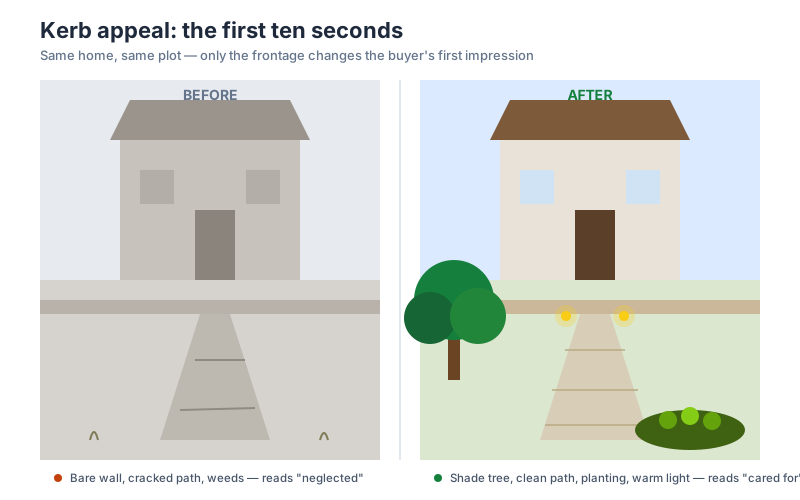
Kerb appeal: the first ten seconds decide a lot
Before a buyer reads the agreement or measures a room, they form a judgement from the gate. Real-estate agents call it the "drive-up" or "drive-by" reaction, and it is disproportionately powerful because it is the lens through which everything after it is interpreted. A clean, green, well-lit approach signals "this home is cared for," and that single inference quietly raises a buyer's tolerance on price and lowers their suspicion about hidden defects. A weedy, cracked, dark approach does the opposite — it primes the buyer to hunt for problems.
This is why kerb appeal punches above its cost. You are not landscaping the whole plot; you are choreographing roughly the first ten seconds: the gate and compound wall, the entry path, one or two strong plants or a single good tree, and the front lighting. For most Indian homes, getting this narrow zone right is the single highest-return landscape move available — far cheaper than a full garden, and far more visible.
What specifically adds value — and what doesn't
Not all landscape spend is created equal. The features that hold and add value tend to be the ones a future buyer reads as low-effort to maintain, genuinely useful, and climate-sensible. The features that destroy value tend to be high-maintenance, hyper-personal, or fragile.
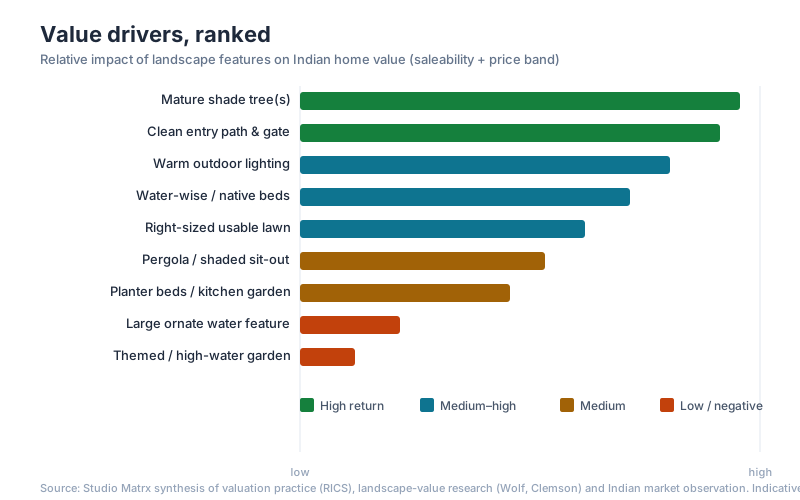
| Feature | Value impact | Why |
|---|---|---|
| Mature shade tree(s), well-placed | High | Irreplaceable on a short timeline; cooling, status, instant maturity |
| Clean, intact hardscape path & entry | High | Reads as "cared for"; durable; fixes first impression |
| Modest, usable lawn or court | Medium–High | Buyers value usable green space; oversized lawns lose points |
| Good, low-key outdoor lighting | Medium–High | Cheap, transforms evening kerb appeal, signals safety |
| Water-wise / native planting | Medium | Low maintenance is a selling point; survives neglect between owners |
| Defined kitchen-garden or planter beds | Medium | Aspirational, but only if tidy and not overgrown |
| Ornate fountain / large water feature | Low / Negative | High upkeep, mosquito and algae risk, very personal |
| Elaborate themed garden (topiary, koi) | Negative | Maintenance liability; narrows the buyer pool |
| Sprawling high-water lawn in a dry city | Negative | Reads as a future water bill and a chore |
The pattern is consistent: buyers pay for green that looks effortless and punish green that looks like a second job. A jamun or neem you cannot buy time for adds value precisely because it is mature; a koi pond subtracts value because the next owner inherits the pump, the feeding, and the algae. For species choices that age gracefully in Indian conditions, our companion guide on the best trees for Indian homes is the practical reference.
Cost versus value: spend where the return is
The smartest way to think about landscape ROI is a quadrant: how much does an item cost, and how much value (saleability + price band + protection) does it return? You want to live in the high-return half and avoid the bottom-right "money pit" corner.
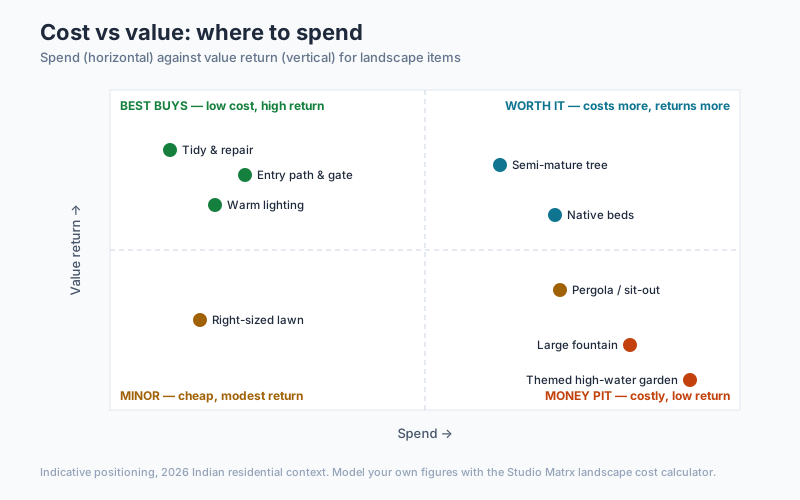
| Item | Indicative cost (₹) | Value return | Verdict |
|---|---|---|---|
| Tidy + repair existing greenery, paths | 10,000–60,000 | High | Do this first, always |
| Front-entry path + gate refresh | 40,000–1,50,000 | High | Best kerb-appeal rupee |
| Warm outdoor / path lighting | 25,000–1,20,000 | High | Cheap drama, signals safety |
| One semi-mature tree, well-sited | 8,000–40,000 each | Medium–High | Buys instant maturity |
| Native / drought-tolerant beds | 30,000–1,50,000 | Medium | Low upkeep = selling point |
| Modest lawn (right-sized) | 40–120 / sq ft | Medium | Good if usable, not vast |
| Pergola / shaded sit-out | 1,00,000–5,00,000 | Medium | Adds usable "room" outdoors |
| Large fountain / water body | 1,50,000–6,00,000+ | Low | Upkeep eats the return |
| Full themed makeover, high-water | 5,00,000+ | Low / Neg | Over-personalised, fragile |
These figures are indicative 2026 ranges and vary widely by city and finish; model your own numbers with our landscape cost calculator and read the full breakdown in the landscape cost guide for India. The discipline that matters is sequence: repair and tidy, then frame the entry, then light it, then add maturity, and only then consider the discretionary features.
The gated-community and villa premium
Where landscape's value effect is clearest in India is at the project and villa-plot scale, not the individual flat. Buyers consistently pay a premium to live inside a well-landscaped gated community, and developers know it — which is why marketing for premium townships leads with avenues of trees, central greens, and walking loops rather than floor plans. Here landscape is sold as lifestyle and as a proxy for management quality: lush, maintained common areas tell the buyer that the society is solvent, organised, and pleasant to live in.
For an individual unit, this means two things. If you own a villa or independent house on its own plot, your private landscape is a direct lever you control, and the high-return moves above apply to you fully. If you own a flat, your individual control is limited to your balcony, terrace, or deck — but the society's common landscape still affects your unit's saleability, so participating in (and protecting) good common-area maintenance is itself a value-protection strategy. A balcony or terrace garden that is genuinely usable and tidy is the apartment owner's version of kerb appeal.
Rentals, resale velocity, and the value of speed
Property value is not only the headline price; it is also how fast and how cleanly you transact. This is where landscape quietly earns its keep, because velocity has real monetary value: every extra month a property sits unsold or unlet carries holding cost — EMI, maintenance, opportunity cost — and a longer time-on-market usually ends in a bigger negotiated discount.
| Outcome lever | Bare / neglected frontage | Well-landscaped frontage |
|---|---|---|
| First-visit impression | Defensive, defect-hunting | Warm, trusting |
| Time on market (resale) | Longer | Shorter |
| Negotiation pressure | Higher discount to asking | Lower discount to asking |
| Rental appeal | Price-led tenants | Quality, longer-stay tenants |
| Achievable rent | At or below band | Top of band |
For rentals specifically, presentation attracts a better class of tenant — the kind who stays longer, treats the property well, and reduces vacancy churn. A clean green entry and a usable balcony garden let you sit at the top of your locality's rent band rather than competing only on price. None of this requires a grand garden; it requires a frontage that looks cared for in photographs and in the first thirty seconds of a viewing.
Maintenance: the value-protector you cannot skip
Here is the rule that catches most owners: a landscape is an asset only while it is maintained; the day it is neglected it flips into a liability. Overgrown beds, a dead tree leaning over the boundary, a cracked path, a green-water tank, peeling pergola paint — these do not read as "neutral," they read as "this whole property is neglected," and they drag down the very first impression you spent money to build.
This is why the value question is really a maintenance question. A modest, well-kept garden beats an ambitious, half-dead one every time, on both kerb appeal and on the implied cost the buyer is taking on. The practical takeaways: right-size the planting to the upkeep you (or the next owner) will realistically commit; favour native and drought-tolerant species that survive neglect; keep hardscape simple and repairable; and budget a small recurring maintenance line rather than a one-time burst followed by decline. For the deeper case on why thoughtful landscape design — not just planting — is what protects this value, see why landscape architecture matters in India, and browse the full landscape hub for design-led approaches.
Mistakes that destroy value
Some landscape spending does not merely fail to add value — it subtracts. These are the patterns that shrink your buyer pool, raise the implied maintenance burden, or actively damage the building.
| Mistake | How it destroys value |
|---|---|
| Over-personalised theme (zen koi, topiary maze) | Narrows buyer pool; reads as a chore to inherit |
| High-water lawn in a water-stressed city | Signals a future bill and a hose-bound weekend |
| Trees planted too close to the structure | Root and foundation risk; a known red flag for buyers |
| Hardscape that traps water against walls | Damp, seepage, structural worry — a deal-killer |
| Fragile, high-maintenance features left to rot | Neglect signal that taints the entire property |
| Over-capitalising beyond the locality | You cannot recover ₹15 lakh of garden in a ₹60 lakh street |
| Blocking light, ventilation, or the facade | Hides the home's own selling points |
| Ignoring drainage to chase aesthetics | The most expensive mistake — invisible until it floods |
The thread running through every entry is over-reach: spending past what the market, the climate, or the next owner can absorb. Landscape adds value when it matches its context and subtracts value when it fights it.
A practical "where to spend for return" priority list
If you have a limited budget and one clear goal — protect and lift the value of your property — spend in this order:
1. Tidy and repair what exists. Clear weeds, trim, fix the broken paver, repaint the gate. Highest return per rupee, every time.
2. Fix the first ten seconds. Gate, entry path, one strong plant or tree, and clean lines at the threshold. This is your kerb appeal.
3. Light it warmly. A few well-placed, low-glare fixtures transform the evening impression and signal safety for a modest sum.
4. Buy maturity selectively. One or two semi-mature, well-sited native trees give an instant sense of an established home.
5. Right-size the green. A modest, usable lawn or court beats a vast, thirsty one. Choose drought-tolerant planting that survives neglect.
6. Add a usable outdoor "room" only if the market supports it. A simple pergola or shaded sit-out, if villas in your locality have them.
7. Treat discretionary water features as cost, not investment. If you want a fountain, want it for yourself — do not expect it back at resale.
Follow that order and you spend the cheap, high-return rupees before the expensive, low-return ones, which is the entire game.
The honest India caveat — and the forward view
It would be dishonest to end on a tidy percentage. In most Indian transactions, the valuer and the buyer's mental model are anchored to land area, built-up area, location, and the prevailing rate per square foot. Landscape is a modifier on top of those fundamentals, not a replacement for them. Its effect is genuine but contextual: largest for villas and plotted homes you control, real but indirect for flats inside well-managed societies, and easily negative when it is over-built, thirsty, or neglected.
What is changing is the direction of buyer preference. As Indian cities heat up, as water grows scarcer, and as wellbeing becomes a conscious purchase criterion, the homes that read as green, shaded, cool, and cared-for are pulling ahead — not as a luxury, but as resilience a buyer can see. The owner who spends a modest, disciplined amount in the right order, and then maintains it, is not chasing a speculative premium. They are buying a faster, cleaner sale and a property that protects its own worth. In a market that increasingly values comfort and climate sense, that is the quiet kind of return that compounds.
References
- Wolf, K. L., "Green Cities: Good Health," University of Washington — research summaries on urban trees, property values, and wellbeing.
- Clemson University Cooperative Extension — homeowner research notes on landscaping and home resale value (commonly cited 5–15% range).
- Royal Institution of Chartered Surveyors (RICS) — valuation practice on presentation, kerb appeal, and saleability within market bands.
- Indian Society of Landscape Architects (ISOLA) — professional perspectives on residential landscape and microclimate benefit.
- Indian Green Building Council (IGBC) — green-home rating criteria covering site greenery, water efficiency, and outdoor comfort.
- National Building Code of India (NBC 2016), Bureau of Indian Standards — site planning and open-space provisions.
- Studio Matrx — indicative 2026 Indian residential landscaping cost ranges and market observations.
Export this guide
Related Guides — Deep-dive reading
Why Landscape Architecture Matters More Than the Building
How the green around, above and beyond your home out-cools, out-drains and out-appreciates the structure itself — at every scale from balcony to city.
LandscapeThe Best Trees for Indian Homes
A research-grade guide to choosing and placing trees around an Indian home — the real cooling and clean-air numbers, the right species for shade, flowers, fragrance and fruit, and the placement science that keeps roots out of your walls and drains.
LandscapeThe Homeowner's Guide to Compound Walls and Gates in India (2026)
A plain-language, start-to-finish walkthrough of building a boundary wall and gate in India — plan and permit first, then material and height, foundation and structure, building and supervision, the gate, finishes, lighting and greenery, budget and long-term upkeep — with a stage-by-stage roadmap, a full planning checklist and answers to the questions every homeowner asks.
Compound WallsRelated Tools — Try Free
Garden Planning Toolkit
Get a tailored garden plan — planting layers, Indian species, features and a checklist — from your climate, space, sun and goals.
PlannerLandscape Cost Calculator
Estimate a garden's cost — hardscape, softscape, lawn, irrigation, lighting and annual upkeep — by area, tier and city.
Budget CalculatorCross-Ventilation Analyzer
Estimate airflow and air changes per hour (ACH) from room size, window areas, layout, and local wind — with NBC 2016 Part 8 compliance check.
Ventilation Calculator