

Dan Pearson
The ecological gardener of place, soil and time
Movements
Signature works
- Tokachi Millennium Forest, Japan
- Hillside, Somerset
- Chatsworth 'trout stream', Chelsea
- Maggie's Centre gardens
- Tower of London Superbloom
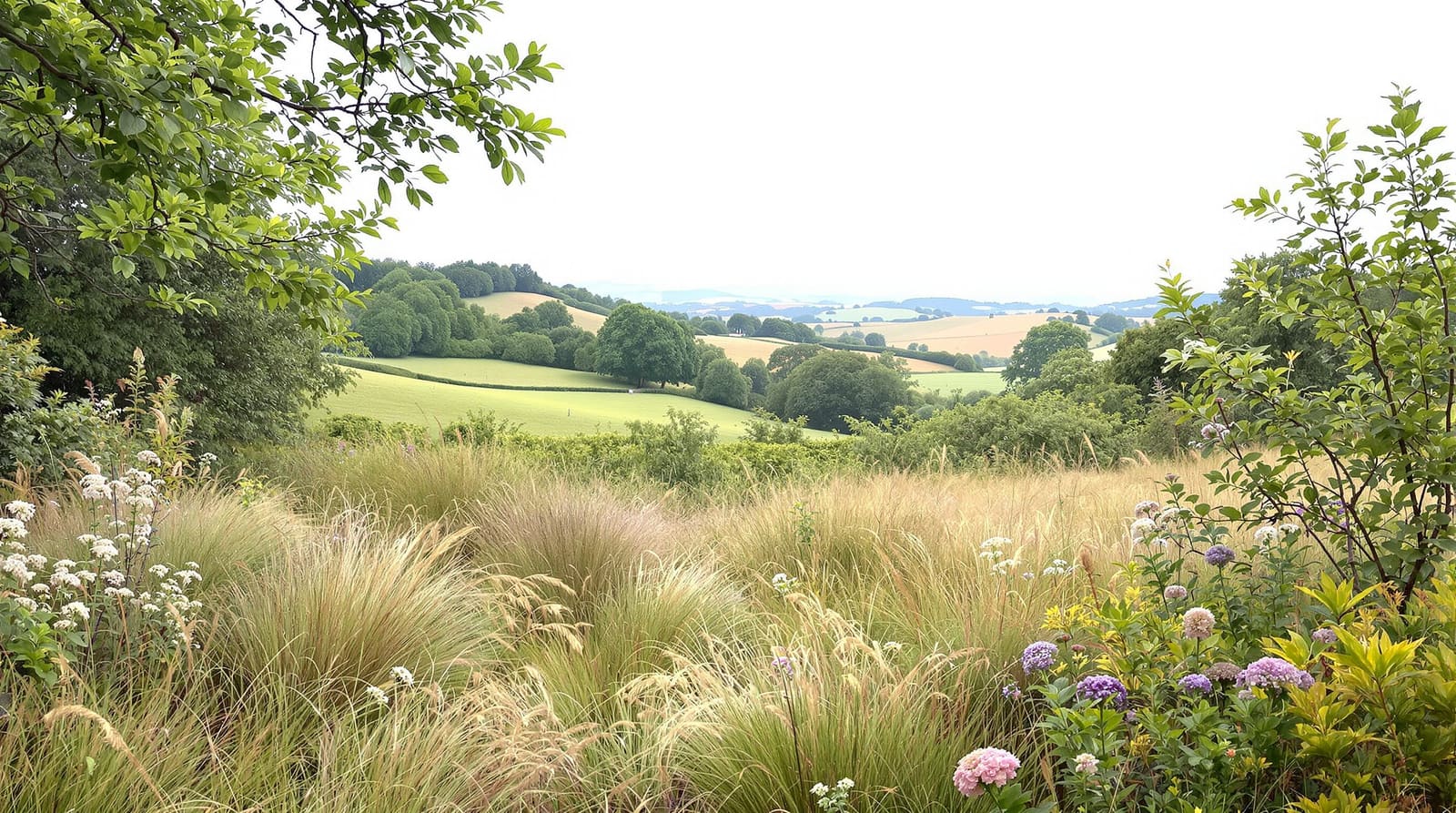
On a hill farm in Somerset, a garden runs out into the land without ever quite announcing where it ends. Vegetables give way to an orchard, the orchard to flowers, the flowers to rough meadow, and the meadow to the steep grazed slopes and ash woods that fold up the valley beyond. This is Hillside, the home and working garden of Dan Pearson, and it is the clearest statement of his life's argument: that the best gardens do not sit upon a place so much as grow out of it, until you can no longer tell quite where the made thing stops and the found one begins.
Dan Pearson is a British garden and landscape designer, born in 1964, and one of the most respected ecological and naturalistic planting designers working anywhere in the world. A deep plantsman with a painterly, atmospheric touch, he is also a gifted nature writer, and across four decades he has built a body of work — from a thousand-year forest in Japan to a meadow in the moat of the Tower of London — that treats land, soil, weather and time as collaborators rather than obstacles.
Pearson's central idea is simple and radical at once: a garden should grow out of its place — working with the soil, climate, ecology and slow time of a specific site — so that it feels found rather than imposed, and merges into the wider landscape around it.
The idea: a garden grown from its place
Pearson's method begins not with a drawing but with reading. Before a single plant is chosen, he wants to understand the site itself — its soil and subsoil, its slope and the way water moves across it, where the light falls and where the frost pools, which way the wind comes, and what the surrounding landscape is already doing. The design then grows outward from those conditions. Plants are selected because they belong to that place and will thrive there with little coercion, and they are arranged in loose, layered, ecological communities rather than tidy blocks. The result is a planting that knits itself together over the seasons, settles, and eventually looks as though it arrived on its own.
This is why so many of his gardens have the quality of being discovered rather than constructed. Pearson is suspicious of formality for its own sake and of the impulse to dominate a site. He prefers atmosphere — the half-light of a wood, the haze of a meadow in seed, the way a path disappears into long grass — to hard geometry. Crucially, he designs for change. A Pearson garden is not finished on the day it is planted; it is set in motion, expected to shift, self-seed, mature and even fail in parts, with the gardener working alongside those processes rather than freezing them. Working with nature, for him, is not a slogan but a practical discipline of patience.
Life and path
Pearson was born in 1964 and was, by his own account, plant-obsessed from childhood, raising seedlings and reshaping his parents' garden long before he could call it a vocation. That early fervour carried him into formal horticultural training of the highest order: he studied at the Royal Horticultural Society's garden at Wisley and then at the Royal Botanic Gardens, Kew, grounding his romantic instincts in rigorous botany and a working plantsman's knowledge of how things actually grow.
From the late 1980s onward he built a double career, as a designer and as a writer. His gardening columns — long associated with The Observer and the Guardian — won a wide readership for their lyrical, closely observed prose, and that observational habit fed directly into his design. He founded what is now Dan Pearson Studio and steadily took on more ambitious commissions, moving from private gardens to landscapes of real scale and public meaning. The turning point in his international reputation was the Tokachi Millennium Forest on the northern Japanese island of Hokkaido, an enormous ecological landscape conceived to last a thousand years.
In time, Pearson and his partner moved to Hillside, a hill farm in Somerset, which became both his home and his most personal long-term project — a productive and ornamental landscape observed season by season in his online journal, Dig Delve, and in his writing. His public profile was sealed by a run of Chelsea Flower Show triumphs, culminating in the celebrated naturalistic "trout stream" garden for Laurent-Perrier inspired by Chatsworth, which took Best in Show in 2015. In 2022 he created Superbloom, a vast wildflower meadow sown into the moat of the Tower of London to mark the Queen's Platinum Jubilee, turning a defensive ditch into a tide of colour and a habitat for pollinators.
The signature works
| Work | Place & dates | Why it matters |
|---|---|---|
| Tokachi Millennium Forest | Hokkaido, Japan (from c. 2000) | An ecological forest-garden landscape designed on a thousand-year horizon to reconnect people with nature — arguably his masterwork. |
| Hillside | Somerset, England (from 2010) | His own home and working garden — vegetables, orchard, flowers & meadow as one landscape, documented through the seasons. |
| Laurent-Perrier "trout stream" garden | Chelsea Flower Show, 2015 | A naturalistic stream-and-meadow garden inspired by Chatsworth that won Best in Show. |
| Maggie's Centre gardens | Various, UK | Calm, place-sensitive healing landscapes for cancer-care centres, where atmosphere does therapeutic work. |
| Torrecchia Vecchia | Lazio, Italy | A romantic, atmospheric garden woven into an old estate & its surrounding countryside. |
| Superbloom | Tower of London, 2022 | A wildflower meadow in the historic moat for the Platinum Jubilee — habitat, spectacle & civic gesture together. |
Of these, the Tokachi Millennium Forest is the fullest expression of Pearson's thinking. Working closely with the head gardener Midori Shintani, he shaped a sprawling landscape of native woodland, earth-formed meadows and gardens that flow into the wider Hokkaido terrain, designed to be sustainable and self-renewing over an almost unimaginable span of time. The brief was not to make a display but to give people a way back into a relationship with nature, and to manage the land so that it would deepen rather than degrade across generations. It is ecological stewardship as design, with the gardener cast as a long-term partner of the place.
Hillside is the intimate counterpart to that vast ambition. Here Pearson works a single Somerset hill farm as one continuous, productive and ornamental landscape — growing food, fruit and flowers, managing meadow and woodland edge, and watching minutely how the place behaves year after year. It is a laboratory for his ideas and the subject of his most personal writing, where the discipline of paying close attention to one patch of ground over a long time becomes both the method and the message.
The philosophy
Pearson's philosophy can be read as a set of working principles that Studio Matrx's own guides translate into Indian conditions. Begin by reading the site and choosing plants that genuinely belong there — the heart of biophilic landscape design and of selecting the best trees for Indian homes. Design with ecological process and resilience in mind, so the planting can cope with the climate it actually lives in, as in climate-resilient gardens. And let the garden be alive with more than people — the logic of wildlife-friendly home landscapes — while remembering, as at Hillside, that a working, productive landscape and an ordered ecology can quietly produce the deep calm explored in why some gardens feel peaceful.
Before you plant anything, read the place: its soil, its slope, its light and water, and the landscape all around it. Then let the garden grow out of those conditions and out of time, working with the land rather than against it, until it feels less made than found.
India
Pearson has never worked in India, and it would be dishonest to claim his English plant palette as a template for Indian gardens — the cool, damp species of a Somerset meadow have no business in the heat of a Deccan summer or the deluge of a coastal monsoon. But his palette is not the point. His method is, and the method is climate-agnostic. Read your own site first: the soil and subsoil, the slope and how water runs and pools, the path of the sun, the prevailing wind, and the landscape beyond your boundary. Then choose plants that belong to that place — in India, native Indian species suited to your region, not borrowed English ones — and arrange them as layered ecological communities that can largely look after themselves.
Designed this way, with ecological process and slow time built in, an Indian garden becomes more resilient, more alive and far less thirsty, and its edges can blur into the land beyond rather than ending at a hard line. That is precisely the ambition behind Studio Matrx's best trees for Indian homes, climate-resilient gardens, wildlife-friendly home landscapes and edible landscapes guides — Hillside-style productivity included. Pearson sits naturally alongside his fellow naturalists here: where Piet Oudolf is the master of planting composition and four-season structure, and Kongjian Yu carries ecological landscape to the scale of whole cities, Pearson is the steward of place, soil, process and time.
Legacy and what we can learn
Pearson's influence runs along two channels at once. As a designer he helped move ecological, place-led planting from a fringe enthusiasm to a mainstream standard, showing that gardens built around soil, site and natural process could be as beautiful and as moving as any formal scheme. As a writer, through his columns and the Dig Delve journal, he taught a generation to look at land closely and patiently, making nature writing and garden-making feel like one continuous act of attention.
His deepest legacy may be a matter of time horizon. The thousand-year stewardship of Tokachi and the year-after-year husbandry of Hillside both insist that a garden is a long relationship with a piece of ground, not a one-off installation. For an Indian gardener, the practical takeaway is the most useful thing he offers: start by reading your place — its soil, slope, water, light and surroundings — and let everything else follow from that. You can begin that reading today, and turn it into a planting plan, with DesignAI.
References
- Pearson, Dan. Natural Selection: A Year in the Garden. Guardian Faber.
- Pearson, Dan. Spirit: Garden Inspiration. Fuel Publishing.
- Pearson, Dan, and Wagner, Steve. Home Ground: Sanctuary in the City. Conran Octopus.
- Pearson, Dan. Dig Delve — online journal (digdelve.com).
- Shintani, Midori, and Pearson, Dan. Tokachi Millennium Forest: Pioneering a New Way of Gardening with Nature. Filbert Press.
- Dan Pearson Studio — project archive and writings (danpearsonstudio.com).
Explore the ideas Pearson championed — place-led, ecological, working-with-nature gardens grown from soil and time — alongside fellow masters Piet Oudolf and Kongjian Yu, and plan a place-led garden of your own with DesignAI.
Philosophies they championed