
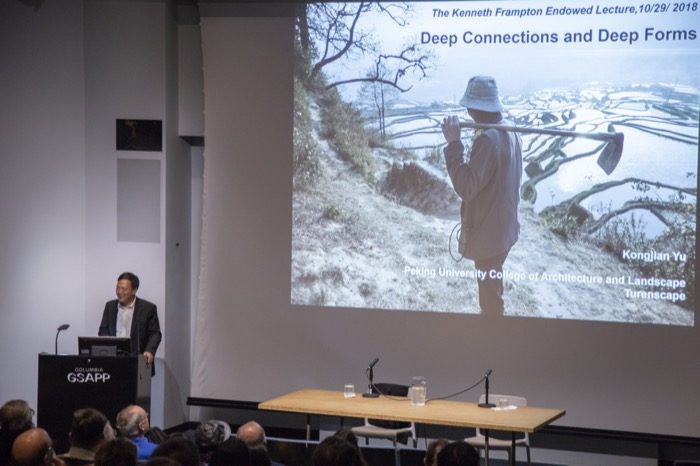
Kongjian Yu
Pioneer of the Sponge City — landscapes that drink the flood
Photo: GSAPPstudent, CC BY-SA 4.0, via Wikimedia Commons
Movements
Signature works
- Qunli Stormwater Park, Harbin
- Yanweizhou Park, Jinhua
- Houtan Park, Shanghai
- Red Ribbon Park, Qinhuangdao
- Sanya Mangrove Park
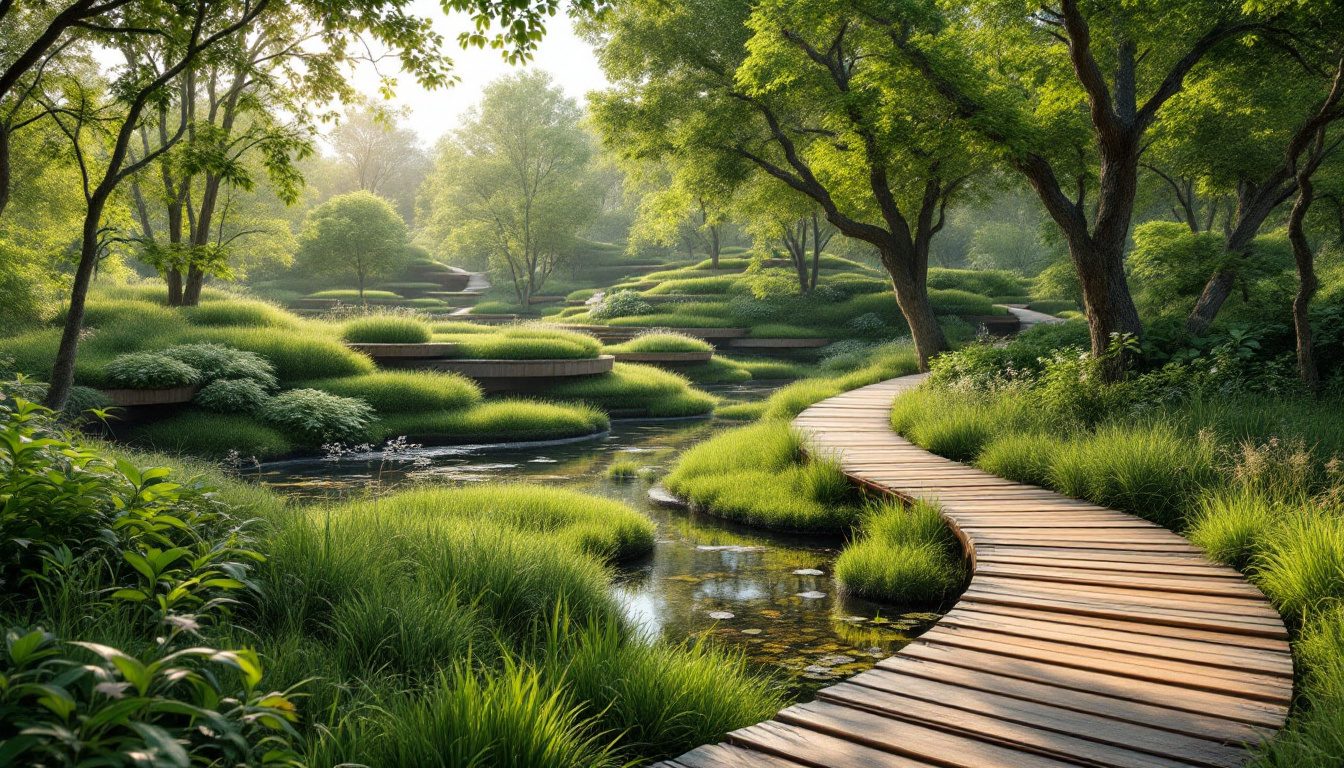
Walk into Qunli Stormwater Park in Harbin, in China's frozen north-east, and the first thing you notice is what is missing. There are no concrete embankments, no straight drainage canals, no manicured lawns clipped into submission. Instead a ring of birch and willow encircles a great green bowl, and a boardwalk lifts you over a shifting mosaic of ponds, reeds and wet meadow. When the summer rains come — and in monsoon-pulse climates they come hard — the whole park drinks. It swells, holds the flood, filters it slowly through banks of native plants, and lets the cleaned water seep back into the city's depleted aquifer. A park that was once destined to be a hard-edged ornament was instead built to do work. It breathes with the seasons.
The mind behind it belongs to Kongjian Yu, born in 1963 in a farming village in Zhejiang province, founder of the Beijing practice Turenscape and of the landscape school at Peking University. He grew up moving water by hand — irrigating paddy, watching the village stream rise and fall — and that peasant intimacy with land and flood never left him. When he returned from a doctorate at Harvard in the late 1990s, he found a China entombing its rivers in concrete and chasing the manicured lawns of an imported, water-hungry idea of beauty. He has spent his career arguing, loudly and against the grain, that this is exactly backwards.
Yu's central idea is the "sponge" — that a city, a park, a riverbank should absorb, store and slowly release rainwater rather than rush it away in pipes and concrete channels, and that a productive, resilient, "big-feet" landscape is both more useful and more beautiful than a decorative one. From that conviction grew the Sponge City movement, now national policy in China, and a body of work that treats water not as an enemy to be expelled but as a guest to be made welcome.
The idea: a city that drinks
For most of the twentieth century, engineers treated rainwater as a problem to be solved by speed. Catch it, channel it, pipe it, expel it — get the flood off the land and into the sea as fast as possible. The result is the "grey" city: rivers straightened into concrete troughs, hillsides sealed, wetlands filled, and an underground spaghetti of storm drains that overflow the moment a cloudburst exceeds their design capacity. Yu's insight was that speed is the trap. A landscape that rushes water away floods downstream when the rain is heavy and goes thirsty when the rain stops.
The sponge does the opposite. It slows water down. Permeable pavements let rain soak in where it falls. Rain gardens and bioswales — shallow planted depressions — catch run-off from roofs and roads and let it filter through soil and roots. Terraced ponds and constructed wetlands hold the surge, releasing it gently over days. The water that would have flooded a street in an hour instead recharges the groundwater over a week, arriving cleaner for having passed through living systems. A sponge city, in Yu's phrase, "makes friends with floods."

This is not only hydrology; it is an argument about beauty. Yu rails against what he calls the "little feet" aesthetic — a reference to the bound feet once prized in imperial China, useless and painful, valued precisely because they signalled that their owner did no work. Ornamental landscape, he says, is the bound foot of design: clipped lawns, exotic flower beds, paved plazas that demand constant irrigation and chemicals while doing nothing for the water cycle, the soil or the people. Against it he sets the "big feet" aesthetic — the unbound, productive, working landscape of the peasant: the rice terrace, the fish pond, the reed marsh, the orchard. Honest, fertile, resilient, and to his eye far more lovely. A landscape should earn its keep.
Life and path
Kongjian Yu was born in 1963 in Dongyu, a village in Zhejiang province, into a farming family. The land he grew up on was a working hydrological machine — paddies, ponds, ditches and a stream that the village had managed for generations. He has often said his entire theory is just an attempt to give scientific language to what his grandparents already knew: that you live with water, you do not fight it.
He studied landscape architecture at Beijing Forestry University, then crossed the Pacific to Harvard's Graduate School of Design, completing a doctorate in design in 1995 under the lineage of Ian McHarg's ecological planning — the tradition that taught designers to read a site through its layers of water, soil, slope and habitat before drawing a single line. After a spell in the United States he returned to China in 1997, at the precise moment the country was urbanising faster than any society in history, pouring concrete over its floodplains and wetlands at terrifying speed.
In 1997 he founded Turenscape — the name fuses "tu" (earth, dirt) and "ren" (people), a deliberate ode to the common bond with the land. A year later he established the College of Landscape Architecture at Peking University, training a generation of designers in ecological thinking. From these two platforms he waged a public campaign — open letters to mayors, books, a relentless stream of built demonstrations — to change how China builds. The breakthrough came when the central government adopted the Sponge City programme as national policy in 2014, naming dozens of pilot cities and committing them to absorbing and reusing a large share of their rainfall on site rather than piping it away. Yu's idea had become a directive. In 2023 he received the Cornelius Gurlitt Geddes recognition and, more notably, the profession's highest honour, the IFLA Sir Geoffrey Jellicoe Award.
The signature works
Turenscape has built hundreds of projects across China and beyond, but a handful carry the whole argument — each one a demonstration that letting a landscape work is cheaper, tougher and lovelier than locking it in concrete.
| Work | Place & dates | Why it matters |
|---|---|---|
| Qunli Stormwater Park | Harbin, 2009–2010 | A green sponge in the middle of a new district: a ring of wetland that captures, cleans and stores stormwater while recharging the aquifer — the sponge city built and proven. |
| Yanweizhou Park | Jinhua, 2014 | A riverside park where Yu removed the concrete flood walls and let the river flood the terraced, planted banks — "making friends with the flood" instead of fighting it. |
| Houtan Park | Shanghai, 2010 | A constructed wetland along the Huangpu that cleans polluted river water as it flows through, turning a brownfield Expo site into a living water-treatment landscape. |
| Red Ribbon Park | Qinhuangdao, 2007 | A single sinuous red bench-and-light element threaded through a wild riverside reed corridor — minimal intervention, maximum restraint, the "big feet" landscape left to be itself. |
| Shanghai Houtan / Minghu wetlands | various, 2010s | Terraced bioswale systems that filter run-off and stormwater through cascading planted cells before release. |
| Sanya Mangrove Park | Sanya, 2016 | Restoration of a degraded coastal wetland into a tidal sponge that buffers storm surge and rebuilds mangrove habitat. |
Qunli is the project most often cited as the sponge city made real. Faced with a low-lying site surrounded by new urban development that would otherwise have been drained and built over, Yu preserved the depression as a vast green sponge. A perimeter of mounds planted with native trees, an inner ring of ponds and a core of wet meadow let the park swallow storm surges, filter the water through wetland plants, and feed the regional groundwater — all while serving as the district's most loved public space.
Yanweizhou is the clearest statement of "letting rivers breathe." The city wanted the usual high concrete flood wall. Yu refused. He argued that a wall simply moves the flood downstream and kills the river ecology. Instead he terraced the banks, planted them with flood-tolerant grasses, and designed the park to be submerged and to recover — a landscape that bends with the monsoon pulse rather than breaking against it. A footbridge stitches the two banks and the town together above the floodable ground.
Houtan shows the third move: the landscape as a machine that does ecological work. Along a strip of the polluted Huangpu, Yu built a cascade of constructed wetland terraces. River water enters dirty at the top and emerges cleaned at the bottom, having been filtered through gravel, soil and the roots of marsh plants — a park that is also a water-treatment plant, growing food and habitat as it works.
The philosophy
Yu's thinking begins with a planning idea he developed at Harvard and refined in China: the ecological security pattern. Before deciding where a city should grow, he maps the landscape's critical processes — where water flows and pools, where floods spread, where species move, where soil must hold — and identifies the strategic points and corridors that, if protected, keep the whole system safe. Development is then steered around this living skeleton rather than smothering it. It is a discipline of restraint: decide first what must never be built on.
From this flows his whole approach to sustainable water management in the landscape. The sponge is not a gadget bolted onto a finished design; it is the structure of the design. Permeable ground, retention basins, bioswales and wetlands are arranged so that the site as a whole holds and cleans the water that falls on it. This is also, deeply, a form of climate-responsive landscape design — a landscape tuned to the actual rhythm of its rains and droughts, designed to flex with extremes rather than assume a gentle average that no longer exists.
And because his sponges are built almost entirely from living systems — native reeds, flood-tolerant trees, wet meadow, mangrove — his work is a powerful argument for biophilic landscape design. The wildlife, the seasonal colour, the sound of water and the sheer aliveness of a Turenscape park are not decoration; they are the very mechanism by which the landscape does its work. Beauty and function, in his hands, are the same thing seen from two sides.
Yu likes to say that the answer to the flood is not a higher wall but a deeper sponge — and that a landscape which does honest work is more beautiful than one which only performs.
India
Few foreign designers speak more directly to India's predicament than Kongjian Yu. The country's monsoon cities live the two faces of the same crisis: Chennai drowned in the 2015 floods and then, within a few years, watched its reservoirs run dry; Bengaluru's lakes flood the streets one season and vanish the next; Hyderabad, Mumbai and Gurugram all flood on tarmac that has sealed off every path the water once took to soak in. This is precisely the grey-city trap Yu spent his career diagnosing — too much concrete, too few sponges, water rushed away when it should be stored.
His prescription maps onto Indian conditions almost line for line, and in fact echoes India's own older wisdom. The stepwell, the temple tank, the village eri and ahar-pyne irrigation tanks of the south and east were sponge systems — landscapes built to catch the monsoon, hold it through the dry months and recharge the ground. Yu's sponge city is, in a sense, that indigenous logic given contemporary form and scientific backing. For Indian homes, neighbourhoods and cities, the lessons are immediate: keep ground permeable, build rain gardens and bioswales to catch run-off, hold water in terraced ponds and recharge pits rather than sealing it under tile, and let rivers and tanks keep their floodable margins instead of walling them in.
The cross-link is not only intellectual. As Indian municipalities reach for "sponge city" language in their own flood plans, Yu's built proof — that a green sponge is cheaper to build, cheaper to maintain and more resilient than concrete — is the strongest single case a designer can put before a sceptical client or council.
Legacy and what we can learn
Kongjian Yu sits in a lineage that runs back to Frederick Law Olmsted, who a century and a half ago insisted that a park could be public infrastructure — Boston's Back Bay Fens was itself a stormwater-cleansing wetland disguised as a park. Yu has taken that buried insight, scrubbed off the picturesque, and rebuilt it for an age of climate extremes and exploding Asian cities. Where Olmsted made infrastructure look like scenery, Yu makes scenery do infrastructure's work, in the open, unashamed of mud and reeds.
In India that baton passes to ecologically minded masters such as Ravindra Bhan, whose generation began arguing that Indian landscape must be rooted in the subcontinent's own water, soil and planting rather than imported lawns. Yu's work gives that argument a hard, measurable edge: not just that native, water-wise landscapes are more appropriate, but that they demonstrably reduce flooding, recharge aquifers and clean water at a fraction of the cost of concrete.
The lesson for anyone shaping a plot, a campus or a city in India is bracingly practical. Before you pave, ask where the water wants to go — and let it. Keep the ground able to drink. Plant the things that thrive on your rainfall instead of fighting your climate with a sprinkler. Treat the flood as a guest with a season, not an enemy to be walled out. Yu proved at the scale of whole cities that a landscape built to absorb, store and reuse its own rain is not a compromise but the tougher, cheaper, more beautiful answer.
These are the instincts we encode in DesignAI — letting water, climate and living systems shape a landscape before ornament ever enters the conversation.
References
- Kongjian Yu & Mary Padua, The Art of Survival: Recovering Landscape Architecture (Images Publishing).
- Kongjian Yu, Designed Ecologies: The Landscape Architecture of Kongjian Yu (ed. William S. Saunders, Birkhäuser).
- Turenscape project archive — Qunli Stormwater Park, Yanweizhou Park, Houtan Park, Red Ribbon Park.
- International Federation of Landscape Architects — IFLA Sir Geoffrey Jellicoe Award 2023 citation.
- Government of China, Ministry of Housing and Urban-Rural Development — Sponge City programme guidance, 2014.
Explore the ideas Yu championed — sustainable water management, climate-responsive landscape design and biophilic landscape design — alongside sibling masters Frederick Law Olmsted and India's Ravindra Bhan.
Philosophies they championed