
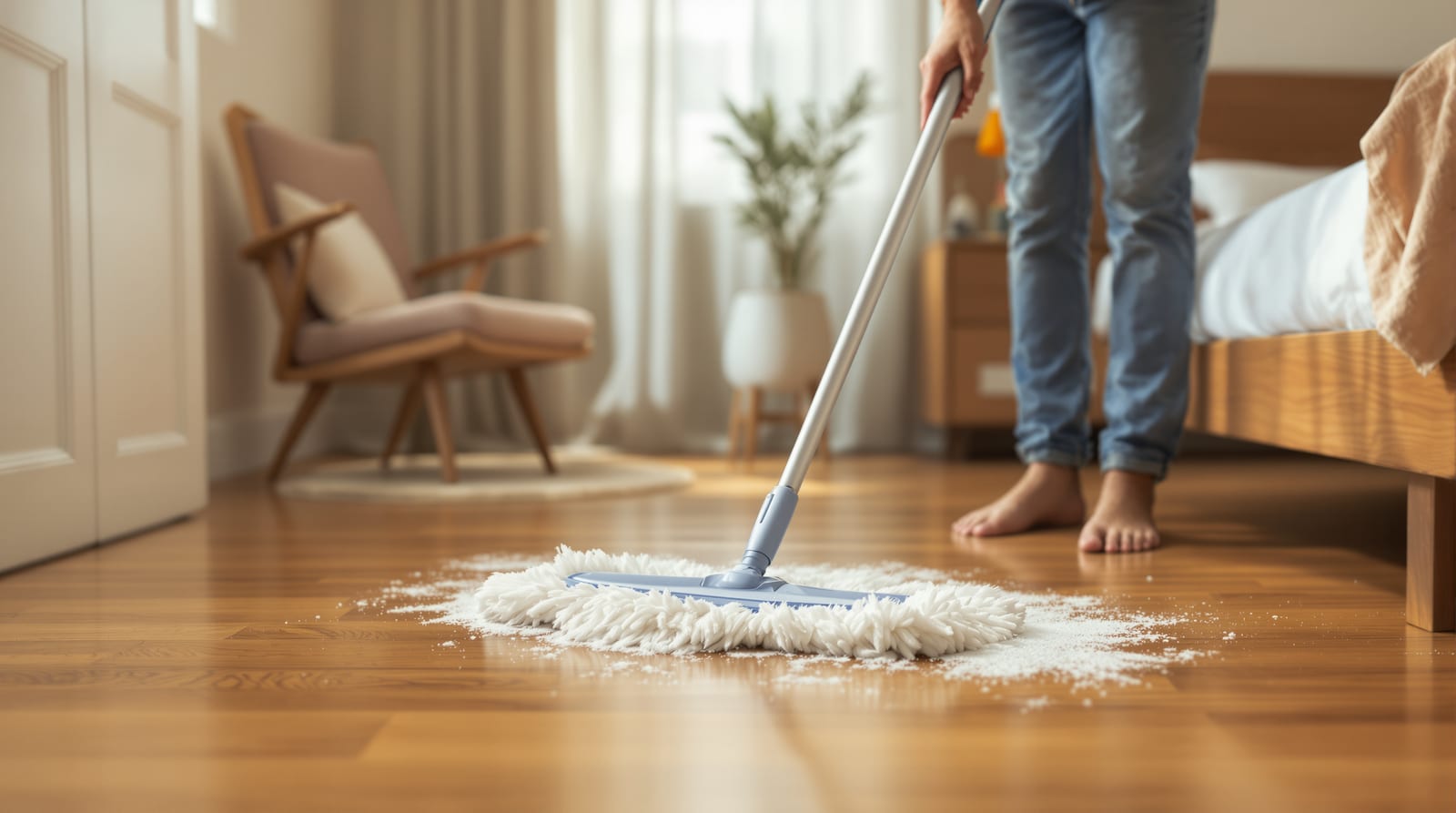
Wooden Floor Maintenance in India: Care for Wood, Engineered & Laminate Floors
How to clean, protect, recoat and repair wood, engineered and laminate floors in India's humid, monsoon-prone climate.
A wooden floor is the one surface in an Indian home that ages by how you treat it. Tiles forgive almost everything; wood remembers every bucket of water, every dragged sofa, every monsoon you left the windows open. The good news is that the rules are simple and they barely cost anything — get the cardinal one right and a quality wood, engineered or laminate floor will outlast the décor around it.
This guide covers all three families that Indian homes actually buy: solid hardwood, engineered wood, and laminate (the rules largely apply to SPC and WPC vinyl too). It is grounded in our humid, monsoon-driven, hot-summer reality — because most wood-floor failures here are moisture failures, not wear failures.
The cardinal rule: damp, never wet
If you remember nothing else, remember this: clean wood, engineered and laminate floors with a well-wrung damp microfibre mop, and NEVER flood them with water. No buckets sloshed across the floor, no hose, no steam mop, no standing puddles. Water is the single biggest enemy of every wood-family floor in India.
Why it matters so much here: laminate and engineered planks have a fibreboard or plywood core that swells permanently when it drinks water — the edges puff up, the click-joints lift, and the damage is irreversible. Solid wood absorbs moisture and cups (edges rise) or crowns (centre rises). A microfibre cloth should feel barely moist to the back of your hand; if you can see a wet streak that does not vanish in under a minute, you used too much water.
Practical routine: dry dust-mop or vacuum (hard-floor setting, no beater bar) two to three times a week to lift the grit that scratches finish, then damp-mop weekly with a wood-specific cleaner. Wipe up any spill immediately — even clean water left to sit overnight near a join can wick into the core.
Which cleaner for which floor
The wrong cleaner does slow, invisible damage: it strips the protective coat, leaves a hazy film, or voids the warranty. Match the product to the floor.
| Floor type | Use | Avoid |
|---|---|---|
| Solid hardwood (oil/UV-oil finish) | Wood-soap or oil-floor cleaner; periodic refresher oil | Water-flooding, steam, silicone "shine" sprays, all-purpose detergent |
| Solid / engineered (lacquer or PU finish) | pH-neutral wood-floor cleaner, well diluted | Vinegar, lemon, acidic cleaners (dull the lacquer), wax on lacquer |
| Engineered wood | Manufacturer-recommended pH-neutral cleaner | Excess water, abrasive pads, oil soap on lacquered surfaces |
| Laminate | Laminate-specific spray-and-mop cleaner, lightly | Wax, polish, oil soap, steam, abrasive scrub |
| SPC / WPC vinyl | Mild pH-neutral floor cleaner | Solvent cleaners, very hot water, beater-bar vacuum |
A few India-specific notes. Vinegar-and-water is folk wisdom for tiles but acid etches and dulls a wood lacquer over time — skip it. Phenyl and strong floor disinfectants are too harsh and leave residue; reserve them for tiled bathrooms, not your wood living room. Buy a dedicated wood-floor cleaner (Pidilite, ICA, Bona-type imports and most flooring brands sell one) and dilute exactly as instructed — over-strong solution leaves a dulling film that then needs buffing off.
Stop cupping and gaps before they start: humidity control
Wood is hygroscopic — it gains width in the wet season and loses it in the dry. In coastal and monsoon India the swing is brutal: a Mumbai or Kochi monsoon pushes relative humidity past 85 per cent, while an air-conditioned Delhi flat in peak summer can drop to 30 per cent. Both extremes deform wood.
What goes wrong, and the fix:
- Cupping (board edges rise higher than the centre): too much moisture from below or in the air. Fix the moisture source, improve ventilation, run AC or a dehumidifier; mild cupping often relaxes back once humidity normalises.
- Gapping (visible gaps open between boards): air too dry, usually constant AC with no humidification in winter. A bowl of water near the vent, indoor plants, or a small humidifier helps; minor gaps close again in the humid season.
- Crowning / buckling / tenting: severe moisture, often a leak or a slab that was never sealed with a damp-proof membrane. This is a repair job, not a cleaning job.
The diagram below shows how a board reacts to moisture moving in from underneath — the classic monsoon failure when a floor was laid without a 200-micron DPM over concrete.
The takeaway from the section view: maintenance lives in that thin top finish layer. Recoating renews the coat without touching the wood; sanding cuts into the wear layer and can only be done so many times — and never on laminate, which has no real wood to sand.
Felt pads, rugs and everyday protection
Most visible damage on a wood floor is not wear, it is mechanical — chair legs, grit, and sun. Cheap habits prevent it:
- Stick felt pads under every chair, sofa and table leg, and check them every few months — a worn pad with grit embedded becomes sandpaper.
- Put doormats at every entry to trap the abrasive sand and dust that ride in on shoes; an Indian home accumulates surprising amounts of fine grit.
- Use rugs in high-traffic runs and under dining chairs, but anchor them with a breathable non-slip underlay (not solid rubber, which can trap moisture and discolour wood).
- Lift furniture to move it — never drag. Fit chair-leg socks on dining chairs that get pulled constantly.
- Trim pet nails; keep heels and hard wheels off the floor.
- Avoid rubber-backed mats and plastic sheeting left in one spot — they trap humidity and leave permanent marks.
Dealing with scratches and dents
Match the repair to the depth and to the floor type.
| Damage | Solid / engineered wood | Laminate |
|---|---|---|
| Light surface scratch in the finish | Wood scratch-repair wax stick or touch-up marker; buff | Coloured wax-fill pencil rubbed in, wipe excess |
| Deeper scratch / small gouge | Tinted wax filler or hard-wax stick, level flush, buff | Wax filler; for plank damage, replace the plank |
| Worn finish over a whole area | Screen-and-recoat (see below) | Cannot be sanded — replace planks |
| Dent (no fibre broken) in solid wood | Damp cloth + warm iron can raise the grain back, then re-oil | Not repairable — swap plank |
| Water-swollen edge | Often needs board replacement | Replace the affected plank |
Keep a spare carton from the original lot — dye-lots and finishes drift between batches, and a click-floor plank can be swapped out cleanly only if you have a match. For deeper guidance see our companion on floor scratch repair, and for finish renewal see our floor resealing guide. For tile chips and cracks, our cracked-tile replacement guide covers the chisel-and-refix method.
Recoating and sanding: solid wood only
This is the big divide that buyers forget. Solid hardwood and most thicker engineered floors can be renewed; laminate, SPC and WPC cannot — they are a photographic décor layer under a wear coat, with no real wood to cut into. Once a laminate's wear layer is gone, the plank is replaced, full stop.
For solid wood:
- Screen-and-recoat (light refresh) every 3-5 years: a fine abrasive screen lightly scuffs the old coat, then one or two fresh coats of finish go on. No deep dust, restores sheen, extends the floor's life dramatically. Budget roughly the same range as a polishing job.
- Full sand-and-refinish every 5-10 years, or when scratches reach the wood and recoating no longer hides wear. A drum/orbital sander takes the floor back to bare wood, then it is stained (optional) and re-finished with oil or PU. Solid wood can take several full refinishes over its life; engineered wood can usually be sanded only once or twice because the real-wood veneer is thin.
Always patch-test the new finish in a corner — sheen and tone shift with age, and you want the result to match before you commit the whole room.
Maintenance schedule
A simple calendar keeps a wood floor healthy with minimal effort. Costs are indicative and vary by city, vendor and floor size; recoating and refinishing are labour-priced jobs, so get a site quote.
| Frequency | Task | Applies to |
|---|---|---|
| Daily / 2-3x week | Dry dust-mop or vacuum (no beater bar); wipe spills at once | All wood, engineered, laminate, vinyl |
| Weekly | Damp microfibre mop with the correct cleaner, well wrung | All |
| Monthly | Check & replace felt pads; shake out doormats; inspect high-traffic runs | All |
| Seasonal (monsoon / peak AC) | Manage humidity — ventilate in damp, humidify in dry AC; check for cupping/gaps | All wood & engineered |
| 1-2 years | Refresh oil coat (oiled solid wood only) | Oiled solid wood |
| 3-5 years | Screen-and-recoat the finish | Solid wood; thicker engineered |
| 5-10 years | Full sand-and-refinish as needed | Solid wood (engineered: once or twice in its life) |
| Never | Sanding / refinishing | Laminate, SPC, WPC — replace planks instead |
Monsoon, AC and sunlight: the India playbook
Three local stresses do most of the damage. Plan for them.
Monsoon. From June to September, humidity and water are everywhere. Keep an absorbent mat at every entry to catch dripping umbrellas and wet feet, and place a second mat just inside. Wipe wet footprints promptly. On the worst days, close windows during driving rain but ventilate on dry breaks; running AC on dry mode or a dehumidifier in coastal homes keeps indoor RH in the comfortable 45-60 per cent band that wood likes. If your area floods, laminate near entries is a known weak point — our laminate flooring guide explains where it does and does not belong.
Air-conditioning. Months of continuous AC dry the air and shrink boards, opening gaps and sometimes lifting click-joints. Counter it with a small humidifier or open-water source in heavily air-conditioned rooms, especially in dry-climate cities. Aim for stable humidity rather than chasing a number — wood hates rapid swings more than it hates a steady high or low.
Sunlight. Strong Indian sun fades and ambers wood, and uneven exposure leaves a pale rectangle where a rug sat. Use sheer curtains or solar film on south- and west-facing windows, and rotate rugs and furniture occasionally so the floor ages evenly. UV is patient and permanent; shading it is the only real defence.
Caring for a wood floor well is mostly restraint — less water, the right cleaner, felt under everything, and a calm hand on the humidity. For the bigger picture on choosing and living with these floors, see our wooden flooring overview, the deep-dives on solid hardwood flooring and engineered wood flooring, and the laminate flooring guide. To plan upkeep costs, Studio Matrx has a floor maintenance cost calculator and a floor polishing cost calculator in our utilities.
Frequently asked questions
Can I mop a laminate or engineered floor with water?
Only with a barely-damp microfibre mop, and only after wringing it almost dry. Never use a wet mop, a sloshed bucket, or a steam mop. Standing water seeps into the core or the click-joints and swells them permanently — this is the number-one cause of laminate and engineered-floor failure in humid India.
Why is my wooden floor cupping or showing gaps?
Cupping (edges rising) means too much moisture — humid monsoon air, a spill left to sit, or no damp-proof membrane under the slab. Gaps mean the air is too dry, usually constant AC in winter. Both are humidity problems. Stabilise indoor humidity to 45-60 per cent and minor cupping and gaps often relax on their own.
How often should I refinish a solid wood floor?
Screen-and-recoat the finish every 3-5 years, and do a full sand-and-refinish roughly every 5-10 years or whenever scratches reach the bare wood. Solid wood tolerates several refinishes; engineered wood usually only one or two because the veneer is thin.
Can laminate flooring be sanded and refinished?
No. Laminate is a printed décor layer under a melamine wear coat — there is no real wood to sand. Once the wear layer is damaged or worn through, the affected planks are replaced, not refinished. The same applies to SPC and WPC vinyl.
What cleaner is safe for wooden floors?
A pH-neutral wood-floor cleaner (or a wood-soap/oil cleaner for oiled finishes), diluted as instructed and used with a damp mop. Avoid vinegar, lemon and acidic cleaners (they dull lacquer), wax or polish on lacquered and laminate floors, harsh phenyl/disinfectants, and silicone "shine" sprays that leave a slippery film.
Export this guide
Related Guides — Deep-dive reading
Floor Scratch Repair India: Fixing Scratches and Scuffs on Wood, Laminate, Vitrified, Marble, Granite and Vinyl Floors
How to repair scratches and scuffs on every floor type in Indian homes: wax sticks and markers for wood and laminate, buffing fine scratches on vitrified and PGVT, honing and re-polishing marble and granite, heat and plank-swap fixes for vinyl and SPC, plus DIY versus call-a-pro guidance and how to stop scratches happening.
Flooring & SurfacesHow to Clean Bathroom Tiles (India): Shine, Hard-Water Film & Soap Scum
A practical, India-first routine for cleaning bathroom tiles and keeping them glossy — the daily squeegee habit, weekly wash, monthly deep clean, and the safe cleaner for each tile type, including the golden rule that natural stone must never meet acid.
BathroomsEngineered Wood Flooring in India: Layers, Wear Layer, Install & Cost (2026)
Engineered wood is a real-wood top veneer bonded over a cross-laminated plywood or HDF core, which makes it far more dimensionally stable than solid wood in Indian humidity — the practical way to get a genuine timber floor here. This guide covers the layer build-up, wear-layer thickness, click vs glue-down install, where it suits, ₹/sq ft, brands and maintenance.
Flooring & SurfacesRelated Tools — Try Free
Cross-Ventilation Analyzer
Estimate airflow and air changes per hour (ACH) from room size, window areas, layout, and local wind — with NBC 2016 Part 8 compliance check.
Ventilation CalculatorWindow Cleaning Cost Calculator
Estimate professional window cleaning cost per visit and per year by access and frequency.
Window CalculatorWindow Maintenance Cost Calculator
Estimate annual window upkeep by frame material — yearly, per-window and 5-year cost.
Window Calculator